

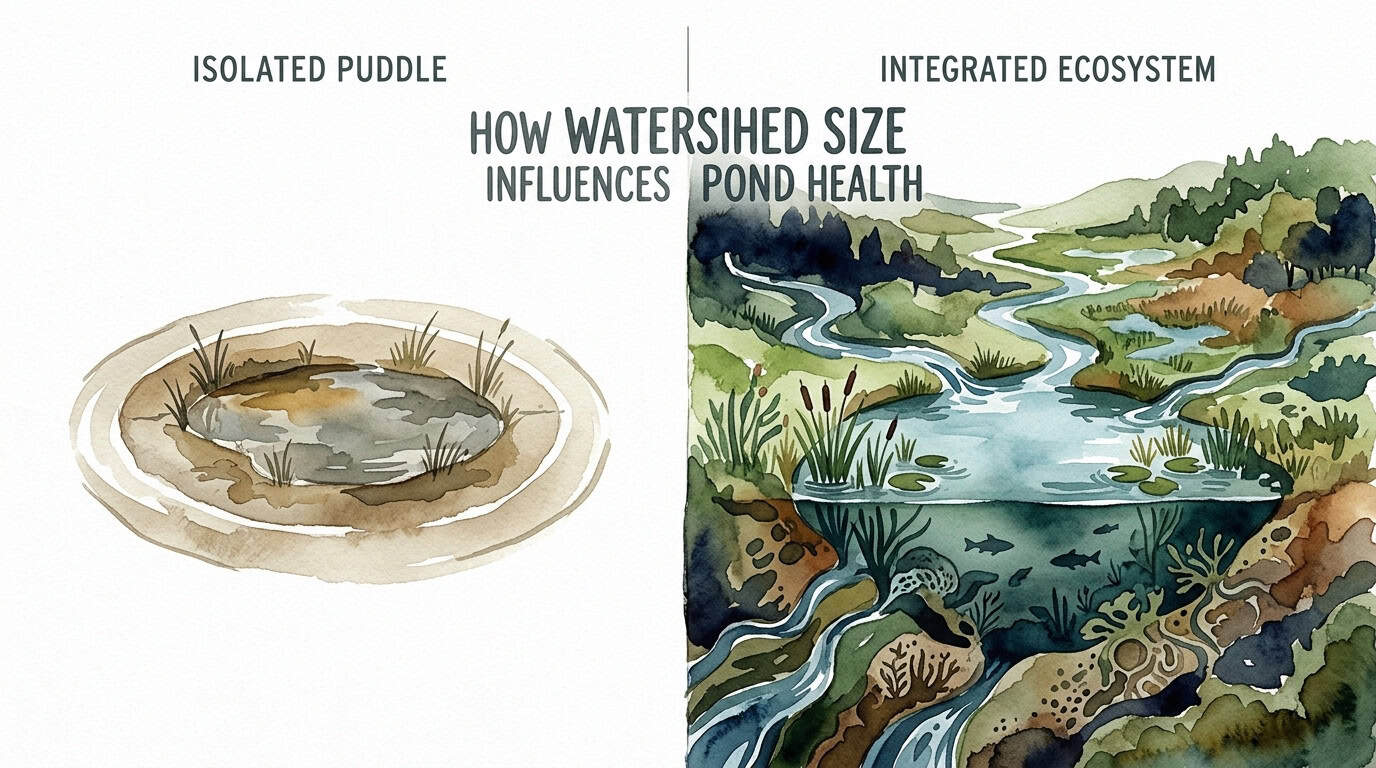
Your pond is only as healthy as the land around it. Stop looking at your pond as a bucket and start seeing it as the heart of a watershed. A larger catchment area means more nutrients, more water, and a more resilient system.
Watershed size dictates the hydraulic loading, nutrient influx, and sediment volume entering a pond. A properly sized watershed—typically ranging from 10 to 50 acres per surface acre of water—ensures consistent water levels and adequate flushing. Conversely, an oversized watershed increases the risk of excessive nutrient loading and rapid siltation, while an undersized catchment leads to stagnation and water loss during dry cycles.
How Watershed Size Influences Pond Health
The watershed, or catchment area, is the total land surface that drains rainfall and snowmelt into a specific body of water. In limnology and aquatic engineering, the relationship between the watershed and the pond is defined by a ratio of land area to water surface area. This ratio is the primary determinant of the pond’s hydrologic and chemical stability.
In real-world applications, such as agricultural irrigation, livestock watering, or recreational fisheries, the watershed acts as the collection engine. When rain falls, the topography of the surrounding land funnels water toward the lowest point—the pond basin. The size of this area determines the volume of “new” water the system receives annually. An integrated ecosystem relies on this periodic influx to replace water lost to evaporation and seepage, while also providing the dissolved minerals and organic matter required for biological productivity.

For example, a pond located in a steep, rocky canyon will have a vastly different health profile than one situated in a flat, heavily forested plain. The former may experience rapid, high-velocity inflows that flush out the system, while the latter may rely on slow, filtered seepage. Understanding the dimensions of the watershed allows a manager to predict how the pond will respond to environmental stressors such as drought, heavy precipitation, or nearby land-use changes.
Quantitative Mechanics: Ratios and Runoff Coefficients
Calculating the effectiveness of a watershed requires an understanding of the drainage ratio and the runoff coefficient. The drainage ratio is the total acreage of the watershed divided by the surface acreage of the pond.
Standard engineering guidelines for the United States suggest the following ratios based on regional climate and soil types:
- Humid Southeast (e.g., Alabama, Georgia): 10:1 to 20:1. High rainfall and clay soils allow for smaller watersheds.
- Central Midwest (e.g., Missouri, Iowa): 20:1 to 30:1. Moderate rainfall requires a larger collection area to maintain levels during summer.
- Arid West (e.g., Western Oklahoma, Texas): 50:1 to 100:1. Low rainfall and high evaporation rates necessitate massive catchment areas.
The runoff coefficient (C) is a dimensionless number between 0 and 1 that represents the percentage of rainfall that actually reaches the pond rather than soaking into the ground. Sandy soils or heavily forested areas have low coefficients (0.10 to 0.20), meaning they absorb most water. Clay soils or paved surfaces have high coefficients (0.70 to 0.95), leading to rapid, high-volume runoff.
Using the Rational Method formula, Q = CiA (where Q is peak runoff, C is the coefficient, i is rainfall intensity, and A is area), managers can calculate the maximum expected inflow. This data is critical for sizing spillways and dams. If the watershed is too large for the pond’s volume, the peak flow (Q) may exceed the spillway’s capacity, leading to dam failure or severe bank erosion.
Nutrient Dynamics and Eutrophication
Pond health is intrinsically linked to the chemical constituents of the runoff. The watershed size determines the “Total Loading” of nutrients such as phosphorus (P) and nitrogen (N). These elements are measured in kilograms per hectare per year (kg/ha/yr).

A larger watershed naturally collects more nutrients. In a balanced system, these nutrients fuel the growth of phytoplankton, which forms the base of the aquatic food web. However, when the watershed:pond ratio is too high, or when the land use is intensive (such as fertilized row crops), the system enters a state of accelerated eutrophication.
Excess phosphorus is the primary driver of harmful algal blooms (HABs). Once phosphorus enters the pond, it often settles into the bottom sediments. In a pond with a large watershed and high turnover, these nutrients may be flushed out regularly. In a stagnant pond with a medium-sized but high-input watershed, the phosphorus accumulates, leading to seasonal “blooms and busts” that deplete dissolved oxygen (DO) levels and cause fish kills.
Sedimentation and Bathymetric Longevity
Sedimentation is the physical process of soil particles being transported from the watershed and settling in the pond. The rate of sedimentation is a function of the watershed’s size, slope, and vegetative cover. This is often quantified using the Sediment Delivery Ratio (SDR), which expresses the percentage of gross erosion that actually reaches the pond.
Large watersheds increase the volume of suspended solids (TSS) entering the system. As water slows upon entering the pond’s basin, it loses the energy required to hold soil in suspension. The heavier sand and silt particles drop first, usually forming a “delta” at the inlet. Finer clays stay suspended longer, causing chronic turbidity that prevents sunlight from reaching submersed aquatic vegetation.
Over time, sedimentation reduces the pond’s depth, a process known as “filling in.” A pond with an oversized watershed might lose 0.1 to 0.5 feet of depth annually. This loss of volume decreases the pond’s thermal stability and increases the likelihood of weed overgrowth, as more of the pond bottom enters the photic zone where sunlight can reach it.
Thermal Stability and Dissolved Oxygen
The hydraulic residence time (HRT)—the average time water remains in the pond—is governed by watershed size and rainfall frequency. HRT has a profound impact on thermal stratification and dissolved oxygen levels.
Ponds with small watersheds have a high HRT, meaning the water is “older” and more prone to deep stratification. In summer, this creates a warm top layer (epilimnion) and a cold, oxygen-depleted bottom layer (hypolimnion). While this can provide a thermal refuge for some species, the lack of mixing can lead to anoxia at the sediment-water interface, releasing trapped nutrients back into the water column.
Ponds with large watersheds experience frequent “flushing events.” While this keeps the water “fresh” and can break up stratification, it also introduces cold, oxygen-poor runoff during spring rains or warm, nutrient-rich runoff during summer storms. Rapid turnover can stress fish populations by causing sudden temperature swings or “clearing” the water of the phytoplankton necessary for forage production.
Challenges and Common Mistakes
One of the most frequent errors in pond management is failing to account for land-use changes within the watershed. A pond designed for a 20:1 ratio in a forested environment will become dangerously overloaded if the watershed is cleared for residential development or intensive agriculture.
Common pitfalls include:
- Ignoring the Runoff Coefficient: Building a pond based on acreage alone without considering soil type. A 10-acre watershed of clay will produce three times the runoff of a 10-acre watershed of sand.
- Under-sizing Spillways: In watersheds larger than 50 acres, standard pipe overflows are rarely sufficient. Without an engineered emergency spillway, the dam is at risk of overtopping.
- Direct Livestock Access: Allowing cattle to graze the entire watershed and the pond bank. This increases sediment and nutrient loading by orders of magnitude through bank destabilization and direct waste input.
Another mistake is the “Isolated Puddle” mindset. Owners often try to treat the pond with chemicals (like copper sulfate for algae) without addressing the watershed-scale nutrient source. This results in a cycle of expensive, temporary fixes that eventually fail as the sediment nutrient bank grows.
Limitations and Environmental Constraints
Watershed influence has practical boundaries. In extremely flat terrain, the watershed may be “undefined,” relying on groundwater seepage rather than surface runoff. These seepage ponds are limited by the local water table and are highly susceptible to drought because they lack a collection area to “catch” passing storms.
In contrast, “In-Stream” ponds—where a dam is built directly across a permanent creek—have effectively “infinite” watersheds. These systems are nearly impossible to manage for water chemistry because the water is replaced so quickly. They act more like widened sections of the stream, making fertilization, liming, or weed control ineffective as the amendments are washed downstream within hours or days.
Practical Tips for Watershed Optimization
Managing the watershed is often more effective than managing the pond itself. To optimize pond health, consider the following best practices:
- Establish Vegetative Buffers: Maintain a 20- to 50-foot strip of unmowed, native grasses and shrubs around the pond perimeter and along all drainage swales. This “filter strip” can trap up to 70% of incoming sediment and 50% of phosphorus.
- Construct Diversion Ditches: If the watershed is too large (e.g., a 100:1 ratio), use terracing or diversion ditches to route excess runoff around the pond rather than through it.
- Silt Basins (Forebays): Construct a small, shallow excavation at the main inlet. This area collects the bulk of the incoming sediment, making it much cheaper and easier to clean out than dredging the entire pond.
- Monitor Upstream Activity: Be aware of construction or timber harvesting in the watershed. Implementing silt fences or straw wattles upstream during these activities can prevent years of damage to the pond’s bathymetry.
Advanced Considerations: Hydraulic Residence Time (HRT)
Serious practitioners should calculate the HRT to understand the biological capacity of their system. The formula for HRT is:
HRT = V / Q
Where V is the total volume of the pond and Q is the average annual inflow.
An HRT of less than 2 weeks suggests the pond is a “flow-through” system where plankton cannot establish a stable population, leading to low fish productivity. An HRT of more than 6 months suggests a “stagnant” system where internal nutrient cycling will dominate, increasing the risk of chronic algae problems. The “sweet spot” for most recreational and production ponds is an HRT of 3 to 8 weeks, allowing for nutrient assimilation without excessive accumulation.
Examples and Scenarios
Scenario A: The Over-Engineered Agricultural Pond
A 1-acre pond is situated at the base of a 60-acre cornfield in Iowa (60:1 ratio). Because the watershed is three times larger than recommended and consists of tilled, fertilized soil, the pond stays muddy year-round. The owner installs a diversion terrace to route 40 acres of the runoff away from the pond. The resulting 20:1 ratio allows the pond to clear, submersed plants to grow, and the fish population to stabilize.
Scenario B: The Undersized Forested Catchment
A 2-acre pond in East Texas is built with only a 10-acre watershed in sandy timberland (5:1 ratio). During a dry summer, the pond level drops 4 feet due to evaporation and seepage. Because the watershed is too small to provide adequate “recharge” from small rains, the water becomes hypersaline and concentrated with tannins. The solution requires clearing a portion of the timber to increase the runoff coefficient or installing a well to supplement the inadequate watershed.
Final Thoughts
Pond health is a direct reflection of the surrounding topography and land management. By shifting the focus from the water’s edge to the ridge lines of the watershed, a manager gains control over the variables that matter most: water volume, nutrient loading, and sediment transport.
A well-balanced watershed-to-pond ratio minimizes maintenance costs and maximizes the lifespan of the system. Whether through the use of diversion ditches to reduce an oversized flow or the implementation of buffer strips to scrub nutrients, the land remains the most powerful tool in the pond owner’s arsenal.

Practitioners should continue to monitor land-use changes and climatic shifts, as the “perfect” watershed of today may require adaptation as the surrounding environment evolves. Deepening one’s understanding of hydrology and soil science is the only way to ensure the heart of the watershed remains vibrant for decades.
Frequently Asked Questions About How Watershed Size Influences Pond Health
What is the ideal watershed-to-pond ratio for a healthy ecosystem?
The ideal ratio depends heavily on geographic location and soil composition. In general, a ratio of 10:1 to 30:1 (acres of land to acres of water) is considered standard for much of the United States. In humid regions with clay-heavy soils, a 10:1 ratio is often sufficient to maintain water levels. In more arid regions or areas with sandy, porous soils, you may require a 50:1 or even 100:1 ratio to overcome high evaporation and seepage rates. Maintaining a ratio within these engineered ranges prevents the pond from either drying up during droughts or being overwhelmed by sediment and nutrients during heavy rainfall events.
Can a watershed be too large for a pond?
Yes, an oversized watershed is a common cause of chronic pond failure. When the drainage area is significantly larger than the pond’s holding capacity, the system experiences excessive “flushing.” This leads to several problems: rapid accumulation of silt and mud, difficulty in maintaining water chemistry (such as lime or fertilizer treatments), and increased risk of dam erosion or failure during storms. Furthermore, a large watershed brings in a higher total volume of nutrients, which can lead to frequent algal blooms and oxygen depletion. In such cases, diversion ditches or swales should be used to route a portion of the runoff around the pond.
How does land use within the watershed affect water quality?
The “character” of the watershed is just as important as its size. Land used for intensive agriculture, livestock grazing, or urban development typically has a high runoff coefficient and carries a heavy load of pollutants, including nitrogen, phosphorus, and sediment. Conversely, a watershed covered in native forest or permanent pasture acts as a natural filter, slowing the water down and allowing it to soak into the soil. This “filtered” runoff is generally cooler, clearer, and lower in nutrients, which promotes a more stable and healthy aquatic environment. Managing what happens on the land is often the most effective way to manage the water in the pond.
Why does my pond stay muddy after a rain if the watershed is the correct size?
If the watershed size is correct but the pond remains turbid, the issue likely lies in the vegetative cover or soil chemistry of the catchment area. Bare soil, construction sites, or livestock paths within the watershed allow raindrops to dislodge clay particles, which then stay suspended in the runoff. This is especially common in “heavy” clay soils where the particles carry a negative electrical charge, preventing them from settling out naturally. Establishing thick grass buffers along all drainage lines can help trap this sediment before it reaches the pond. In some cases, soil chemistry within the watershed may also require amendments to prevent chronic “suspension” of fine particles.
Does a small watershed affect fish growth and production?
A watershed that is too small can severely limit fish production by creating a stagnant environment. Without sufficient “new” water to flush the system, metabolic wastes from fish and decaying organic matter accumulate, leading to poor water quality and stunted growth. Additionally, small watersheds often fail to maintain stable water levels during summer months. As the water volume shrinks, fish are crowded into smaller areas, increasing stress, disease transmission, and the risk of summer-kill due to oxygen depletion. For high-production fisheries, ensuring a reliable recharge from a properly sized watershed is essential for maintaining the dissolved oxygen and mineral balance required for growth.