

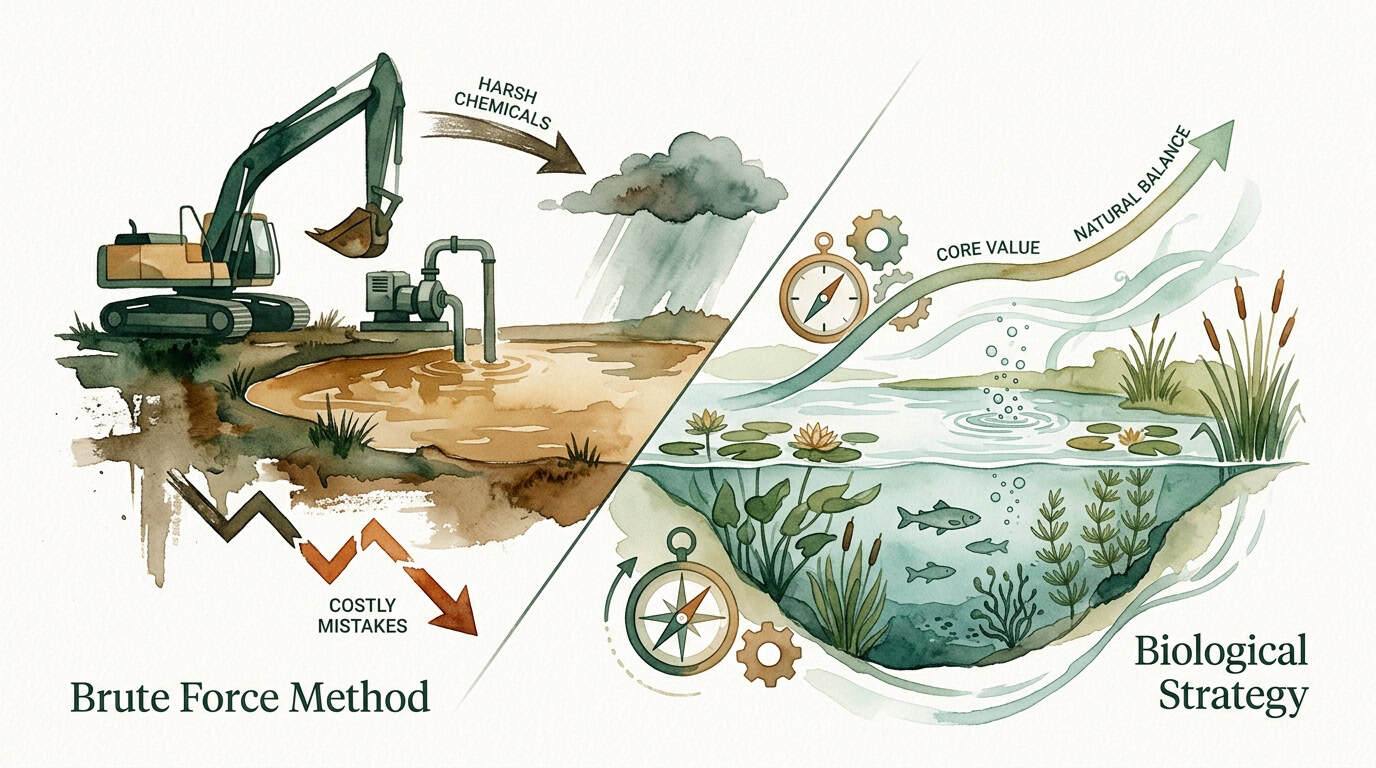
Don’t hire more labor when you need more logic. When comparing pond companies, look at their methods. Are they fighting nature with manual labor, or using science to make nature do the work? Here’s how to choose.
Pond management often defaults to reactive, labor-intensive interventions. These methods address symptoms—such as algal blooms or muck accumulation—without modifying the underlying environmental variables. Professional pond management requires an shift toward mechanical and biological optimization to achieve long-term stability.
Choosing a provider based on scientific metrics rather than aesthetic promises ensures a higher return on investment. This guide examines the technical benchmarks required to evaluate a pond management strategy effectively.
How To Compare Pond Management Companies And Avoid Costly Mistakes
Evaluating a pond management company requires a departure from subjective visual assessments. Most homeowners and facility managers focus on water clarity, but clarity is a lagging indicator of ecosystem health. To avoid costly mistakes, one must analyze a company’s approach to nutrient loading and dissolved oxygen (DO) levels.

Pond management exists because stagnant water bodies act as nutrient sinks. Nitrogen and phosphorus enter through runoff, leading to cultural eutrophication. A company that only offers “brute force” chemical applications is merely resetting the biological clock without stopping the clock’s movement.
Real-world pond management applies to everything from small backyard koi ponds to massive municipal stormwater basins. In each scenario, the goal is to maintain an aerobic state. When a pond becomes anaerobic (lacking oxygen), it switches from a carbon sink to a nutrient source, releasing sequestered phosphorus back into the water column.
A competent company will prioritize the measurement of Sediment Oxygen Demand (SOD). This metric determines how much oxygen the muck at the bottom consumes. If a company does not mention oxygen levels or nutrient sequestration, they are likely selling a temporary cosmetic fix rather than a sustainable management system.
How Mechanical and Biological Systems Work Together
Successful pond management relies on the synergy between gas transfer and microbial respiration. This process begins with mechanical aeration. Unlike decorative fountains, which primarily move surface water, diffused aeration systems utilize shore-mounted compressors to pump air to the pond floor.
Membrane diffusers break the air into millions of fine bubbles. As these bubbles rise, they create a laminar flow that carries oxygen-depleted water from the bottom to the surface. This atmospheric exchange increases the overall Dissolved Oxygen (DO) concentration throughout the entire water column.
Once the water is oxygenated, biological strategies become viable. Aerobic bacteria are up to 20 times more efficient at breaking down organic matter than anaerobic bacteria. These microbes consume the “muck”—the layer of dead leaves, fish waste, and grass clippings—and convert it into harmless gases like carbon dioxide.

This dual approach targets the “Logic” over “Labor” philosophy. Instead of manually dredging or raking weeds, the system uses the physics of gas transfer to empower biological decomposition. Over time, this reduces the pond’s Trophic State Index (TSI), moving it from a nutrient-rich “eutrophic” state to a more balanced “mesotrophic” state.
The Practical Benefits of Data-Driven Management
The primary benefit of a logic-based strategy is mechanical efficiency. Standard Aeration Efficiency (SAE) is a critical metric here, measuring the pounds of oxygen transferred per horsepower-hour (lb O2/hp-hr). High-efficiency diffused systems typically achieve SAE ratings of 2.0 to 8.0, whereas surface fountains often fall between 1.5 and 2.5.
Lower operational costs result from this efficiency. Because diffused systems target the hypolimnion (the bottom water layer), they prevent thermal stratification. Eliminating the “dead zone” at the bottom of the pond prevents sudden turnovers that cause mass fish kills, saving the cost of restocking and emergency remediation.
Long-term muck reduction is another measurable advantage. Biological treatments, when paired with proper aeration, can reduce muck layers by several inches per season. This process, often called “bio-dredging,” costs a fraction of mechanical dredging, which can exceed $100,000 for a one-acre pond.
Finally, chemical dependency decreases significantly. When nutrients are sequestered by beneficial microbes or bound by mineral additives like aluminum sulfate (alum) or lanthanum-modified clay, algae have no food source. This eliminates the “see-saw” effect of killing algae with chemicals only to have it return weeks later.
Challenges and Common Mistakes in Selection
One of the most frequent errors in pond management is undersizing the aeration system. A system that provides 1.0 mg/L of oxygen when the Sediment Oxygen Demand (SOD) is 2.0 mg/L will fail. The pond remains anaerobic at the sediment interface, and the investment in equipment yields no biological return.
Another challenge is the misidentification of aquatic vegetation. Applying a broad-spectrum algaecide to a pond dominated by vascular plants (like milfoil or pondweed) is ineffective and wasteful. Professional companies must conduct a thorough vegetation survey before prescribing any treatment.
Timing errors also lead to system failure. Many managers wait until a bloom is visible to take action. By then, the nutrient levels are so high that treatment causes a rapid die-off. This decomposition consumes all available oxygen, leading to a secondary crash of the entire aquatic population.
Failure to monitor water chemistry beyond pH and temperature is a significant oversight. Without tracking Phosphorus (P) and Nitrogen (N) levels, a company cannot determine if their strategy is actually reducing the pond’s internal nutrient load.
Limitations and Environmental Constraints
Not every pond can be managed solely through biological means. External nutrient loading from surrounding agricultural fields or manicured golf courses can overwhelm even the most efficient aeration systems. If the inflow of phosphorus exceeds the rate of microbial sequestration, the pond will continue to decline.
Pond depth also presents a physical limitation. Diffused aeration requires a minimum depth—typically 4 to 6 feet—to allow the bubbles enough “hang time” to create an effective lift. In very shallow ponds, the rise rate is too fast to create significant circulation, making surface agitators more effective in those specific cases.
Heavy metal contamination in the sediment is another boundary. If the muck contains high levels of lead, arsenic, or copper from decades of industrial runoff, biological decomposition will not remove these toxins. In such cases, mechanical dredging is the only viable path to restoration.
Finally, extreme water flow-through rates (high flushing) can wash away beneficial bacteria treatments before they have time to colonize the substrate. Management strategies must be calibrated to the residence time of the water body.
Comparing Traditional vs. Scientific Management
Choosing between a “Brute Force” labor approach and a “Biological Strategy” logic approach involves analyzing life-cycle costs and ecosystem health.
| Feature | Brute Force (Labor-Heavy) | Biological Strategy (Logic-Heavy) |
|---|---|---|
| Primary Tool | Algaecides & Manual Raking | Diffused Aeration & Microbes |
| Response Time | Immediate (1-3 days) | Gradual (4-12 weeks) |
| Long-term Cost | High (Infinite cycle) | Low (System maintenance) |
| Muck Impact | Increases (Dead matter settles) | Decreases (Oxidative digestion) |
| SAE Rating | N/A | 2.0 – 8.0 lb O2/hp-hr |
| Stability | Low (Frequent crashes) | High (Self-regulating) |
The “Brute Force” method provides the “golf course look” quickly but ignores the 6 inches of muck at the bottom that fuels the next bloom. The “Biological Strategy” focuses on the nutrient budget, ensuring the pond stays clean with minimal intervention over the years.
Practical Tips for Evaluating Your Pond
Start by measuring the Dissolved Oxygen (DO) at both the surface and the bottom. A healthy pond should have at least 5.0 mg/L of DO throughout the water column. If the bottom reading is significantly lower than the surface, your pond is stratified and at risk of a turnover.
Track the “muck” depth using a simple probe or “sludge judge.” Measure in five consistent locations once per year. If the muck layer is increasing despite treatments, the current management company is failing to address the organic load.
Check the efficiency of your mechanical equipment. An aging compressor that runs 24/7 but fails to produce a robust bubble plume at the diffuser site is wasting electricity. Use a pressure gauge to ensure the system is operating within the manufacturer’s recommended PSI range.
Request a “Nutrient Budget” from your provider. They should be able to tell you the approximate Nitrogen and Phosphorus levels and how their specific treatments (like phosphorus binders or bacterial inoculants) are designed to reduce those numbers.
Advanced Considerations for Serious Practitioners
For those managing high-value aquatic assets, monitoring the Oxidation-Reduction Potential (ORP) or “Redox” is essential. Redox measures the water’s ability to cleanse itself. A positive Redox potential (above +200mV) indicates a healthy, oxidative environment where waste is being efficiently processed.

Consider the role of the Nitrogen Cycle. In an oxygen-rich environment, Nitrosomonas and Nitrobacter bacteria convert toxic ammonia into nitrites and then nitrates. Without enough oxygen, this process stalls, leading to ammonia spikes that are lethal to fish and highly stimulatory for algae growth.
Standard Oxygen Transfer Efficiency (SOTE) is another advanced metric. While SAE measures energy efficiency, SOTE measures how much of the air pumped into the water actually dissolves. Fine-bubble diffusers have a much higher SOTE than coarse-bubble diffusers because they maximize the surface-area-to-volume ratio of the air.
Furthermore, investigate the specific strains of bacteria being used. “Off-the-shelf” products often contain generic sludge-eaters. Serious practitioners look for “Bio-Stimulants” or specific strains like Bacillus subtilus that are selected for their ability to produce cellulase and protease enzymes in cold or low-oxygen environments.
Example Scenario: The One-Acre Pond Calculation
Consider a 1-acre pond with an average depth of 6 feet and 6 inches of organic muck. This represents approximately 800 cubic yards of sediment.
A “Brute Force” approach might involve monthly algaecide treatments costing $300 each ($2,100 per season). After five years, the client has spent $10,500, yet the muck layer has likely grown to 8 inches due to the accumulation of dead algae. The pond is now shallower and hotter, making blooms even more frequent.
A “Logic-Based” approach involves installing a $2,500 diffused aeration system and an annual $800 biological treatment program. Year one cost is $3,300. In years 2 through 5, the cost is only $800/year plus $200 in electricity. Total 5-year spend is $7,300.
The result of the logic approach is a muck reduction of 2 to 4 inches, an increase in total water volume, and a stable DO profile. The client has saved over $3,000 while actually improving the asset’s value rather than just masking its decline.
Final Thoughts on Logic vs. Labor
Selecting a pond management company is an exercise in resource allocation. Companies that rely on manual labor and chemical resets are fighting an uphill battle against the natural laws of eutrophication. These methods are inherently inefficient and lead to a cycle of increasing costs and decreasing results.
A scientific approach leverages the physics of aeration and the biochemistry of microbial decomposition. By focusing on metrics like SAE, SOTE, and dissolved oxygen levels, a manager can turn a pond from a liability into a self-sustaining ecosystem. The goal is to make nature do the work.
When interviewing a potential company, ask for data. Ask about their aeration efficiency and their strategy for nutrient sequestration. If the answer is simply “more chemicals” or “more raking,” you are hiring labor when you desperately need logic. Apply these principles to your water body to ensure its health for the coming decades.