

Knowing the difference could save you thousands.
Are you just treading water or actually improving your property? Learn why maintenance keeps things the same, but management and restoration make things better.
Understanding the technical hierarchy of aquatic care is essential for any property manager, HOA board, or private landowner. Ponds are not static features; they are dynamic biological reactors that require specific mechanical and chemical interventions to remain functional. Failure to distinguish between routine maintenance, strategic management, and intensive restoration often leads to “expenditure without improvement,” where capital is spent on symptoms rather than root causes.
Maintenance focuses on the immediate physical and chemical state, ensuring components like pumps and filters operate within design specifications. Management expands this scope to include the long-term ecological trajectory, specifically targeting nutrient loading and dissolved oxygen (DO) levels. Restoration is a high-capital corrective action required when the system has reached its “expiration date,” typically due to sediment accumulation or structural failure.

This article provides a technical framework for evaluating these three tiers of pond care. We will examine the metrics of efficiency, the mechanics of sediment removal, and the chemical protocols required to maintain a stable aquatic environment.
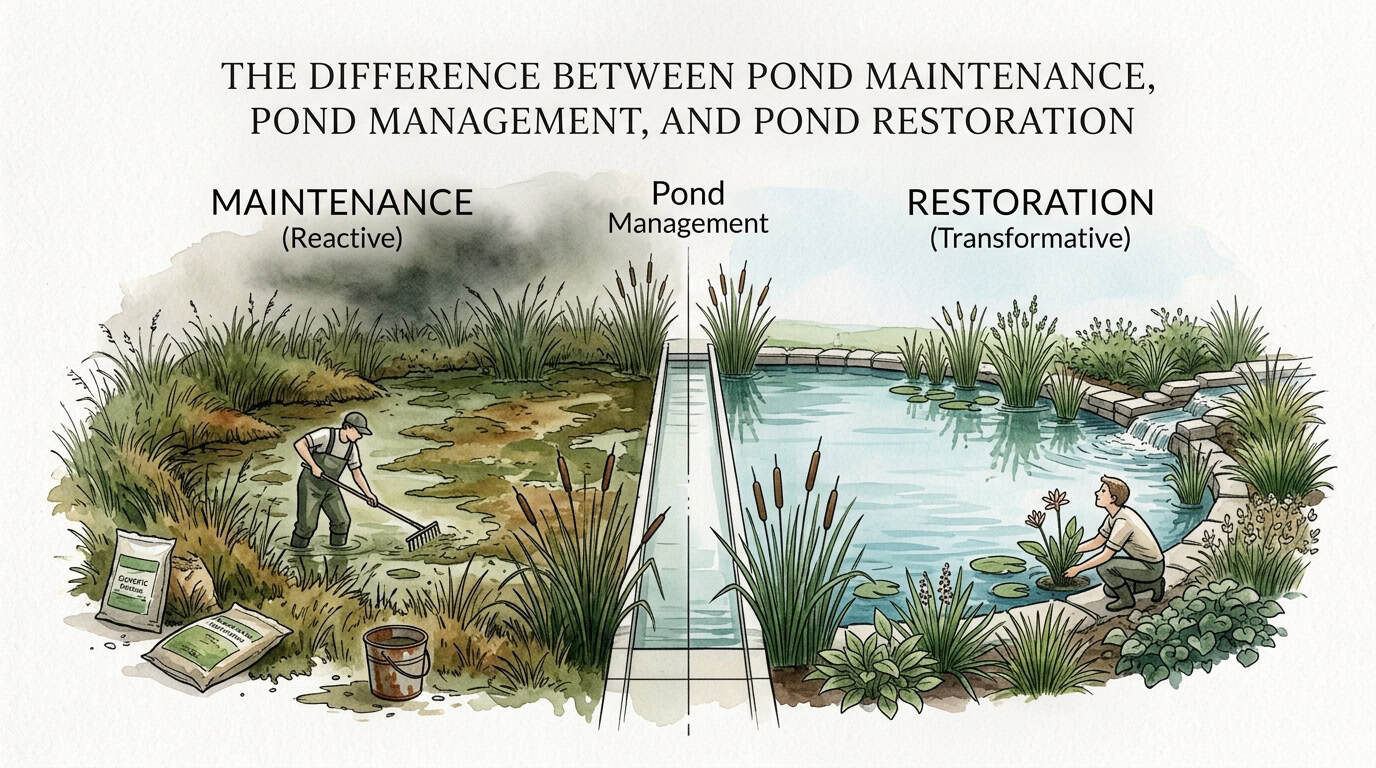
The Difference Between Pond Maintenance, Pond Management, And Pond Restoration
Pond maintenance refers to the routine, reactive tasks required to keep a water body in its current state. Technical maintenance involves debris removal, pump seal inspections, and basic water testing for pH and alkalinity. For smaller residential ponds, maintenance costs typically range from $170 to $450 per month, covering tasks like skimmer basket cleaning and minor vegetation trimming. Maintenance does not aim to change the ecosystem; it simply prevents immediate degradation.
Pond management is a proactive, science-based approach that focuses on the biological and chemical health of the water column. This involves managing the “trophic state” of the pond—preventing it from moving from an oligotrophic (low nutrient) to a eutrophic (high nutrient) state. Management techniques include the installation and optimization of diffused aeration systems, the application of phosphorus binders, and the use of beneficial bacteria to accelerate organic decomposition. Professional management ensures that the pond remains a functional asset rather than becoming an environmental liability.
Pond restoration is an intensive engineering process used to return a degraded water body to its original design parameters. This is necessary when sediment accumulation has reduced the pond’s depth to the point where management is no longer effective. Restoration often involves “dredging,” which is the mechanical or hydraulic removal of accumulated silt and organic muck. Restoration projects are capital-intensive, with costs for a 1-acre pond often ranging from $5,000 to $20,000, depending on sediment depth and disposal logistics.
How Technical Pond Systems Operate
Operating a pond successfully requires a deep understanding of hydraulic and biological systems. The most critical component in any managed pond is the aeration system. Aeration increases the Standard Oxygen Transfer Efficiency (SOTE), which is the measure of how effectively oxygen is moved from the air into the water.
Diffused aeration systems utilize a shore-mounted compressor that pushes air through weighted tubing to diffusers located at the pond’s bottom. Fine-bubble diffusers are significantly more efficient than coarse-bubble systems, often achieving a SOTE of approximately 6.9% per meter of depth. These bubbles create a “rising plume” that breaks up thermal stratification—a condition where warm, oxygen-rich water sits on top of cold, anoxic water. Eliminating this stratification is vital for preventing “pond turnover,” which can cause rapid oxygen depletion and catastrophic fish kills.

Sediment removal is the primary mechanism of restoration. Mechanical dredging utilizes long-reach excavators to scoop muck from the pond bed, which is effective for smaller ponds with accessible shorelines. Hydraulic dredging, conversely, uses a suction pump to move sediment as a slurry through a pipeline to a dewatering area. This method is preferred for larger water bodies or areas where heavy machinery cannot access the banks. Precise bathymetric surveys are used before restoration to map the sediment volume and calculate the exact number of cubic yards requiring removal.
Benefits of Strategic Aquatic Management
Implementing a high-level management strategy provides measurable benefits to property value and infrastructure longevity. For stormwater ponds, management ensures the system retains its design volume for flood control. According to the EPA, stormwater wet ponds are critical for removing Total Suspended Solids (TSS), and a well-managed pond can remove up to 80% of sediment before it enters local waterways.
Asset protection is another quantitative advantage. Communities that treat their ponds as infrastructure—similar to roofs or HVAC systems—can avoid the sudden $100,000 expense of an emergency dredging project. Reserve planning for pond restoration should begin at least 10 years in advance to distribute the capital burden. Regular management can extend the life of a pond by 15 to 20 years by reducing the rate of internal nutrient recycling.
Hydraulic efficiency is improved through consistent management of aquatic vegetation. Invasive species like hydrilla or water hyacinth can reduce flow rates and increase water loss through transpiration. Controlled chemical applications using fluridone or diquat, combined with biological controls like triploid grass carp, keep these populations at levels that do not interfere with the pond’s hydraulic function.
Challenges and Common Mechanical Failures
Misdiagnosis of pond issues is the most frequent cause of wasted expenditure. A common mistake is treating an algae bloom with copper sulfate without addressing the underlying phosphorus loading. While the copper kills the algae, the dead organic matter sinks to the bottom, decomposes, and releases more phosphorus, creating a feedback loop known as “internal loading.”
Improper aeration sizing is another significant challenge. If a compressor is undersized for the pond’s volume or depth, it will fail to circulate the water effectively. This leads to “dead zones” near the bottom where anaerobic bacteria produce hydrogen sulfide and ammonia. Furthermore, over-aerating can be just as problematic, as it may disturb the sediment layer and increase turbidity, which inhibits the growth of beneficial submerged plants.
Structural failures often occur in older ponds where the liner or the outflow structure (riser) has reached its service limit. Leaks in HDPE liners or the piping systems can lead to subsurface erosion, which threatens the stability of the pond’s banks. Regular visual inspections for “seeps” and monitoring water levels are the only ways to detect these issues before they require a full-scale restoration.
Limitations and Environmental Constraints
Environmental regulations impose strict limitations on restoration activities. The Clean Water Act, specifically Sections 401 and 404, often requires permits for dredging or discharging material into “waters of the United States.” Navigating these permits can add months to a project timeline and thousands of dollars in engineering fees.
Geological constraints also play a role. Ponds built on limestone or porous soils require bentonite clay or synthetic liners to maintain water levels. If these liners are punctured during a restoration project—such as by an excavator bucket—the cost of repair can exceed the cost of the dredging itself. Additionally, the disposal of dredged material is a major logistical hurdle. If the sediment is contaminated with heavy metals or oils from urban runoff, it must be hauled to a specialized landfill, which can triple the trucking costs.
Weather conditions are a constant variable in pond care. High heat reduces the water’s ability to hold dissolved oxygen while simultaneously increasing the metabolic demand of the aquatic life. During summer months, management systems must operate at peak efficiency to avoid a “squeeze” where supply cannot meet demand, leading to ecological collapse.
Technical Comparison of Pond Care Tiers
| Factor | Maintenance | Management | Restoration |
|---|---|---|---|
| Primary Goal | Operational Uptime | Ecological Stability | Structural Recovery |
| Technical Scope | Mechanical/Physical | Chemical/Biological | Heavy Engineering |
| Average Cost | $1,000 – $5,000 / year | $2,000 – $10,000 / year | $20,000 – $100,000+ |
| Interval | Monthly/Quarterly | Continuous/Seasonal | Every 15-25 years |
| Complexity | Low | Moderate | High |
Best Practices for Optimized Pond Oversight
Optimization starts with a comprehensive water quality monitoring program. Testing should be conducted at least twice a year to establish a baseline for Nitrogen (N), Phosphorus (P), and Potassium (K) levels. Understanding the N:P ratio is essential; a ratio below 10:1 often favors the growth of cyanobacteria (blue-green algae), which can produce harmful toxins.
Mechanical components require a strict preventative maintenance schedule. Air compressors should have their filters changed every 3 to 6 months, and the vanes or pistons should be inspected for wear annually. For fountain systems, the intake screens must be kept clear of debris to prevent cavitation, which can damage the pump motor.
Implementing a “no-mow” buffer zone around the pond’s perimeter is a highly effective management tactic. A buffer of 3 to 5 feet of native grasses and sedges acts as a biological filter, trapping nutrients and sediment from surface runoff before they enter the water. This simple intervention can significantly reduce the frequency of required dredging.
Advanced Limnological Considerations
Serious practitioners utilize bathymetric mapping to make data-driven decisions. Using GPS-synchronized sonar, technicians can create high-resolution 3D models of the pond floor. These maps reveal exactly where sediment is accumulating, allowing for “targeted dredging” rather than excavating the entire basin. This precision saves thousands in disposal costs.
Thermal stratification modeling is another advanced tool. By monitoring temperature at various depths, managers can calculate the “thermocline”—the depth at which water temperature changes rapidly. This data allows for the optimization of aeration diffuser placement. If the diffusers are placed above the thermocline, they will fail to mix the bottom water, leaving the deepest parts of the pond in a state of hypoxia.
Nutrient remediation through phosphorus sequestration is a cutting-edge management technique. Products containing lanthanum-modified clay or aluminum sulfate (alum) are applied to the water column to bind with reactive phosphorus. Once bound, the phosphorus becomes an inert solid that settles to the bottom, effectively “starving” algae of its primary food source. This chemical intervention can yield immediate results in water clarity and clarity.
Scenario: Restoration of a 5-Acre Community Pond
In a typical suburban development, a 5-acre stormwater pond had lost 40% of its design depth over 20 years. The community faced chronic algae blooms and foul odors. Initial maintenance efforts—manual weed removal and surface algaecides—had failed to address the root cause: 12,000 cubic yards of organic muck.
The restoration process began with a bathymetric survey to quantify the sediment. The HOA elected for hydraulic dredging because the banks were heavily landscaped and could not support an excavator. A cutterhead suction dredge was deployed, pumping the slurry into Geotube dewatering bags located in a nearby common area.
After 60 days of dredging, the pond’s depth was restored from 3 feet to its original 8 feet. The total cost was $180,000, or $15 per cubic yard. Following the restoration, the community implemented a management plan including a 2-HP diffused aeration system and biannual nutrient testing. Within one season, water clarity improved from 12 inches to 5 feet, and the internal nutrient loading was reduced by 70%.
Final Thoughts
Pond care is a technical discipline that requires a clear distinction between maintenance, management, and restoration. Maintenance keeps the equipment running, but management keeps the ecosystem stable. Restoration is the ultimate corrective action when the previous two have been neglected or have reached their natural limits.

Property owners should view their ponds as dynamic infrastructure. Investing in proactive management—specifically aeration and nutrient control—is the most cost-effective way to delay the massive capital expenditure of a restoration project. Understanding the mechanics of dissolved oxygen and the chemistry of phosphorus will provide a significant return on investment through improved water quality and asset longevity.
The most successful aquatic systems are those governed by data rather than reaction. By utilizing bathymetric mapping, consistent water testing, and optimized mechanical systems, you can ensure your pond remains a valuable property asset for decades. Encourage your board or management team to adopt these technical standards to move beyond simply “treading water.”