

Pond Talk is an Amazon Associate. As an Amazon Associate we earn from qualifying purchases.
Is your pond a glass box for your fish, or is it the heartbeat of your local ecosystem? The ‘clean’ look of a concrete basin is actually a desert for local wildlife. Embracing the ‘wild edge’ turns your backyard into a sanctuary for frogs, dragonflies, and birds while reducing your own maintenance.
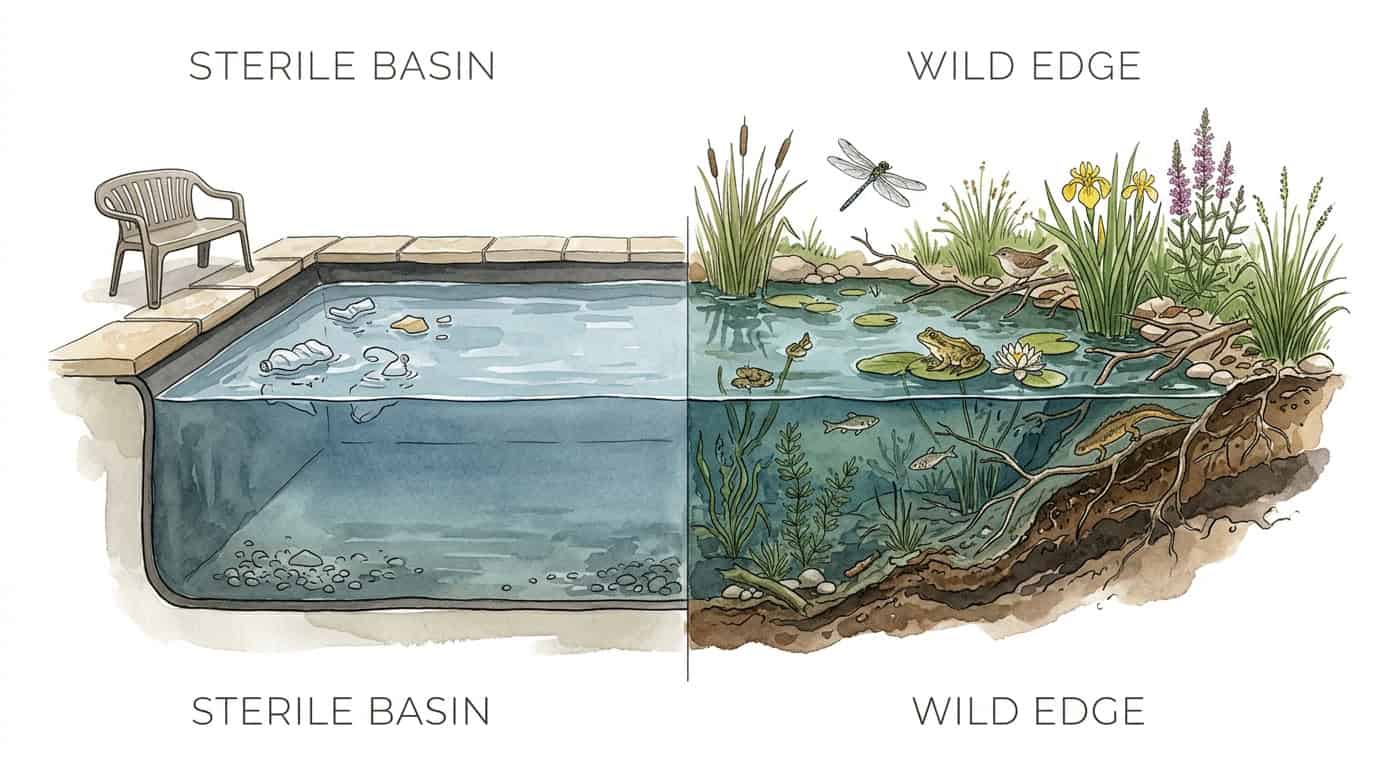
Establishing a functional wildlife pond requires a departure from traditional ornamental water feature design. A sterile basin focuses on mechanical filtration and chemical suppression of biological activity to maintain visual clarity. Conversely, a wild edge design leverages complex littoral zones and biological nutrient sequestration to create a self-regulating system. This technical transition shifts the pond from an isolated unit to an integrated ecological node.
Pond Design For Attracting Local Wildlife
Wildlife pond design focuses on maximizing the interface between terrestrial and aquatic environments. This design philosophy prioritizes the creation of varied micro-habitats through specific topographical gradients and substrate selections. Unlike standard koi ponds that use vertical walls to prevent predator access, wildlife ponds utilize shallow, accessible margins to facilitate the life cycles of amphibians and invertebrates.

These systems exist to restore local biodiversity by providing stepping-stone habitats in fragmented landscapes. In real-world applications, they serve as stormwater management tools, temperature regulators for urban microclimates, and breeding grounds for species like the Green Frog (*Rana clamitans*) or the Common Dragonfly. A successful wildlife pond functions as a biological filter where the “waste” of the system becomes the fuel for a diverse food web.
The Sterile Basin vs. The Wild Edge
A sterile basin typically features steep, 90-degree concrete or plastic walls. This configuration creates a “death trap” for small mammals and reptiles that may fall in and find no exit point. In contrast, the wild edge utilizes a 1:10 or 1:20 slope ratio. This gradual incline creates an expansive “drawdown zone”—an area of shallow water between 1 cm and 10 cm deep where the highest concentration of pond biodiversity resides.
Technical Specifications for Pond Topography
Designing for wildlife requires precise control over the pond’s vertical and horizontal profiles. The objective is to provide distinct thermal and depth refuges for different species throughout the seasonal cycle.
Littoral Zone Ratios
The littoral zone is the area of the pond where sunlight reaches the bottom, allowing for plant growth. For a wildlife-centric system, this zone should comprise 60% to 70% of the total surface area. Slope angles must be kept shallow to prevent sediment slumping and to provide stable footing for emergent vegetation.
- Ultra-Shallow Margins (1–10 cm): These areas are critical for damselfly oviposition and bird bathing. Slopes here should be 1:20 (3 degrees).
- Standard Marginal Shelves (15–30 cm): This depth supports the majority of emergent plants like Pickerel Rush (*Pontederia cordata*).
- Deep Refuge Zone (60 cm – 1.2 m): A central area of greater depth is necessary to prevent total freezing in winter and to provide a thermal buffer against high summer temperatures.
Substrate Selection and Hydraulic Conductivity
Selecting the right substrate influences the pond’s ability to process nutrients. Using a mix of rounded river cobbles, pea gravel, and a thin layer of screened topsoil (free of wood chips or organic fertilizers) encourages the growth of nitrifying bacteria. High-porosity substrates increase the surface area for biofilm development, which is the primary driver of biological filtration in a natural system.
The Biological Filtration Process
A wild edge pond replaces mechanical pressurized filters with a living regeneration zone. This process involves the movement of water through plant roots and gravel beds, where nutrients like phosphorus and nitrogen are sequestered.
Nutrient Cycling and BOD Management
Biochemical Oxygen Demand (BOD) is the amount of dissolved oxygen needed by aerobic biological organisms to break down organic material. In a sterile pond, BOD is managed by removing organic matter manually or via skimmers. In a wildlife pond, the goal is to balance BOD through plant uptake.
Submerged plants, such as Hornwort (*Ceratophyllum demersum*), act as oxygenators. They release oxygen directly into the water column during photosynthesis, supporting the aerobic bacteria that decompose fallen leaves and waste. High-density planting reduces the available nutrients for algae, maintaining water clarity through competition rather than chemical suppression.
Nitrogen Sequestration Rates
Aquatic plants vary in their efficiency at removing pollutants. Research indicates that floating plants like Water Hyacinth can absorb significantly more nitrogen per square meter than submerged species. However, because floating plants block sunlight, a balanced ratio of 30% floating, 40% emergent, and 30% submerged vegetation is recommended for optimal system stability.
Benefits of the Wild Edge Approach
Transitioning to a natural pond design provides measurable advantages in both ecological impact and long-term maintenance costs.
- Self-Regulating Pest Control: Creating habitat for dragonflies and damselflies provides natural predation of mosquito larvae. A healthy wildlife pond rarely has a mosquito problem because the larvae are consumed before they can hatch.
- Thermal Regulation: The high biomass in a wild edge pond reduces the rate of temperature fluctuation. This stability protects sensitive amphibian eggs from sudden cold snaps or heat waves.
- Lower Long-Term Costs: While a natural pond may have a higher initial installation cost due to the size of the regeneration zone, annual maintenance is significantly lower.
| Feature | Sterile Basin (Chlorine/Mechanical) | Wild Edge (Biological) |
|---|---|---|
| Annual Maintenance Cost | $3,000 – $6,000 | $1,000 – $2,500 |
| Liner Longevity | 10 – 15 Years (Vinyl) | 30+ Years (EPDM) |
| Chemical Input | High (Chlorine, Algaecide) | Zero |
| Biodiversity Impact | Negative (Death Trap) | High (Nursery Site) |
| Filtration Method | Mechanical/Pressurized | Biological/Phyto-filtration |
Challenges and Common Pitfalls
Designing a wildlife pond is not without technical risks. Most failures stem from a lack of understanding regarding the pond’s hydrologic and biological limits.

The Steep-Sided Trap
Constructing sides with a gradient steeper than 1:3 is the most common error. This causes soil erosion into the center of the pond, leading to rapid siltation. More importantly, it prevents wildlife from exiting. Even a pond with a liner can be made safe by adding “wildlife ramps” made of stacked flat stones or large branches that extend from the bottom to the shore.
Invasive Plant Dominance
Using non-native species can lead to a monoculture that provides little value to local fauna. For example, Yellow Floating Heart can quickly cover a pond’s surface, blocking light and causing the water to become anaerobic. Always source native species from local nurseries to ensure the plants support the specific life cycles of your region’s insects and amphibians.
High BOD Spikes
Excessive organic input, such as large amounts of autumn leaves falling into a small pond, can cause a spike in BOD. This leads to oxygen depletion, resulting in “winter kill” where dormant frogs and insects suffocate under the ice. Netting the pond during leaf fall or ensuring a robust population of oxygenating plants can mitigate this risk.
Limitations and Practical Constraints
A wildlife pond is not a universal solution for every landscape. Specific environmental and structural factors may limit the feasibility of a wild edge design.
- Space Requirements: To achieve a 1:20 slope and include a deep refuge zone, a wildlife pond often requires a larger footprint than a vertical-walled basin. Small yards may only be able to support “micro-pools,” which are prone to rapid temperature swings and drying out.
- Zoning and Safety: Local regulations often require fencing for any water body over a certain depth (typically 18 to 24 inches). The sprawling nature of a wild edge pond can make fencing more difficult or aesthetically intrusive.
- Evaporation Rates: Shallow margins increase the surface area-to-volume ratio, leading to higher evaporation rates in arid climates. This may require more frequent topping off with dechlorinated water.
Practical Tips for Implementation
Immediate steps can be taken to optimize an existing pond or plan a new installation for maximum wildlife efficiency.
- Introduce Large Woody Debris: Placing a partially submerged log provides a basking site for turtles and a transition point for emerging dragonflies.
- Vary the Substrate Size: Use a combination of sand, 20mm gravel, and 100mm cobbles. This creates different-sized voids that house various aquatic invertebrates.
- Avoid Fish Overstocking: High fish populations, particularly goldfish or koi, will consume the eggs and larvae of amphibians and dragonflies. If wildlife is the priority, keep fish density low or eliminate them entirely.
- Create “Beach” Entries: A simple pile of pea gravel at one end of the pond creates a shallow beach that allows even the smallest insects to drink without drowning.
Advanced Considerations for Practitioners
For those looking to optimize a system’s performance, understanding the relationship between hydraulic retention time and nutrient uptake is essential.
Hydraulic Retention Time (HRT)
HRT is the average time water stays in the regeneration zone. For effective biological filtration, water should be circulated through the plant roots and gravel beds at a rate that allows for bacterial nitrification. A pump that moves the total volume of the pond through the regeneration zone once every two to four hours is generally sufficient. Faster flow rates may shear the beneficial biofilms off the substrate, while slower rates can lead to stagnant, anaerobic pockets.
Sediment Management
Over time, all ponds accumulate “muck” or organic sediment. In a wildlife pond, this sediment is a vital habitat for hibernating frogs and macroinvertebrates. Instead of a total clean-out, which destroys the ecosystem, practitioners should perform a “partial dredge” every 3–5 years, removing only a portion of the sediment from the deepest zone to maintain water volume.
Example Scenario: A 1,000-Gallon Wildlife Node
Consider a project aimed at converting a standard 1,000-gallon garden pond into a wildlife sanctuary.
Step 1: Topographical Adjustment. The existing 2:1 slopes are reshaped. One side is extended outward to create a 3-meter long “wild edge” with a 1:15 slope. This increases the pond’s footprint but provides a massive increase in littoral habitat.
Step 2: Substrate Layering. A 5 cm layer of washed pea gravel is added to the new shallow area. Three large granite boulders are placed at the water’s edge to provide thermal mass for reptiles.
Step 3: Planting Strategy. Twenty units of *Anacharis* (oxygenator) are weighted and dropped into the deep zone. The marginal shelf is planted with a 50/50 mix of *Juncus effusus* (Soft Rush) and *Iris versicolor* (Blue Flag Iris). The rush provides vertical structure for dragonfly larvae to climb out of the water.
Step 4: Monitoring. Within 48 hours, water striders and backswimmers populate the surface. Within one season, the nutrient levels stabilize, and algae growth remains below 5% coverage without the use of UV clarifiers or algaecides.
Final Thoughts
Success in wildlife pond design is measured by the complexity of the food web it supports rather than the absence of “dirt.” Shifting from a sterile, high-maintenance basin to a wild edge system requires an investment in ecological understanding and topographical planning. The result is a self-sustaining environment that performs its own filtration and pest control.
Building a pond with gradual slopes and diverse plant zones provides the necessary infrastructure for local species to thrive. These systems reduce the long-term chemical and electrical burden on the owner while contributing to regional conservation efforts. Every additional centimeter of shallow, plant-rich margin increases the capacity of the pond to act as a resilient biological engine.
Experimenting with different native plant combinations and substrate depths allows for a more nuanced understanding of your local ecosystem’s needs. A well-designed wildlife pond is not a static feature but a dynamic process that grows more efficient and biodiverse over time. Focus on the data of the slopes and the biology of the zones, and the wildlife will follow.
Amazon and the Amazon logo are trademarks of Amazon.com, Inc, or its affiliates.