

Pond Talk is an Amazon Associate. As an Amazon Associate we earn from qualifying purchases.
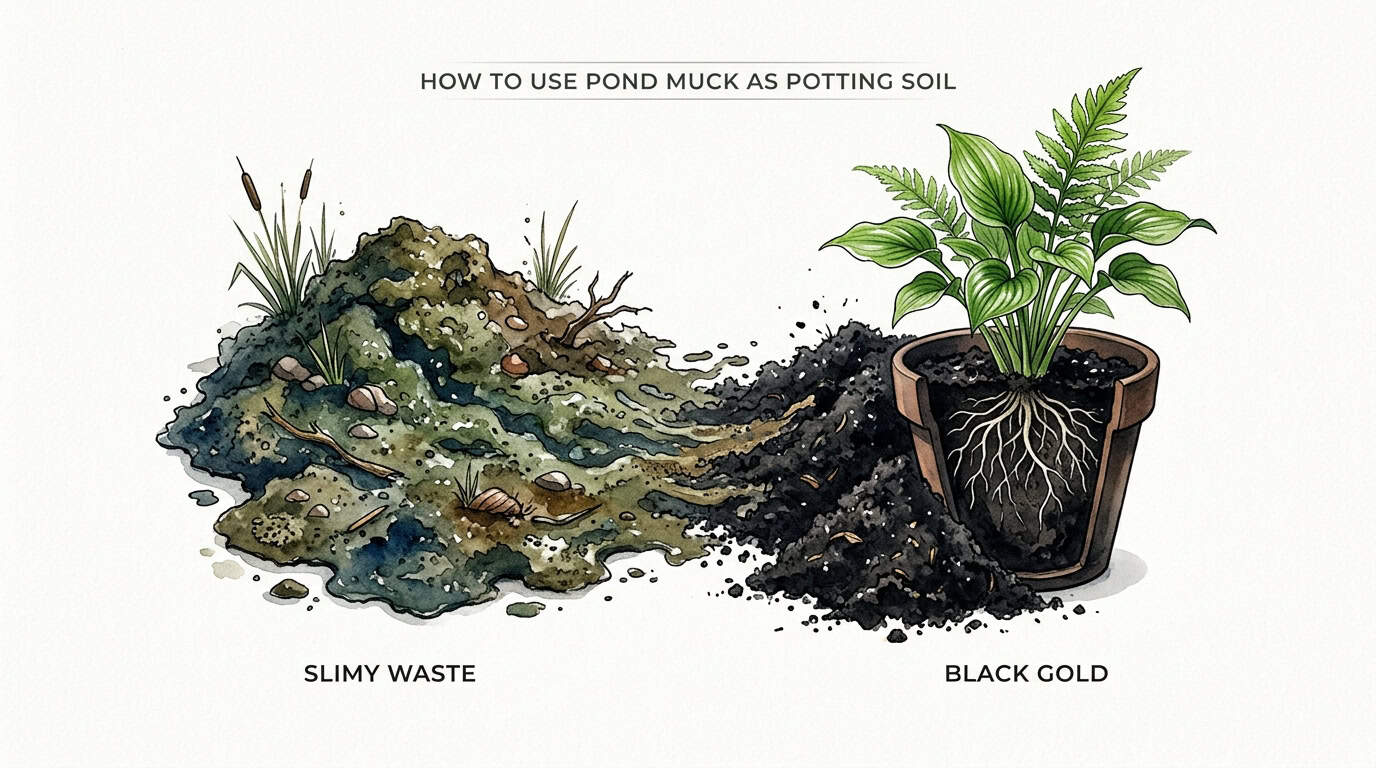
That ‘smelly mess’ at the bottom of your pond is actually the secret ingredient to the most expensive potting mix on the market. Spring cleaning usually means hauling buckets of muck to the curb. But what if that ‘waste’ is actually the nutrient-dense fuel your marginal plants have been starving for? Here is how to process it.
Efficient pond management requires a shift from viewing benthic sediment as a waste product to viewing it as a high-value substrate component. This material, often referred to as ‘pond muck,’ represents a concentrated accumulation of organic carbon, nitrogen, and phosphorus that has settled out of the water column over years or decades. Transforming this anaerobic sludge into a viable growth medium requires specific mechanical and biological stabilization techniques to ensure plant safety and structural integrity.
How To Use Pond Muck As Potting Soil
Pond muck is a complex mixture of allochthonous and autochthonous organic matter, minerals, and microorganisms. Allochthonous materials include external inputs like fallen leaves, grass clippings, and wind-blown silt, while autochthonous materials consist of decayed aquatic plants, algae, and fish waste. This combination creates a dense, nutrient-rich sediment that, once stabilized, functions as a high-performance soil amendment or primary substrate.

In professional aquaculture and landscaping, this material is valued for its high Cation Exchange Capacity (CEC) and moisture-retention properties. It is particularly effective for marginal aquatic plants, heavy-feeding perennials, and moisture-loving ornamentals. However, raw pond muck is typically anaerobic, meaning it lacks oxygen and contains high levels of hydrogen sulfide (H2S) and methane (CH4). Successful application requires moving the material through a dewatering and aerobic conversion phase to eliminate these toxic gases and pathogentic risks.
Using pond muck as potting soil serves as a form of closed-loop nutrient cycling. Instead of purchasing peat-based mixes that are stripped from sensitive wetlands, practitioners can harvest the accumulated fertility already present in their own systems. This approach reduces the need for synthetic fertilizers while improving the physical structure of the resulting potting medium.
Mechanical Extraction and Biological Stabilization
The transition from anaerobic sludge to stable potting soil involves three primary phases: extraction, dewatering, and aerobic composting. Each phase must be managed to optimize nutrient retention and minimize environmental runoff.
Extraction and Initial Sorting
Mechanical dredging or manual extraction with perforated shovels is the first step. For small-scale systems, a ‘muck shovel’ with drainage holes allows for the initial separation of solids from the water column. Larger systems may utilize hydraulic dredging, which creates a slurry that must be pumped into geotextile bags or settling basins. At this stage, it is critical to remove large debris such as rocks, branches, or invasive root masses that could interfere with the consistency of the final mix.
The Dewatering Protocol
Freshly harvested muck is typically 80% to 90% water by weight. Dewatering is essential to reduce volume and prepare the material for microbial activity. Spread the muck in layers of 4 to 6 inches on an impermeable surface with a slight gradient to allow for leachate collection. Exposure to solar radiation and wind facilitates evaporation. Geotextile tubes are an advanced alternative, acting as a mechanical filter that retains solids while allowing water to permeate the fabric under pressure.
Aerobic Conversion (Composting)
Once the material reaches a consistency similar to damp clay, it must be aerated. This stage shifts the microbial population from anaerobic bacteria to aerobic species. The process typically requires blending the muck with a high-carbon bulking agent, such as wood chips, straw, or sawdust, to achieve a Carbon-to-Nitrogen (C:N) ratio of approximately 25:1 or 30:1. Frequent turning of the pile ensures that oxygen reaches the core, facilitating the oxidation of sulfur compounds and the breakdown of complex lignins and celluloses.
Physicochemical Benefits of Processed Pond Sediment
Processed pond muck offers several measurable advantages over standard commercial potting soils, particularly regarding nutrient density and water-holding capacity.
The Cation Exchange Capacity (CEC) of pond sediments can range from 14 to 78 meq/100g, depending on the clay and organic matter content. A high CEC indicates a superior ability to hold and exchange essential cations like Calcium (Ca2+), Magnesium (Mg2+), and Potassium (K+), preventing them from leaching away during irrigation. This makes the substrate an excellent reservoir for long-term nutrient release.
Organic matter in pond muck typically includes 45% cellulose and 20% lignin. These components provide a structural matrix that increases the water-holding capacity of the soil. Research indicates that for every 1% increase in organic matter, the soil can hold significantly more plant-available water. In a container environment, this translates to reduced irrigation frequency and increased resilience during heat stress.
The micronutrient profile of benthic sediment is often broader than that of synthetic mixes. Trace elements like Iron (Fe), Manganese (Mn), and Zinc (Zn) accumulate in the pond bottom over time, providing a full-spectrum nutrient base that supports vigorous plant development and robust immune responses.
Operational Challenges and Risk Mitigation
Utilizing pond muck is not without technical risks. Practitioners must account for chemical imbalances and potential contaminants that could stunt plant growth or pose health hazards.

Anoxic Toxicity
Raw muck is often saturated with hydrogen sulfide, identifiable by a ‘rotten egg’ odor. If applied directly to plant roots without stabilization, these gases can cause immediate root necrosis. Complete aerobic stabilization is mandatory. The material is ready for use only when the foul odor has been replaced by a neutral, earthy scent.
Pathogen Management
Pond water and sediment can harbor pathogens, including E. coli or Salmonella, especially in ponds frequented by waterfowl or livestock. To mitigate this risk, the composting process must reach internal temperatures of 131°F (55°C) for at least three consecutive days. This ‘Process to Further Reduce Pathogens’ (PFRP) ensures the final potting soil is safe for handling and for use with edible crops.
Heavy Metal Accumulation
Ponds located in urban areas or near industrial sites may accumulate heavy metals such as Lead (Pb), Copper (Cu), and Cadmium (Cd). These elements bind to the organic fraction of the muck and do not break down. Before using large quantities of sediment for food production, performing a laboratory soil test is a necessary step to ensure heavy metal concentrations are within safe regulatory limits.
Environmental and Structural Limitations
Certain constraints make pond muck less ideal for specific applications or environments. Understanding these boundaries is key to maintaining system efficiency.
The density of processed pond muck is significantly higher than that of peat-moss or perlite-based commercial mixes. A container filled with a high-muck substrate will be considerably heavier, which may be a limitation for rooftop gardens, hanging baskets, or large-scale nurseries that require frequent pot movement.
High phosphorus levels in pond muck can be a disadvantage in regions with strict phosphorus runoff regulations. If used in outdoor containers that drain into local waterways, the nutrient-rich leachate could contribute to eutrophication in nearby lakes or streams. In these scenarios, the soil should be used as a minor amendment rather than a primary substrate, or containers should be equipped with closed-cycle drainage systems.
For seed starting or for plants highly sensitive to damping-off fungi, the non-sterile nature of pond muck is a drawback. Unlike commercial ‘soilless’ mixes that are heat-treated to eliminate weed seeds and spores, pond muck will contain a diverse biological load. This makes it better suited for established transplants and perennials rather than delicate seedlings.
Quantitative Comparison: Processed Muck vs. Commercial Mixes
A comparison of physical and chemical metrics highlights the functional differences between these growing media.
| Metric | Processed Pond Muck | Commercial Peat Mix |
|---|---|---|
| Bulk Density (g/cm³) | 0.8 – 1.2 (High) | 0.1 – 0.3 (Low) |
| CEC (meq/100g) | 14 – 78 (High) | 10 – 25 (Moderate) |
| Nitrogen (N) Content | 1.5% – 4.5% (Variable) | 0.1% – 0.5% (Initial) |
| Microbial Diversity | Extremely High | Low (Sterilized) |
| Weed Pressure | Moderate to High | Negligible |
Optimization Protocols for Substrate Formulation
Achieving the best results with pond muck requires precise blending. Pure muck is often too dense and may lack the macroporosity required for healthy root respiration.
The 1-1-1 Formula
A standard starting point for a high-performance mix is equal parts processed pond muck, coarse perlite (or sharp sand), and aged bark fines. This combination balances the moisture retention and nutrient density of the muck with the drainage and aeration provided by the inorganic components.
pH Correction
Pond sediments can range in pH from 6.0 to 8.5 depending on the local geology and the presence of calcium carbonates (marl). Test the pH of the stabilized material before use. If the mix is too alkaline for acid-loving plants, incorporate elemental sulfur or pine bark. If it is too acidic, a small application of dolomitic lime can stabilize the range.
Moisture Control
During the blending process, ensure the material is at ‘field capacity’—it should feel like a wrung-out sponge. If the muck is too dry, it can become hydrophobic and difficult to rewet. If too wet, it will clump and prevent proper air integration.
Advanced Considerations: Nutrient Mineralization
Serious practitioners should understand the rate at which nutrients in pond muck become available to plants. Unlike synthetic fertilizers that provide an immediate spike, organic nitrogen in benthic sediment must be mineralized by soil microbes.
This process is temperature-dependent. In cooler spring temperatures, the release of nitrogen from the cellulose and lignin structures is slow. As soil temperatures rise above 65°F (18°C), microbial activity increases, accelerating the conversion of organic nitrogen into plant-available ammonium and nitrate. Because of this slow-release characteristic, pond muck-based soils provide a consistent nutrient supply throughout the growing season, reducing the ‘feast or famine’ cycle common with chemical feeding.
Scaling considerations also apply. For larger estates or small farms, the use of a solarizing plastic cover over dewatered muck piles can accelerate pathogen destruction and weed seed sterilization. This ‘biosolarization’ technique uses trapped solar heat to reach higher temperatures than passive composting alone.
Example Scenario: Substrate Production for a Large-Scale Iris Nursery
Consider a nursery specializing in Japanese Water Iris (Iris ensata). These plants require high organic matter, consistent moisture, and a slightly acidic to neutral pH.
The operator dredges 50 cubic yards of muck from a local retention pond. After 4 weeks of dewatering on a concrete pad, the volume is reduced by 60%. The operator then blends the remaining 20 cubic yards of material with 10 cubic yards of pine bark fines and 10 cubic yards of coarse sand.
Laboratory testing shows a CEC of 45 meq/100g and a pH of 6.8. The resulting mix is used to pot 5,000 divisions. Because of the high CEC and nutrient-rich nature of the muck, the nursery reduces its supplemental liquid fertilization by 40% over the growing season. The high water-holding capacity also reduces irrigation frequency by 2 days per week compared to their previous peat-perlite mix.
Final Thoughts
The transformation of pond muck into potting soil is a highly efficient technical process that turns a maintenance liability into a biological asset. By focusing on mechanical dewatering and aerobic stabilization, anyone can produce a professional-grade substrate that rivals expensive commercial products.
This approach not only enhances the health of the aquatic system by removing excess nutrients but also provides terrestrial plants with a diverse, slow-release fertility source. The density, moisture retention, and high cation exchange capacity of processed sediment make it a superior choice for a wide variety of horticultural applications.
Experimentation with different blending ratios and bulking agents will allow you to fine-tune the mix for your specific plant species. Embracing this nutrient-cycling methodology contributes to a more sustainable, self-sufficient landscape management strategy.
Amazon and the Amazon logo are trademarks of Amazon.com, Inc, or its affiliates.