

Pond Talk is an Amazon Associate. As an Amazon Associate we earn from qualifying purchases.
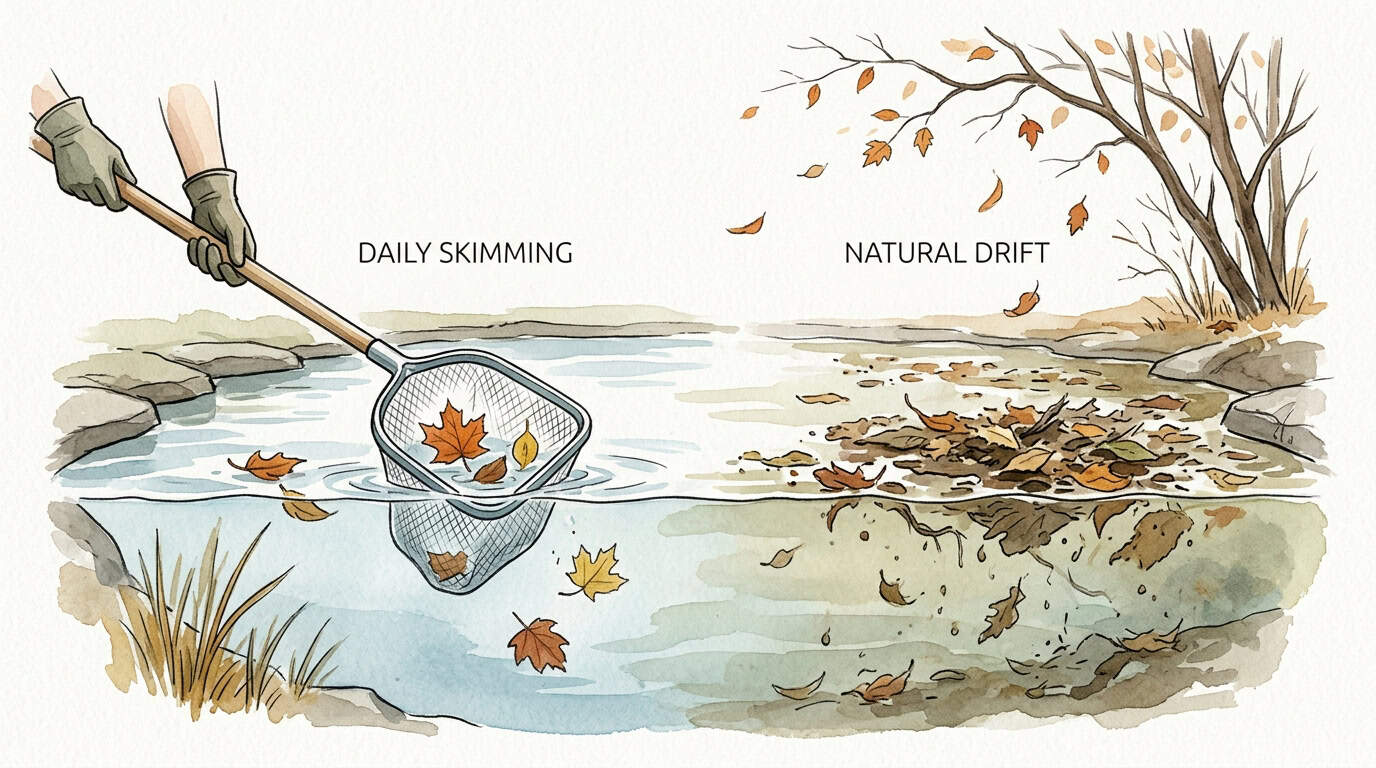
Stop fighting the wind and start letting it do your fall pond chores for you. Every autumn, pond owners spend hours bent over their water with a net. But if you understand the ‘drift’ of your backyard, you can let nature do the heavy lifting. Aligning your skimmer with the prevailing wind allows 90% of the leaves to ‘self-collect’ before they ever have a chance to sink. Here is how to map your pond’s flow.
Surface debris management is a critical component of aquatic ecosystem health. When organic matter like leaves, pine needles, and pollen remain on the water surface, they are easily removed. Once they become waterlogged and sink, they begin a process of anaerobic decomposition that consumes dissolved oxygen and releases hydrogen sulfide and excess nutrients into the water column. Managing this load requires an understanding of fluid dynamics and local meteorology.
A well-placed mechanical skimmer acts as the primary defense against this organic loading. The efficiency of these units is not determined solely by pump capacity. Instead, the interaction between surface tension, wind vectors, and intake velocity determines the success of the system. This guide provides a technical breakdown of how to optimize your pond for passive debris collection.

Effortless Fall Pond Maintenance
Effortless maintenance in the context of a backyard pond refers to the strategic utilization of environmental forces to reduce manual labor. The primary force at play is wind-driven surface drift. Wind exerts a shear stress on the surface of the water, creating a thin layer of movement that carries buoyant debris. If the pond’s mechanical intake is positioned in opposition to this wind, the pump must work against nature to pull debris back toward the skimmer.
Positioning the skimmer on the leeward side of the pond—the side toward which the wind blows—creates a synergy where the wind pushes debris directly into the skimmer mouth. This setup transforms the entire surface of the pond into a giant funnel. This approach is used in professional koi pond design and large-scale lake management to minimize the accumulation of muck on the pond floor.
Consider the analogy of a treadmill. If you are trying to move a ball toward one end, it is significantly easier if the treadmill is already moving in that direction. In a pond, the wind is the treadmill belt. When the skimmer is placed at the “downstream” end of the wind’s path, the mechanical suction only needs to perform the final capture rather than the entire transport of the leaf across the pond’s surface.
How Wind-Driven Collection Works
The movement of surface water is governed by the fetch—the distance of open water over which the wind blows. Even on a small backyard pond, a consistent breeze creates enough kinetic energy to move floating objects. To harness this, you must first identify your prevailing autumn winds. These are often different from summer breezes due to changing high-pressure systems.
The technical process involves three stages: drift, concentration, and intake. Drift occurs as the wind pushes the top few millimeters of water. Concentration happens when the debris reaches the edge of the pond and begins to stack up. Intake is the final stage where the skimmer’s weir door—a floating flap—allows the surface tension to break, pulling the concentrated debris into a collection basket.
To implement this, observe your pond on a breezy day. Drop a few buoyant objects, such as ping pong balls or dry leaves, in the center. Note where they accumulate. This “collection point” is the ideal location for a skimmer. If the skimmer is already installed in a sub-optimal location, you can often use “aim-able” return jets to create a circular flow that assists the wind, guiding debris toward the intake mouth.
Benefits of Strategic Skimmer Placement
The primary benefit of wind-aligned skimming is the drastic reduction in Total Organic Carbon (TOC) entering the nitrogen cycle. When leaves are removed quickly, they do not have time to leach tannins, which turn the water a tea-like brown. This maintains high water clarity and stabilizes the pH levels, which can otherwise fluctuate during heavy decomposition phases.
Mechanical efficiency is also improved. When the wind assists the skimmer, the pump can often be run at a lower variable speed while still achieving 100% surface clearance. This reduces electricity consumption and extends the life of the pump motor by reducing the head pressure required to move water against environmental resistance.
Oxygen levels remain higher in ponds with efficient surface skimming. Decomposing organic matter is a major “oxygen sink.” By removing the debris before it sinks, you preserve the dissolved oxygen for your fish and beneficial aerobic bacteria. This is especially vital in the fall as water temperatures drop and fish prepare for metabolic slowdown.
Challenges and Common Mistakes
One common mistake is ignoring “dead zones” created by pond geometry. An irregular, kidney-shaped pond or a pond with large rock outcrops can create eddies where wind cannot reach. In these areas, debris will circulate in a loop or sit stagnant regardless of skimmer placement. These zones require supplemental circulation, such as a small submersible pump or an aerator, to push debris back into the main wind current.
Another pitfall is the use of undersized weir doors. A skimmer with a narrow opening (e.g., 6 inches) has a very small “zone of influence.” In high-wind conditions, the wind may push debris past a narrow skimmer faster than the suction can pull it in. Wider weir doors (10-12 inches) are generally more effective at capturing debris in wind-prone areas because they provide a larger target for the wind-driven drift.

Failure to account for water level fluctuations also hinders performance. Most skimmers rely on a floating weir door to create a “skim” effect. If the water level is too high, the weir cannot pivot, and the skimmer simply pulls water from the middle of the column rather than the surface. If the level is too low, the skimmer may suck air, potentially damaging the pump. Maintaining a consistent water level via an auto-fill valve is essential for passive systems.
Limitations of Wind-Based Systems
Environmental variables are not always consistent. While prevailing winds exist, gusts can come from any direction during a storm. A system designed solely for a North-West wind will fail when a South-East front moves through. This means that while wind alignment can handle 90% of the work, some manual intervention or a multi-skimmer setup may be necessary for complex pond shapes.
Surface obstructions significantly limit the effectiveness of drift. Water lilies, lotus plants, and floating islands act as “leaf traps.” If these plants are located between the wind source and the skimmer, they will catch the leaves before they reach the intake. Owners of heavily planted ponds may find that wind-driven skimming is only effective in the open-water portions of the pond.
Large ponds, typically those over 5,000 gallons or with surface areas exceeding 400 square feet, often reach the limit of what a single skimmer can handle. The friction of the water and the sheer volume of debris during a “heavy drop” can overwhelm a single intake. In these scenarios, the mechanical limit of the basket volume becomes the bottleneck, regardless of how well the wind is moving the leaves.
Comparison: Manual Netting vs. Passive Skimming
| Feature | Manual Netting | Passive Skimming |
|---|---|---|
| Labor Requirement | High (Daily in Fall) | Low (Weekly Basket Emptying) |
| Consistency | Intermittent | Continuous (24/7) |
| Impact on Water Quality | Moderate (Leaves may sink) | High (Removes before sinking) |
| Initial Cost | $20 – $50 (Net) | $300 – $1,500 (Skimmer/Pump) |
| Efficiency | Dependent on User Effort | Dependent on Flow Design |
Practical Tips for Optimizing Flow
- Use an anemometer: Measure wind speed and direction over a week in October to identify the most frequent wind vector for your specific micro-climate.
- Install directional return jets: Position your pump returns (where water enters the pond) to create a “river” effect that pushes water in the same direction as the prevailing wind.
- Adjust weir tension: Some skimmers allow for weir adjustments. Ensure the door moves freely with minimal resistance so even a light breeze can push a leaf over the edge.
- Prune overhangs: If specific trees drop the majority of the load, prune branches that hang directly over “dead zones” to ensure leaves fall into the active “drift zones.”
- Dye Testing: Use a non-toxic pond dye or a small amount of milk to visualize the surface currents. This reveals exactly where the water is moving and where it is stalling.
Advanced Considerations: Hydraulic Optimization
For serious practitioners, the goal is to achieve laminar flow across the majority of the pond surface. Laminar flow is smooth and predictable, unlike turbulent flow which can trap debris in small whirlpools. Achieving this requires balancing the Gallons Per Hour (GPH) of the pump with the surface area. A general rule of thumb is to turn over the pond volume at least once per hour, but for surface skimming, the velocity of the surface water is more important than the total volume.
The “Capture Zone” of a skimmer can be calculated. This is the area where the intake velocity exceeds the resistance of the water. By increasing the pump’s GPH, you expand this zone. However, a more efficient method is to use a “skimmer sweep”—a jet of air or water directed across the surface—to shepherd debris into the capture zone. This allows for high efficiency without requiring an oversized, energy-hungry pump.
Sub-surface aeration can also interfere with skimming. Large air bubbles rising to the center of the pond create a “boil” that pushes water outward in all directions. If the aerator is too strong, it can actually push debris away from the skimmer. Moving the aerator to a deeper section or turning it down during the height of the leaf fall can improve skimmer performance significantly.
Example Scenario: The 2,500-Gallon Rectangular Pond
Consider a 2,500-gallon pond measuring 10 feet by 20 feet. The prevailing autumn wind blows from North to South along the 20-foot axis. If the skimmer is placed on the North wall, it must fight the wind to pull leaves back. The leaves will likely pile up on the South wall, sink, and decay.
By moving the skimmer to the center of the South wall, the 20-foot “fetch” works in the owner’s favor. The wind builds momentum, pushing every floating leaf toward the South wall. The skimmer, now located at the natural accumulation point, captures the debris effortlessly. To further optimize, the owner installs a return jet on the North wall, pointing South. This creates a constant surface current of 0.5 feet per second, ensuring that even on calm days, the leaves move toward the intake. Total manual labor is reduced from 30 minutes of netting per day to 5 minutes of emptying a basket twice a week.
Final Thoughts
Successful pond management is less about manual labor and more about working within the existing physical parameters of your environment. By aligning mechanical filtration with natural wind patterns, you create a self-cleaning system that maintains water quality with minimal intervention. This technical approach to “drift” ensures that organic loads are managed at the surface, preventing the downstream issues of muck accumulation and oxygen depletion.
Focus on the physics of your pond. Small adjustments to skimmer placement, jet direction, and water levels yield disproportionate improvements in system stability. As the autumn season progresses, observe the patterns and tune your setup. The goal is a system where the wind is a tool, not an adversary.
Experimenting with these flow dynamics will provide a deeper understanding of aquatic ecosystems. Whether you are managing a small goldish pond or a large koi habitat, the principles of surface tension and wind drift remain the same. Master the drift, and the pond will largely take care of itself.
Amazon and the Amazon logo are trademarks of Amazon.com, Inc, or its affiliates.