

Pond Talk is an Amazon Associate. As an Amazon Associate we earn from qualifying purchases.
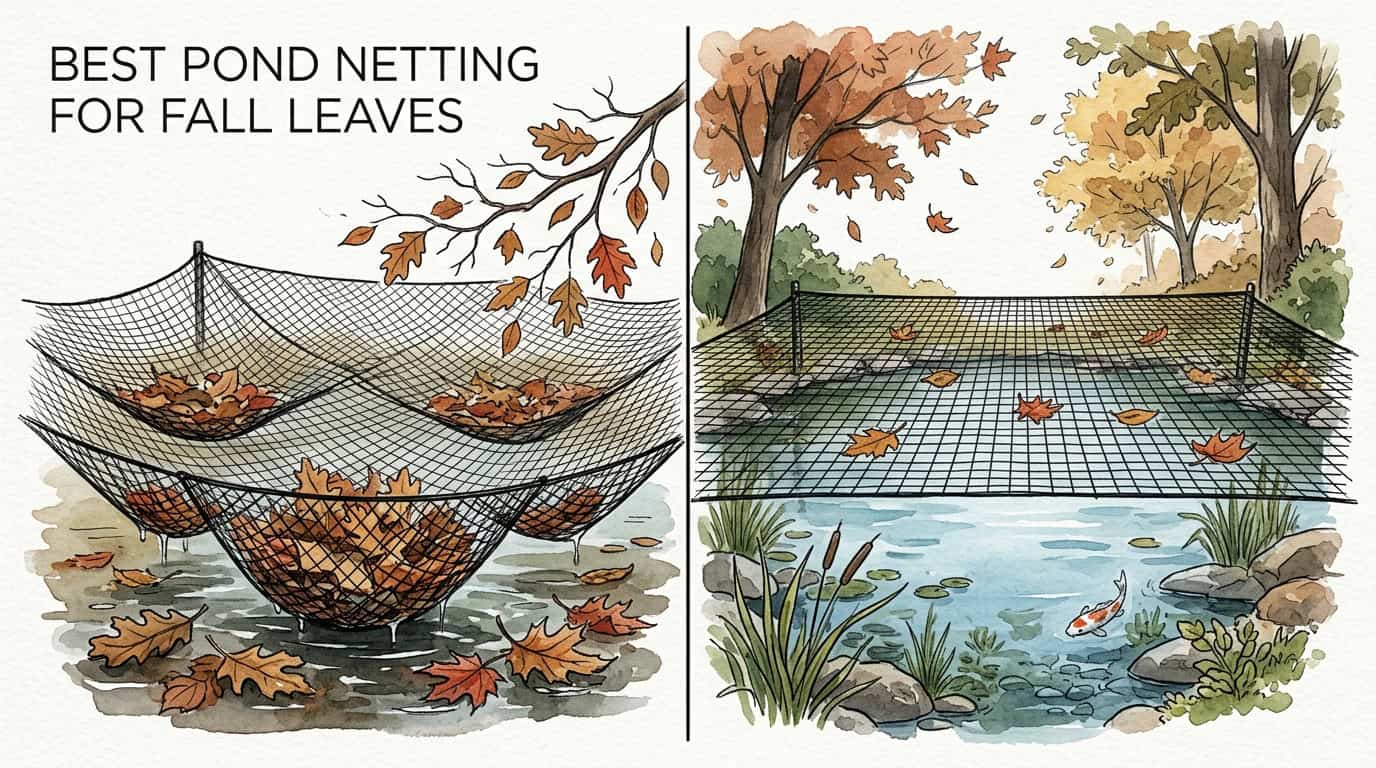
Is your safety net actually poisoning your water with rotting debris? Most pond owners treat netting like an afterthought, but a sagging net is just a tea bag for rot. Switch to a high-tension structural system to keep the debris out of the water column entirely.
Debris management in closed aquatic systems is frequently reduced to a seasonal chore rather than treated as a critical component of hydraulic and biological maintenance. When autumn leaves accumulate on a traditional, loosely draped mesh, the resulting “sag” allows organic matter to sit in the upper strata of the water column. This initiates a rapid leaching process that releases dissolved organic carbon (DOC) and tannins into the system long before the leaves sink to the benthos.
Effective management requires a shift from passive containment to active exclusion. A high-tension structural netting system utilizes mechanical principles to ensure that leaves remain suspended above the water’s surface, where they can desiccate and be removed by wind or mechanical clearing. This article provides a technical evaluation of the materials, structural engineering, and biological implications of pond netting systems designed for high-efficiency debris exclusion.

Best Pond Netting For Fall Leaves
Selection of the primary mesh material is the first point of failure in most debris exclusion strategies. High-Density Polyethylene (HDPE) is the industry standard for long-term structural applications due to its superior environmental resistance profile. Unlike traditional nylon, HDPE is hydrophobic, meaning it does not absorb water or lose tensile strength when saturated. Research indicates that nylon netting can absorb up to 9% of its weight in water, resulting in a 20-30% reduction in tensile strength and a significant increase in material sag.
The mesh geometry is equally critical. For deciduous leaves—such as oak, maple, and birch—a mesh size of 1/2 inch to 3/4 inch is recommended. Smaller mesh sizes, such as 1/4 inch, provide higher exclusion rates but increase the sail area of the net. This creates higher wind-loading stresses on the anchor points and support structure. Conversely, 1-inch mesh may allow smaller debris and pine needles to penetrate the barrier, leading to gradual sludge accumulation.
UV stability is a non-negotiable metric. Netting exposed to direct solar radiation undergoes photodegradation, where UV-B rays break the polymer chains through a process known as chain scission. To mitigate this, high-quality HDPE netting is extruded with carbon black or other UV inhibitors. Standardized testing shows that stabilized HDPE can retain over 80% of its breaking strength after years of exposure, whereas untreated polymers may fail within a single season of high solar irradiance.
How the Structural System Operates
A functional exclusion system is more than just a mesh; it is a tensioned membrane structure. The mechanics are governed by the relationship between span, sag, and tension. To keep a net suspended above the water, it must be supported by a framework or a series of high-tension cables that counteract the downward force of gravity and the weight of accumulated debris.
Support structures generally follow one of two mechanical designs: the arched conduit dome or the tensioned wire grid. Arched systems use the compressive strength of PVC or flexible fiberglass poles to create a convex surface. This geometry naturally sheds leaves toward the perimeter of the pond, preventing central accumulation. The “ribcage” design is often employed here, where a central spine supports perpendicular ribs anchored 8 to 12 inches beyond the pond’s edge to avoid liner puncture.
The wire grid system relies on tensile strength. Stainless steel aircraft cables or high-tensile nylon wires are stretched across the span and secured to rebar anchors. By utilizing turnbuckles, a technician can apply pre-tension to the wires—typically around 15-20% of their ultimate breaking load. The netting is then laid over this grid and secured with zip ties or clips. This method is preferred for larger surface areas where arched supports would be structurally unstable.
The Physics of Pre-Tensioning
Tensioning a horizontal line results in a catenary curve. The horizontal tension (Th) required to maintain a specific sag (S) for a given span (L) is calculated using the formula: Th = (w * L^2) / (8 * S), where ‘w’ represents the weight of the net and the anticipated debris load. As the allowed sag decreases, the required tension increases exponentially. This is why robust anchoring is the most overlooked part of the system.
Benefits of High-Tension Exclusion
The primary biological benefit of a tensioned system is the preservation of the water’s Dissolved Oxygen (DO) levels. When leaves enter the water, they increase the Biochemical Oxygen Demand (BOD). Aerobic bacteria consume oxygen to break down the organic matter. If the BOD exceeds the rate of oxygen diffusion at the surface, the system becomes anaerobic. This leads to the production of hydrogen sulfide and ammonia, both of which are toxic to fish.
Furthermore, high-tension systems prevent the accumulation of tannins. Tannins are polyphenolic compounds that stain the water a tea-brown color. While aesthetically unpleasing, they also lower the pH and reduce light penetration, which can inhibit the growth of beneficial submerged aquatic vegetation. By keeping leaves dry and suspended, the system ensures that these compounds are never introduced to the water column.
From a maintenance perspective, a dry leaf is significantly easier to manage than a wet one. Wet leaves adhere to surfaces and form a dense mat that is difficult to remove. Dry leaves can be cleared with a high-velocity leaf blower in a fraction of the time required for manual skimming. This efficiency metric is a key driver for professionals managing multiple large-scale water features.
Challenges and Common Mechanical Mistakes
The most frequent failure mode in pond netting is insufficient anchoring. Using plastic tent stakes in soft soil will inevitably lead to anchor pull-out as the net loads with debris or snow. Professional installations utilize 12-to-18-inch rebar stakes driven at a 45-degree angle away from the pond. For concrete or stone surroundings, expansion bolts or specialized masonry anchors are required to maintain the necessary tension.

Another common error is the failure to account for snow load. In northern climates, a horizontal net can accumulate several inches of snow, which weighs significantly more than dry leaves. If the system is not designed for this load, the netting will either tear or pull the supports into the pond. For areas with heavy snowfall, a steep-pitched arched frame is mandatory to ensure snow slides off before it can accumulate.
Chemical degradation also poses a challenge. While HDPE is resistant to many chemicals, it can be weakened by certain water treatments or high concentrations of chlorine if used near swimming pools. Periodic inspections for “chalking”—a white, powdery residue on the surface of the net—can indicate the early stages of polymer breakdown. Brittle fibers that snap under light pressure are a clear sign that the net has reached the end of its service life.
Limitations and Environmental Constraints
No system is universal. High-tension netting can be difficult to implement in ponds with irregular, rocky perimeters where securing a stable anchor is impossible. In these scenarios, a custom-fabricated floating frame may be the only viable alternative, although it lacks the exclusion efficiency of a fully suspended system.
Aesthetic considerations also limit the use of high-tension systems. For many homeowners, the visual impact of a structural frame and black mesh detracts from the natural beauty of the water feature. While “invisible” monofilament nets exist, they often lack the tensile strength required for high-tension applications and can pose a greater entanglement risk to local wildlife, such as birds and frogs.
Access for winter maintenance is another constraint. Once a high-tension net is installed, accessing the pond for pump maintenance or fish health checks becomes difficult. Designers must incorporate “access ports”—sections of the net that can be easily unclipped and moved without compromising the tension of the entire structure.
Comparison: SAGGY MESH vs. PRO TENSION
| Feature | Saggy Mesh (Traditional) | Pro Tension (Structural) |
|---|---|---|
| Debris Contact | High (leaves soak in water) | Zero (leaves remain suspended) |
| Material | Lightweight Polypropylene or Nylon | UV-Stabilized HDPE |
| Impact on DO | Negative (Increases BOD) | Neutral (Preserves oxygen) |
| Maintenance | Manual skimming required | Leaf blower compatible |
| Structural Life | 1–2 Seasons | 5–10+ Seasons |
Practical Tips and Best Practices
Timing is the most critical variable in fall management. The exclusion system should be fully operational before the first frost, as the sudden drop in temperature triggers a rapid leaf drop in many deciduous species. Installing the system in late summer allows for a tension check and adjustment before the seasonal load begins.
To prevent wildlife entanglement, ensure the net is visible. Small birds and mammals may not see black mesh against the dark water. Adding a few pieces of high-visibility tape or small “weighted” markers can alert wildlife to the barrier. Additionally, leave a small, controlled gap at the very bottom of the perimeter—away from the water’s surface—to allow amphibians like frogs and toads to move in and out of the pond area if necessary.
Inspect the tension of the turnbuckles weekly during the peak of the fall season. As the netting stretches and the anchor points settle into the soil, the system will naturally lose some of its pre-tension. A quick adjustment of the turnbuckles can prevent the catenary curve from deepening and allowing debris to touch the water.
Advanced Considerations for Professionals
For large-scale pond installations (over 500 square feet), the linear expansion of the polymer becomes a significant factor. HDPE has a high coefficient of thermal expansion. In colder temperatures, the material will contract and increase the tension on the anchors. If a system is tensioned to its limit on a warm day, the cold autumn nights could cause anchor failure or net tearing due to over-tensioning.
Calculating the potential “snow-water equivalent” (SWE) is also necessary for year-round installations. A heavy, wet snow can have a density of 20 lb/ft³. On a 10×20 foot pond, even two inches of such snow results in a total load of 4,000 lbs. In these cases, the internal support frame must be engineered with heavy-gauge PVC or even steel conduit to prevent a catastrophic collapse.
Biological monitoring can provide data on the effectiveness of the exclusion system. Measuring the Total Ammonia Nitrogen (TAN) and the Dissolved Organic Carbon (DOC) levels before and after the fall season will reveal the success of the debris management strategy. A well-designed system should show no significant spike in TAN or DOC despite heavy leaf fall in the surrounding area.
Example Scenario: Calculating Load and Tension
Consider a rectangular pond with a span of 12 feet. The owner wants to keep a high-quality HDPE net (weight 0.05 lbs per square foot) suspended with no more than 6 inches (0.5 ft) of sag. The anticipated load of wet leaves is estimated at 0.5 lbs per square foot.
First, calculate the total load (w) per linear foot. For a 1-foot-wide section of the span, the total weight is 0.55 lbs/ft². Since we are calculating per linear foot of the supporting cable, we must determine the weight acting on that specific line. If cables are spaced 2 feet apart, the load per linear foot of cable (w) is 1.1 lbs/ft.
Using the horizontal tension formula: Th = (1.1 * 12^2) / (8 * 0.5). This results in (1.1 * 144) / 4, which equals 39.6 lbs of horizontal tension per support line. This is well within the breaking strength of a standard 1/8-inch stainless steel cable (approx. 1,700 lbs), but it demonstrates the significant force applied to the anchors. Multiplying this by 6 cables results in nearly 240 lbs of constant pull on the perimeter anchors.
Final Thoughts
Modern pond management requires a move away from reactive cleaning and toward proactive mechanical exclusion. By understanding the material properties of HDPE and the physics of tensioned structures, pond owners can prevent the biological degradation caused by decomposing organic matter. A well-engineered netting system is not merely a cover; it is a critical filter that functions before the debris ever enters the water.
While the initial setup of a high-tension structural system requires more technical effort than simply draping a net, the long-term benefits to water chemistry and maintenance efficiency are undeniable. Preserving the aerobic state of the pond during the winter months ensures a healthier ecosystem for fish and a significantly easier spring startup for the owner.
Experimenting with different framework geometries and tensioning hardware will allow for a system that is tailored to the specific environmental stressors of your landscape. Whether managing a small decorative feature or a large-scale koi pond, the principles of high-tension exclusion remain the most effective method for maintaining water quality in the face of heavy seasonal debris.
Amazon and the Amazon logo are trademarks of Amazon.com, Inc, or its affiliates.