

Pond Talk is an Amazon Associate. As an Amazon Associate we earn from qualifying purchases.
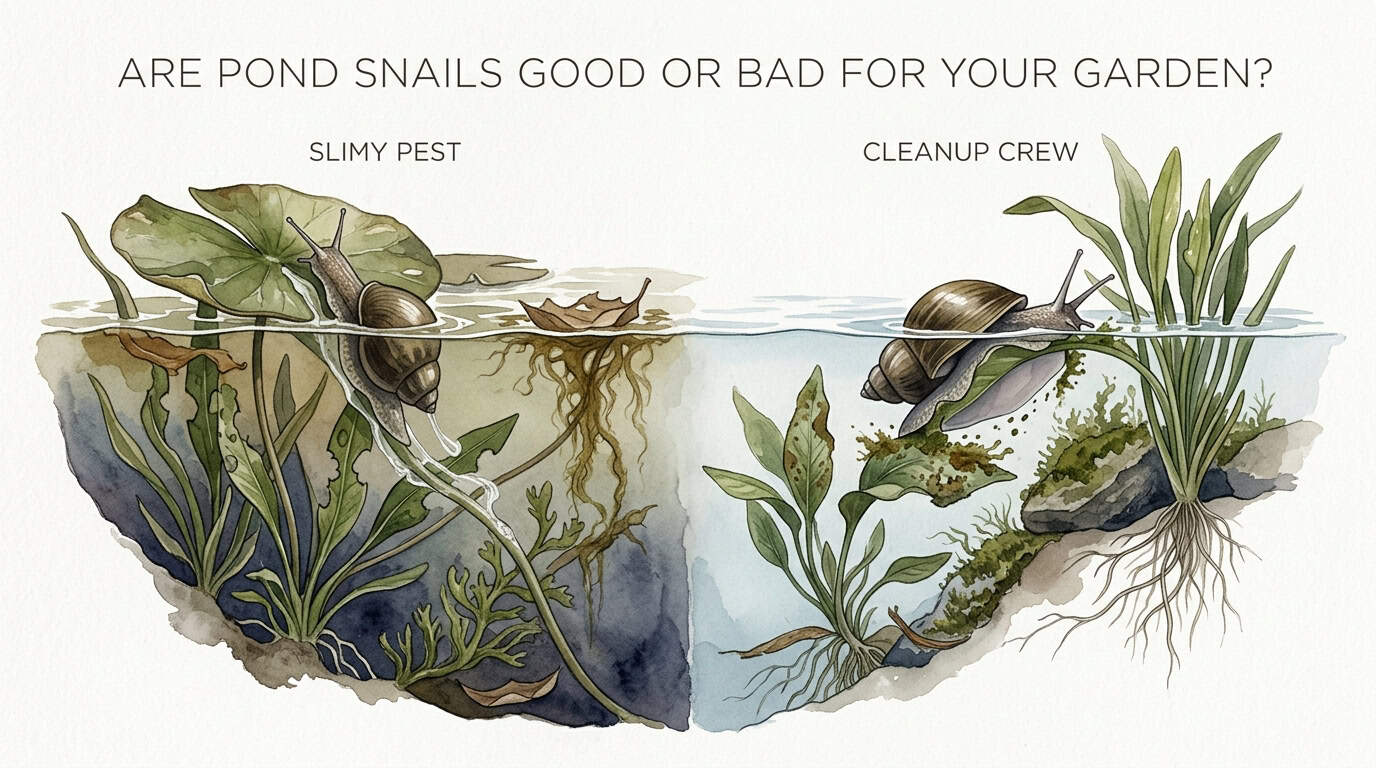
While most see a slimy invasion in the spring, the expert pond owner sees a self-cleaning engine coming to life. Spring often brings a sudden surge of snails to your pond. Before you reach for the chemicals, learn why these ‘slimy pests’ are actually your pond’s most vital spring cleaning team. They work 24/7 so you don’t have to.
Are Pond Snails Good Or Bad For Your Garden?
Pond snails are freshwater gastropod mollusks that occupy a specific ecological niche as primary consumers and detritivores. In a managed aquatic ecosystem, these organisms function as a biological filtration layer, processing organic matter that would otherwise contribute to nitrogen spikes and anaerobic conditions. While often labeled as “pests” due to their rapid reproduction cycles in nutrient-rich environments, their presence is typically a symptom of an underlying biological surplus rather than a primary problem.
These gastropods exist in a state of constant grazing, utilizing a specialized anatomical structure called a radula to scrape biofilm, periphyton, and decaying organic debris from submerged surfaces. In real-world pond management, they serve as a decentralized maintenance crew. They reach crevices and plant stems where mechanical filtration and manual cleaning cannot effectively penetrate.
Biological data suggests that a healthy population of pond snails contributes significantly to the nutrient cycle. They convert complex organic polymers found in “muck” or detritus into simpler, more bio-available forms of nitrogen and phosphorus. This process, known as nutrient remobilization, allows aquatic plants and beneficial nitrifying bacteria to more efficiently sequester these elements, thereby improving overall water clarity and stability.
The Mechanical Efficiency of the Gastropod Radula
The primary mechanism of action for the pond snail is the radula, a chitinous, ribbon-like structure covered in rows of microscopic, replaceable teeth. This organ functions similarly to a bucket-wheel excavator, rasping away layers of algae and bacterial biofilm. Research indicates that certain species can adjust the force of this rasping based on the density of the substrate, allowing them to clean delicate plant leaves without compromising the structural integrity of the live tissue.
Feeding efficiency is not merely about volume but about the systematic removal of the “epilithic” layer—the coating of algae and microbes on rocks. By stripping this layer, snails prevent the “choking” of rocky substrates where beneficial bacteria colonies reside. This mechanical action keeps the surface area of the pond’s biological media open and active, maximizing the efficiency of the nitrogen cycle at the substrate level.
Statistical models of snail consumption show that during peak activity in the spring, a robust population can consume a significant portion of the pond’s gross primary productivity. In some high-nitrogen environments, gastropod grazers have been documented consuming up to 75% of the available algae and biofilm within a localized area. This high throughput makes them an essential component of an integrated pest management (IPM) strategy for algae control.
Biofiltration and Nutrient Cycling
Pond snails are active participants in “nitrogen spiraling,” the process by which nitrogen is used, excreted, and reused as it moves downstream or through a closed system. Snails ingest organic nitrogen in the form of algae and detritus and excrete it primarily as ammonium (NH4+). While ammonium is toxic in high concentrations, in a balanced pond, it is immediately assimilated by aquatic plants or converted into nitrates by Nitrosomonas and Nitrobacter bacteria.
Quantitative analysis of snail excretion indicates that they can account for a substantial portion of the total ammonium demand in a productive aquatic system. By continuously recycling nitrogen, snails prevent the “pooling” of nutrients in the bottom sediment (muck). This prevents the formation of anaerobic pockets, which are responsible for the production of hydrogen sulfide and other toxic gases that can harm fish.
In addition to nitrogen, snails play a role in the phosphorus cycle. As they break down decaying plant matter, they release phosphorus back into the water column in a soluble form. This ensures that submerged and marginal plants have a steady supply of nutrients for growth, which in turn provides more oxygen to the water through photosynthesis.
Species Analysis: Comparative Performance
Not all pond snails provide the same level of service. Selection of the appropriate species depends on the specific maintenance requirements and the environmental parameters of the pond.
| Species | Primary Food Source | Reproduction Method | Technical Advantage |
|---|---|---|---|
| Japanese Trapdoor Snail | String Algae, Detritus | Live-bearing (Slow) | Winter hardy; does not overpopulate quickly. |
| Ramshorn Snail | Biofilm, Soft Algae | Egg-laying (Rapid) | High consumption rate; excellent for smaller crevices. |
| Great Pond Snail | Algae, Decaying Matter | Egg-laying (Moderate) | Large size allows for processing of larger debris. |
| Bladder Snail | Biofilm, Waste | Egg-laying (Very Rapid) | Highest surface area coverage per mg of biomass. |
Japanese Trapdoor Snails (Viviparus malleattus) are often preferred by serious practitioners because they are live-bearers with a nine-month gestation period. This mechanical constraint on their reproduction prevents the “snail explosions” common with egg-laying species like the Ramshorn or Bladder snail. Furthermore, Trapdoor snails are highly effective at grazing string algae (filamentous algae), which is one of the most difficult types of algae to manage manually.
Benefits of Gastropod Integration
The integration of snails into a pond ecosystem provides measurable advantages in terms of mechanical optimization and chemical stability.
- Algae Suppression: Consistent grazing reduces the need for chemical algaecides, which can cause oxygen crashes and harm fish.
- Detritus Reduction: Snails accelerate the breakdown of “muck,” extending the time between manual pond vacuuming or dredging.
- Substrate Aeration: Burrowing species, such as the Trapdoor snail, move through the top layer of sediment, preventing compaction and promoting oxygen exchange.
- Plant Health: By removing epiphytic algae from the leaves of aquatic plants, snails allow the plants to maximize light absorption and CO2 exchange.
These benefits are most observable in the spring when temperatures rise, and nutrient levels are high. During this period, the “self-cleaning” capacity of a snail-rich pond significantly reduces the workload for the pond owner.

Challenges and Common Mistakes
The most frequent error in snail management is the failure to account for population triggers. Snail populations are directly proportional to the available food supply. If a pond has a massive influx of snails, it is a definitive indicator of excess nutrients—likely from overfeeding fish or a lack of adequate filtration.
Another common mistake is the use of copper-based medications or algaecides. Gastropods are extremely sensitive to copper ions (Cu2+). Even low concentrations designed to kill algae can result in 100% snail mortality. When snails die en masse, their decaying biomass creates a massive ammonia spike, which can be lethal to the remaining pond inhabitants.
Practitioners must also avoid “over-cleaning” the pond. Removing every trace of algae can lead to snail starvation. When primary food sources are depleted, some species may turn to the soft tissues of live aquatic plants, specifically lilies and oxygenators. This is not a “pest behavior” but a survival mechanism triggered by a lack of supplemental or natural nutrition.
Limitations and Environmental Constraints
Environmental parameters dictate the efficiency and survival of pond snails. Calcium availability is the most significant limiting factor. Snails require calcium carbonate (CaCO3) to build and maintain their shells. In soft water environments (low GH and KH), snail shells may become pitted, thin, or translucent, leading to premature mortality.
Temperature also plays a critical role. While species like the Japanese Trapdoor snail can survive under ice in a dormant state, tropical species like the Apple Snail (Pomacea canaliculata) will perish if water temperatures drop below 50°F (10°C). Furthermore, in very high temperatures, the metabolic rate of snails increases, which also increases their oxygen consumption. In a poorly aerated pond, this can contribute to nocturnal oxygen depletion.
Water pH is another critical variable. Most freshwater snails thrive in a pH range of 7.0 to 8.5. Acidic water (pH Practical Tips for Optimization
To maximize the efficiency of your biological cleaning team, implement the following best practices:
- Monitor Calcium Levels: Maintain a General Hardness (GH) of at least 150 ppm. If your water is naturally soft, add crushed oyster shells or limestone to the filter to provide a slow-release source of calcium.
- Stocking Density: For effective algae control, aim for approximately 10 Trapdoor snails per 50 square feet of surface area.
- Supplemental Feeding: In the early spring or late fall when natural algae growth is slow, provide algae wafers or blanched vegetables to maintain the population.
- Avoid Copper: Check the ingredients of all water treatments. If copper is listed, do not use it in a pond containing gastropods.
By maintaining these parameters, you ensure that the snails remain in peak physical condition, allowing them to perform their “scrubbing” duties with maximum efficiency.
Advanced Considerations: Snails as Bio-indicators
Experienced pond managers use snails as a real-time monitoring system for water quality. Because snails are in constant contact with the substrate and the water column, they respond rapidly to chemical changes.
For example, if you observe all the snails in your pond congregating at the waterline or climbing out of the water, it is often a sign of low dissolved oxygen (DO) or a spike in nitrites. Snails can detect these stressors long before fish show symptoms. Similarly, if shells appear to be eroding or “pitting,” it serves as an early warning of a pH drop or a mineral deficiency that could eventually affect your fish’s bone development and slime coat.
Using snails as a bio-indicator allows for proactive management. Instead of waiting for a fish to show signs of illness, the behavior of the gastropod population provides the data needed to make adjustments to aeration or water chemistry.
Examples of Snail Impact in Practice
Consider a 1,000-gallon pond with a moderate fish load and high sun exposure. Without gastropods, the owner might struggle with “blanket weed” (string algae) covering the rocks and liner. Manual removal takes hours every week, and chemical treatments provide only temporary relief.
By introducing 20-30 Japanese Trapdoor snails, the system changes. The snails begin at the base of the algae filaments, rasping them away from the substrate. Within 14 to 21 days, the visible “fur” on the rocks is significantly reduced. More importantly, the waste produced by the snails is processed by the pond’s existing bio-filter, turning the algae into plant food.
In this scenario, the snails have replaced a recurring chemical cost and several hours of manual labor with a self-sustaining biological process. The metrics show a decrease in “muck” depth over the season and a more stable pH due to the consistent cycling of organic matter.
Final Thoughts
Pond snails represent one of the most efficient, low-maintenance components of a healthy aquatic ecosystem. By viewing them as a “self-cleaning engine” rather than a pest, you can leverage their natural behaviors to maintain a clearer, more stable pond environment. Their ability to recycle nutrients and manage biofilm is unmatched by any mechanical substitute.
The key to success lies in understanding the balance between nutrient availability and population density. When you provide the necessary calcium and maintain a stable pH, these gastropods will provide years of service, ensuring that your pond’s biological machinery remains in peak condition.
Experiment with different species to find the best fit for your specific pond architecture. Whether you choose the slow-breeding Trapdoor snail or the industrious Ramshorn, you are investing in a biological system that works 24/7 to keep your water garden thriving.
Amazon and the Amazon logo are trademarks of Amazon.com, Inc, or its affiliates.