

Pond Talk is an Amazon Associate. As an Amazon Associate we earn from qualifying purchases.
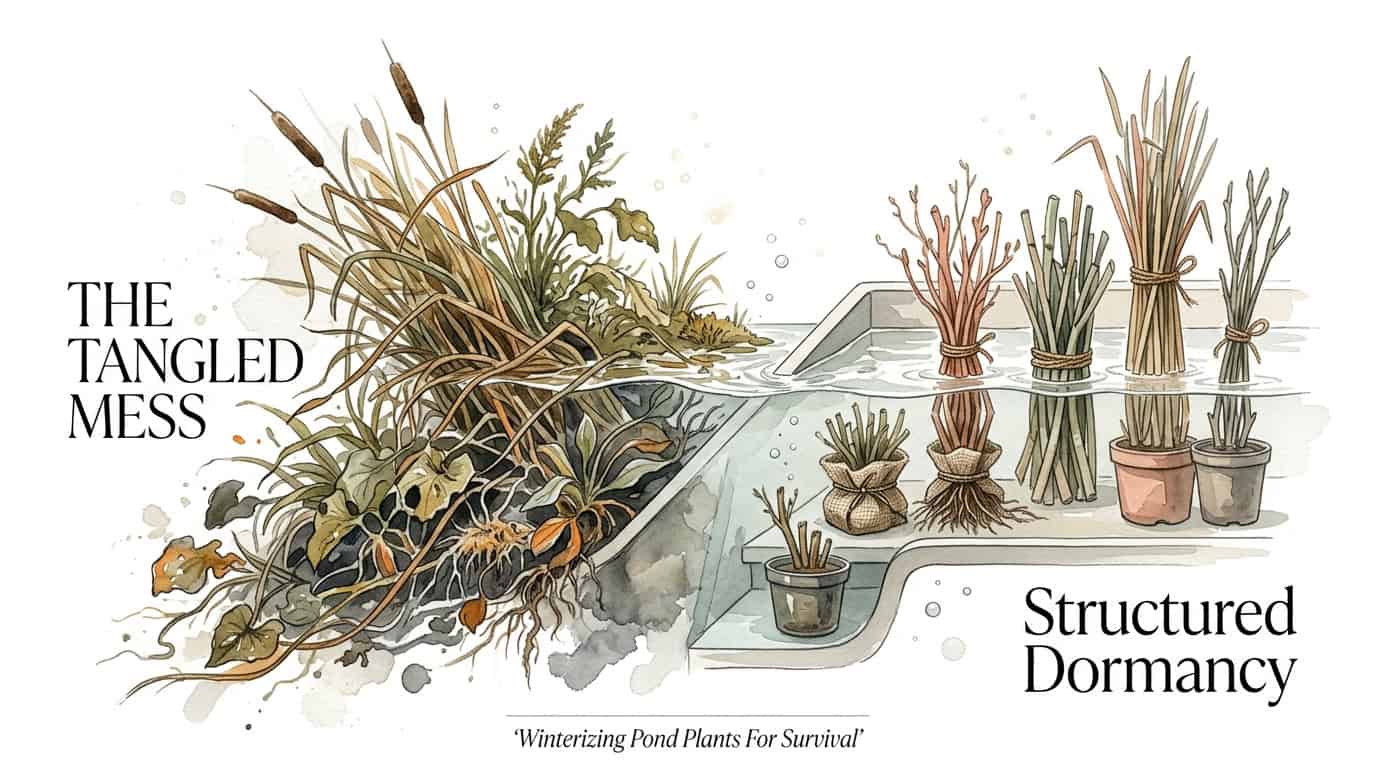
A little bit of organization in November prevents a massive cleanup in March. Most pond owners leave their lilies to rot once the first frost hits, creating a toxic sludge for fish. By switching from a chaotic surface to an organized dormant system, you protect your water quality and ensure your plants explode with life next spring. Here is how to organize your aquatic perennials before the ice sets in.
Winterizing Pond Plants For Survival
Winterizing pond plants is the technical process of managing aquatic biomass to facilitate metabolic dormancy while preventing environmental degradation. Aquatic perennials, specifically the Nymphaeaceae family, undergo a physiological shift as photoperiods shorten and thermal energy in the water column dissipates. This transition requires mechanical intervention to reduce the biological oxygen demand (BOD) within the closed system of a pond.
Survival of these specimens depends on protecting the apical meristem, or the growing point of the rhizome, from cellular crystallization. In temperate climates, ice formation on the surface creates an insulating barrier, but if the ice reaches the plant tissue, expansion of water within the cells causes irreversible mechanical damage. Proper winterization ensures that hardy species are positioned in the thermal stable zone of the pond, typically at depths where water remains at a constant 4°C (39.2°F).

In real-world applications, this process serves two functions. First, it preserves the genetic material and stored energy of the plant for the subsequent growing season. Second, it maintains water chemistry parameters by removing senescent tissue that would otherwise contribute to nutrient loading and gas accumulation under ice cover.
Mechanical Procedures for Dormancy Transition
The transition to a dormant state involves a sequence of mechanical steps designed to optimize plant health and water quality. This process begins when water temperatures consistently drop below 10°C (50°F). At this threshold, the metabolic rate of aquatic perennials slows significantly, and chlorophyll production ceases.
Hardy water lilies require a standard “cut and sink” protocol. Operators should use long-handled pruning shears to remove all surface pads and emergent stems. The cut should be made approximately 5 to 10 centimeters above the crown or rhizome. Removing this foliage prevents the accumulation of organic matter on the pond floor, which is a primary driver of anaerobic decomposition.
Once the foliage is cleared, the planting container must be relocated. Move the pots to the deepest section of the pond, ensuring they are at least 45 to 60 centimeters below the expected frost line. This depth leverages the anomalous expansion of water; because water is densest at 4°C, this relatively warmer water settles at the bottom, providing a thermal buffer against surface freezing.
Tropical species require a different mechanical approach. These plants do not possess the physiological adaptations to survive temperatures below 10°C. They must be extracted from the pond entirely. After removing the foliage and rinsing the root system, the tubers can be stored in a medium of moist sand or peat moss. Storage temperatures must remain between 10°C and 15°C (50°F to 60°F) to maintain dormancy without inducing rot or premature sprouting.
Benefits of Systematic Plant Organization
Systematic organization of pond plants provides measurable improvements in the ecological stability of the aquatic environment. One of the primary advantages is the reduction of the Chemical Oxygen Demand (COD). When plant tissue dies and sinks, microbial populations consume dissolved oxygen to break down the cellulose and lignin. In a frozen pond, where gas exchange with the atmosphere is restricted, this oxygen depletion can lead to catastrophic “winterkill” of fish populations.
Managing the biomass also prevents the spike of Hydrogen Sulfide (H2S). This gas is a byproduct of sulfate-reducing bacteria that thrive in the anaerobic conditions created by rotting lilies. By removing the foliage before it decays, the substrate remains aerobic for a longer duration, and the risk of toxic gas accumulation is mitigated.
Furthermore, organized dormancy facilitates a more efficient spring startup. Plants that have been properly pruned and positioned emerge from dormancy with greater vigor because they are not competing with a layer of decomposing sludge. The lack of excess nutrients from decayed matter also reduces the likelihood of early-season algae blooms, which often capitalize on the nutrient flush associated with poorly managed ponds.
Challenges and Common Technical Errors
The most frequent mistake in winterizing pond plants is improper timing. Initiating the process too early can deprive the plant of necessary carbohydrate accumulation. Aquatic perennials use the late summer and early autumn to store starch in their rhizomes. If the foliage is removed while the plant is still actively photosynthesizing, the energy reserves for spring emergence will be insufficient.
Another challenge is the “hollow stem” effect found in certain marginal plants like Juncus or Typha. If these plants are cut below the water line before the pond freezes, water can enter the hollow structures and reach the crown, leading to rot. These species should be left standing until spring or cut well above the maximum water level to maintain a physical barrier.
Failure to disinfect tools between plants represents a significant biosecurity risk. Fungal pathogens and waterborne viruses can be transferred via cutting surfaces. Using a 10% bleach solution or isopropyl alcohol between specimens is a critical best practice that is often overlooked in residential pond management.

Limitations of Winterization Methods
Winterization techniques are limited by the physical dimensions of the pond and the severity of the local climate. In shallow ponds that freeze solid, mechanical repositioning of hardy lilies is ineffective. If the entire water column reaches 0°C, the rhizomes will freeze regardless of their position. In these scenarios, the only viable option is to move the plants to a frost-free indoor environment or utilize a high-wattage de-icer to maintain a liquid zone.
Environmental trade-offs also exist regarding the removal of all organic matter. Some beneficial macroinvertebrates rely on detritus for overwintering habitat. Total removal of plant tissue can decrease the biodiversity of the pond’s micro-fauna. However, in most closed-system garden ponds, the risk of water quality failure outweighs the benefit of providing habitat for these organisms.
Species-specific limitations must also be considered. While most hardy lilies follow a standard protocol, Lotus (Nelumbo) are exceptionally sensitive to rhizome disturbance during the dormant transition. Moving a Lotus pot once it has entered dormancy can snap the brittle growing points, resulting in the death of the specimen. These plants should remain in their original position if the depth is sufficient.
Comparison: Hardy vs. Tropical Management Requirements
The management of aquatic perennials can be divided into two distinct strategies based on the plant’s thermal tolerance. The following table outlines the technical differences in maintenance requirements.
| Parameter | Hardy Perennials (e.g., Nymphaea) | Tropical Perennials (e.g., Victoria) |
|---|---|---|
| Temperature Threshold | Can survive near 0°C if not frozen solid. | Tissue damage occurs below 10°C. |
| Dormancy Location | In-pond (deep zone). | Ex-pond (indoor storage). |
| Pruning Requirement | Total removal of surface foliage. | Removal of foliage and root trimming. |
| Medium Storage | Natural pond substrate. | Moist sand, peat, or distilled water. |
| Labor Intensity | Low (mechanical movement only). | High (extraction and monitoring). |
Practical Best Practices for Pond Techs
Precision is the key to successful winterization. Using a calibrated pond thermometer is essential; do not rely on ambient air temperatures to gauge water conditions. Water has a high specific heat capacity and lags behind air temperature changes. Operations should only commence when the water temperature at the 30-centimeter depth remains below 10°C for three consecutive days.
Investing in heavy-duty, submersible gloves is a necessary step for operator safety and efficiency. Cold water immersion can lead to a rapid loss of manual dexterity, increasing the risk of dropping and damaging heavy planting containers. Utilizing a “hook and rope” system for lowering pots into deep zones prevents the need for full entry into the water, preserving the thermal layers of the pond.
Labeling each container with a waterproof tag is a critical step for spring organization. When the pond is a dark, cold environment in November, it is easy to forget which pot contains which cultivar. Proper labeling ensures that in the spring, plants can be returned to their specific depth requirements based on their growth habits (e.g., dwarf varieties vs. vigorous spreaders).
Advanced Considerations: The Chemistry of Under-Ice Decomposition
For the serious practitioner, understanding the Carbon-to-Nitrogen (C:N) ratio of decomposing lilies is vital. Lily pads have a relatively high carbon content. When these decompose in a low-oxygen environment, the process is dominated by anaerobic bacteria. These bacteria are less efficient than aerobic ones, leading to the accumulation of intermediate organic acids which can lower the pH of the pond water.
The solubility of gases also changes with temperature. While cold water can hold more dissolved oxygen than warm water, this potential is only realized if there is an interface for gas exchange. If a pond is completely sealed by ice, the “oxygen debt” created by even a small amount of leftover lily foliage can be significant. The Henry’s Law constant for oxygen increases as temperature decreases, but without a hole in the ice maintained by an aerator or de-icer, the partial pressure of CO2 and H2S will rise to toxic levels.
Managing the microbial kinetics involves the use of specialized cold-water bacterial inoculants. These strains are psychrophilic, meaning they remain active at temperatures between 2°C and 7°C. Adding these beneficial bacteria during the winterization process assists in the slow breakdown of any remaining microscopic organic debris, ensuring the nitrogen cycle continues even when the primary biofilter is dormant.
Example Scenario: Calculating Organic Load
Consider a 4,000-liter pond with five mature hardy water lilies. Each lily produces approximately 0.5 square meters of surface foliage during the peak season. If left to rot, this represents 2.5 square meters of high-carbon biomass.
Calculation of potential oxygen depletion:
Standard aquatic plant tissue contains approximately 40% carbon by dry weight. A single square meter of lily foliage can weigh roughly 200 grams when dry. Therefore, 2.5 square meters equals 500 grams of dry organic matter, containing 200 grams of carbon.
Stoichiometrically, the oxidation of 12 grams of carbon requires approximately 32 grams of oxygen. To fully decompose 200 grams of carbon, the system would require approximately 533 grams of dissolved oxygen. In a 4,000-liter pond at 4°C, the maximum dissolved oxygen saturation is roughly 12.5 mg/L, totaling only 50 grams of oxygen for the entire pond.
Without mechanical removal, the decomposition of just five lilies would require over ten times the total oxygen available in the pond. This quantitative example illustrates why leaving foliage to rot is biologically unsustainable in a closed system.
Final Thoughts
The technical management of aquatic perennials during the winter months is a critical intervention for the long-term viability of the pond ecosystem. By systematically removing organic biomass and repositioning hardy specimens to the thermal stable zone, the operator mitigates the risks of anaerobic toxicity and metabolic failure. These steps transition the pond from a state of chaotic decay to one of structured dormancy.
Execution of these protocols requires attention to water chemistry, temperature thresholds, and mechanical precision. While the process demands significant labor in the late autumn, the resulting stability of the water column and the vigor of the spring growth justify the effort. Success is measured by the absence of toxic gas odors in the spring and the immediate resumption of growth as temperatures rise.
Those seeking to further optimize their systems should explore the integration of aeration technology and psychrophilic bacterial treatments. These advanced tools complement mechanical winterization, providing a multi-layered defense against environmental stress. Mastery of these dormant systems is what separates a high-performance water feature from a seasonal maintenance liability.
Amazon and the Amazon logo are trademarks of Amazon.com, Inc, or its affiliates.