

Pond Talk is an Amazon Associate. As an Amazon Associate we earn from qualifying purchases.
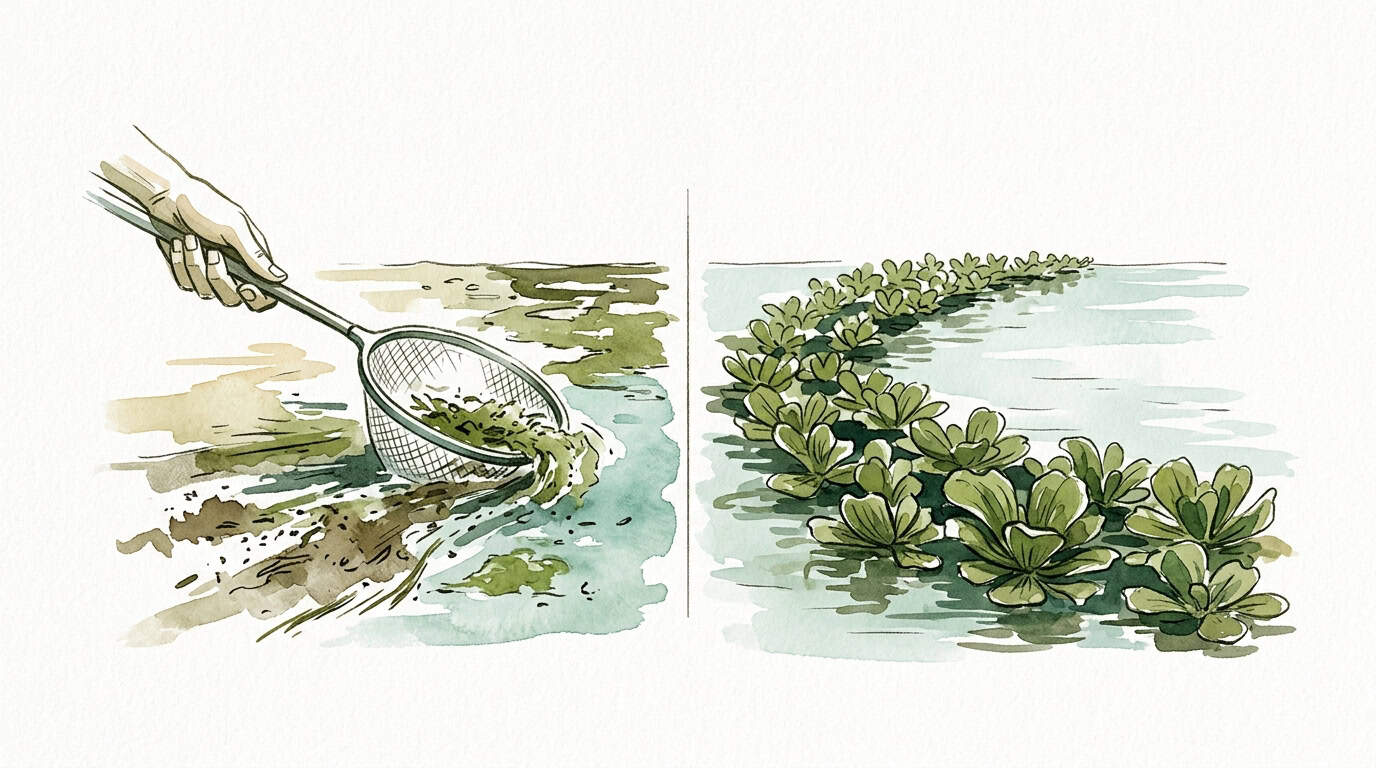
Stop fighting the wind and start using it to do your weekend chores for you. Why spend three hours skimming leaves when a well-placed stand of Pickerel Weed can do it for you? Understanding your yard’s wind patterns allows you to turn your plants into a natural filtration net.
Surface debris management is a critical factor in maintaining the oligotrophic or mesotrophic status of a closed-loop pond system. Organic matter such as deciduous leaves, pine needles, and pollen contributes significantly to the nitrogen and phosphorus loading of the water column. Traditional methods rely on mechanical skimmers or manual labor to remove these materials before they sink and enter the benthic decomposition cycle.
Implementing a vegetative wind barrier leverages the kinetic energy of the atmosphere to consolidate floating particulates. This approach treats the pond surface as a fluid transport system where the wind acts as the primary mover. Strategic placement of emergent aquatic vegetation creates a mechanical sieve that captures and holds debris in a localized zone for efficient extraction.

Using Plants To Clean Pond Surfaces
Vegetative surface cleaning is the application of botanical structures to intercept wind-driven floating matter. This technique relies on the physical presence of stems and leaves at the air-water interface to disrupt the laminar flow of surface currents. The plants act as a stationary net, taking advantage of the natural drift caused by prevailing winds.
Aquatic environments are subject to wind-driven surface drift, where the top layer of water moves at approximately 3% of the wind speed. Floating debris follows this current until it encounters an obstruction. In a standard pond, this usually means the debris accumulates along a muddy shoreline, where it becomes difficult to remove and begins to rot immediately. Using emergent plants like Pontederia cordata (Pickerel Weed) provides a structured, accessible trap that keeps debris suspended and concentrated.
Real-world applications of this method are found in wastewater treatment wetlands and high-efficiency koi ponds. In these systems, engineers design the pond’s “fetch”—the distance over which wind blows—to maximize the accumulation of solids at a specific collection point. Replacing a concrete or plastic edge with a dense stand of aquatic plants allows for a more integrated, biological solution that performs the same function as a mechanical skimmer without the associated electrical costs.
Mechanical Principles of Wind-Driven Filtration
Wind-driven debris transport is governed by the interaction between atmospheric shear stress and the water’s surface tension. When wind moves across the pond, it exerts a force that induces a shallow surface current. This current is the primary vehicle for transporting leaves, seeds, and algae to the pond’s perimeter. The efficiency of this transport is determined by the fetch length and the aerodynamic drag of the debris itself.
Surface Drift and Fetch Calculations
The velocity of the surface current (Vs) can be roughly estimated as Vs ? 0.03 * W10, where W10 is the wind speed measured 10 meters above the ground. For a small residential pond with a wind speed of 10 mph, the surface water moves at approximately 0.3 mph. While seemingly slow, this constant movement is sufficient to clear a 50-foot pond surface in less than two hours.
Fetch is the uninterrupted distance the wind travels over the water. A longer fetch allows for the development of larger surface waves and more consistent current vectors. To optimize a plant-based cleaner, the collection zone must be located at the leeward end of the longest possible fetch line. Identifying the prevailing wind direction using local meteorological data or a “wind rose” diagram is the first step in positioning the vegetative net.
Stem Density and Drag Coefficients
Emergent plants provide mechanical resistance to the surface current. The effectiveness of a plant stand in trapping debris depends on its stem density and the diameter of the individual stalks. Pickerel Weed is particularly effective because of its thick, rigid stems and the rosette growth pattern of its leaves. These structures create a high drag coefficient (Cd), which significantly reduces the velocity of the water as it passes through the stand.
Fluid dynamics studies indicate that as water enters a dense vegetation zone, the mean kinetic energy is converted into turbulent kinetic energy at the scale of the plant stems. This turbulence causes floating particles to lose momentum and become ensnared in the complex network of stalks. A stem spacing of 2.5 to 5 times the stem diameter (2.5D to 5D) is ideal for creating a trap that is permeable to water but impermeable to most common pond debris.
The Selection of Biological Filter Media
Choosing the correct plant species is as important as the placement itself. The plant must be an emergent perennial with enough structural integrity to withstand wind pressure and the weight of accumulated organic matter. It must also thrive in the specific depth of the pond’s littoral zone.
Pontederia cordata (Pickerel Weed)
Pickerel Weed is the gold standard for vegetative skimming. It typically grows to heights of 2 to 4 feet, with glossy, heart-shaped leaves that provide a broad surface area for intercepting wind-blown material. Its stems are spongy yet resilient, allowing them to bend slightly under high wind loads without snapping. The plant spreads via thick rhizomes, which eventually form a dense, uniform mat that prevents debris from leaking through the “filter” during wind shifts.
Sagittaria latifolia (Common Arrowhead)
Arrowhead is another viable option, though it offers a different structural profile. The “arrow” shaped leaves are more aerodynamic, which may reduce its effectiveness as a wind-block compared to Pickerel Weed. However, its stem density can be higher in certain soil types, making it a better secondary barrier for finer particulates like pollen or duckweed. Combining both species can create a multi-tiered filtration system that addresses different sizes of debris.

Benefits of Vegetative Surface Cleaning
Utilizing a natural system for surface cleaning offers several technical and economic advantages over mechanical alternatives. The primary benefit is the elimination of operating expenses (OPEX). Mechanical skimmers require 110V or 220V power, consistent pump maintenance, and occasional replacement of plastic baskets or nets. A vegetative barrier operates 24/7 with zero energy consumption.
Biological sequestration is a secondary benefit. While the plants act as a physical trap, they also actively absorb the nutrients (nitrogen and phosphorus) that leach out of the trapped organic matter. This helps to mitigate the risk of algae blooms that often occur when debris is allowed to rot on a bare shoreline. The root systems of these plants also provide a massive surface area for beneficial nitrifying bacteria, further improving water quality.
- Reduced Mechanical Wear: Less debris reaching the main pump intake extends the life of mechanical components.
- Erosion Control: Dense stands of Pickerel Weed buffer wave action, protecting the pond’s edge from hydraulic scouring.
- Habitat Integration: Unlike plastic skimmer boxes, vegetative traps provide nursery areas for beneficial insects and amphibians.
- Zero Power Consumption: The system relies entirely on atmospheric energy.
Challenges and Common Mistakes
Failure in vegetative skimming systems usually stems from improper siting or neglect of the plant’s growth cycle. The most common error is ignoring seasonal wind shifts. Many pond owners plant their “trap” based on summer wind patterns, only to find that the prevailing winds in autumn—when leaf drop is at its peak—come from the opposite direction. This results in the debris accumulating on the opposite, unprotected side of the pond.
Neglecting the “saturation point” is another frequent mistake. A vegetative trap is not a bottomless pit. Once the stems are clogged with a significant volume of leaves, the “net” becomes a solid wall. Subsequent debris will bounce off the edge of the plant stand and drift elsewhere. Regular removal of the trapped material is required to maintain the permeability of the filter.
Over-planting can also lead to issues. If the entire perimeter of the pond is planted with Pickerel Weed, the wind has no clear exit point for debris. This creates a situation where the debris just circles the pond without ever being consolidated. A successful system requires a clear, unplanted “fetch” area that directs the surface current into a specific, high-density collection zone.
Limitations of Plant-Based Skimming
Plant-based systems are not a universal solution. In very large ponds (greater than 2 acres), the volume of debris may overwhelm even the densest stand of vegetation. In these cases, the plants may need to be supplemented with floating booms or mechanical harvesters. Environmental factors such as extreme water level fluctuations can also kill off the littoral plants, rendering the trap useless until they regrow.
Dormancy is a significant limitation in temperate climates. Most emergent plants, including Pickerel Weed, die back to the rhizome in the winter. If your pond experiences heavy leaf fall in late November after the plants have gone dormant, the skeletal remains of the stems may not be strong enough to hold the weight of the debris. In these regions, the vegetative trap is most effective for spring and summer cleanup, such as controlling pollen and grass clippings.
Thermal stratification can also impact the system. In very deep ponds, the wind-driven surface current may only move the top few inches of water. If the debris is heavy or water-logged (such as water-soaked pine cones), it may sink below the surface current before it ever reaches the plant barrier. This method is specifically designed for buoyant, surface-floating matter.
Comparison of Surface Cleaning Methods
| Feature | Manual Skimming | Mechanical Skimmers | Vegetative Barriers |
|---|---|---|---|
| Capital Expense (CAPEX) | Very Low | High ($200 – $1,500) | Moderate (Cost of Plants) |
| Operating Expense (OPEX) | Low (Labor only) | Moderate (Electricity) | Zero |
| Efficiency | Variable | Very High | High (Wind Dependent) |
| Maintenance Frequency | Daily/Weekly | Weekly (Empty Basket) | Monthly/Seasonal |
| Biological Impact | Neutral | Neutral/Negative | Very Positive |
Practical Tips and Best Practices
Maximizing the efficiency of your vegetative skimmer requires precise planting and management. Start by monitoring your pond for two weeks during the season when debris is most problematic. Note the exact location where floating objects naturally tend to gather. This is your “target zone.” Planting anywhere else will significantly reduce the effectiveness of the system.
When planting Pickerel Weed, aim for a density of at least 3 to 5 plants per square foot. This density ensures that the stems are close enough to trap small items like pine needles but far enough apart to allow water to flow through without creating a stagnant dead-zone. Use a staggered planting pattern rather than straight rows to increase the “tortuosity” of the path the water must take, which enhances particle trapping.
- Orient for Prevailing Winds: Place the largest stand at the North/Northwest side if your local autumn winds come from that direction.
- Maintain a Clear Fetch: Keep the center of the pond free of lilies or floating plants that might interrupt the surface current before it reaches the trap.
- Harvest Regulated: When the trap is full, use a long-handled pond net to scoop out the concentrated debris. Since it is already consolidated in the plants, this takes minutes rather than hours.
- Thinning: Every 2-3 years, thin out the rhizomes to prevent the stand from becoming so thick that it pushes out into the deeper water and reduces the pond’s volume.
Advanced Considerations: Fluid Dynamics and TKE
Serious practitioners may wish to consider the Turbulent Kinetic Energy (TKE) dissipation within the plant stand. As water enters the vegetation, the drag from the stems creates “wake turbulence.” This turbulence is characterized by small eddies that help to keep debris from immediately sinking. By maintaining the correct Reynolds number (a dimensionless value that predicts flow patterns), you can ensure that the debris stays near the surface where it is easier to remove.
The Reynolds number for flow around a plant stem is calculated as Re = (V * D) / ?, where V is the current velocity, D is the stem diameter, and ? is the kinematic viscosity of the water. In a typical pond, these flows are often in the “laminar-to-turbulent transition” zone. Increasing the stem diameter (by choosing mature plants) or increasing the density can push the flow into a more turbulent regime, which actually improves the trapping efficiency for fine particulates like algae filaments.
Another advanced strategy involves the use of “deflection barriers.” If your pond’s shape is irregular, you can plant a thin line of rushes or reeds to act as a funnel, directing the wind-driven debris away from hard-to-reach coves and toward your main Pickerel Weed collection point. This topographical manipulation of the surface current allows you to clean a large, complex pond with a single, manageable trap.
Example Scenario: The 0.5-Acre Farm Pond
Consider a rectangular 0.5-acre pond with its long axis oriented East-to-West. The prevailing wind in this region is from the West at an average of 8 mph during the spring. This creates a surface current moving East at approximately 0.24 mph. Without any intervention, pollen and willow seeds would cover the entire 150-foot length of the pond.
By planting a 20-foot wide by 5-foot deep crescent of Pickerel Weed at the Eastern end, the owner creates a 100-square-foot capture zone. Over the course of a 12-hour breezy day, the surface current will carry approximately 90% of the floating surface matter into this crescent. Instead of skimming 21,780 square feet of water, the owner only needs to clear the 100-square-foot area inside the plant stand.
Using a standard pond net, the owner can remove several pounds of organic matter in a single session. This removal prevents that organic load from sinking. If left alone, those several pounds of organic matter would decompose, releasing enough phosphorus to potentially trigger an algae bloom across the entire pond. The system works with the local environment rather than against it, utilizing free atmospheric energy to maintain water clarity.
Final Thoughts
Implementing a vegetative surface cleaning system represents a shift from mechanical intervention to ecological management. By treating aquatic plants as functional components of the pond’s infrastructure, you can achieve higher levels of water quality with lower long-term costs. Pickerel Weed and other emergent species offer a robust, self-replicating solution to the constant problem of surface debris.
Efficiency in these systems is not a product of luck but of careful observation and technical application. Success depends on the accurate calculation of wind vectors, the strategic spacing of botanical structures, and a consistent harvest schedule. For the pond owner willing to study their local micro-climate, the rewards are a cleaner pond and significantly more free time on the weekends.
Experimenting with different species and densities will allow you to fine-tune the trap for your specific environment. Whether you are managing a small koi pond or a large recreational water body, the principles of wind-driven transport remain the same. Start by observing where the wind naturally deposits the most leaves, and let nature provide the tools to clean it up.
Amazon and the Amazon logo are trademarks of Amazon.com, Inc, or its affiliates.