

Pond Talk is an Amazon Associate. As an Amazon Associate we earn from qualifying purchases.
Your margin plants should be doing more than just looking pretty. Don’t spend your autumn with a skimmer net in hand. Strategically planting tall, dense marginals like Sweet Flag or Bulrush creates a natural shelter that catches wind-blown debris before it ever hits the water. It is the difference between an exposed, vulnerable pond and a sheltered, self-protecting ecosystem.
Effective pond management requires a shift from reactive mechanical cleaning to proactive biological engineering. Pond owners often view marginal plants as purely aesthetic additions, yet these species function as high-efficiency mechanical filters and aerodynamic barriers. Designing a perimeter with specific height-to-density ratios allows for the interception of organic matter before it undergoes the leaching process in the water column. This transition from an open water surface to a managed littoral zone represents a fundamental upgrade in system stability.
Protecting Ponds From Fall Leaves
Protecting ponds from fall leaves is a specialized application of “shelterbelt” or “windbreak” technology adapted for aquatic environments. It involves the use of emergent vegetation—specifically plants that remain upright throughout the autumn—to serve as a physical interceptor for deciduous debris. In a standard pond environment, wind carries leaves across the terrestrial landscape until they reach the water surface. Once the debris makes contact with the water, surface tension and eventual saturation cause it to sink, where it contributes to the sludge layer.

Biological leaf protection is used in both residential water features and large-scale stormwater management systems to reduce the overall organic load. In real-world applications, this method serves as the first line of defense in a multi-stage filtration strategy. An analogy for this system is the “snow fence” used in civil engineering; rather than attempting to shovel snow once it covers a road, engineers place fences to drop the snow in a designated “dead zone” where it cannot cause harm. Similarly, tall marginal plants create a low-velocity zone where leaves drop onto the damp soil or among the plant stalks rather than into the deep water.
This method matters because it addresses the primary cause of seasonal water quality crashes. When leaves enter a pond, they immediately begin to leach tannins and dissolved organic carbon. Over the following weeks, microbial decomposition consumes dissolved oxygen at an accelerated rate, potentially leading to anaerobic conditions that are lethal to fish and beneficial bacteria.
How It Works: Aerodynamics and Surface Tension
The mechanics of biological debris capture rely on two primary principles: wind velocity reduction and physical entanglement. When wind encounters a stand of tall, stiff plants like Sweet Flag (*Acorus calamus*), the air is forced to move through or over the barrier. This creates a “lee side” effect where the wind speed drops significantly immediately behind the plants. Research into agricultural windbreaks suggests that the effective distance of wind reduction on the protected side can range between 10 to 30 times the height of the barrier.
Physical entanglement occurs when the structural architecture of the plant—its leaves, stalks, and seed heads—acts as a mechanical sieve. Dense stands of Bulrush (*Typha* or *Scirpus*) present a high surface area that catches leaves mid-flight. Because these plants are located at the water’s edge, they stop the debris at the perimeter. The leaves become trapped in the “dry” or “damp” zone of the margin, preventing them from ever entering the main water body.
Hydrodynamic factors also play a role. Wind-induced surface currents often push floating debris toward the edges. In a pond with an exposed surface, these leaves would eventually saturate and sink into the center. In a pond with sheltered margins, the dense vegetation prevents the wind from pushing the debris across the entire surface. The plants act as a “soft” perimeter that holds the leaves in a shallow area where they can be more easily removed or where they decompose without depleting the oxygen of the deep-water zone.
Benefits of Biological Debris Management
Utilizing marginal plants for leaf management provides measurable improvements to the pond’s chemical and mechanical health. The most significant benefit is the reduction in Biochemical Oxygen Demand (BOD). Microorganisms require oxygen to break down leaf litter; specifically, for every pound of organic matter digested, a substantial portion of the water’s dissolved oxygen is consumed. Keeping leaves out of the water maintains higher oxygen levels throughout the winter months.
Nutrient cycling is also improved. Marginal plants are efficient at absorbing nitrogen and phosphorus directly from the water and soil. When leaves are trapped in the margin and allowed to decompose on the damp soil, the nutrients they release are often taken up by the roots of the marginal plants themselves in the following spring. This creates a closed-loop system where the “waste” of the autumn becomes the “fertilizer” of the next growing season.
Mechanical efficiency is a secondary but vital advantage. Mechanical skimmers and pond vacuums have finite capacities and operational costs. Biological barriers work 24 hours a day without electrical input or mechanical failure. They also provide bank stabilization; the rhizomatous root systems of plants like Sweet Flag weave through the soil, preventing the erosion that often occurs when wind-driven waves hit an unprotected bank.
Challenges and Common Mistakes
Implementation of a biological leaf barrier is not without technical hurdles. The most common mistake is selecting plants that collapse or go dormant too early in the season. Some marginal species, like Pickerelweed, may melt away at the first frost, leaving the pond surface completely exposed just as the heaviest leaf fall begins. Selecting “stiff-necked” species that maintain their structural integrity through early winter is essential for mechanical success.
Overgrowth presents another challenge. Bulrushes and Cattails are highly aggressive and can rapidly colonize the entire pond surface if not contained. Without proper depth management or root barriers, a protective margin can quickly turn into an invasive monoculture that reduces open water area. This requires the pond manager to maintain a clear boundary between the littoral zone and the deep-water zone.
Inadequate planting density is a frequent cause of system failure. If plants are spaced too far apart, wind and debris will simply pass through the gaps. A biological windbreak requires a minimum density to effectively “trip” the wind and drop the debris. Gaps in the perimeter act as funnels, actually increasing wind velocity at those points and pushing debris deeper into the pond than if no plants were present at all.

Limitations of the Method
Biological barriers have specific environmental boundaries. In regions with extreme wind speeds or during hurricane-force events, the aerodynamic resistance of marginal plants can be overwhelmed. In these cases, leaves will be carried over the tops of the plants and deposited in the center of the pond regardless of the barrier’s height.
Scale and fetch (the distance wind travels over open water) also limit effectiveness. Large ponds with a long fetch generate significant internal wave action. While marginal plants can trap incoming leaves, they cannot prevent debris from falling directly into the center of a massive water body. This method is most effective for ponds where the majority of the leaf load is carried in from the surrounding terrestrial landscape rather than falling from directly overhanging trees.
Species selection is limited by water depth. Most effective “barrier” plants require a specific depth (usually 0 to 6 inches) to thrive. If the pond bank is too steep, there may not be enough shelf space to establish a wide enough buffer. A buffer narrower than three feet is generally insufficient to provide significant mechanical filtration for wind-blown debris.
Exposed Surface vs. Sheltered Margins
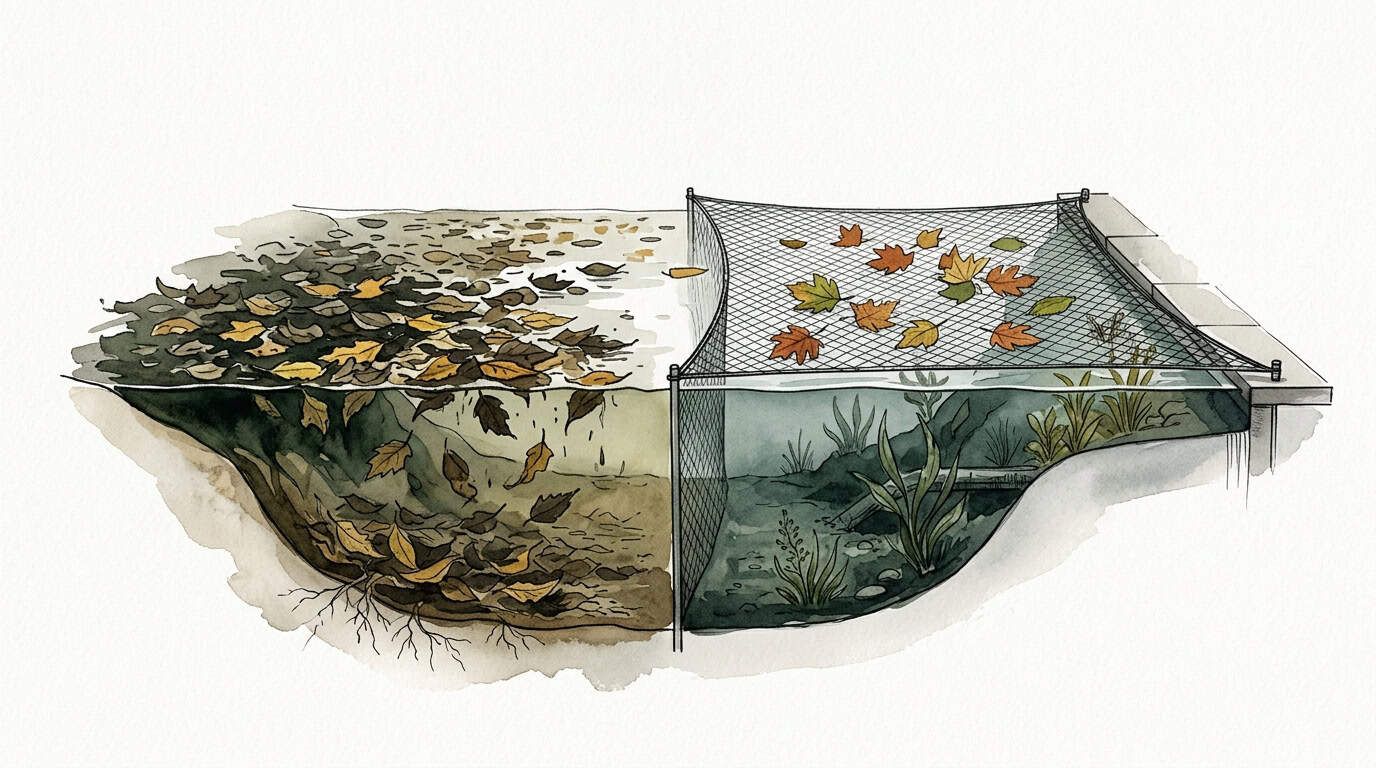
Comparing an exposed surface pond to one with sheltered margins highlights the differences in maintenance requirements and ecological stability.
| Factor | Exposed Surface | Sheltered Margins |
|---|---|---|
| Leaf Load Path | Direct entry to water column. | Interception at the perimeter. |
| Decomposition Site | Bottom sludge (Anaerobic). | Littoral damp zone (Aerobic). |
| Wind Velocity | Unimpeded; causes rapid mixing. | Reduced; maintains stratification. |
| BOD Impact | High oxygen consumption. | Minimal oxygen impact. |
| Maintenance Mode | Reactive (Skimming/Vacuuming). | Proactive (Pruning/Perimeter cleanup). |
The complexity of an exposed system lies in the management of the resulting sludge, whereas the complexity of a sheltered system lies in the initial design and species selection. While a sheltered margin requires more upfront planning, it significantly reduces the long-term operational cost of pond ownership.
Practical Tips and Best Practices
Successful deployment of a biological leaf barrier requires attention to planting metrics. Aim for a planting density of 3 to 5 plants per linear foot along the windward side of the pond. This creates the “wall” effect necessary for wind speed reduction. On the leeward side, density can be lower, as the primary goal is to prevent internal debris from being blown out or trapped in difficult-to-reach areas.
Orient the tallest plants toward the direction of the prevailing autumn winds. In many temperate regions, this is the Northwest. By placing Sweet Flag or Bulrush in a 5-foot-wide band on this side, you maximize the “shadow” of protected water. Ensure the plants chosen have a mature height that is at least twice the height of the anticipated debris trajectory; for example, if leaves are blowing in from a nearby 4-foot slope, your plants should ideally reach 3 to 4 feet in height to intercept them.
Maintain the “damp zone” by keeping the water level consistent. If the water level drops too low, the marginal plants may go into drought stress and lose their stiff upright structure. Conversely, if the water is too deep, some species may become “leggy” and lack the density needed for filtration. Periodically thin out dead stalks in the spring, but leave them standing throughout the winter to provide the necessary mechanical barrier during the off-season.
Advanced Considerations: Nitrogen and Phosphorus Loading
Serious practitioners should consider the nutrient loading capacity of their marginal zones. Leaf litter is a significant source of phosphorus. When a single large oak tree drops its leaves into a pond, it can introduce enough phosphorus to trigger massive algal blooms in the following spring. By trapping these leaves in a marginal zone populated by “nutrient sponges” like Bulrush, you effectively sequester those nutrients before they become bioavailable to algae.
Data suggests that some marginal species can remove up to 60-80% of suspended solids from the water passing through them. This mechanical filtration is enhanced by the biofilm that grows on the submerged portions of the plant stalks. This biofilm consists of beneficial bacteria and periphyton that process dissolved nutrients in real-time. Designing a margin with high “stem density” increases the surface area for these biofilms, further purifying the water that circulates through the barrier.
Calculating the “Nitrogen Uptake Rate” of your specific plant choices can help you determine the size of the buffer needed. For instance, a pond receiving high runoff from a fertilized lawn will require a wider, more robust margin than a pond in a naturalized meadow. A margin that is too small for the nutrient load will eventually become saturated, leading to plant die-off or localized algae growth within the buffer itself.
Example: Managing a 1,500-Gallon System
Consider a 1,500-gallon pond located near a deciduous treeline. Without protection, this pond might collect 50 pounds of wet leaf litter over a single season. This organic load could require a mechanical skimmer to run 24/7, with daily cleanouts of the basket. If the skimmer fails, those 50 pounds of leaves sink, potentially consuming 100 pounds of oxygen during decomposition—far more than the 1,500 gallons of water can hold at saturation.
Implementing a 4-foot-wide buffer of Sweet Flag along the 15-foot windward edge changes the dynamic. The plants, standing 3 feet tall, reduce the wind speed across the pond surface by approximately 40%. Instead of 50 pounds of leaves entering the water, 40 pounds are trapped in the marginal foliage. Only 10 pounds reach the water, which the mechanical skimmer can easily handle. The owner then performs a single perimeter cleanup in late November, removing the trapped leaves from the dry stalks in a fraction of the time required for daily skimming.
Final Thoughts
Biological filtration through marginal planting is a mechanical solution disguised as a landscape feature. Transitioning from an exposed surface to a sheltered margin reduces the organic load on the pond’s ecosystem, preserves dissolved oxygen levels, and stabilizes water chemistry. High-performance species like Sweet Flag and Bulrush provide the structural integrity needed to withstand autumn winds while functioning as long-term nutrient sinks.
Integrating these plants requires a move away from the “manicured lawn” aesthetic in favor of a functional littoral shelf. While the initial establishment of these zones requires careful species selection and density planning, the reduction in seasonal maintenance is substantial. A well-engineered pond margin does the heavy lifting of debris management, allowing the pond’s internal filtration systems to focus on maintaining water clarity and biological balance.
Experimenting with different species and densities will allow you to fine-tune the system to your specific microclimate. As the marginal zone matures, it becomes more than a barrier; it evolves into a self-sustaining part of the pond’s immunity against environmental stress. Focus on structural integrity and nutrient uptake, and the results will manifest in a clearer, healthier pond year-round.
Amazon and the Amazon logo are trademarks of Amazon.com, Inc, or its affiliates.