

Pond Talk is an Amazon Associate. As an Amazon Associate we earn from qualifying purchases.
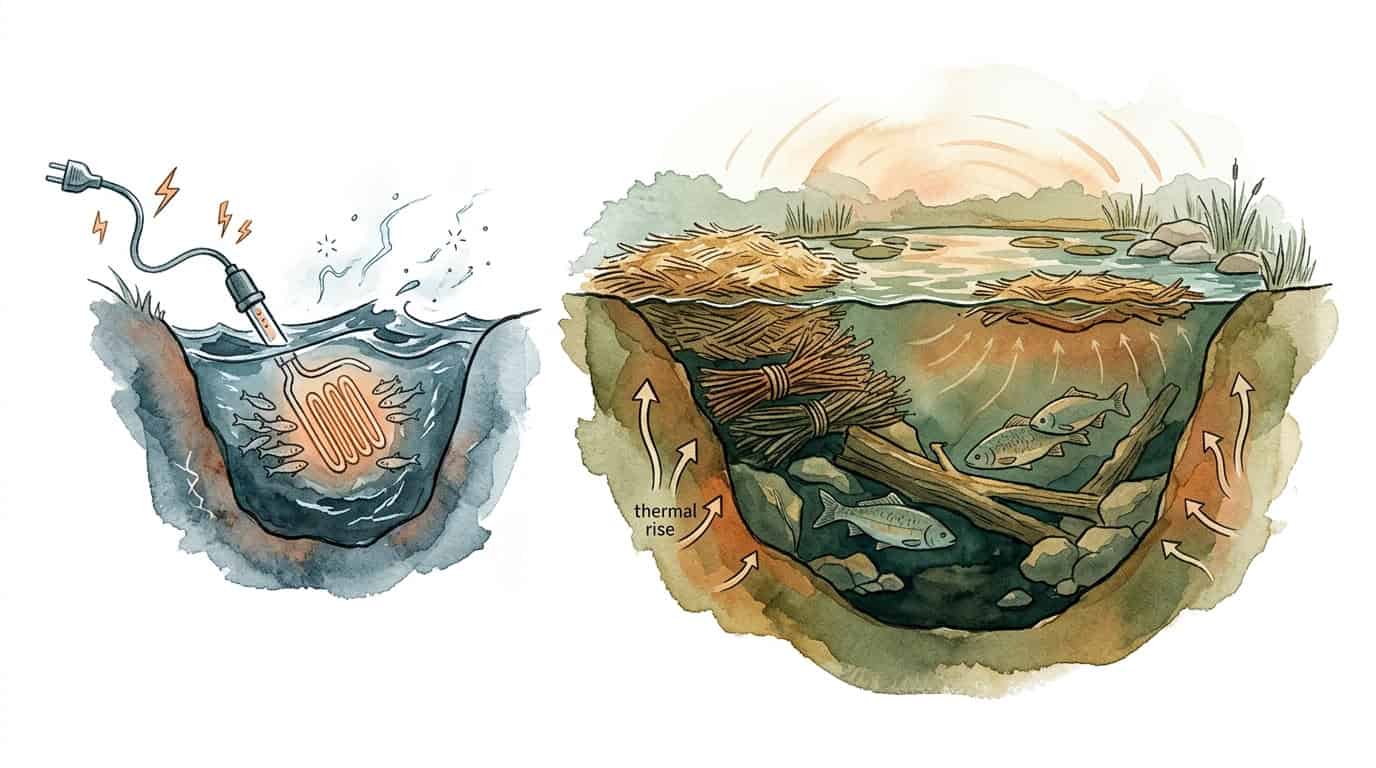
Will your fish survive the winter if the power goes out? Relying on a floating heater makes your pond’s life fragile and dependent on the grid. Designing a deep ‘thermal refuge’ into the pond floor uses the earth’s natural insulation to keep your fish safe, even in a total blackout.
Overwintering Fish Without Electricity
Overwintering fish without electricity is a passive management strategy that utilizes the thermodynamic properties of water and the geothermal mass of the earth. This method eliminates the need for mechanical heating elements, which are prone to electrical failure, high operational costs, and localized heat stress. In natural ecosystems, such as temperate lakes and deep ponds, aquatic life survives the winter because water exhibits a unique density anomaly. Liquid water reaches its maximum density at approximately 3.98 degrees Celsius (39.2 degrees Fahrenheit). Because this dense water sinks to the bottom, it forms a stable layer of liquid that is insulated from the freezing air temperatures by the water above it and the eventual ice sheet on the surface.
In a backyard or commercial pond setting, this concept is replicated by excavating a portion of the pond to a depth that extends below the local frost line. This deep zone acts as a thermal battery, drawing heat from the surrounding soil which maintains a relatively constant temperature between 10 and 13 degrees Celsius (50 to 55 degrees Fahrenheit) year-round. While the surface may freeze solid, the fish reside in the “thermal refuge” at the bottom. This approach is widely used in permaculture pond design, koi keeping in northern latitudes, and sustainable aquaculture where grid independence is a priority.

The Physics of Thermal Stratification
Understanding the success of an unheated pond requires a technical look at how water behaves as it cools. Most substances contract and become denser as they lose thermal energy. Water follows this rule until it reaches 3.98 degrees Celsius. At this specific temperature, the hydrogen bonds between molecules begin to form a more open, hexagonal lattice. As the water cools further toward 0 degrees Celsius, it expands and becomes less dense. Consequently, 4-degree water is the heaviest water in the system.
In a pond deeper than 36 to 48 inches, a process called “reverse stratification” occurs during winter. The coldest water (0 to 1 degree Celsius) stays at the surface because it is lighter than the water below it. Eventually, this surface layer transitions into ice, which has a density of approximately 917 kg/m³, significantly lower than liquid water’s 1,000 kg/m³. The ice layer then serves as a secondary insulator, reducing the rate of heat loss from the water column to the atmosphere. The bottom layer, the “hypolimnion” of the small pond, remains at or near 3.98 degrees Celsius. Fish such as koi and goldfish are poikilothermic, meaning their internal temperature tracks the environment. At 4 degrees Celsius, their metabolic rate drops to a state of torpor, requiring minimal caloric intake and significantly reduced oxygen levels.
Designing the Thermal Refuge: Depth and Geometry
Proper pond geometry is the primary factor in ensuring survival without an electric heater. A shallow pond with a uniform depth will lose heat too rapidly because the surface-area-to-volume ratio is too high. Designing a successful thermal refuge involves creating a “well” or a deep basin that represents at least 25% to 35% of the total pond floor area.
Depth requirements vary by USDA Hardiness Zone. In Zone 6 or 7, a minimum depth of 3 feet is often sufficient. In Zones 4 and 5, where frost lines can reach 30 to 48 inches, the thermal refuge should be excavated to a depth of 5 to 6 feet. This depth ensures that the bottom water is far enough removed from the ice-water interface to prevent convective mixing from cooling the entire column. The transition from the shallow planting shelves to the deep refuge should be steep but stable, typically at a 45-degree angle, to minimize the total volume of water that needs to be maintained at the 4-degree threshold.
Geothermal Heat Transfer and Soil Conductivity
The earth itself is the primary heat source for a passive overwintering system. Soil has a high thermal mass and serves as a massive heat reservoir. Heat transfer between the soil and the pond occurs via conduction through the pond liner. The thermal conductivity ($k$) of soil typically ranges from 0.36 W/m·K in dry conditions to 1.59 W/m·K in saturated conditions.
Because the ground below the frost line remains at a constant temperature (roughly 50 degrees Fahrenheit in many temperate regions), there is a constant heat flux moving from the soil into the pond water. If the pond is deep enough, this geothermal energy compensates for the heat being lost through the ice at the surface. Utilizing a high-quality EPDM liner facilitates this transfer, whereas installing thick foam insulation between the liner and the earth can actually be counterproductive in a winter context, as it would isolate the pond from its geothermal heat source.
Gas Exchange and Dissolved Oxygen Dynamics
Oxygen depletion, rather than cold temperature, is the most common cause of fish mortality in unheated ponds. While cold water has a higher saturation point for dissolved oxygen (DO) than warm water, the presence of an ice sheet prevents atmospheric gas exchange. Fish in a state of torpor require a minimum DO level of approximately 2.0 mg/L.
Simultaneously, organic matter at the bottom of the pond (leaves, fish waste, and dead algae) continues to decompose through the actions of psychrophilic (cold-loving) bacteria. This decomposition consumes oxygen and releases toxic gases such as carbon dioxide (CO2), methane (CH4), and hydrogen sulfide (H2S). If these gases are trapped under the ice, they can reach lethal concentrations. A passive system must incorporate a method for “gas release.” This is achieved not by heating the water, but by maintaining a small opening in the ice. A low-wattage aeration stone placed only 12 inches below the surface can create enough localized turbulence to prevent a small area from freezing without disturbing the thermal layers at the bottom.
Benefits of Passive Thermal Management
Choosing a deep-refuge design over an electric heater provides several quantifiable advantages. Electrical resilience is the most significant benefit. Mechanical de-icers and heaters consume between 100 and 1,500 watts of power continuously. A power outage during a blizzard will cause these units to fail exactly when they are most needed. A deep pond is immune to such failures.
Maintenance requirements are also significantly lower. Electric heaters are prone to mineral buildup on the heating elements and internal thermostat failures. Passive systems involve no moving parts or electrical components within the water. Furthermore, the 4-degree stable environment at the pond bottom is more natural for the fish. Localized heating from a floating unit can sometimes create temperature gradients that encourage fish to move into shallower, colder water, leading to “winter kill” if they become trapped by rapidly forming ice.
Common Mistakes in Pond Winterization
Mechanical destratification is a frequent error made by pond owners. Using a high-volume pump or placing an aeration diffuser at the very bottom of the pond will “churn” the water. This forces the 4-degree water from the bottom up to the freezing surface and pulls 0-degree water down to the bottom. In a matter of hours, this can drop the temperature of the entire water column to 1 or 2 degrees Celsius, which is below the survival threshold for many ornamental fish species.

Accumulated organic load is another critical failure point. Entering winter with several inches of “muck” or leaf litter on the pond floor increases the Biological Oxygen Demand (BOD). As the bacteria work to break down this material under the ice, they strip the water of oxygen faster than the small gas-release hole can replenish it. Proper autumn maintenance, including netting the pond and using a pond vacuum, is essential for a passive system to function correctly.
Limitations of the Thermal Refuge Method
Passive overwintering is not a universal solution. In extremely shallow ponds (less than 24 inches deep), there is insufficient volume to maintain a stable thermal gradient. In these cases, the entire pond may reach 0 degrees Celsius, leading to “solid freeze” conditions that kill all aquatic life.
Environmental factors like “ice-on” duration also play a role. In regions where the pond remains frozen for more than 4 months without a thaw, the risk of oxygen depletion remains high regardless of depth. Additionally, certain sensitive or “fancy” varieties of goldfish, such as Orandas or Ranchus, lack the physiological robustness to survive even 4-degree water for extended periods. These species generally require indoor overwintering or active heating to 10 degrees Celsius or higher.
Comparison: Electric Heaters vs. Passive Thermal Refuges
| Metric | Electric Floating Heater | Passive Thermal Refuge |
|---|---|---|
| Energy Consumption | 100W – 1500W (Continuous) | 0W |
| Failure Risk | High (Grid failure, element burnout) | None (Physical geometry only) |
| Operational Cost | $15 – $60 per month (Avg) | $0 |
| Stability | Localized warmth only | Uniform 4°C bottom layer |
| Installation Effort | Low (Plug and play) | High (Initial excavation required) |
Practical Tips for Passive Overwintering
Ensuring success requires monitoring specific metrics throughout the season. Purchasing a wireless pond thermometer with a probe designed for deep-water use allows for the tracking of the bottom temperature without disturbing the ice. If the temperature at the floor of the refuge drops below 3.5 degrees Celsius, it indicates that the pond is losing heat faster than the geothermal flux can replace it.
Utilizing a windbreak can significantly reduce heat loss. High-velocity winds across the surface of the ice or water increase the rate of evaporative cooling and convective heat transfer. Placing decorative boulders, evergreen shrubs, or even a temporary fence on the windward side of the pond can preserve the internal thermal energy. Furthermore, if snow accumulates on the ice, it should be partially cleared. While snow acts as an insulator, it also blocks sunlight, preventing any remaining submerged plants or algae from photosynthesizing and producing supplemental oxygen.
Advanced Considerations: Metabolic Depression and SMR
Serious practitioners should understand the Standard Metabolic Rate (SMR) of their fish. Research indicates that freshwater fish can reduce their metabolic oxygen demand by nearly 50% when the temperature drops from 15 degrees Celsius to 5 degrees Celsius. This state of torpor is not a “sleep” but a biological “power-save” mode.
Heart rates slow to a few beats per minute, and the fish rely on stored glycogen in the liver for basic cellular maintenance. Because the fish are not moving, the “Bohr effect”—the shift in the oxygen-hemoglobin dissociation curve—allows their blood to bind oxygen more efficiently in cold conditions. Avoiding any activity that startles the fish is paramount. Sudden movements or loud noises can trigger a “flight response,” causing a spike in metabolic activity that the fish’s depleted energy stores and the low-oxygen environment cannot support.
Example Scenario: Zone 5 Pond Case Study
Consider a 2,000-gallon pond in Zone 5 (Illinois/Indiana) where the frost line is 36 inches. A pond designed with a uniform depth of 24 inches will likely reach a temperature of 1 degree Celsius throughout the water column by mid-January. The fish in this scenario face a high probability of death due to “ice-crystal” formation in their tissues or metabolic collapse.
In contrast, the same 2,000-gallon pond designed with a 1,000-gallon “deep well” measuring 60 inches deep provides a different outcome. Monitoring data from such a setup shows that while the top 12 inches freeze solid, the bottom 24 inches of the “well” remain at a consistent 3.9 to 4.1 degrees Celsius. The thermal mass of the surrounding soil, which is insulated by the frozen upper crust of the earth, prevents the deep water from cooling further. In this environment, 10-year-old koi have been documented to survive 90-day periods of continuous ice cover with zero mortality.
Final Thoughts
Designing a pond with a thermal refuge is an investment in long-term resilience and biological stability. By leveraging the physical laws of water density and the geothermal capacity of the earth, you create a system that protects aquatic life independently of the electrical grid. This method shifts the focus from “active heating” to “passive preservation,” aligning the pond’s environment with the natural cycles of temperate water bodies.
Implementing this strategy requires careful planning during the construction phase, specifically regarding depth and bottom surface area. However, the result is a low-maintenance, high-reliability ecosystem that saves money and provides peace of mind during the harshest winter months. Success in passive overwintering ultimately depends on the balance between geothermal heat gain, minimized organic decay, and the maintenance of a simple vent for gas release. Applying these technical principles ensures that your fish remain safe in their dormant state, ready to emerge as the water warms in the spring.
Amazon and the Amazon logo are trademarks of Amazon.com, Inc, or its affiliates.