

Pond Talk is an Amazon Associate. As an Amazon Associate we earn from qualifying purchases.
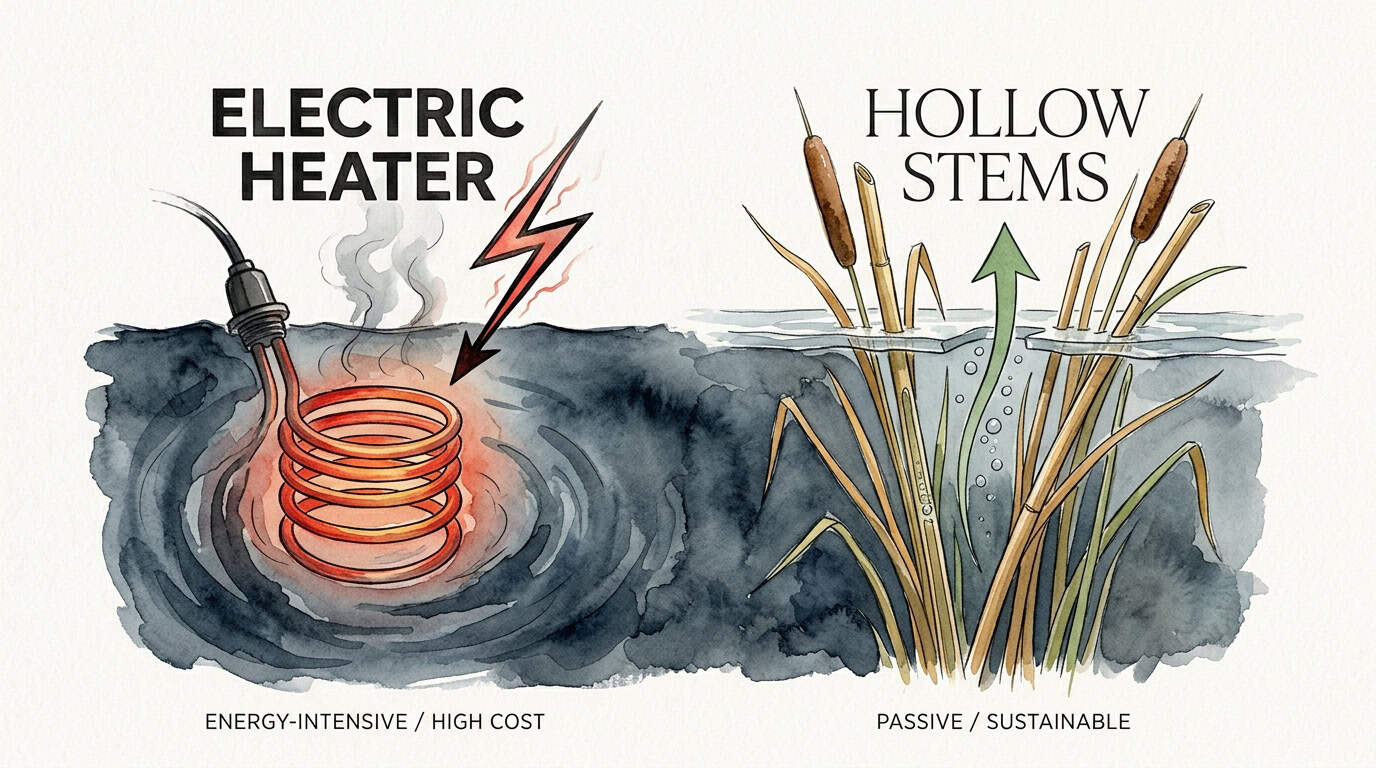
Are you paying for electricity to keep your fish breathing, or is your garden doing it for free? While most pond owners are running up their electric bills with floating heaters, smart gardeners are using the ‘hollow stem’ secret. Discover how native plants act as natural snorkels for your hibernating fish, providing gas exchange even when the surface is frozen solid.
Maintaining a healthy aquatic environment during the winter months requires a fundamental understanding of gas exchange dynamics. In a closed system, such as a frozen pond, the primary threat to aquatic life is not the cold itself, but the accumulation of toxic gases and the depletion of dissolved oxygen (DO). Standard mechanical interventions involve high-wattage de-icers or aerators. However, a biological alternative exists through the strategic use of emergent macrophytes.
This method leverages the evolutionary adaptations of specific wetland plants to facilitate a passive, zero-energy gas conduit between the atmosphere and the water column. Utilizing these botanical structures allows for a more efficient and resilient winterization strategy that aligns with the natural biogeochemical cycles of the pond ecosystem.

Natural Winter Pond Aeration Methods
Natural winter pond aeration refers to the process of using biological or physical non-mechanical means to maintain the exchange of oxygen (O2) and carbon dioxide (CO2) across the air-water interface during periods of ice cover. The primary mechanism in this approach is the utilization of emergent vegetation, specifically plants with specialized internal tissues designed for gas transport.
In the wild, wetlands do not freeze into anaerobic death traps because the presence of rushes, reeds, and sedges provides a persistent “ventilation” system. These plants possess aerenchyma, a spongy tissue featuring large, longitudinal air-filled spaces. These channels, known as lacunae, extend from the above-water stems down into the roots and rhizomes. Even when the plant enters senescence (winter dormancy), the structural integrity of these hollow or porous stems remains, acting as a direct physical bridge through the ice layer.
This method is used primarily in naturalized ponds, koi ponds with moderate stocking densities, and water gardens designed for low-maintenance sustainability. It serves as a secondary or even primary life-support system by ensuring that the “boundary layer” of ice is bypassed by a physical gas-permeable conduit.
Mechanics of Aerenchyma and Passive Gas Diffusion
The technical core of natural aeration lies in the cellular structure of emergent plants. Most terrestrial plants would suffocate in waterlogged soil; however, wetland species have developed aerenchyma to survive anoxic conditions. This tissue is formed through either schizogeny (the separation of cells) or lysogeny (the programmed death of cells), resulting in a network of air pipes.
During the winter, the physical structure of these pipes facilitates gas exchange via two primary physical principles. The first is simple molecular diffusion, where gases move from areas of high concentration to low concentration. As fish and bacteria consume oxygen in the water, the O2 levels drop, creating a concentration gradient that pulls atmospheric oxygen down through the hollow stems. Conversely, the buildup of CO2, methane (CH4), and hydrogen sulfide (H2S) in the water creates a gradient that pushes these toxic gases up through the stems and out to the atmosphere.
The second principle is “thermal venting” or pressure-driven mass flow. Temperature differentials between the warmer water at the pond bottom (typically 4°C or 39.2°F due to the density of water) and the colder atmospheric air can create slight pressure changes within the stem lacunae. This pressure gradient can accelerate the movement of gases beyond the rates of simple diffusion, effectively “pumping” fresh air into the rhizosphere and water column.
Benefits of Botanical Aeration Systems
Implementing a biological gas exchange system offers several measurable advantages over mechanical alternatives. The most immediate benefit is the total elimination of energy consumption for the purpose of gas exchange. A standard 1250-watt floating heater can consume over 900 kWh per month if running continuously, leading to significant seasonal costs. Botanical systems operate at zero cost once established.
Mechanical reliability is another critical factor. Electric heaters are prone to element failure, limescale buildup, and power outages. If a heater fails during a deep freeze, the pond can seal in hours. Hollow stems, being distributed across the pond’s perimeter or shallow zones, provide a redundant system with no moving parts. The failure of a single stem does not compromise the entire system, as multiple points of contact with the atmosphere exist.
Furthermore, these plants contribute to the overall nutrient cycle. During the growing season, they sequester nitrogen and phosphorus, which reduces the biological load that would otherwise contribute to oxygen-depleting decomposition during the winter. By the time winter arrives, the plant has served its role as a filter and transitions into its role as a ventilator.
Challenges and Common Structural Pitfalls
The primary challenge in relying on plants for winter aeration is maintaining the structural integrity of the stems. If the stems are crushed by heavy snow or snapped off below the water line, the “snorkel” effect is neutralized. Ice expansion can sometimes pinch or collapse the internal lacunae of softer-stemmed species, reducing the effective cross-sectional area for gas diffusion.
A common mistake is the “clean-up” reflex. Many pond owners cut their aquatic plants back to the crown in late autumn to prevent dead material from falling into the pond. Cutting the stems below the expected ice level effectively “plugs” the snorkel. This removal of the gas conduit forces the pond to rely solely on the surface area for gas exchange, which becomes zero once the ice seals.

Accumulated snow cover presents an additional mechanical challenge. While the stems may provide a vent, a thick blanket of heavy, wet snow can flatten the vegetation against the ice. This not only cuts off the air supply but also blocks light from reaching any submerged evergreen plants, such as Ceratophyllum demersum (Hornwort), which might otherwise provide supplemental oxygen through photosynthesis.
Limitations of Biological Gas Exchange
Biological aeration is not a universal solution for all pond configurations. The effectiveness of hollow stems is limited by the ratio of fish biomass to the available gas-exchange surface area provided by the plants. In a highly overstocked koi pond, the metabolic demand for oxygen may exceed the diffusion rate capable of being supported by a few dozen stems.
Environmental constraints also play a significant role. In regions where temperatures remain consistently below -20°C (-4°F) for extended periods, the ice thickness may exceed the “active zone” of the plant’s structural strength. Furthermore, very deep ponds (greater than 6-8 feet) may experience stratification where the oxygen introduced via the stems near the surface does not reach the lower depths where fish hibernate.
Lastly, the decomposition of the plants themselves can be a double-edged sword. If too much organic matter is left to rot in the water, the biological oxygen demand (BOD) created by the decomposing tissue can consume more oxygen than the stems can provide. This necessitates a balanced approach to biomass management.
Comparison: Electric Heaters vs. Hollow Stems
When evaluating winterization strategies, it is helpful to compare mechanical and biological methods across specific metrics.
| Metric | Electric Heater (De-icer) | Hollow Stem (Botanical) |
|---|---|---|
| Initial Cost | $50 – $200 | $5 – $15 per plant |
| Monthly Operating Cost | $20 – $120+ | $0.00 |
| Failure Risk | High (Electrical/Mechanical) | Low (Physical collapse) |
| Maintenance | Cleaning/Testing | Autumn trimming height |
| Ecosystem Value | None | High (Habitat/Filtration) |
Practical Tips for Maximizing Winter Gas Exchange
To optimize the use of plants as winter snorkels, specific maintenance protocols should be followed. The most critical step is the “high cut” method. Instead of removing the entire stem in autumn, trim emergent plants to a height of 10 to 12 inches above the water line. This ensures the stems remain visible and clear of the ice surface even if the water level fluctuates or ice thickness increases.
Species selection is equally vital. Focus on plants known for robust aerenchyma and winter structural persistence. Acorus calamus (Sweet Flag), Typha species (Cattails), and Juncus effusus (Soft Rush) are superior performers. These species have dense internal structures that resist crushing. Avoid “soft” aquatic plants like Canna or Pontederia cordata (Pickerel Weed), as their stems often collapse into a mushy state shortly after the first hard frost.
Encourage the growth of these plants in “planting shelves” around the perimeter. Positioning them in 6 to 12 inches of water allows the stems to emerge through the ice at the edges, which is where gas exchange is most effective. Clearing snow from the areas around these stems after a heavy storm will further improve the diffusion rate and protect the stems from being flattened.
Advanced Considerations: Henry’s Law and Gas Solubility
For those seeking to optimize their system to a professional level, it is necessary to consider the physics of gas solubility in cold water. According to Henry’s Law, the amount of dissolved gas in a liquid is proportional to its partial pressure above the liquid. In winter, water at 4°C can hold significantly more dissolved oxygen than water at 25°C. For example, 100% saturation at 4°C is roughly 13 mg/L, whereas it is only about 8 mg/L at 25°C.
However, the metabolic rate of fish, governed by the Q10 rule, also drops. A koi’s metabolic rate decreases by approximately half for every 10°C drop in temperature. This means that while the fish need less oxygen in winter, the potential for the water to hold oxygen is higher. The limitation is strictly the “seal” of the ice.
The role of the “rhizosphere” (the area around the roots) is also an advanced consideration. Some of the oxygen transported down the stems actually leaks out of the roots into the surrounding soil/muck. This is known as Radial Oxygen Loss (ROL). This oxygenation of the substrate supports aerobic bacteria that would otherwise go dormant, allowing them to continue breaking down organic waste even in the winter, which reduces the buildup of toxic methane and hydrogen sulfide at the pond bottom.
Scenario: A 1,500-Gallon Pond Case Study
Consider a 1,500-gallon pond in a Zone 5 climate with a depth of 3 feet. This pond contains ten 10-inch koi. During a typical January freeze, the surface seals with 4 inches of ice. Without intervention, the oxygen levels would begin to decline within 72 hours as the fish and bacteria consume the existing DO.
If this pond has a perimeter shelf planted with Juncus effusus (Soft Rush) at a density of 5 plants per linear foot, and the stems were trimmed to 12 inches above the water in November, the result is a massive array of natural vents. Each stem of Juncus contains hundreds of micro-canals.
In this scenario, the total cross-sectional area of the thousands of rush stems provides enough gas permeability to maintain DO levels above 5 mg/L, which is more than sufficient for koi in a state of torpor (hibernation). The pond owner observes no “gasping” fish at the surface during a mid-winter thaw, and the lack of an electric bill confirms the efficiency of the biological “snorkel” system.
Final Thoughts
Relying on the natural “hollow stem” secret is more than just a cost-saving measure; it is a commitment to a technically sound, resilient pond management strategy. By understanding the function of aerenchyma and the physics of gas diffusion, a pond owner can transition from high-maintenance mechanical systems to a self-sustaining biological model.
Success in winter aeration through vegetation depends on species selection and the discipline to avoid over-pruning in the fall. Leaving these structural conduits intact allows the pond to “breathe” throughout the most challenging months of the year.
The transition to botanical aeration invites a deeper observation of the pond’s seasonal cycles. As you move away from the hum of an electric heater and toward the quiet efficiency of a well-planted water garden, you create a more stable environment for your fish and a more ecologically integrated feature in your landscape. Experimenting with different species and planting densities will allow you to fine-tune your pond for maximum winter survivability.
Amazon and the Amazon logo are trademarks of Amazon.com, Inc, or its affiliates.