

Pond Talk is an Amazon Associate. As an Amazon Associate we earn from qualifying purchases.
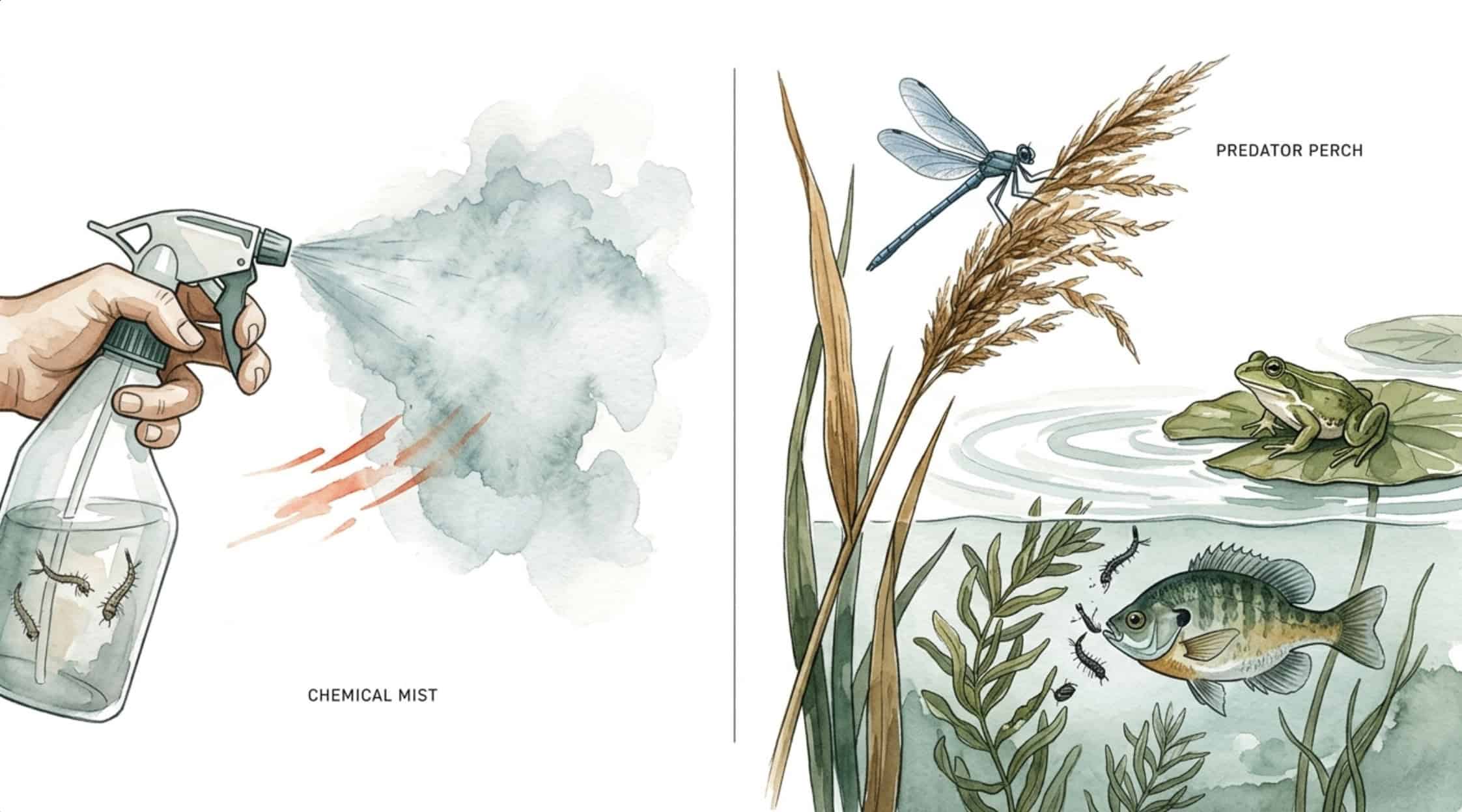
Why spray for mosquitoes when you can hire a professional team of dragonflies for free? Chemical sprays are an isolated solution that kills the good with the bad. By integrating predator perches and deep-water zones, you invite the dragonflies and frogs that can eat thousands of mosquito larvae a day.
Integrated pest management (IPM) in aquatic environments relies on shifting the ecological balance from pest dominance to predator stability. Traditional chemical interventions often provide temporary relief but result in “pest resurgence” because they eliminate the natural predators that regulate mosquito populations. A natural approach focuses on the biological, mechanical, and physical constraints that prevent Culicidae (mosquito) development at the larval and pupal stages.
Ecological mosquito management is not a passive process. It requires precise engineering of the pond’s physical characteristics and the careful selection of biological agents. This technical guide examines the metrics and methodologies required to achieve a self-sustaining, mosquito-resistant aquatic system. Understanding the lifecycle of the mosquito and the specific environmental triggers for oviposition allows pond managers to create inhospitable zones for pests while optimizing habitat for beneficial organisms.
Natural Mosquito Control For Ponds
Natural mosquito control for ponds is a strategy that utilizes biological predation, physical agitation, and habitat modification to suppress the reproduction and survival of mosquito species. Unlike broad-spectrum insecticides, this method targets the specific vulnerabilities of the mosquito life cycle—primarily the aquatic stages of egg, larva, and pupa. Stable aquatic ecosystems naturally contain these pests, but human-made ponds often lack the complexity required to support a robust predator-prey network.
The primary target of these controls is stagnant or slow-moving water, which serves as the requisite breeding ground for mosquitoes. Females of most species, such as Culex and Anopheles, seek out calm water surfaces where surface tension is high enough to support their egg rafts. The goal of natural control is to manipulate this environment so that eggs either cannot be laid or are consumed before they can reach the adult winged stage.
This approach is used in residential ponds, agricultural reservoirs, and municipal stormwater facilities to mitigate the risk of vector-borne diseases. It relies on the principle of competitive exclusion and high-efficiency predation. When a pond is properly designed, the energy required for a mosquito to successfully reproduce exceeds the available environmental rewards, leading to a localized population collapse.
How Biological Control Mechanisms Work
Biological control involves the introduction or encouragement of organisms that naturally hunt or infect mosquito larvae. This section breaks down the three primary categories of biological intervention: bacterial pathogens, insect predators, and larvivorous fish.
Microbial Control: Bacillus thuringiensis israelensis (BTI)
BTI is a naturally occurring soil bacterium that produces protein crystals during sporulation. These crystals act as highly specific protoxins. When mosquito larvae ingest these crystals, the alkaline environment of their midgut (pH 9.0–10.5) solubilizes the protein, converting it into active delta-endotoxins. These toxins bind to specific receptor sites on the gut wall, creating pores that lead to epithelial cell lysis and eventual death through sepsis or starvation.
Implementation requires a consistent dosage, as BTI does not establish permanent colonies in the water column. It is most effective against first through third-instar larvae. Because the activation of the toxin requires a specific alkaline gut pH and unique membrane receptors, BTI remains non-toxic to humans, fish, and most other beneficial insects.
Insect Predation: The Odonata Impact
Dragonflies and damselflies (Order: Odonata) are the most efficient aerial and aquatic predators in the mosquito control network. Dragonfly nymphs are entirely aquatic and possess a specialized labium (lower lip) that can be extended rapidly to capture mosquito larvae. Research indicates that a single dragonfly nymph can consume an average of 40 to 60 mosquito larvae per day, representing a 45% daily reduction in larval density.
Adult dragonflies continue this predation in the terrestrial environment. Known as “mosquito hawks,” they hunt through visual tracking and can consume between 30 and 100 adult mosquitoes daily. Promoting these predators requires the installation of emergent vegetation and predator perches, which provide the necessary infrastructure for hunting and the transition from nymph to adult.
Larvivorous Fish: Species Selection and Metrics
Fish provide a continuous, high-volume reduction of larvae. While Gambusia affinis (the Western Mosquitofish) is often cited as the gold standard, its invasive nature and aggressive behavior toward native amphibians often make it a secondary choice for balanced ecosystems. Native alternatives, such as the Fathead Minnow (Pimephales promelas) or the Killifish (Fundulus spp.), often provide similar efficacy without the ecological downside.
Stocking rates must be calculated based on surface area rather than total volume. A typical recommendation for small ponds is 2 to 5 fish per square meter of surface area. Fish must have access to the shallow margins of the pond, where larvae often congregate to avoid deep-water predators.
Physical and Mechanical Control Strategies
Physical controls focus on the physics of the water surface and the thermal properties of the pond. These interventions are often more reliable than biological controls because they do not depend on the survival of a specific organism.

Surface Agitation and Surface Tension
Mosquito larvae and pupae are air-breathers that must penetrate the water’s surface tension using a specialized respiratory siphon. The physics of this interaction relies on the cohesion of water molecules. Mechanical aeration, such as bottom-diffused aerators or surface fountains, creates constant turbulence that breaks this tension. When the surface is disturbed, the larvae cannot maintain the necessary contact with the atmosphere and eventually drown.
Furthermore, female mosquitoes prefer to oviposit on “glassy” or still water. Constant movement across the surface acts as a mechanical deterrent, forcing females to seek alternative, more stable breeding sites. For optimal results, aerators should be sized to move at least 1.5 to 2.0 times the total pond volume per day.
Deep Water Engineering
Mosquito larvae thrive in shallow water, typically less than 24 inches deep, where water temperatures are higher and predators are less likely to venture. Designing ponds with steep, vertical walls and deep-water zones (exceeding 3 feet) significantly reduces the available breeding habitat. Shallow margins should be minimized or managed with rock armoring to prevent the formation of stagnant pools.
Benefits of Natural Pond Management
Choosing natural systems over chemical sprays offers significant operational and ecological advantages. These benefits are measurable through long-term maintenance costs and the overall health of the local micro-environment.
- Long-Term Stability: Unlike chemical treatments that require bi-weekly re-application, a biological system becomes more effective as it matures.
- Non-Target Safety: Natural controls specifically target mosquito larvae without harming bees, butterflies, or aquatic amphibians.
- Nutrient Management: Many mosquito predators also consume other organic waste, helping to maintain water clarity and reduce algal blooms.
- Reduced Resistance: Insects frequently develop resistance to synthetic pyrethroids and organophosphates. Biological predation and physical surface disruption are mechanisms that mosquitoes cannot adapt to biologically.
Challenges and Common Mistakes
Failure in natural mosquito control often stems from a lack of technical understanding of the pond’s nitrogen cycle or physical layout. Identifying these pitfalls early is essential for success.
Excessive vegetation is a frequent error. While some plants are necessary for predators, overgrowth creates “pockets” of stagnant water that fish and dragonfly nymphs cannot penetrate. If the vegetation density exceeds 30% of the surface area, it effectively protects the mosquito larvae from their predators. Regular thinning of emergent plants like cattails is mandatory.
Nutrient loading from runoff is another significant challenge. High levels of nitrogen and phosphorus fuel algal growth, which provides both food and cover for mosquito larvae. If a pond is receiving high levels of fertilizer runoff, the mosquito population will likely outpace the predation capacity of the natural system. Implementing a buffer zone of native grasses around the pond perimeter can mitigate this risk by filtering nutrients before they enter the water.
Limitations of the Natural Approach
Natural mosquito control is not a “plug-and-play” solution. It requires an established ecosystem, which means there is a lag time between implementation and efficacy. In ephemeral ponds—those that dry up periodically—predator populations like fish cannot survive, making these environments prime breeding grounds for floodwater mosquitoes.
In highly polluted water or areas with extreme industrial runoff, biological agents may struggle to survive. In these cases, mechanical aeration becomes the primary tool, as the water chemistry may be too toxic for sensitive species like dragonfly nymphs or certain native fish. Success also depends on the scale of the surrounding environment; if neighboring properties have massive amounts of standing water, the natural control on your pond may be overwhelmed by migrating adult mosquitoes.
Comparison: Natural Systems vs. Chemical Intervention
| Factor | Natural (Predator/Perch) | Chemical (Spray/Mist) |
|---|---|---|
| Initial Cost | Moderate (Aeration/Plants) | Low |
| Long-term Cost | Minimal | High (Continuous) |
| Efficacy Period | Year-round / Self-sustaining | 7–14 days |
| Impact on Biodiversity | Positive Increase | Negative Reduction |
| Resistance Risk | Zero | Very High |
Practical Tips for Implementation
Effective implementation starts with the physical layout. Install predator perches for dragonflies by placing 3-foot bamboo stakes or willow stems in the soft mud along the shoreline. Angle these sticks slightly toward the water to provide a vantage point for hunting males. High points in open areas are preferred by species like the Blue Dasher.
Optimizing for fish requires the creation of “shelter zones.” While you want fish to reach the edges, they also need deep areas to escape summer heat and winter cold. A pond depth of at least 4 feet in the center is recommended for temperate climates. Ensure that any pump intakes are screened to prevent the accidental suction of fish or large predatory insects.
Regularly monitor the pond using a “dipping” technique. Use a white cup to take samples from the edges of the water. If you see more than two or three larvae per dip, your predator-to-prey ratio is off, and you may need to supplement with BTI dunks or increase aeration flow rates.
Advanced Considerations for Practitioners
Serious pond managers should monitor Dissolved Oxygen (DO) levels and pH. Low DO levels (below 3 mg/L) stress fish and Odonata nymphs, reducing their metabolic rate and predation efficiency. Mosquito larvae, however, can survive in low-oxygen environments because they breathe atmospheric air. Keeping DO levels above 5 mg/L ensures your predators are always at peak performance.
Nitrogen management is also critical. High ammonia or nitrite levels are toxic to fish. Ensure your pond has a functioning biological filter or enough submerged aquatic plants (like Anacharis or Ceratophyllum) to process waste. These plants also provide the necessary surface area for dragonfly nymphs to hide and hunt. The goal is a balanced nitrogen cycle where waste is converted into plant biomass, which in turn supports the insect and fish populations that control the mosquitoes.
Scenario: The Suburban Detention Pond
Consider a 1,000-square-foot detention pond that has become a mosquito breeding site. A chemical-only approach would involve spraying the perimeter every two weeks at a cost of $150 per visit. Over a six-month season, this totals $1,800 without solving the underlying issue of stagnant water.
An ecological conversion would involve:
- Installing a 1/2 HP bottom diffused aerator ($600).
- Adding 200 native Fathead Minnows ($50).
- Planting 50 emergent aquatic plants along the shelf ($150).
- Installing 10 predator perches around the perimeter (Free/Scavenged).
Total initial investment: $800. In the first season, the mosquito population is reduced by the mechanical disruption of the surface. By the second season, the minnow population has tripled, and the dragonfly population has established itself. The recurring cost is only the electricity for the aerator, roughly $15 per month, and the system provides 24/7 suppression.
Final Thoughts
Shifting from chemical dependency to biological stability is the most efficient way to manage aquatic mosquito vectors. This method respects the complex interactions of the pond ecosystem and uses physics and biology to achieve results that chemicals cannot match. By focusing on surface tension, predation metrics, and deep-water engineering, pond owners can create a landscape that is both beautiful and inhospitable to pests.
Success requires patience and observation. A pond is a living system, and it takes time for the predator-prey balance to stabilize. However, once established, these natural systems provide a level of security and environmental health that single-source chemical solutions simply cannot offer. Experimenting with different native fish species and perch placements will allow you to fine-tune your pond for maximum efficiency.
Amazon and the Amazon logo are trademarks of Amazon.com, Inc, or its affiliates.