

Pond Talk is an Amazon Associate. As an Amazon Associate we earn from qualifying purchases.
Too much plant cover can suffocate your pond just as fast as too little. During the summer heat, your plants are in a race for space. Standard maintenance involves hacking them back when they get ‘too big,’ but precision management is about airflow. By thinning the center of your plant masses, you create ‘oxygen chimneys’ that let the pond breathe without sacrificing the shade your fish need. Here is how to prune like a pro.
Aquatic ecosystems rely on a delicate balance of gas exchange and nutrient cycling. High water temperatures in summer reduce the solubility of oxygen, making the physical structure of your plant life a critical factor in fish survival. Thick mats of floating or submerged vegetation act as a physical barrier, trapping carbon dioxide and preventing atmospheric oxygen from dissolving into the water column.
Precision pruning focuses on maintaining a functional architecture within the pond. This approach moves beyond aesthetics and treats the pond as a biological machine that requires mechanical tuning. Efficient gas exchange requires clear paths to the surface, which is achieved through the strategic removal of biomass rather than a superficial trim of the perimeter.

How To Prune Pond Plants
Pond plant pruning is the mechanical removal of excess vegetative biomass to optimize dissolved oxygen levels and nutrient sequestration. It involves distinct techniques for three primary plant categories: submerged oxygenators, floating-leaved plants, and marginal/emergent species. Each category interacts with the water chemistry and physical space differently, requiring a specialized maintenance protocol.
Submerged plants, such as Hornwort or Elodea, perform photosynthesis entirely underwater and are often called “oxygenators.” While they produce oxygen during the day, they consume it at night through respiration. Overcrowded submerged beds create stagnant zones where water circulation stops, leading to localized anoxia. Pruning these plants ensures that water can flow through the stems, carrying oxygenated water to the lower depths.
Floating plants, including Water Lilies and Water Lettuce, provide essential shade that regulates water temperature. However, if they cover more than 50-70% of the surface, they block the interface where atmospheric oxygen enters the water. Marginal plants grow at the pond’s edge and serve as the primary nutrient filters. Pruning these involves removing dead or decaying foliage before it sinks to the bottom and turns into muck, which would otherwise fuel unwanted algae blooms.
Mechanical Pruning Techniques and Procedures
Effective pruning requires a systematic approach to ensure the plant’s health while maximizing the pond’s respiratory capacity. Follow these steps for a technical, high-efficiency maintenance session.
Submerged Plant Thinning
Submerged species require thinning rather than topping. Use aquatic shears or long-handled trimmers to reach into the center of the plant mass. Remove approximately one-third of the total volume by cutting stems near the base. This creates internal channels for water movement. Avoid “mowing” the tops of these plants, as this often stimulates denser lateral growth, which further restricts flow.
Floating-Leaved Plant Management
Water lilies should be managed by removing the oldest leaves first. These are typically the leaves furthest from the center of the crown or those showing signs of yellowing. Cut the leaf stem as close to the tuber as possible. Creating “chimneys” involves removing enough pads in the center of the pond to leave open patches of water. These patches act as thermal windows, allowing heat to escape at night and oxygen to diffuse during the day.
Marginal and Emergent Pruning
Marginal plants like Iris or Rushes should be dead-headed after flowering to prevent seed production, which redirects energy back into the root system. Remove any foliage that leans into the water. Decaying organic matter in the water column consumes dissolved oxygen through microbial decomposition. Keeping marginal foliage upright and trimmed prevents this oxygen demand.
Benefits of Precision Thinning
Precision thinning offers measurable improvements to the pond’s environmental metrics. These benefits are centered on gas exchange efficiency and nutrient management.
- Optimized Dissolved Oxygen (DO): Removing internal plant mass increases the surface area available for gas exchange and allows wind-driven surface turbulence to reach deeper.
- Enhanced Nutrient Sequestration: Pruning stimulates new, vigorous growth. Younger plant tissue is more efficient at absorbing nitrates and phosphates from the water compared to old, stagnant growth.
- Prevention of “Summer Kills”: By maintaining a balance of 15–25% plant coverage for large systems, or up to 50% for shaded garden ponds, you reduce the risk of nocturnal oxygen crashes during heatwaves.
- Improved Water Clarity: Thinning reduces the amount of detritus that accumulates within plant beds. Less detritus means fewer nutrients are available for suspended algae (green water).
Challenges and Common Mistakes
Mechanical maintenance of aquatic systems is not without risk. Errors in technique can lead to unintended biological consequences.
Fragmentation is a significant risk for certain invasive or aggressive species like Elodea. Small pieces of the plant that break off during pruning can float away and establish new colonies. If fragments are not meticulously removed from the pond, the pruning session may result in a more crowded pond within weeks. Always use a fine-mesh net to clear the water surface of all debris after cutting.
Nutrient spikes can occur if too much biomass is removed at once. Plants act as a “sink” for nutrients; removing them suddenly can leave an excess of nitrogen in the water, which algae will quickly exploit. Limit pruning to no more than 30% of the total plant volume in a single session to allow the remaining plants and the biofiltration system to adjust to the change in nutrient uptake.

Limitations of Mechanical Pruning
Pruning is a maintenance tool, not a permanent solution for pond imbalances. In very large ponds or lakes, manual pruning becomes logistically impossible and requires expensive mechanical harvesters. Furthermore, pruning does not address the underlying source of excess nutrients, such as fertilizer runoff or high fish stocking densities. If the nutrient input remains high, plants will simply grow back at an accelerated rate.
Environmental constraints also dictate when pruning is ineffective. During extreme heatwaves where water temperatures exceed 85°F (29°C), even a well-pruned pond may struggle to hold enough dissolved oxygen. In these cases, mechanical aeration (such as bottom-diffused air or fountains) is a necessary supplement to plant management. Pruning alone cannot overcome the physical laws of oxygen solubility in very warm water.
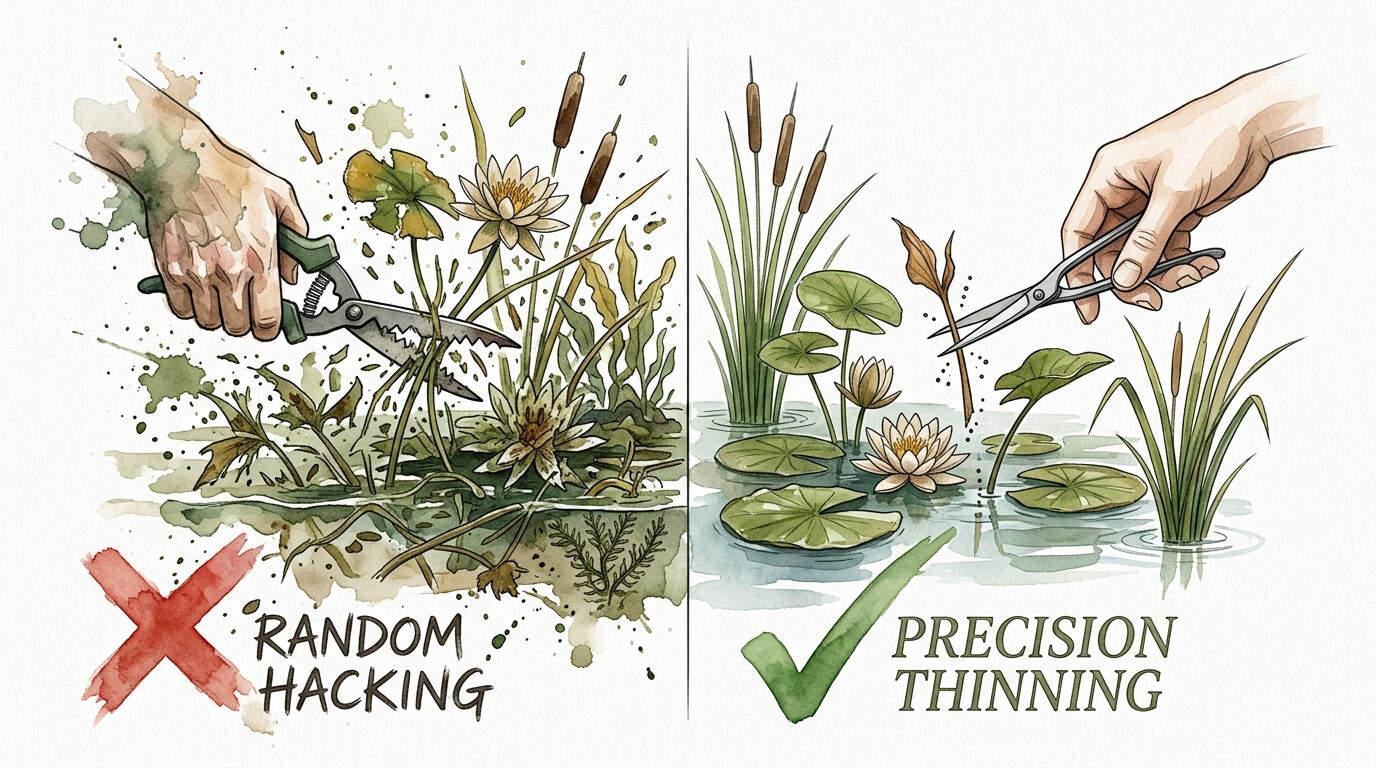
Comparison: Random Hacking vs. Precision Thinning
The difference between these two approaches lies in the long-term ecological impact and maintenance frequency. Random hacking focuses on the visible perimeter, while precision thinning focuses on internal architecture.
| Metric | Random Hacking | Precision Thinning |
|---|---|---|
| Oxygen Impact | Low; surface interface remains blocked. | High; creates oxygen chimneys for gas exchange. |
| Regrowth Rate | Rapid; stimulates dense, “bushy” lateral growth. | Controlled; promotes vertical and healthy new growth. |
| Debris Generation | High; leaves many small fragments in the water. | Low; involves clean cuts at the plant base. |
| Aesthetic Quality | Ragged; plants look “cut” or unnatural. | Natural; preserves the visual integrity of the plant. |
| Labor Efficiency | Requires frequent, weekly intervention. | Monthly or seasonal sessions are sufficient. |
Practical Best Practices
Adhering to a technical maintenance schedule ensures the pond remains stable throughout the growing season. Use these best practices to optimize your results.
- Use Specialized Tools: Invest in high-quality stainless steel pond shears and a telescoping reach tool. Dull blades crush plant stems, leading to rot and slower recovery times.
- Monitor Dissolved Oxygen: Perform pruning sessions in the morning when plants have finished their nocturnal respiration cycle. This allows you to observe any stress in fish before the heat of the day begins.
- Meticulous Waste Removal: Every gram of plant matter left in the pond will eventually decompose and consume oxygen. Use a skimmer net to remove every floating leaf or stem fragment.
- Disinfect Tools: If you maintain multiple ponds, clean your tools with a mild bleach solution or specialized aquatic disinfectant to prevent the spread of pathogens or invasive species.
Advanced Considerations for Dissolved Oxygen Management
Experienced practitioners must understand the relationship between plant biomass and the Dissolved Oxygen (DO) cycle. Photosynthesis produces oxygen only during daylight hours, while respiration is a constant 24-hour process. In a densely planted pond, the “O2 swing” can be extreme. Daytime DO levels might reach 12 mg/L (supersaturation), but drop to 2 mg/L at 4:00 AM.
Thinning the plant mass reduces the total respiratory demand of the pond. By decreasing the number of living cells that require oxygen at night, you raise the “floor” of your nocturnal DO levels. This is why thinning the center of a plant mass is more effective than trimming the edges; it reduces the volume of the oxygen-consuming “engine” while maximizing the surface area for atmospheric diffusion.
Calculations and Applied Scenarios
Consider a 1,000-gallon pond with 80% surface coverage of Water Lilies during a July heatwave. Surface gas exchange is restricted to only 20% of the pond’s area. If the water temperature hits 80°F, the maximum oxygen it can hold is roughly 8.0 mg/L. However, the high plant density and fish respiration could pull that level down to 3.0 mg/L by dawn, stressing the fish.
A precision thinning session that removes 30% of the central lily pads increases the gas exchange area from 200 square feet to 500 square feet. This 150% increase in the “breathing surface” allows for significantly higher diffusion rates. Furthermore, removing 30% of the biomass reduces the nocturnal oxygen demand proportionally, potentially keeping the dawn DO levels above the safe threshold of 5.0 mg/L for koi and other sensitive species.
Final Thoughts
Effective pond management requires a move away from purely aesthetic maintenance toward a functional, biological approach. Pruning is the primary mechanical lever you can pull to influence the gas exchange and nutrient dynamics of your aquatic environment. By creating oxygen chimneys and thinning the internal structures of your plant masses, you facilitate a healthier, more resilient ecosystem.
Regular monitoring of your plant density and water parameters will allow you to fine-tune your pruning frequency. Start with small, frequent thinning sessions rather than massive seasonal overhauls. This gradual approach minimizes biological shock to the pond and provides a more stable habitat for your fish. As you master these techniques, you will find that the pond’s clarity and health improve with far less effort than traditional “hacking” methods.
Amazon and the Amazon logo are trademarks of Amazon.com, Inc, or its affiliates.