

Pond Talk is an Amazon Associate. As an Amazon Associate we earn from qualifying purchases.
Is your pond a giant compost bin, or is it designed for 5-minute seasonal cleanups? Pond cleaning doesn’t have to be a full-day sludge-fest. Creating a ‘silt zone’ at the deep end allows you to concentrate organic waste into one small, easily accessible area. It’s the difference between vacuuming a whole house and just emptying a single dustbin.
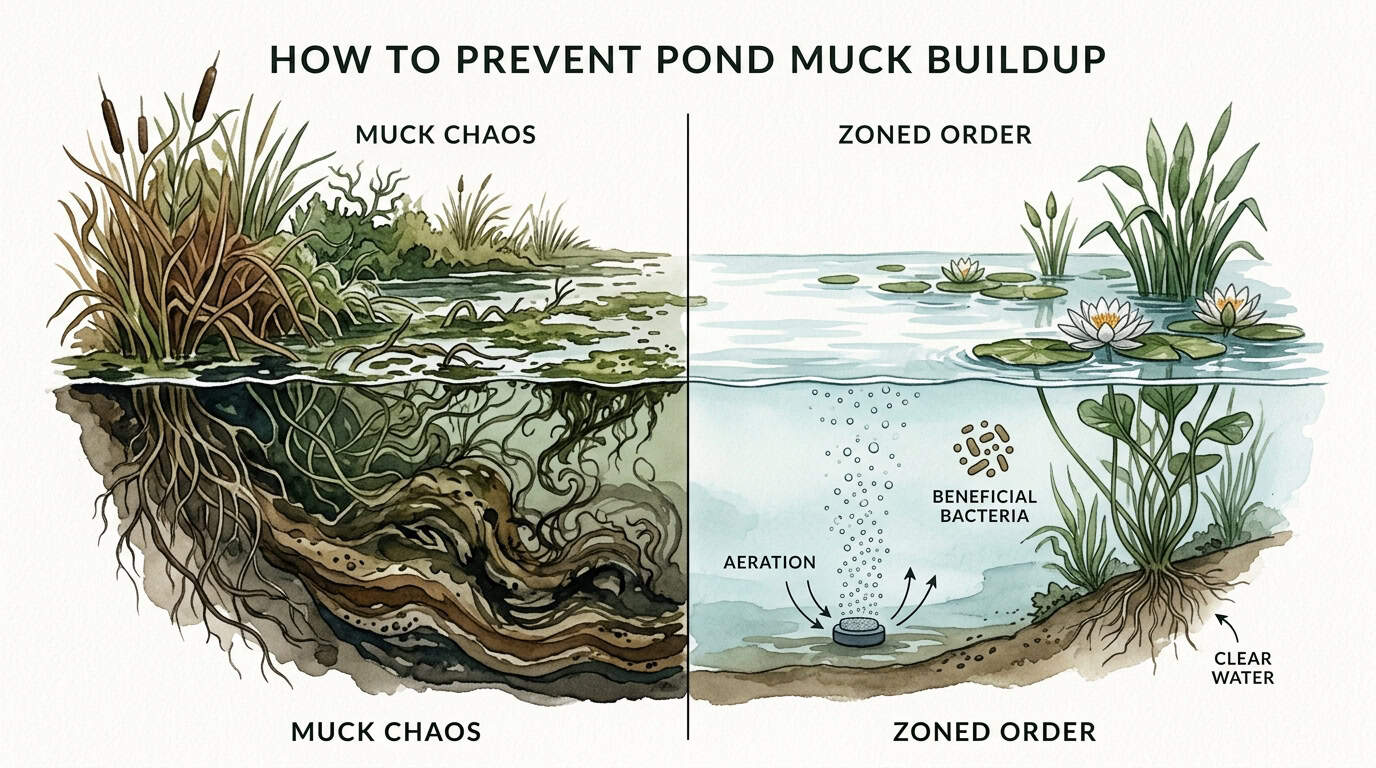
Managing a pond environment requires a shift from passive observation to active mechanical optimization. Traditional pond designs often suffer from what is termed “Muck Chaos,” where organic debris settles uniformly across the entire floor. This distribution increases the surface area of anaerobic decomposition, leading to spikes in hydrogen sulfide and localized oxygen depletion. Transitioning to a “Zoned Order” system involves engineering the pond’s floor to utilize gravitational forces and fluid dynamics.
Concentrating waste in a pre-defined silt zone or sediment basin minimizes the maintenance footprint. Instead of removing hundreds of square feet of liner surface debris, you target a high-density collection point. This article examines the technical requirements for sediment management, hydraulic efficiency, and the physics of particle settling.

How To Prevent Pond Muck Buildup
Pond muck, or benthic sludge, is the accumulation of autochthonous organic matter like fish waste and algae, combined with allochthonous inputs such as leaf litter and windblown dust. Preventing its buildup is not a matter of stopping waste production but managing its final destination. In a controlled aquatic system, prevention is defined as the successful transport of solids to a mechanical extraction point before biological degradation occurs.
Engineering a pond for muck prevention relies on the principle of directed sedimentation. In real-world civil engineering, this is seen in stormwater detention ponds and wastewater treatment facilities where “forebays” or “sediment traps” are used to capture heavy solids before the water reaches the main basin. In a garden pond or koi pond, this involves creating a topographical low point where flow rates decrease enough to allow particles to fall out of suspension.
Effective prevention requires understanding the organic loading rate. Research indicates that for every pound of Biochemical Oxygen Demand (BOD) removed from a system, approximately 0.2 pounds of dry sludge is produced. Without a zoned collection system, this sludge spreads across the liner, creating a thin, pervasive layer of anaerobic activity. By utilizing a dedicated silt zone, you restrict this activity to a small, manageable sector of the pond.
How It Works: The Physics of Particle Settling
The movement of debris in a pond is governed by fluid mechanics and Stokes’ Law. This law describes the settling velocity of a spherical particle in a viscous fluid. To design an efficient silt zone, you must calculate the terminal velocity of the most common debris types to ensure they settle in the target area rather than remaining in the water column.
The settling velocity (Vs) is determined by the formula: $V_s = \frac{2}{9} \frac{(\rho_p – \rho_f)}{\mu} g R^2$. In this equation, $\rho_p$ is the density of the particle, $\rho_f$ is the density of the water, $\mu$ is the dynamic viscosity, $g$ is gravity, and $R$ is the radius of the particle. Technical data shows that a fine silt particle (~0.01 mm) has a settling velocity of approximately 0.01 cm/s, while fine sand (~0.1 mm) settles at 15 cm/s.
To implement a silt zone, the pond bottom must be sloped toward a central or corner collection point. A horizontal-to-vertical ratio of 3:1 (approximately 18 degrees) is often used for stability in earthen ponds, but for lined ponds designed for maximum waste transport, a 1:1 or 45-degree slope is significantly more efficient. Steeper slopes ensure that once a particle reaches the liner, the force of gravity exceeds the frictional resistance of the liner material, causing the particle to slide into the silt zone.
Hydraulic residence time (HRT) also plays a critical role. If the flow velocity throughout the pond is too high, particles remain in suspension and eventually clog the mechanical filter media or the pump intake. By widening the pond at the deep end where the silt zone is located, the cross-sectional area increases, which causes a localized reduction in flow velocity. This drop in speed triggers the sedimentation process exactly where it is intended.
Benefits of Zoned Sedimentation
Utilizing a zoned order approach offers measurable improvements in both water chemistry and maintenance efficiency. Concentrating waste reduces the total volume of anaerobic zones within the pond. Anaerobic pockets are responsible for the production of methane and hydrogen sulfide, both of which are toxic to aquatic life at high concentrations.
Maintenance man-hours are significantly reduced. In an unzoned “Muck Chaos” system, a full pond drain and scrub may take 8 to 12 hours depending on the surface area. In a system with a dedicated silt zone and a bottom drain or specialized vacuum point, the same removal of solids can be achieved in 5 to 10 minutes of targeted suction or backwashing.
Water quality parameters remain more stable. Since organic waste is removed before it fully breaks down into ammonia and nitrite, the biological filter experiences a lower total nitrogenous load. This results in lower nitrate levels and a reduced frequency of algae blooms, which are often fueled by the nutrients released from decomposing bottom muck.
Challenges and Common Mistakes
One of the most frequent errors in pond design is the “Flat Bottom Trap.” Designing a pond with a flat floor assumes that debris will naturally find its way to the pump. In reality, friction and low-velocity dead zones mean debris will stay exactly where it lands. Correcting this after installation is costly and often requires a complete liner replacement.

Inadequate slope angles represent another common failure point. If the slope is less than 15 degrees, the “angle of repose” for organic sludge may prevent it from sliding. The sludge stays on the slopes, requiring manual intervention to push it toward the deep end. Utilizing a smooth EPDM or PVC liner helps, but a steep, intentional grade is the only way to ensure passive transport.
Flow interference from aeration is often overlooked. While aeration is vital for gas exchange, a poorly placed air stone can create upward currents that prevent sediment from settling. Placing diffusers directly above the silt zone is counterproductive. Instead, diffusers should be placed at mid-depth or in shallower zones to create a toroidal flow pattern that pushes debris toward the deep collection point.
Limitations of Silt Zones
Silt zones are highly effective for heavy solids but have limitations when dealing with neutrally buoyant or colloidal organic particles. Stokes’ Law confirms that particles with a diameter smaller than 0.001 mm (clay and some types of algae) have such low settling velocities that they may stay in suspension for weeks or months. For these particles, mechanical filtration through pressurized bead filters or sand filters is required alongside the silt zone.
Environmental constraints like high groundwater tables can also limit the depth of the silt zone. If the deep end of the pond is dug below the water table, the pressure from the surrounding soil can cause the liner to “bubble” or lift. In these cases, a shallower, wider sediment basin is required, which necessitates a larger surface area and may decrease the overall aesthetic volume of the pond.
Scale is another factor. In very small ponds (under 500 gallons), the footprint of a proper silt zone may take up too much of the fish’s swimming space. In these scenarios, builders must rely more heavily on high-turnover mechanical filtration rather than gravitational settling.
Zoned Order vs. Muck Chaos: Efficiency Metrics
| Factor | Muck Chaos (Flat Bottom) | Zoned Order (Silt Zone) |
|---|---|---|
| Annual Maintenance Hours | 20–40 hours | 2–4 hours |
| Solids Removal Efficiency | 15% – 30% (Manual) | 85% – 95% (Passive) |
| BOD Concentration | High (Accumulated) | Low (Exported) |
| Anaerobic Risk | High | Minimal |
| Equipment Lifecycle | Short (Pump clogs frequently) | Long (Clean intake) |
Practical Tips for Implementation
When constructing a new system, install a bottom drain at the lowest point of the silt zone. This allows for the “vortex” effect where the drain’s suction combined with the sloped floor pulls waste out of the system entirely. For existing ponds, a retro-fit bottom drain or a specialized pond vacuum can be used to target the silt zone without disturbing the rest of the pond.
Utilizing “sweeping” jets can improve efficiency. Placing returns from the filter at a tangent to the pond’s edge creates a circular water motion. This movement, known as a centripetal flow, helps move heavier debris from the perimeter toward the center, where the silt zone should be located. This mechanical assist ensures that even larger debris like leaves are eventually moved to the collection area.
Monitoring the “sludge trigger point” is essential for long-term health. Most engineering standards for stormwater ponds suggest dredging or cleaning when the sediment basin is 25% full. In a backyard pond, this threshold should be much lower. Removing waste once a week from the silt zone prevents the buildup of organic acids that can crash the pond’s carbonate hardness (KH) and pH levels.
Advanced Considerations: Aeration-Driven Currents
Serious practitioners often use “bottom diffusers” with integrated air membranes. When placed strategically, the rising air bubbles create a “lifting” effect that draws water from the bottom toward the surface. While this sounds like it would disrupt settling, it actually creates a vacuum at the bottom that pulls water (and debris) from the surrounding areas toward the diffuser.
If the diffuser is placed near the edge of the silt zone, the resulting current acts as a conveyor belt for waste. As the water is pulled toward the rising air column, solids are dragged along the bottom and deposited into the silt zone. This technique requires precise calibration of air volume; too much air will cause turbulence that re-suspends the waste.
Calculating the “Settling Ratio” for your specific fish load is another advanced step. Large koi produce more waste per gallon than goldfish. If your system is heavily stocked, the silt zone volume should be increased to account for a higher daily TSS (Total Suspended Solids) output. A common benchmark is to dedicate 5% to 10% of the total pond floor area to the silt zone.
Example: Calculating a Silt Zone for a 5,000-Gallon Pond
Consider a 5,000-gallon pond with a target turnover rate of once per hour. The pond is 15 feet long and 10 feet wide. In a “Muck Chaos” scenario, the 150 square feet of floor would collect debris evenly. By sloping the floor at a 30-degree angle toward a 3-foot wide silt zone at one end, we concentrate that waste into a 30-square-foot area.
The expected organic load from 10 large koi is approximately 0.5 pounds of waste per day. Over one month, this results in 15 pounds of organic matter. In a flat-bottom pond, this creates a microscopic but biologically active film across 150 square feet. In the zoned system, that 15 pounds is concentrated in the 30-square-foot silt zone, reaching a thickness that is easily captured by a 4-inch bottom drain.
By opening the waste valve on the bottom drain for 30 seconds daily, the operator can flush the concentrated waste using only 50 gallons of water. This equates to a 1% daily water change that simultaneously removes 90% of the day’s solid waste. This level of efficiency is impossible in an unzoned system without a full-scale manual cleaning.
Final Thoughts
Designing a pond around a dedicated silt zone transforms maintenance from a reactive chore into a controlled mechanical process. By utilizing gravity, specific slope angles, and the principles of sedimentation, you can ensure that organic waste is moved to a central location for easy removal. This “Zoned Order” prevents the biological decay that leads to poor water quality and fish health issues.
Focusing on the physics of the pond bottom allows the biological filtration system to function at peak efficiency. When the mechanical burden is handled by a well-engineered silt zone, the nitrifying bacteria in the filter can focus on processing dissolved ammonia rather than struggling against a constant influx of solid debris. This results in a more resilient and stable aquatic ecosystem.
Experimenting with flow rates and diffuser placement will help fine-tune the system. Every pond has unique variables, from the type of fish kept to the surrounding vegetation. Applying these technical principles ensures that your pond remains an asset to your landscape rather than a maintenance liability. Consistent removal of waste from the silt zone is the most effective way to maintain long-term clarity and biological balance.
Amazon and the Amazon logo are trademarks of Amazon.com, Inc, or its affiliates.