

Pond Talk is an Amazon Associate. As an Amazon Associate we earn from qualifying purchases.
Are we breeding the resilience out of our ponds in exchange for flashy colors that can’t survive the first frost? Modern pond plants are bred for the showroom, but ancient varieties were bred for the storm. Discover why switching back to heirloom cultivars is the secret to a zero-maintenance winter pond.
Establishing a sustainable aquatic ecosystem requires a shift from aesthetic-first selection to physiological-performance selection. High-performance heirloom cultivars offer a genetic blueprint designed for metabolic stability during extreme thermal fluctuations. This guide examines the mechanical and biological advantages of prioritizing heirloom genetics over modern hybrid alternatives for long-term pond viability.
Hardy Heirloom Water Lilies For Winter
Heirloom water lilies, specifically those hybridized in the late 19th century, represent a pinnacle of aquatic plant engineering. These varieties were developed primarily by Joseph Bory Latour-Marliac, who successfully crossed hardy European species like Nymphaea alba with North American species like Nymphaea odorata and Nymphaea mexicana. The resulting cultivars were designed for the unheated, naturalistic ponds of the Victorian era, where survival was a baseline requirement rather than an optional feature.
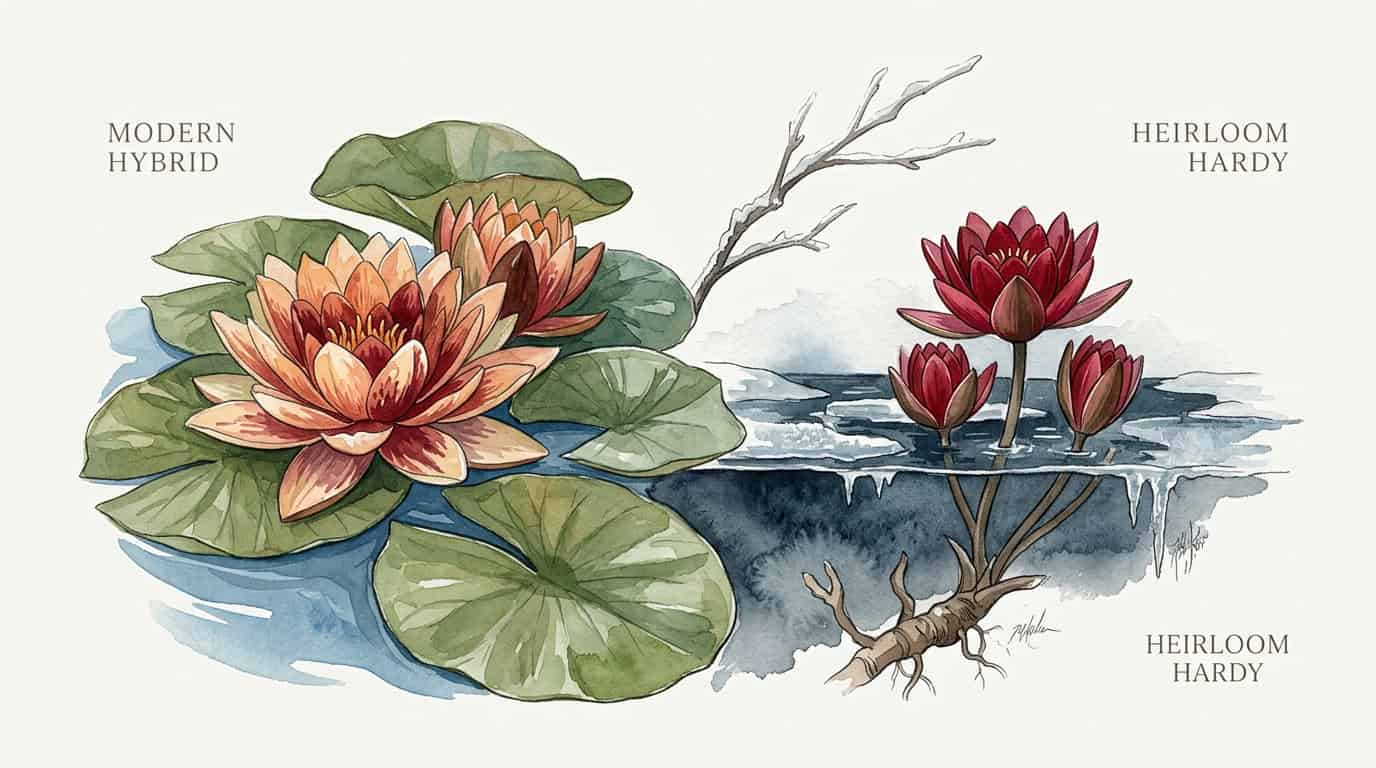
In real-world applications, these plants function as the primary carbon sequestration and nutrient filtration units of a pond. Unlike many modern hybrids that prioritize flower count and neon pigmentation at the expense of root mass, heirlooms focus on rhizome development. A thick, starch-heavy rhizome acts as a biological battery, storing the chemical energy necessary to maintain cellular integrity throughout the winter dormancy period.
These plants exist as a solution to the “annual replacement” cycle common in modern water gardening. Where a flashy tropical-hybrid may succumb to cellular wall collapse as soon as water temperatures drop below 50°F (10°C), heirloom hardies enter a state of ecodormancy. This physiological state allows the plant to survive in water temperatures as low as 34°F (1°C), provided the rhizome remains below the ice line.
The Mechanism of Cold Adaptation
Resilience in heirloom cultivars is not a single trait but a suite of coordinated physiological responses. Understanding these mechanisms allows a pond manager to optimize the environment for maximum survival.
One primary mechanism involves the reallocation of resources. In late summer, as photoperiods shorten, heirloom lilies begin transferring carbohydrates from their leaves into the rhizome. This process is far more efficient in heirloom varieties compared to modern intersubgeneric (ISG) hybrids. High concentrations of starch in the rhizome serve two purposes: providing energy for spring regrowth and acting as an internal antifreeze by increasing cellular solute concentration, which lowers the freezing point of the plant’s internal fluids.
Another critical factor is the synthesis of cold-shock proteins and osmoregulatory substances. Research into cold-tolerant species like Nymphaea candida shows that these plants accumulate compounds such as myo-inositol and L-proline. These molecules stabilize the cellular membranes and prevent the degradation of organelles when temperatures plummet. Heirloom cultivars retain these ancestral genetic pathways, whereas intensive breeding for color in modern hybrids can sometimes inadvertently silence or weaken these defensive responses.
System Optimization for Heirloom Performance
Maximizing the zero-maintenance potential of heirloom plants requires correct physical positioning within the pond’s depth profile.
Mechanical placement is the most critical factor in winter survival. The goal is to keep the plant’s crown—the growing point—below the ice line. In most temperate climates, this means a minimum planting depth of 18 to 24 inches (45 to 60 cm). At this depth, the water maintains a consistent temperature of approximately 39.2°F (4°C), which is the point of maximum water density. This layer of water acts as a thermal insulator, shielding the rhizome from the fluctuating air temperatures and the freezing surface ice.
Substrate composition also plays a role in thermal regulation. Heavy clay-based loams are superior to gravel or loose potting soil for heirloom lilies. Clay provides a dense thermal mass that retains heat longer than water alone. Additionally, the weight of the clay ensures the rhizome remains anchored, preventing “frost heaving” where the expansion of ice can occasionally pull lightweight pots toward the surface, exposing the delicate crown to sub-zero temperatures.
Benefits of Heirloom Transitioning
Switching to heirloom cultivars offers measurable improvements in pond efficiency and maintenance requirements.
Metabolic Stability: Heirloom varieties have predictable dormancy cycles. They enter dormancy earlier than hybrids, which prevents them from wasting energy on “late-season” growth that will inevitably be killed by the first frost. This conservative growth strategy ensures a higher survival rate across multiple seasons.
Nutrient Management: Because heirlooms develop massive, long-lived rhizome systems, they act as superior nutrient sinks. They are capable of absorbing and storing vast amounts of nitrogen and phosphorus from the water column, which reduces the biological load on mechanical filtration systems and limits algae growth in the spring.

Mechanical Longevity: Heirloom lilies are famously long-lived. While modern hybrids may lose vigor and require replacement after 3–5 years, many Latour-Marliac cultivars in historical gardens have survived for over a century. This reduces the long-term capital expenditure of the pond system.
Challenges and Technical Constraints
Transitioning to heirlooms is not without its specific requirements and potential pitfalls.
One common mistake is underestimating the spatial requirements of heirloom genetics. Many of these varieties, such as ‘Gladstoniana’ or ‘Marliacea Albida’, are extremely vigorous. They were bred for large estate ponds and can easily overwhelm a small pre-formed pond or a container garden. Without regular division every 3–4 years, the rhizomes can become “pot-bound,” leading to a reduction in flower size and eventual crown rot due to poor oxygen circulation at the center of the mass.
Another challenge is the bloom latency. Some heirloom varieties take longer to establish and reach peak flowering compared to modern hybrids. A modern hybrid might produce a dozen blooms in its first season, whereas a Latour-Marliac variety might focus on root development for the first year, producing fewer flowers. For the practitioner, this requires a shift in perspective: valuing long-term system stability over immediate visual gratification.
Environmental Limitations
Heirloom hardies are optimized for temperate zones (USDA Zones 3–9). In true tropical environments, these plants may struggle because they require a vernalization period—a period of cold—to reset their growth hormones. Without a winter cooling phase, some heirloom cultivars may grow continuously but eventually lose vigor or stop blooming as their internal biological clocks become desynchronized.
Conversely, in extremely shallow ponds that freeze solid to the bottom, even the most resilient heirloom will perish. The plant can survive being encased in ice for short periods, but if the rhizome’s internal temperature drops below its critical limit (typically around 28°F or -2°C for the hardiest varieties), the cellular walls will rupture. In such environments, the only solution is to physically relocate the pots to a deeper area or provide supplemental heating.
Technical Comparison: Heirloom vs. Modern Hybrid
The following data compares the performance metrics of traditional heirloom hardy lilies (Panel B) against modern intersubgeneric (ISG) or tropical hybrids (Panel A).
| Performance Metric | Modern Hybrids (ISG) | Heirloom Hardy |
|---|---|---|
| Winter Survival (Zone 5) | Low (often requires indoor storage) | High (stays in pond) |
| Rhizome Density | Low to Medium | Very High |
| Starch Storage Capacity | Moderate | Exceptional |
| Maintenance Interval | Seasonal (High Intervention) | Multi-Year (Low Intervention) |
| Genetic Stability | Variable (often sterile or unstable) | Highly Stable |
Best Practices for Winter Transitioning
To ensure the highest survival rate when transitioning to an heirloom-based system, follow these technical protocols.
- Stop fertilization as soon as water temperatures drop to 60°F (15.5°C). Forcing growth late in the season prevents the plant from correctly entering the “resource reallocation” phase.
- Trim foliage only after it has turned completely brown and “mushy.” Removing green leaves prematurely deprives the rhizome of the final carbohydrate injection it needs for winter dormancy.
- Verify planting depth. Ensure that at least 12 inches of water remains above the top of the pot throughout the winter. Evaporation can lower water levels, potentially exposing the crown to freezing air.
- Maintain gas exchange. While heirloom plants are hardy, they still require an oxygenated environment. Decomposing organic matter under a sealed ice layer produces methane and hydrogen sulfide. Use a small aerator or a de-icer to keep a small hole open in the ice for gas exchange.
Advanced Considerations: Genetic Bottlenecks
Serious practitioners should be aware of the genetic bottlenecks present in modern aquatic plant breeding. Because many modern hybrids are created from a very narrow pool of parent plants to achieve specific flower colors (like the elusive “hardy blue”), they often lose the broad-spectrum environmental resilience found in the parent species.
Heirloom cultivars often represent “wide” crosses that incorporate a more diverse range of alleles (gene variants). This diversity provides a buffer against emerging diseases and unpredictable climate shifts. For instance, the Marliac-type rhizome is structurally different from the “Odorata-type” or “Tuberosa-type.” It is a heavy, slow-growing, clumping rhizome that is less prone to invasive spreading and more efficient at nutrient sequestration. Selecting for specific rhizome architecture is a more advanced, technical way to plan for long-term pond health.
Scenario: Cold-Climate Pond Performance
Consider a pond located in USDA Zone 4 (minimum temperatures of -30°F). A practitioner using modern ISG hybrids would need to remove the plants by late September, store the tubers in moist sand in a temperature-controlled basement (approx. 50°F), and monitor them for rot throughout the winter. The labor cost and risk of storage failure are high.
In contrast, a practitioner using the heirloom cultivar ‘Marliacea Chromatella’ (introduced in 1887) simply ensures the pot is sitting in 30 inches of water. The plant enters ecodormancy naturally. In the spring, as the water reaches 50°F, the high starch reserves in the ‘Chromatella’ rhizome trigger rapid leaf development, often outperforming the stored hybrids that must first overcome “transplant shock.” The heirloom system achieves zero-maintenance winterization through mechanical positioning and genetic resilience.
Final Thoughts
Relying on heirloom cultivars is not a step backward into the past, but a step toward biological efficiency. These plants were engineered during an era when the survival of the species was the primary metric of success. By prioritizing rhizome health and metabolic stability, a pond manager can create an ecosystem that is truly resilient to the elements.
The shift toward heirloom genetics reduces the need for seasonal intervention, chemical fertilizers, and expensive winter storage solutions. It allows the pond to function as a self-sustaining unit, where the plants manage the water quality and survive the winter based on their own internal biological clocks.
Practitioners are encouraged to experiment with established varieties such as ‘Chromatella’, ‘James Brydon’, or ‘Marliacea Albida’. These cultivars offer the data-backed reliability needed for a low-maintenance, high-performance water garden. Focusing on the technical specifications of the plant’s root system rather than just the flower’s color is the key to mastering the winter pond.
Amazon and the Amazon logo are trademarks of Amazon.com, Inc, or its affiliates.