

Pond Talk is an Amazon Associate. As an Amazon Associate we earn from qualifying purchases.
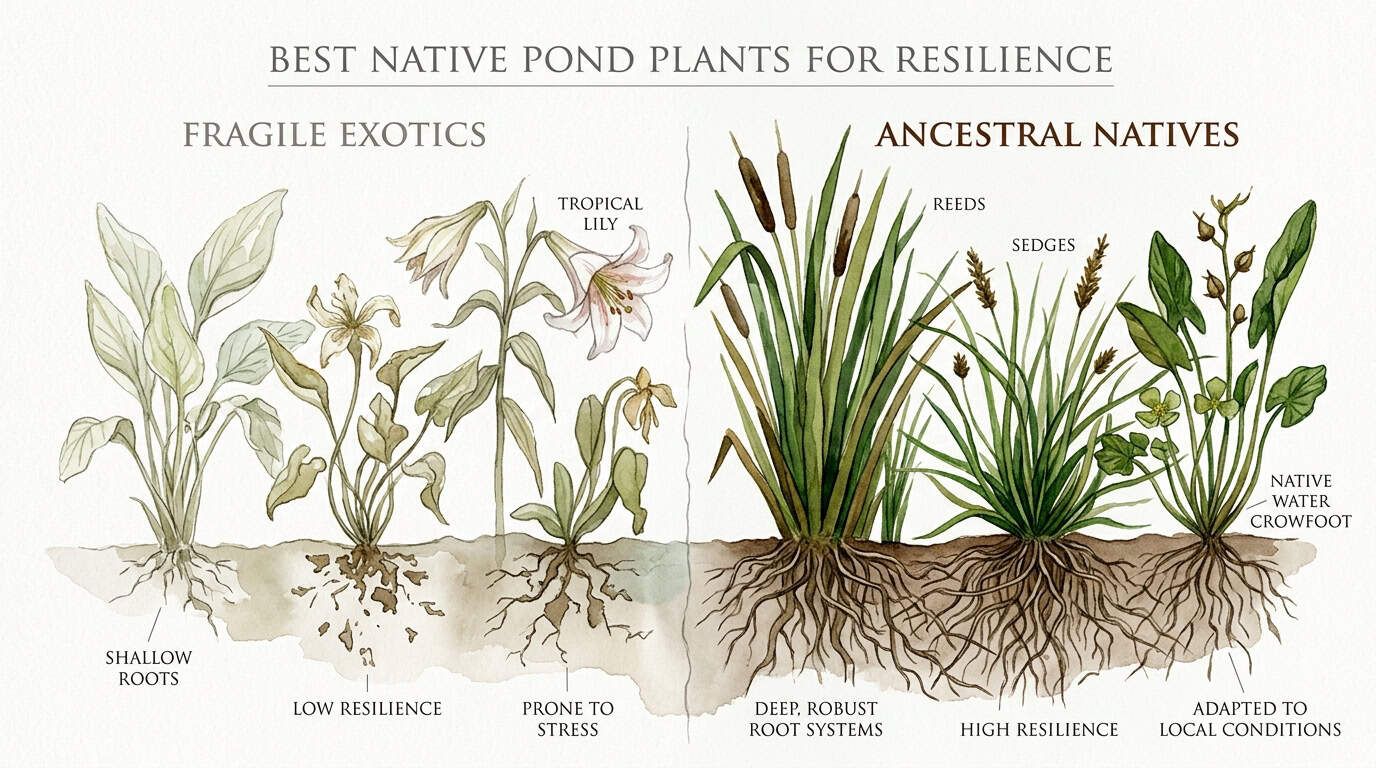
Modern hybrids require a life-support system; ancestral natives require nothing but water. We have been conditioned to buy the flashiest tropical imports every spring, only to watch them die by winter. The ancestral plants native to your region have spent thousands of years perfecting the art of seasonal survival. Switching to natives means less replanting, less disease, and a pond that actually helps the local ecosystem thrive.
Managing an aquatic ecosystem requires a shift from aesthetic-driven gardening to biological systems engineering. Exotic species often lack the physiological adaptations necessary to manage local nutrient loads or survive thermal fluctuations without mechanical assistance. In contrast, ancestral natives function as high-efficiency biological filters, integrating seamlessly into the nitrogen cycle and providing structural stability to the pond substrate.
Best Native Pond Plants For Resilience
Resilience in an aquatic environment is defined by a plant’s ability to maintain metabolic functions despite high variance in water chemistry and temperature. For North American temperate ponds, specific taxa have evolved to maximize nutrient sequestration while minimizing energetic output for maintenance.
Sagittaria latifolia (Broadleaf Arrowhead)
Known technically as a high-capacity emergent macrophyte, Sagittaria latifolia is a primary candidate for nutrient-heavy systems. Research indicates that this species can extract significant amounts of phosphorus directly from the sediment, sequestering it within its leaf tissue at rates higher than many other wetland species. Its starchy tubers, often called “duck potatoes,” serve as carbohydrate reservoirs that ensure survival through sub-zero dormancy.
Nymphaea odorata (Fragrant Water Lily)
Unlike tropical hybrids that require water temperatures above 70°F (21°C) to prevent dormancy-induced decay, Nymphaea odorata is a hardy perennial capable of surviving in USDA Zone 4. Its large, floating orbicular leaves provide essential solar shielding, reducing the thermal gain of the water column and suppressing photoautotrophic algae growth. The spongy rhizomes are anatomically specialized with hollow air channels (aerenchyma) that facilitate oxygen transport to the anaerobic muck layer.
Juncus effusus (Common Rush)
This species serves as a critical component for shoreline stabilization and mechanical filtration. Its cylindrical stems possess high tensile strength, allowing them to dissipate wave energy and prevent bank erosion. From a chemical perspective, the rhizosphere of Juncus effusus supports diverse microbial communities that catalyze the conversion of ammonia into less toxic nitrates.
Ceratophyllum demersum (Hornwort)
As a rootless submerged macrophyte, Ceratophyllum demersum functions as an apex oxygenator. It derives its nutrients entirely from the water column, making it an efficient tool for reducing dissolved nitrogen and phosphate. Technical data shows that this species can outcompete planktonic algae for resources, effectively clearing the water through nutrient limitation.
How the Native Ecosystem Functions
The integration of native plants into a pond system utilizes the principles of phytoremediation and biological nutrient cycling. This process is not merely about plant growth but involves a complex synergy between plant physiology and microbial activity.
The Nitrogen Assimilation Process
Plants absorb nitrogen primarily in two forms: ammonium (NH4+) and nitrate (NO3-). Technical studies have shown that many native aquatic plants, such as Pontederia cordata and Phragmites australis, exhibit a significant preference for ammonium. This is energetically favorable because the plant does not have to expend metabolic energy to reduce nitrate back into ammonium for amino acid synthesis.
Rhizosphere Filtration
The root zone, or rhizosphere, of native emergent plants acts as a localized bioreactor. The plants pump oxygen down into the roots, creating aerobic micro-zones within the otherwise anaerobic pond bottom. This allows nitrifying bacteria (Nitrosomonas and Nitrobacter) to colonize the root surfaces, where they process fish waste and organic debris into plant-available nutrients.
Biomass Accumulation and Sequestration
Natives are optimized for seasonal biomass production. During the growing season, they rapidly convert dissolved minerals into plant tissue. As the plants enter senescence in the fall, they translocate mobile nutrients (like nitrogen and potassium) back into their root systems for storage. This cycle prevents the sudden release of nutrients into the water, which would otherwise trigger an algae bloom during the spring thaw.
Advantages of Ancestral Native Integration
The mechanical and biological advantages of native species over exotics can be quantified through efficiency metrics and resource consumption.
Thermal Regulation and Stability
Native floating-leaved plants are adapted to provide 50-70% surface coverage. This coverage maintains water temperatures significantly lower than exposed ponds. High water temperatures lead to lower dissolved oxygen (DO) levels, which can stress or kill aquatic fauna. Natives maintain DO stability by preventing rapid temperature spikes.
Reduced Mechanical Filtration Requirements
A pond heavily stocked with native macrophytes reduces the load on mechanical bead filters and UV sterilizers. The plants themselves act as a biological filter. For every 10 square feet of healthy native plant coverage, the biological loading capacity of the pond increases, allowing for higher stocking densities of fish or lower pump run times.

Pest and Pathogen Resistance
Exotic tropicals are often susceptible to local pests, requiring chemical treatments that can disrupt pond chemistry. Native species have co-evolved with local insect populations and fungi. They possess natural chemical defenses (secondary metabolites) that prevent devastating infestations, eliminating the need for algicides or pesticides.
Challenges and Common Pitfalls
While native plants are superior in resilience, their management requires an understanding of their growth patterns and potential for dominance.
Invasive-like Growth Patterns
Some natives, such as Typha latifolia (Cattail), are highly aggressive. Without containment, their rhizomes can colonize the entire shallow margin of a pond in a single season. This rapid expansion can lead to “pond creep,” where the water surface area is progressively lost to emergent vegetation.
The “Messy” Aesthetic Misconception
Practitioners often mistake the natural senescence of natives for a system failure. Unlike evergreen tropicals that look uniform until they die, natives go through a visible transition into dormancy. Browned foliage is a sign of nutrient translocation, not disease. Failing to prune this dead biomass before the winter freeze can result in excessive organic buildup on the pond floor.
Substrate Selection Errors
Planting natives in pure gravel or sterile media often leads to nutrient deficiency. While they can pull nutrients from the water, many emergent natives require a heavy loam or clay-based substrate to anchor their expansive root systems and access mineral deposits.
Limitations of Native Plant Systems
Native pond plants are not a universal solution for every aquatic configuration. Their effectiveness is bound by environmental and spatial constraints.
Regional Specificity
A plant considered a “native” in the Florida Everglades is a “fragile exotic” in Minnesota. Using a native from the wrong ecoregion negates the benefits of resilience. Practitioners must source plants specifically adapted to their local hardiness zone and water chemistry (pH, alkalinity).
Water Depth Constraints
Most native emergent plants have a strict operational depth, typically between 2 and 12 inches. If a pond is designed with vertical walls and no shallow shelves, the integration of these high-efficiency filters becomes structurally impossible without the use of floating islands or hanging baskets.
Establishment Phase Vulnerability
While mature natives are nearly indestructible, young plugs are vulnerable. They can be easily dislodged by large fish like Koi or outcompeted by existing algae if not given a protective “settling” period. Until the root system is established, the plant’s nutrient uptake efficiency is a fraction of its potential.
Comparison: Fragile Exotics vs. Ancestral Natives
The following data outlines the operational differences between standard tropical imports and native species across key performance indicators.
| Metric | Fragile Exotics (Tropicals) | Ancestral Natives (Hardy) |
|---|---|---|
| Overwintering Cost | High (Heated tanks or annual replacement) | Zero (Natural dormancy) |
| Nitrogen Uptake Rate | Variable (Temperature dependent) | High (Sustained throughout season) |
| Maintenance Man-Hours | 3-5 hours/month (Fertilizing, pest care) | 1 hour/month (Occasional thinning) |
| Ecological Integration | Low (Limited pollinator value) | High (Host plants for local fauna) |
| Chemical Requirements | Frequent fertilization/algicides | Minimal (Self-sustaining in balanced systems) |
Practical Tips for Implementation
Integrating native plants effectively requires a mechanical approach to planting and placement.
- Zone Planting: Divide your pond into zones by depth. Place oxygenators like Hornwort in the deep center, floating-leaved plants like Water Lilies in the mid-depths, and emergents like Pickerelweed in the shallow margins.
- Containment Strategy: Use heavy-duty, no-hole aquatic pots for aggressive species like Cattails. This allows the plant to provide filtration benefits without taking over the entire footprint.
- Biomass Removal: In late fall, prune dead foliage about 2 inches above the water line. Removing this material prevents the organic matter from decomposing in the water over winter, which keeps nutrient levels low for the spring.
- Substrate Optimization: Use a mix of 70% unscreened clay and 30% topsoil. Avoid peat-based potting soils, as they will float and release tannins that cloud the water.
Advanced Considerations: Phytoremediation and BNI
For serious practitioners, the use of native plants goes beyond simple filtration. Advanced concepts like Biological Nitrification Inhibition (BNI) and heavy metal sequestration can be utilized to manage highly polluted or high-stocking-density systems.
Biological Nitrification Inhibition (BNI)
Some native grasses and sedges release specialized compounds from their roots that inhibit the rapid conversion of ammonium to nitrate by bacteria. This may seem counterintuitive, but it allows the plant to “save” the ammonium for itself, preventing nitrogen loss through leaching or denitrification. This creates a more stable, closed-loop nutrient cycle.
Heavy Metal Sequestration
Species like Sagittaria latifolia and Typha latifolia have been studied for their ability to accumulate heavy metals such as lead, zinc, and copper in their tissues. In urban areas where runoff may contain these pollutants, native plants act as a protective barrier, preventing these toxins from accumulating in the fish or local wildlife.
Example Scenario: Zero-Nitrate Pond Design
Consider a 1,000-gallon pond with a medium fish load. To achieve near-zero nitrate accumulation using only native plants, the following biomass ratio is required:
Step 1: Surface Coverage. Aim for 60% coverage using Nymphaea odorata. For a 10’x10′ pond, this means approximately 6 large lily pads. This reduces UV penetration and limits algae’s ability to fix carbon.
Step 2: Submerged Biomass. Add 10-15 bundles of Ceratophyllum demersum. These act as the primary water-column scrubbers, absorbing nitrates and phosphates that the lilies cannot reach.
Step 3: Emergent Perimeter. Plant a 2-foot wide “bio-shelf” along 50% of the pond perimeter with a mix of Pontederia cordata and Juncus effusus. These plants provide the microbial surface area needed to process the ammonia produced by the fish.
Using this configuration, the biological oxygen demand (BOD) is met primarily by the plants, and the nitrate levels will typically remain below 5 ppm without the need for frequent water changes.
Final Thoughts
Relying on native aquatic plants is a shift toward ecological efficiency. By selecting species that have evolved within your specific climate, you eliminate the metabolic stress that kills exotic imports. These ancestral natives are not just decorative additions; they are the mechanical components of a self-regulating water treatment system.
A pond built around native species requires less financial investment in chemicals and replacement plants. It operates with a higher level of stability, managing nutrient spikes and temperature swings with biological precision. The end result is a system that functions as a true habitat, where the plants and water quality are maintained by natural processes rather than constant human intervention.
Experimenting with local species like Arrowhead or Pickerelweed will demonstrate the difference in vigor and filtration capacity. As the system matures, the reduction in maintenance man-hours and the increase in water clarity will validate the move from fragile exotics to resilient ancestral natives.
Amazon and the Amazon logo are trademarks of Amazon.com, Inc, or its affiliates.