

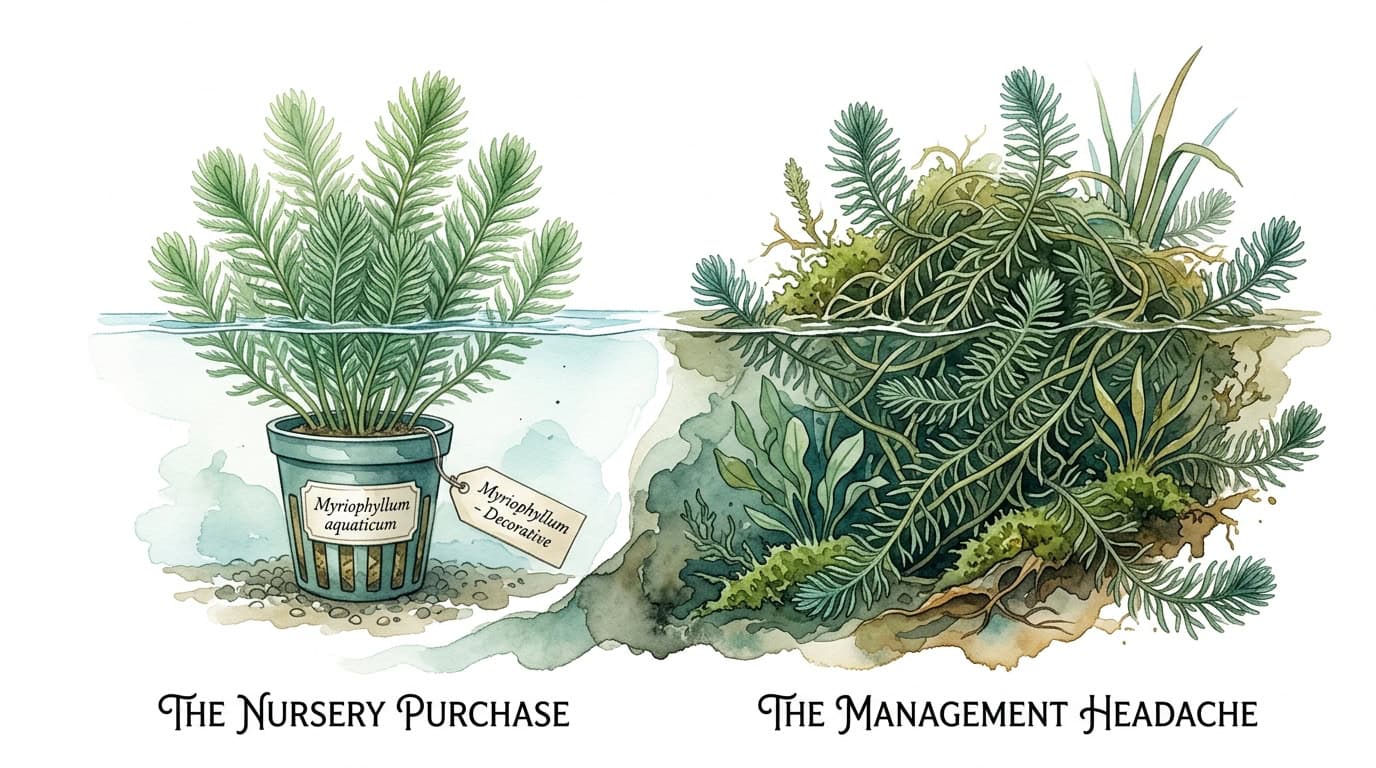
Don’t buy a problem. If you already have Parrot Feather, here is how to stop the spread. Its feathery foliage is striking, but Parrot Feather is a ‘super-invader’ that grows above and below the water. Don’t let your decorative plant become a natural disaster.
The Nursery Purchase vs The Management Headache often begins with a single potted specimen. This aquatic perennial, known scientifically as Myriophyllum aquaticum, originates from the Amazon River basin. It has successfully transitioned from a popular aquarium plant to a high-risk invasive species across five continents.
Effective management requires an objective understanding of its biological architecture and mechanical resilience. This guide provides a technical framework for identifying, treating, and suppressing Parrot Feather populations in both decorative and natural aquatic systems.
How To Treat Parrot Feather In Decorative And Natural Ponds
Myriophyllum aquaticum is a vascular macrophyte characterized by heterophylly, meaning it produces two distinct leaf forms. The submerged leaves are soft, filamentous, and typically reddish-orange. The emergent leaves are grayish-green, stiff, and arranged in whorls of four to six around a robust stem. These emergent stems can extend up to 30 centimeters above the water surface, resembling small coniferous trees.

This species thrives in shallow, nutrient-rich (eutrophic) freshwater environments. It is commonly found in drainage ditches, slow-moving streams, and the littoral zones of lakes and ponds. Because it must remain rooted in the sediment, depth is a primary limiting factor. Stems typically reach lengths of 1.5 to 2 meters, though submerged runners can extend significantly further across the benthos.
Outside its native South American range, Parrot Feather populations are almost exclusively female. This means reproduction is entirely vegetative. A single plant fragment containing a node can develop into a new colony. This high regenerative capacity makes M. aquaticum one of the most difficult aquatic weeds to eradicate.
Treating Parrot Feather involves a choice between mechanical, chemical, and physical control methods. Selection depends on the scale of infestation, water flow rates, and environmental sensitivities of the site. Success is measured by the reduction of biomass and the prevention of downstream propagation.
Technical Methods for Eradication and Control
Managing Myriophyllum aquaticum requires a multi-stage approach. The goal is to maximize biomass removal while minimizing the production of viable fragments.
Mechanical Removal and Physical Extraction
Mechanical control is often the first line of defense for small, localized infestations. Technical practitioners prioritize hand-pulling or raking in closed systems where fragments can be contained.
Hand-pulling is effective for isolated clumps. Technicians must reach into the sediment to extract the entire rhizome system. Leaving the roots behind allows for rapid regrowth from stored carbohydrates. All extracted material should be placed in impermeable bags and transported to an off-site disposal facility to prevent re-entry into the watershed.

Mechanical harvesters are used for larger infestations. These machines cut and collect vegetation simultaneously. This method provides immediate hydraulic relief but carries high risks. Cutting blades inevitably create small fragments. If the harvester does not have a 100% recovery rate, the remaining fragments will drift and colonize new areas.
Chemical Treatment Protocols
Herbicides offer a more systemic solution for large-scale or dense mats. The choice of active ingredient depends on whether the target is the emergent foliage or the submerged biomass.
Systemic herbicides are preferred for long-term control. Active ingredients like Triclopyr and Imazapyr translocate through the plant’s vascular system into the rhizomes. Triclopyr is a selective broadleaf herbicide, making it ideal for ponds where native monocots (like grasses and lilies) must be preserved. Imazapyr is non-selective and highly effective but requires careful application to avoid off-target damage.
Contact herbicides like Diquat or Flumioxazin provide rapid “burn-down” of visible foliage. These are useful for clearing surface mats quickly. They do not kill the root system, meaning regrowth is inevitable within weeks or months. Contact herbicides are often used in “tank mixes” with systemic products to provide both immediate results and long-term suppression.
The emergent leaves of Parrot Feather have a thick, waxy cuticle designed to repel water. Standard herbicide applications will bead and roll off the foliage. Successful treatment requires the addition of a high-quality non-ionic surfactant or a methylated seed oil (MSO). These additives break surface tension and allow the chemical to penetrate the leaf tissue.
Physical and Environmental Manipulation
Physical controls alter the environment to make it inhospitable for M. aquaticum. Benthic barriers (large mats of plastic or fabric) can be placed on the pond bottom to compress the plants and block sunlight. This method is effective for small areas like boat ramps or swimming docks but is cost-prohibitive for entire lakes.
Drawdowns involve lowering the water level to expose the plants to desiccation or freezing. Parrot Feather rhizomes are relatively resistant to drying, so the water must be kept low for several months to ensure total mortality. This technique is only feasible in man-made reservoirs with water-control structures.
Benefits of Proactive Management
Controlling Parrot Feather restores the mechanical and ecological functionality of a water body. Unmanaged growth leads to severe degradation of the aquatic infrastructure.
Removal of dense mats improves hydraulic flow. Myriophyllum aquaticum increases the “roughness” of a channel, significantly slowing water movement. In drainage systems, this leads to sediment accumulation and increased flood risk during high-rain events. Maintaining clear channels ensures efficient water transport and reduces maintenance costs for culverts and pumps.
Water quality improves as native vegetation returns. Parrot Feather mats block sunlight, preventing the growth of native phytoplankton and submersed macrophytes. This leads to a decline in dissolved oxygen (DO) levels, especially at night when the plants consume oxygen through respiration. Restoring a balanced plant community stabilizes DO levels and supports healthy fish populations.
Management also reduces habitat for disease vectors. The stagnant, nutrient-rich water within a Parrot Feather mat is an ideal breeding ground for mosquitoes. By eliminating the mats, practitioners increase surface water movement and allow predatory fish access to mosquito larvae, providing a natural form of pest control.
Challenges and Common Mistakes
The primary challenge in Parrot Feather management is the “fragmentation trap.” Many users attempt to clear the weed using standard lawn tools or underwater weed rakes without proper containment.
One common mistake is using a weed whacker or mower on emergent stems at the water’s edge. This creates thousands of small, buoyant fragments. Each fragment can drift downstream and establish a new colony within days. Professionals use “bubble curtains” or physical nets to trap any escaping material during mechanical work.
Timing is another critical factor. Applying herbicides during a period of high water flow is often a waste of resources. The chemical is diluted before it can be absorbed by the plant. Similarly, treating too late in the autumn after the plant has entered dormancy will yield poor results, as the vascular system is no longer moving nutrients (and herbicides) to the roots.
Underestimating the waxy cuticle leads to many chemical failures. Using a standard agricultural herbicide without an aquatic-approved surfactant usually results in 0% efficacy. The plant simply sheds the liquid, and the active ingredient ends up in the water column rather than inside the target plant.
Limitations of Current Control Methods
No single method provides a “silver bullet” for Myriophyllum aquaticum. Every approach has environmental or logistical constraints.
Chemical treatments are restricted by water use regulations. If a pond is used for irrigation or livestock watering, there may be a mandatory “waiting period” after herbicide application. Some products, like 2,4-D, have strict labels regarding their use near potable water intakes. Always consult local regulations and product labels before application.
Environmental conditions can also limit efficacy. In highly turbid water, contact herbicides like Diquat lose effectiveness because the chemical binds to suspended sediment particles rather than the plant tissue. In these cases, systemic herbicides applied to the emergent foliage are the only viable chemical option.
Biological control remains a long-term goal but is not currently a localized solution for most pond owners. While the Lysathia beetle has been successful in South Africa, it is not yet widely available or approved for general use in many other regions. This leaves the burden of management on mechanical and chemical interventions.
Practical Comparison: Control Strategies
Choosing the right approach requires balancing cost, speed, and long-term effectiveness. The following table compares common management strategies for Myriophyllum aquaticum.

| Method | Initial Cost | Labor Intensity | Success Rate | Regrowth Risk |
|---|---|---|---|---|
| Hand-Pulling | Low | High | High (Small Areas) | Moderate |
| Mechanical Harvesting | High | Moderate | Immediate (Visible) | High (Fragmentation) |
| Systemic Herbicide | Moderate | Low | Very High | Low |
| Contact Herbicide | Low | Low | Moderate (Top-kill) | Very High |
| Benthic Barriers | High | High (Installation) | High (Underneath) | Low |
Best Practices for Technical Management
For those managing a Parrot Feather infestation, following a standardized protocol increases the probability of eradication.
Establish a containment zone before starting any physical work. Use fine-mesh netting downstream or around the perimeter of the work area. This ensures that no fragments escape the site. Check the nets frequently during the process to ensure they are not bypassed by water flow.
Use the “Rule of Thirds” when treating with herbicides in a closed system. Killing too much vegetation at once can lead to a massive spike in decomposition. As bacteria break down the dead plants, they consume all available dissolved oxygen, which can cause a total fish kill. Treat only one-third of the pond at a time, waiting 10 to 14 days between applications.
Integrate multiple methods for the best results. A highly effective strategy involves an initial chemical treatment to weaken the population and kill the root systems, followed by mechanical removal of the dead biomass. This removes the nutrients from the system and prevents the “rebound” effect often seen with singular treatments.
Advanced Considerations for Practitioners
Serious practitioners must account for the nutrient sequestration capabilities of Myriophyllum aquaticum. This plant is a “luxury consumer” of nitrogen and phosphorus. When it is killed and left to rot in the pond, those nutrients are released back into the water column.
This sudden nutrient load often triggers a secondary problem: massive algae blooms. To prevent this, consider applying a phosphorus-binding agent (like aluminum sulfate or lanthanum-modified clay) immediately following a large-scale Parrot Feather treatment. This “locks” the nutrients into the sediment and prevents them from fueling algae growth.
Monitor the site for at least three growing seasons after the last visible plant has been removed. Rhizomes can remain dormant in the sediment for extended periods. Early detection of “pioneer” shoots allows for spot-treatment, which is significantly cheaper and easier than managing a full-scale re-infestation.
Example Scenario: Remediating a 1-Acre Eutrophic Pond
Consider a one-acre pond with 40% coverage of Parrot Feather. The water is slow-moving, and the average depth is 1.5 meters.
A technician would first select a systemic herbicide like Triclopyr (formulated as Garlon 3A or Renovate 3). Based on a typical label rate of 2.5 ounces per gallon of mix, the applicator would prepare a foliar spray with a 0.5% v/v non-ionic surfactant.
The pond is divided into three zones. Zone A is treated on Day 1. The technician uses a backpack sprayer to thoroughly wet the emergent foliage, ensuring the spray does not “run off” the waxy leaves. On Day 14, Zone B is treated. By this time, the vegetation in Zone A should be showing signs of epinasty (twisting and browning). On Day 28, Zone C is treated.
Six weeks after the final treatment, the biomass has collapsed. The technician now uses a long-reach rake to pull the dead material to the shore, where it is allowed to dry completely before being composted away from the water. This process removes roughly 1,500 pounds of wet organic matter and associated nutrients from the pond ecosystem.
Final Thoughts
Myriophyllum aquaticum is a biological challenge that demands a disciplined, technical response. Its ability to regenerate from fragments and resist standard herbicide applications makes it a formidable opponent in aquatic management. Successful control is not achieved through a single application but through a sustained program of monitoring and multi-modal intervention.
Prioritizing the health of the entire aquatic system is essential. By understanding the mechanical limits of the plant—such as its depth requirements and fragmentation risks—practitioners can deploy tools more effectively. Whether using systemic chemicals to target the root system or physical barriers to shade out growth, the objective remains the same: the restoration of native biodiversity and hydraulic efficiency.
Consistency is the hallmark of a successful management plan. Those who treat Parrot Feather as a one-time task will likely see a return of the infestation. Those who view it as a multi-year optimization process will successfully protect their water resources from this invasive super-invader. Apply these principles, monitor your results, and maintain the integrity of your aquatic environment.