

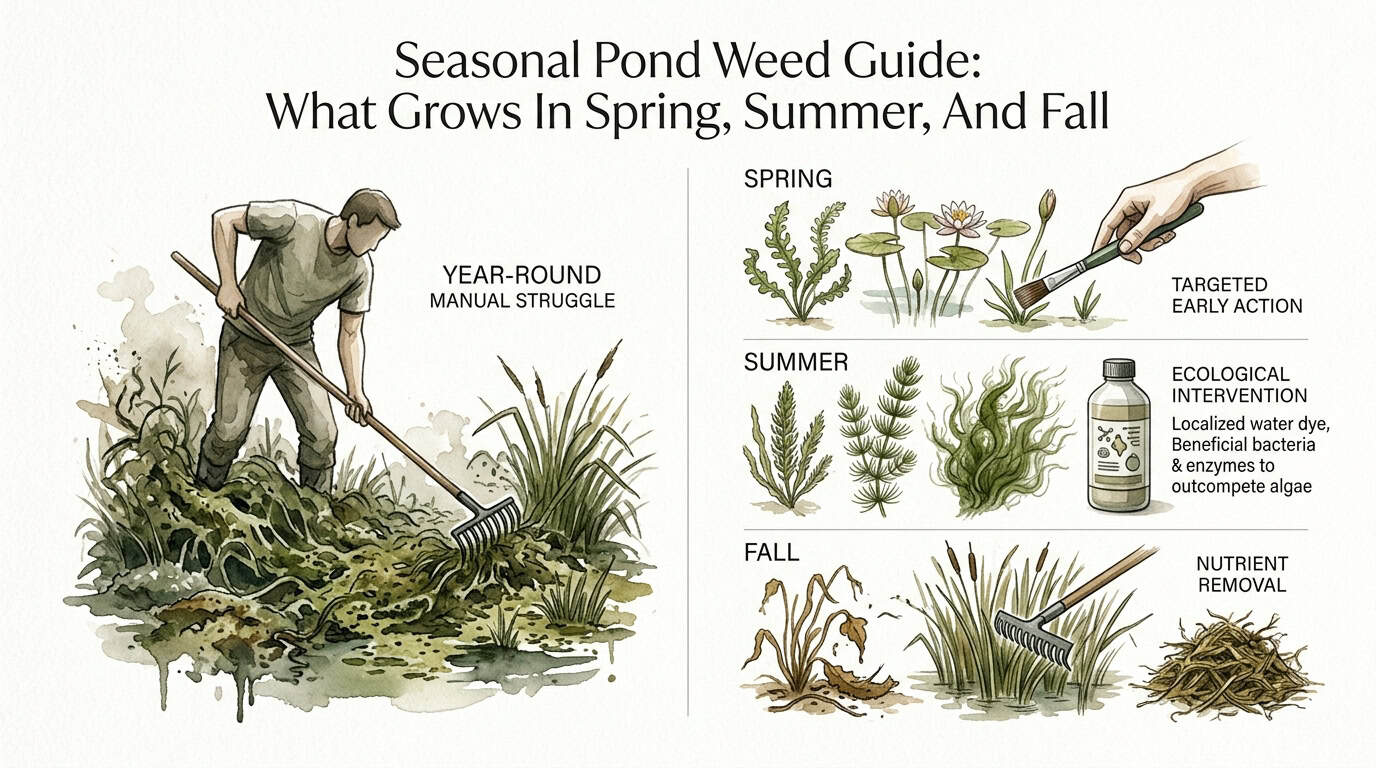
Work with the seasons, not against them. If you’re raking in July, you missed the window in March. Every weed has a season. Learn when to act so you can spend your summer swimming instead of raking. #PondCalendar #SeasonalLiving #SmartLandscaping
Managing an aquatic ecosystem requires an understanding of phenology—the study of cyclic and seasonal natural phenomena. For the pond manager, this translates to identifying specific physiological windows where vegetation is most vulnerable to intervention. Strategic management is not merely about biomass removal but about disrupting the lifecycle of nuisance species before they reach peak metabolic rates.
The Year-Round Manual Struggle vs The Seasonal Strategic Strike represents the difference between reactive and proactive maintenance. A reactive approach addresses high-density mats in mid-summer, which significantly increases the risk of dissolved oxygen (DO) depletion. Conversely, a strategic strike targets plants during early growth phases when biomass is low and nutrient sequestration is just beginning.
Effective pond management relies on data-driven timing. By monitoring water temperatures and identifying the first signs of germination, a manager can deploy mechanical or chemical controls with higher efficiency and lower environmental impact. This article outlines the technical progression of aquatic plant growth and the corresponding optimization strategies for each season.

Seasonal Pond Weed Guide: What Grows In Spring, Summer, And Fall
Aquatic vegetation follows a rigorous biological schedule dictated by water temperature, photoperiod, and nutrient availability. In the spring, as water temperatures rise above 40°F (4°C), cold-tolerant species such as curly-leaf pondweed (Potamogeton crispus) and filamentous algae begin their growth cycles. These species often emerge while native plants are still dormant, allowing them to establish dominance in the littoral zone.
Summer marks the period of peak biomass production. When water temperatures exceed 60°F (15.5°C), the metabolic rate of aquatic plants increases exponentially. Invasive species like Eurasian watermilfoil (Myriophyllum spicatum) can grow up to several inches per day during this window. This rapid expansion leads to the formation of dense surface mats that shade out benthic organisms and impede gas exchange at the air-water interface.
Fall transitions the ecosystem into a period of senescence and propagule production. Many submersed plants begin to transfer energy from their foliage into reproductive structures like turions or rhizomes. For instance, curly-leaf pondweed produces turions that sink to the sediment, remaining viable for multiple years. Understanding these transitions is critical for timing removals so that the nutrient load within the plant tissue is extracted from the system rather than being recycled into the muck.
Spring: The Emergence Phase
Early season growth is dominated by “winter annuals” and opportunistic algae. Filamentous algae, often referred to as “pond scum,” begins as benthic mats before buoying to the surface as oxygen bubbles get trapped in the fibrous matrix. Curly-leaf pondweed is particularly aggressive in spring, with its unique life cycle allowing it to reach the surface by early May in temperate climates.
Summer: The Biomass Peak
During June and July, the pond reaches its highest levels of primary productivity. Submersed macrophytes like Coontail and Elodea expand rapidly. Floating species such as duckweed (Lemna minor) and watermeal can cover the surface entirely, potentially leading to thermal stratification where the surface water becomes significantly warmer than the oxygen-depleted bottom layers.
Fall: The Nutrient Sink
As daylight hours shorten, plants begin to die back. This senescence releases nitrogen and phosphorus back into the water column, often fueling secondary late-season algae blooms. Management in this phase focuses on removing dead material to prevent the accumulation of organic sludge (muck) on the pond floor.

How To Implement Seasonal Control Strategies
Executing a seasonal strike requires a combination of monitoring and mechanical or chemical application. The first step is establishing a baseline via water temperature tracking. Most systemic herbicides and biological controls, such as triploid grass carp, have specific thermal thresholds for efficacy. For example, many aquatic herbicides require water temperatures in the 60°F to 70°F range to ensure the plant is actively translocating the active ingredient.
Mechanical removal should be timed to capture the plant after it has pulled nutrients from the sediment but before it releases seeds or turions. For curly-leaf pondweed, this window typically closes by late June. Using a high-tensile aquatic rake or a motorized harvester allows for the physical extraction of nitrogen and phosphorus from the pond, which is a key advantage over chemical-only methods that leave decaying matter in the water.
Integrated Pest Management (IPM) involves using multiple tools in a specific sequence. A common professional protocol involves an early spring application of a nutrient binder (like Alum or Phoslock) to sequester phosphorus, followed by mechanical harvesting of early-emerging weeds in May, and spot-treating recalcitrant species in July. This prevents any single species from reaching a “tipping point” where it dominates the entire volume of the pond.
Benefits of Strategic Seasonal Management
The primary benefit of seasonal timing is the maximization of resource efficiency. Treating a pond in early spring requires significantly less herbicide—sometimes up to 50% less—than treating a fully matured infestation in July. This is due to the lower total biomass present and the higher susceptibility of young, tender plant tissue to chemical uptake.
Ecological stability is significantly higher when management occurs in sync with seasonal cycles. By removing invasive species early, you provide a competitive advantage to native plants that provide better habitat for fish and invertebrates. Furthermore, early-season removal avoids the “biomass crash” associated with late-summer treatments, which can cause dissolved oxygen levels to drop below the 5.0 mg/L threshold necessary for fish survival.
Long-term nutrient reduction is perhaps the most critical measurable benefit. Every pound of plant material removed from the pond represents a measurable quantity of phosphorus and nitrogen that will not contribute to next year’s growth. Mechanical harvesting in late spring or early summer is essentially a form of “mining” nutrients out of the ecosystem, leading to clearer water and less muck accumulation over several seasons.
Challenges and Common Pitfalls
One of the most frequent errors is waiting until the vegetation is “visible” or “unsightly” before taking action. By the time a pond is covered in surface mats, the plants have already established extensive root systems and potentially released reproductive propagules. This delay forces the manager to use more aggressive measures, which increases the risk of collateral damage to non-target species.
Incorrect identification often leads to the use of ineffective tools. For instance, using a contact herbicide like copper sulfate on a rooted vascular plant like Eurasian watermilfoil will only “burn” the surface leaves, leaving the root system intact for rapid regrowth. Conversely, using a systemic herbicide on filamentous algae is ineffective because algae lack the vascular system required to translocate the chemical.
Failure to account for fragmentation is a major challenge during mechanical removal. Species like milfoil and fanwort can regenerate from tiny stem fragments. If a manager uses a harvester or rake without containing and removing all cut pieces, they may inadvertently spread the infestation to other parts of the pond. This is why thorough collection is as important as the cutting process itself.
Limitations and Environmental Constraints
Environmental factors can impose hard limits on management options. High water flow or heavy rainfall shortly after a chemical treatment can dilute the product below the required parts-per-billion (ppb) concentration, rendering the application useless. Similarly, high turbidity (cloudy water) can interfere with the efficacy of certain herbicides like Diquat, which binds to suspended soil particles rather than the target weeds.
Thermal constraints are a physical reality for biological controls. Triploid grass carp, while effective, have reduced metabolic activity in cooler water. If stocked in late fall, they may not begin significant consumption until the following spring, by which time invasive weeds may have already established a canopy. Furthermore, in very shallow ponds, high summer temperatures can reduce the water’s oxygen-carrying capacity, making any form of biomass decay (natural or induced) a risk to the fishery.
Regulatory boundaries must also be considered. Many regions require permits for the application of aquatic herbicides or the stocking of certain fish species. These regulations often include “blackout dates” to protect spawning fish or nesting waterfowl, which may conflict with the “ideal” biological window for weed control. Compliance with these rules is mandatory and requires advanced planning.
Comparison of Management Methods
Choosing the right method depends on the scale of the infestation, the target species, and the desired outcome. The following table compares the three primary approaches based on technical metrics.
| Metric | Mechanical Removal | Chemical Control | Biological (Grass Carp) |
|---|---|---|---|
| Selectivity | High (Surgical) | Moderate to High | Low (Non-selective) |
| Nutrient Impact | Removes N/P from system | Recycles N/P into muck | Recycles N/P via waste |
| Labor Intensity | High | Low | Very Low |
| Speed of Results | Instant | 7-21 Days | 1-2 Seasons |
| Cost per Acre | Moderate/High | Moderate | Low |
Practical Tips for Pond Optimization
Begin monitoring water clarity and temperature as soon as the ice melts. A Secchi disk can be used to measure water transparency; a sudden increase in clarity often precedes a massive submersed weed bloom as sunlight reaches deeper into the water column. If clarity is high, consider applying a pond dye in early spring to limit light penetration and suppress photosynthesis in deeper zones.
Focus on littoral zone “spot cleaning.” The edges of a pond, usually the first 5-10 feet of depth, are where the most biomass is produced. By keeping these areas clear through regular raking or localized treatments in May and June, you prevent the accumulation of organic matter that fuels late-season algae. This targeted approach is more efficient than attempting to manage the entire surface area of a large pond.
Aerate your water to maintain higher dissolved oxygen levels during the summer months. Sub-surface aeration systems (diffusers) help prevent thermal stratification and provide a “safety net” if you need to treat large areas of weeds chemically. Higher oxygen levels at the pond bottom also facilitate aerobic bacteria, which help digest the organic muck and naturally reduce the nutrient load over time.
Advanced Considerations: The TNC Cycle
Serious practitioners should understand the Total Nonstructural Carbohydrate (TNC) cycle of target plants. TNC refers to the stored energy (starches and sugars) within the plant’s roots and stems. Most aquatic perennials have a TNC minimum in the late spring as they expend energy to reach the surface. This is the physiological “weak point.” Treating with systemic herbicides during this TNC minimum ensures that the plant cannot recover, as it has no stored energy reserves left.
In contrast, TNC levels peak in the late summer and fall as the plant prepares for dormancy. Treating during this phase is often less effective because the plant is already shutting down and may not absorb the herbicide. However, some emergent species like cattails and water lilies are best treated in late summer when they are actively moving nutrients (and thus translocated herbicides) into their root systems for winter storage.
Mapping the pond’s bathymetry (depth contours) can further refine management. Understanding where the shallow shelves are located allows for the precise placement of bottom barriers or the targeted use of granular herbicides. Combining bathymetric data with species-specific growth metrics allows for the creation of a multi-year management plan that shifts the ecosystem from a weed-dominated state to one of balanced native growth.
Example Scenario: 1-Acre Retention Pond
Consider a 1-acre retention pond with a history of Eurasian watermilfoil and filamentous algae. In a reactive scenario, the owner waits until July when the pond is 70% covered. They apply a heavy dose of herbicide, causing a massive biomass die-off. This results in a DO crash, a minor fish kill, and a secondary algae bloom in August fueled by the decaying milfoil.

In the strategic scenario, the owner begins in late March by applying a pond dye to reduce light reaching the bottom. In mid-April, when water temperatures hit 55°F, they use a long-reach rake to remove early filamentous algae. In mid-May, as the milfoil begins to reach for the surface but has not yet “topped out,” they perform a spot treatment with a systemic herbicide. Because the biomass is 80% lower than it would be in July, they use a fraction of the chemical, and the dissolved oxygen remains stable. By June, the pond is clear and healthy, requiring only minimal maintenance for the remainder of the season.
Final Thoughts
Sustainable pond management is an exercise in biological timing. By understanding the specific growth phases of aquatic vegetation—from the early germination of curly-leaf pondweed to the peak metabolism of milfoil—managers can intervene with higher precision and lower costs. Moving from a reactive manual struggle to a seasonal strategic strike reduces the total nutrient load of the pond and fosters a more resilient ecosystem.
Effective management requires a combination of physical removal, chemical intervention, and nutrient sequestration. No single tool is a panacea; rather, the success of a pond management program is determined by the integration of these methods within the correct phenological windows. Consistent monitoring of water temperature and clarity provides the data necessary to make these decisions with confidence.
Encourage the development of native plant communities once invasive species are under control. A balanced pond with diverse native vegetation is naturally more resistant to future invasions and provides a more stable habitat for wildlife. By working with the natural rhythm of the seasons, you ensure the long-term health and usability of your aquatic resource.