

Pond Talk is an Amazon Associate. As an Amazon Associate we earn from qualifying purchases.
When you kill the algae with chemicals, you’re also killing the microscopic clean-up crew that keeps it away. Standard algaecides create a ‘Ghost Pond’—it looks clear for a week, but the biological engine is dead. Without microbes to process nutrients, the next algae bloom will be twice as aggressive. The secret isn’t a ‘clean’ pond; it’s a ‘living’ one.
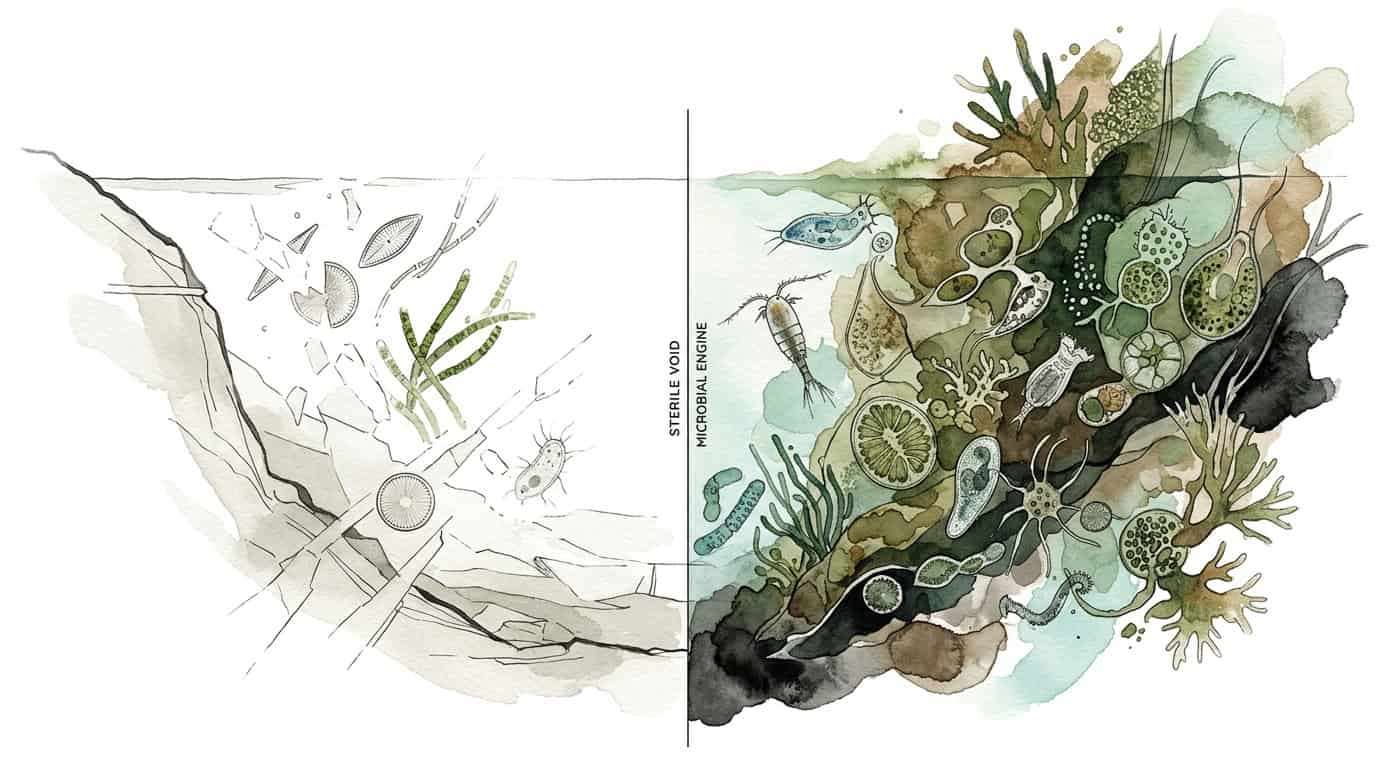
Maintaining a pond environment requires a shift in perspective from cosmetic management to biochemical optimization. While the immediate elimination of filamentous or planktonic algae provides a short-term optical improvement, the resulting “Sterile Void” destabilizes the aquatic ecosystem. Transitioning to a “Microbial Engine” involves cultivating specific bacterial colonies that function as the primary nutrient processors for the system.
Practical pond management often fails because users treat the symptoms—algal biomass—rather than the systemic cause, which is nutrient loading. High concentrations of Nitrogen (N) and Phosphorus (P) act as the fuel for these blooms. When chemicals intervene, they leave the fuel in the water column while removing the only mechanisms capable of sequestering it.
Algaecide Side Effects On Pond Life
Chemical algaecides, particularly copper-based compounds like copper sulfate or chelated copper, operate as non-selective toxins. Their primary function is the disruption of cellular photosynthesis and enzyme activity within the target organism. However, these chemicals do not distinguish between nuisance algae and the beneficial biofilm that coats pond surfaces.
Copper sulfate remains the most widely utilized algaecide due to its low cost, yet it is a heavy metal that does not biodegrade. It precipitates out of the water column and accumulates in the bottom sediment, creating a toxic layer that prevents the growth of beneficial microorganisms. This accumulation leads to a “sterile bottom,” where the critical processes of decomposition are halted, allowing organic muck to build up indefinitely.
A second critical side effect is the “Oxygen Crash.” When a large volume of algae dies simultaneously after treatment, the decomposition process demands immense quantities of Dissolved Oxygen (DO). Microbial decomposers, if any survive the chemical application, work at an accelerated rate to break down the dead biomass, consuming oxygen and often driving levels below 1.5 mg/L. This hypoxic state is frequently the primary cause of fish kills following algaecide application.
Furthermore, the destruction of the microbial community results in a spike in Total Ammonia Nitrogen (TAN). Without nitrifying bacteria like Nitrosomonas and Nitrobacter, the ammonia released from decaying organic matter remains in its toxic, un-ionized form (UIA). This creates a lethal environment for aquatic life even if the water appears visually clear.
The Mechanics of the Microbial Engine
Establishing a functional microbial engine requires the introduction and support of specific bacterial strains capable of rapid nutrient sequestration and organic matter breakdown. Unlike the “Sterile Void” approach, which relies on chemical inputs, this system utilizes biological catalysts to maintain water quality.
Nitrification and Ammonia Conversion
The nitrogen cycle is the mechanical backbone of pond health. Ammonia enters the system through fish waste, decaying vegetation, and external runoff. In a healthy microbial engine, nitrifying bacteria convert toxic ammonia into nitrite, and subsequently into nitrate. While nitrate is less toxic, it still serves as a nutrient source for algae.
Heterotrophic Bacteria and Muck Reduction
Strains such as Bacillus subtilis and Bacillus velezensis are highly efficient at processing complex organic solids. These bacteria produce extracellular enzymes—proteases, amylases, and cellulases—that break down the cellular framework of dead plants and fish waste. Data indicates that targeted Bacillus applications can reduce sediment phosphorus by up to 60% and total nitrogen by up to 75% over a sustained period.
Phosphorus Sequestration
Phosphorus is often the limiting nutrient in freshwater systems. When phosphorus levels exceed 0.03 mg/L, the risk of significant algal blooms increases. Microbial solutions compete with algae by absorbing orthophosphates directly into their cellular biomass or by facilitating the precipitation of phosphorus into the sediment in a form that is less bioavailable to floating algae.
Benefits of a Biological Management Strategy
Adopting a biological approach provides measurable improvements in system stability and long-term maintenance efficiency. The move away from reactive chemical treatments toward proactive bio-augmentation results in a more resilient aquatic environment.
- System Homeostasis: Biological treatments do not cause the radical swings in pH or Dissolved Oxygen associated with chemical shocks.
- Reduced Muck Accumulation: Continuous microbial activity breaks down organic “sludge,” reducing the need for mechanical dredging or manual raking.
- Sustainable Nutrient Control: By addressing the root cause (excess N and P), the frequency and intensity of algae blooms naturally diminish over time.
- Environmental Safety: Microbial treatments are non-corrosive and pose zero risk of heavy metal accumulation in the soil or groundwater.
Challenges and Common Pitfalls
The most frequent error in pond management is “mixing methods.” Applying a copper-based algaecide to a pond recently treated with beneficial bacteria will immediately neutralize the microbial investment. You cannot run a “sterile” and “living” system simultaneously.
Temperature is another critical constraint. Most nitrifying and heterotrophic bacteria see a significant decline in metabolic activity when water temperatures drop below 50°F (10°C). Attempting to “kickstart” a microbial engine in mid-winter without cold-water specific strains is a waste of resources.

Poor aeration is a major bottleneck for biological systems. Microbes require oxygen to fuel the oxidation of ammonia and the breakdown of organic matter. If the pond has stagnant zones or low turnover rates, the bacteria will fail to colonize effectively, leading to anaerobic pockets that release hydrogen sulfide and other toxic gases.
Limitations of Microbial Management
Biological systems are not “instant fixes.” While an algaecide might clear a pond in 48 hours, a microbial engine may take 4 to 8 weeks to fully establish and begin outcompeting algae for nutrients. Users expecting immediate clarity often revert to chemicals too soon, resetting the biological clock.
External nutrient loading can also overwhelm a microbial system. If a pond receives constant high-phosphorus runoff from fertilized lawns or agricultural fields, the bacteria may not be able to process the volume of incoming nutrients fast enough to prevent a bloom. In these scenarios, physical barriers or buffer strips must be implemented alongside the biological treatment.
Comparison: Chemical vs. Biological Management
The following table summarizes the operational differences between the two primary management paradigms.
| Factor | Chemical (Sterile Void) | Biological (Microbial Engine) |
|---|---|---|
| Speed of Action | Rapid (24-72 hours) | Gradual (2-6 weeks) |
| Nutrient Impact | Leaves nutrients in water | Sequesters and processes nutrients |
| Oxygen Demand | High (risk of crash) | Stable (supports DO levels) |
| Long-term Cost | High (requires repetition) | Decreasing (system becomes self-sustaining) |
| Safety | Potential toxicity to fish/plants | Safe for all aquatic life |
Practical Tips for Implementation
Successful bio-augmentation requires precise execution. Follow these best practices to ensure the microbial engine reaches peak efficiency.
- Maximize Surface Area: Bacteria need a substrate to colonize. Adding biological filter media or textured rock surfaces increases the total “microbial housing” available in the system.
- Monitor Dissolved Oxygen: Ensure your aeration system is sized correctly. A general rule for decorative ponds is to turnover the entire volume of water once per hour. For larger ponds, use diffused aeration to provide oxygen at the sediment-water interface.
- Manage pH Levels: Nitrifying bacteria perform optimally between a pH of 7.5 and 8.5. If the water is too acidic, the microbial engine will stall, and ammonia will accumulate.
- Use Specialized Strains: Select a blend that includes both nitrifying (for ammonia) and heterotrophic (for sludge) bacteria. “All-in-one” products are often less effective than targeted, high-CFU (Colony Forming Unit) treatments.
Advanced Considerations for Practitioners
Serious practitioners should look into the role of enzymatic biocatalysts. These are non-living proteins that act as specialized “keys” to unlock complex organic molecules, making them easier for bacteria to digest. Adding a biocatalyst during the initial phase of a biological transition can accelerate the breakdown of existing muck by 30-40%.
Understanding the Carbon-to-Nitrogen (C:N) ratio is also vital. Heterotrophic bacteria require a carbon source to process nitrogen. In some ultra-clear ponds with high fish loads, the system may become “carbon limited.” Adding a small amount of a complex carbohydrate biostimulant can trigger a massive microbial bloom that strips the remaining nitrogen from the water.
Real-World Scenario: The Phosphorus Spike
Consider a 1-acre pond treated with a traditional copper algaecide to clear a heavy bloom of filamentous algae. Within 72 hours, the algae dies and sinks. This mass of decaying organic matter releases approximately 10-20 lbs of phosphorus back into the water column.
Because the copper also killed the Bacillus and Nitrosomonas colonies, there is no biological mechanism to process this release. Within 10 days, a new bloom—often a more resilient species of blue-green algae (cyanobacteria)—erupts to consume the available phosphorus. This cycle, known as the “Algaecide Rebound,” creates a dependency on chemical inputs.
In contrast, a pond managed with a microbial engine would have a standing population of Bacillus bacteria. As the algae naturally dies or is suppressed by biological competition, the bacteria immediately sequester the released phosphorus into their own cells, preventing the secondary bloom and maintaining water clarity.
Final Thoughts
Shifting from a “Sterile Void” to a “Microbial Engine” is a fundamental move toward ecological efficiency. Chemical solutions provide the illusion of control through immediate destruction, but they ultimately degrade the biological infrastructure required for long-term clarity. By fostering a diverse community of beneficial microorganisms, you create a system that actively works to clean itself.
The transition requires patience and a technical focus on water chemistry and aeration. Success is measured not just by the absence of algae, but by the stability of dissolved oxygen levels, the reduction of bottom sludge, and the homeostatic balance of the nitrogen cycle. Experimenting with different bacterial strains and support systems will provide the data needed to optimize any specific aquatic environment.
Amazon and the Amazon logo are trademarks of Amazon.com, Inc, or its affiliates.