

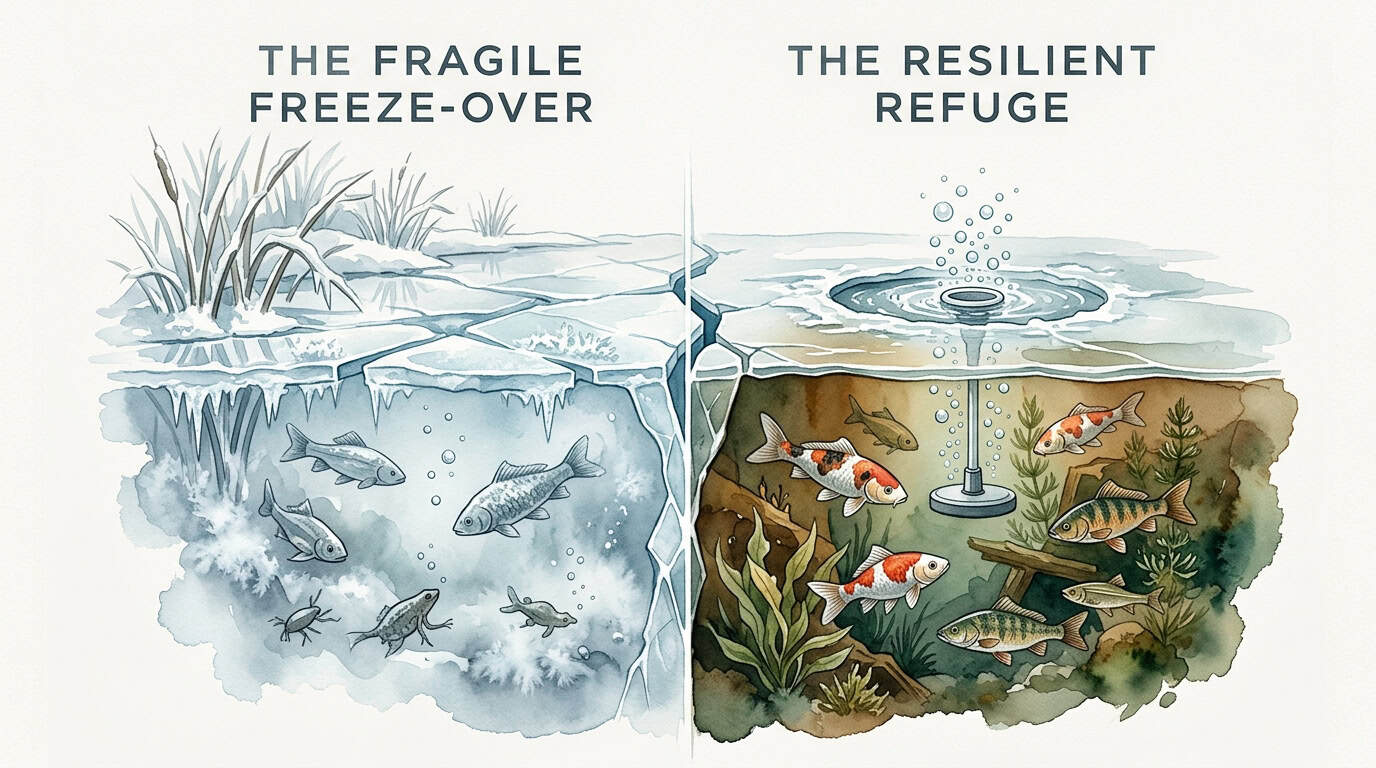
A frozen pond isn’t a dead pond—unless you let the gases build up. Ice is a lid that traps toxic gases. Learn the simple mechanical shifts that turn a fragile, frozen trap into a resilient winter sanctuary for your fish.
Winter pond management is an exercise in gas laws and thermal dynamics. When the surface of a pond seals with ice, the water column becomes a closed system. Photosynthetic oxygen production drops as snow blocks light penetration, while biological oxygen demand (BOD) persists through the decomposition of benthic organic matter. This imbalance creates a lethal environment for aquatic life if left unmanaged.
The transition from a thriving ecosystem to a “fragile freeze-over” occurs when the rate of gas accumulation exceeds the rate of atmospheric exchange. To prevent catastrophic failure, a practitioner must implement mechanical systems that facilitate degassing and maintain dissolved oxygen (DO) levels above critical thresholds. This guide provides the technical framework for optimizing winter pond resilience through calculated mechanical and chemical management.
Winter Pond Care For Fish And Wildlife
Winter pond care is the process of maintaining specific water quality parameters—primarily dissolved oxygen and toxic gas concentrations—during periods of sub-freezing temperatures. In temperate climates, ponds undergo a process called inverse stratification. Because water is at its maximum density at 39.2°F (4°C), this relatively “warm” water sinks to the bottom, creating a thermal refuge for fish. The surface layer, which is closer to the freezing point (32°F or 0°C), remains at the top until it crystallizes into ice.

This stratification is vital for the survival of cold-blooded organisms like koi, goldfish, and native sunfish. These species enter a state of torpor, where their metabolic rates drop to approximately 10% of their summer levels. However, even in this suppressed state, they require oxygen and must avoid exposure to high concentrations of metabolic waste products. Winter care focuses on ensuring this thermal layer remains stable while the surface remains permeable to gas exchange.
In real-world applications, such as professional aquaculture or managed backyard ecosystems, winter care is the difference between a successful spring restart and a total loss of biomass. It involves the deployment of aeration systems, de-icers, and the monitoring of the nitrogen cycle under extreme cold conditions.
How to Implement Mechanical Degassing and Aeration
The primary goal of winter pond mechanics is the maintenance of an opening in the ice, often referred to as a “breathing hole.” This is achieved through two main methods: diffused aeration and resistive heating.
Diffused Aeration Mechanics
Diffused aeration uses an air compressor located onshore to push air through weighted tubing to a diffuser placed on the pond floor or a suspended shelf. As the bubbles rise, they create a “muffin-top” effect at the surface. This physical agitation breaks the surface tension and prevents ice from forming in a specific radius. More importantly, the bubbles facilitate the transfer of oxygen into the water and the stripping of carbon dioxide (CO2) and hydrogen sulfide (H2S) out of the water.
Thermal Placement and Supercooling
Placement of the diffuser is critical. During summer, diffusers are placed at the deepest point to eliminate stratification. In winter, this is a fatal mistake. Placing a diffuser at the bottom of a deep pond will mix the 39.2°F (4°C) bottom water with the 32°F (0°C) surface water, causing the entire pond to drop toward the freezing point. This phenomenon, known as supercooling, can kill fish within hours. For winter operation, the diffuser should be moved to a shallow shelf, approximately 1/3 of the total depth, or suspended 12 to 18 inches below the surface.
Resistive De-Icers
Pond de-icers (or heaters) use electrical resistance to heat a small area of the surface. Unlike aerators, they do not add oxygen; they only ensure a vent for gases. Technical optimization requires selecting a de-icer with a wattage appropriate for the pond’s surface area and the local climate’s minimum temperature. A common standard is 100-250 watts for small ponds in mild winters, scaling up to 1500 watts for larger systems in arctic zones.

Benefits of Mechanical Winterization
Implementing a dedicated winterization strategy provides measurable improvements in ecosystem stability and fish health. These benefits are rooted in the maintenance of chemical equilibrium and thermal protection.
- Gas Stripping: Continuous agitation allows H2S and CO2 to escape. H2S, a byproduct of anaerobic decomposition, is toxic at levels as low as 0.002 ppm for many fish species.
- Dissolved Oxygen Stability: Cold water has a higher saturation capacity for oxygen (e.g., ~14 mg/L at 32°F vs. ~8 mg/L at 77°F). Mechanical aeration ensures the water reaches these levels, providing a buffer against the BOD of decaying plants.
- Biofilter Protection: While nitrifying bacteria (Nitrosomonas and Nitrobacter) slow down significantly below 50°F, they do not die. Maintaining DO levels ensures that these colonies remain viable for a faster spring “wake-up” cycle.
- Predator Deterrence: Moving water is more difficult for some predators, like herons, to navigate, although this is a secondary benefit compared to the biological factors.
Challenges and Common Mistakes
The most frequent errors in winter pond care involve physical disruptions and energy inefficiency. Understanding these pitfalls is essential for maintaining the “Resilient Refuge.”
Chopping the Ice
When a pond freezes over, many owners attempt to break the ice manually with a hammer or shovel. This is technically detrimental. Water is an excellent conductor of sound and pressure waves. The physical impact of striking the ice sends high-frequency vibrations through the water column that can rupture the swim bladders of torpid fish or cause acute stress-induced mortality. If an opening must be made, a kettle of hot water should be used to melt a hole quietly.
Overfeeding in Cold Water
Feeding fish when water temperatures are below 50°F (10°C) is a leading cause of winter death. In torpor, fish cannot digest protein effectively. The food remains in the gut, where it rots, leading to bacterial infections or internal blockages. Furthermore, any uneaten food adds to the organic load, increasing the BOD and toxic gas production under the ice.
Power Failure Vulnerability
Mechanical systems are only as resilient as their power source. A 24-hour power failure in a heavily stocked pond during a deep freeze can lead to immediate oxygen depletion. Serious practitioners often utilize battery backups or high-volume manual aeration kits as a secondary fail-safe.
Limitations of Winter Management Systems
Every mechanical system has its boundaries. Recognition of these constraints prevents the misapplication of technology in environments where it cannot succeed.
Environmental extremes, such as temperatures consistently below -20°F, can overwhelm standard de-icers. In these cases, the heat loss at the surface exceeds the heat output of the resistive element, causing the “breathing hole” to seal. Similarly, very shallow ponds (under 24 inches deep) lack the thermal mass to maintain a 39.2°F (4°C) bottom layer, regardless of management. In such environments, “The Fragile Freeze-Over” is inevitable, and fish should be overwintered indoors.
Furthermore, mechanical aeration is limited by the surface area of the bubbles. In extremely large ponds (over 1 acre), a single small aerator may not provide sufficient gas exchange for the entire biomass. Practitioners must calculate the Cubic Feet per Minute (CFM) required based on the pond volume and fish density to ensure adequate coverage.
Comparison: Pond Heaters vs. Aerators
The choice between a heater (de-icer) and an aerator is often a trade-off between energy efficiency and oxygenation capacity. The following table compares the two primary systems based on standard operational data.
| Factor | Floating De-Icer (Heater) | Diffused Aeration System |
|---|---|---|
| Primary Function | Maintains ice-free vent hole via heat. | Oxygenates and degasses via agitation. |
| Energy Consumption | High (250W – 1500W). | Low (10W – 60W for garden ponds). |
| Operating Cost | ~$15 – $50 per month. | ~$0.50 – $3.00 per month. |
| Oxygen Addition | Minimal (passive exchange only). | High (active transfer). |
| Risk of Supercooling | None. | High if diffuser is placed too deep. |
| Lifespan | 2–5 years (heating elements burn out). | 5–10 years (compressor rebuilds needed). |
Practical Tips and Best Practices
To optimize the performance of a winterized pond, follow these technical best practices:
- Install a DO Meter: For ponds with high-value koi, a Dissolved Oxygen meter is the only way to verify that the system is meeting the 5 ppm minimum requirement.
- Insulate Air Lines: Air lines running from a compressor to the pond can develop condensation, which freezes and blocks airflow. Use a larger diameter pipe for the onshore run or bury the line below the frost line.
- Clear the Snow: If the ice is clear, some photosynthesis can continue. Use a broom to clear snow from at least 25% of the pond surface to allow light penetration. Do not use a snowblower or heavy equipment that causes vibration.
- Check Water Levels: Evaporation still occurs in winter. A drop in water level can reduce the thermal mass and expose the liner to ice damage. Top off the pond with dechlorinated water if levels drop significantly.
Advanced Considerations: The Cold-Water Nitrogen Cycle
The relationship between ammonia, pH, and temperature is the most complex aspect of winter pond care. Ammonia (NH3) is highly toxic, while ammonium (NH4+) is relatively harmless. The ratio between these two is governed by the water’s temperature and pH.
In cold water (
To mitigate this, maintain a steady KH (carbonate hardness) level of at least 100 ppm to prevent pH swings, and be prepared to perform small, temperature-matched water changes if a warm spell is forecasted.
Example Scenario: Managing a 2,000-Gallon Koi Pond
Consider a 2,000-gallon pond with a depth of 4 feet and a stocking density of 10 medium koi. The practitioner is located in Zone 6, where surface ice reaches 4-6 inches in thickness.
The mechanical setup includes a 40-watt linear piston air pump and a 200-watt backup de-icer. The diffuser is placed on a shelf 18 inches below the surface. This setup provides approximately 1.5 CFM of airflow. In this scenario, the rising bubbles maintain an 18-inch diameter hole in the ice. This hole facilitates the escape of approximately 20-30 grams of CO2 per day, preventing acidosis in the fish.
During a week-long sub-zero snap, the de-icer kicks in when the air agitation is insufficient to keep the hole open against the encroaching ice rim. By keeping the diffuser at 18 inches, the bottom 30 inches of the pond remains at a stable 39°F, ensuring the koi stay in a safe state of torpor without the risk of supercooling or gas suffocation.
Final Thoughts
Successful winter pond management is a matter of mechanical consistency and biological monitoring. By understanding the physics of gas exchange and the thermal properties of water, a pond owner can transition from a “Fragile Freeze-Over” to a “Resilient Refuge.” The key is to facilitate the natural degassing process without disrupting the critical thermal layers that fish depend on for survival.
Mechanical aeration remains the most efficient and cost-effective method for maintaining winter water quality. While heating elements serve as a valuable fail-safe, the primary driver of health is the continuous exchange of toxic waste gases for life-sustaining oxygen. Practitioners should focus on equipment placement, energy efficiency, and the chemical shifts that occur as temperatures fluctuate.
Applying these principles ensures that the pond ecosystem remains dormant but healthy, ready for a vigorous and successful emergence in the spring. For those looking to deepen their expertise, exploring the nuances of redox potential and advanced automated sensor integration represents the next level of precision in aquatic management.