

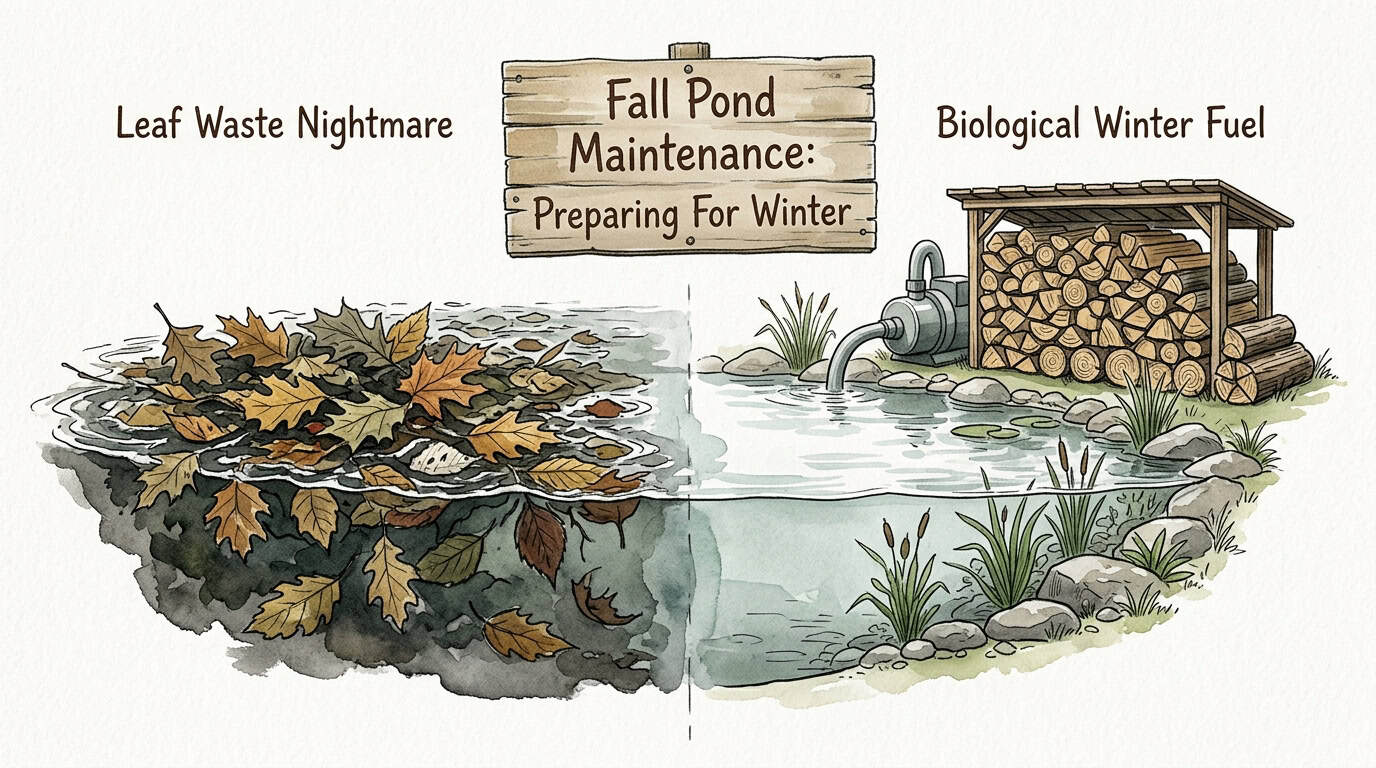
Don’t let fall debris turn your pond into a toxic gas chamber this winter. In the fall, every leaf that hits the water is either a future toxin or garden gold. Here is how to manage the transition to protect your ecosystem.
The transition from autumn to winter represents a critical shift in the biogeochemical stability of a pond. As photoperiods shorten and ambient temperatures decline, the metabolic rates of aquatic organisms and beneficial microbes undergo significant changes. Without intervention, the accumulation of allochthonous organic matter—primarily deciduous leaf litter—can overwhelm the system’s ability to process waste.
This article provides a technical roadmap for pond owners and professionals to optimize their filtration systems and water chemistry before the surface freezes. We will examine the mechanics of nutrient cycling, the role of psychrophilic bacteria, and the engineering requirements for maintaining dissolved oxygen in ice-covered environments. Understanding these variables is the difference between a successful overwintering and a systemic collapse.
Fall Pond Maintenance: Preparing For Winter
Fall pond maintenance is the systematic removal of organic debris and the recalibration of life-support equipment to account for declining temperatures. It exists as a preemptive measure to prevent “winterkill,” a phenomenon where fish die due to oxygen depletion and the accumulation of toxic gases under ice. In real-world situations, this process involves transitioning from high-flow summer filtration to specialized winter setups that prioritize gas exchange over mechanical debris removal.

The primary driver of winter water quality issues is the decomposition of organic solids. When leaves enter the pond, they sink to the benthos and form a “muck layer.” In warm water, aerobic bacteria rapidly break this material down. However, as temperatures drop below 50°F (10°C), standard mesophilic bacteria enter dormancy. If the debris remains, it undergoes anaerobic decomposition, producing methane and hydrogen sulfide (H2S), which cannot escape if the pond is sealed by ice.
Visualizing the pond as a closed-system bioreactor helps in understanding why this matters. During summer, the reactor has high energy input (sunlight) and high throughput (pump circulation). In winter, the energy input drops, and the system must rely on stored chemical energy. If the “fuel” (organic debris) is too high, the resulting chemical reactions will deplete the available oxygen, leading to a toxic environment.
The Mechanics of Decomposition and Gas Dynamics
Decomposition is a chemical process influenced by the Carbon-to-Nitrogen (C:N) ratio of the input material. Deciduous leaves, such as those from Oak or Maple, often possess C:N ratios exceeding 90:1. For efficient microbial breakdown, a ratio closer to 30:1 is required. This imbalance means that leaves decompose slowly in pond water, requiring a significant amount of dissolved oxygen (DO) to facilitate the process.
Gas exchange is governed by Henry’s Law, which states that the amount of dissolved gas in a liquid is proportional to its partial pressure above the liquid. Cold water naturally holds more dissolved oxygen than warm water. For instance, water at 32°F (0°C) can hold approximately 14.6 mg/L of DO, whereas water at 77°F (25°C) holds only 8.3 mg/L. However, this increased capacity is irrelevant if ice prevents the diffusion of oxygen from the atmosphere or the venting of CO2 and H2S.
The biological oxygen demand (BOD) increases as more organic matter is added to the system. If the BOD exceeds the rate of oxygen diffusion, the pond becomes hypoxic. Maintaining a hole in the ice using a de-icer or aerator is not merely about “keeping a hole open”; it is about maintaining a functional interface for gas molecules to cross the boundary between the liquid and gaseous phases according to their concentration gradients.
Step-by-Step Mechanical and Biological Optimization
Begin by deploying a pond net before the peak leaf drop occurs. A 1/4-inch to 1/2-inch mesh size is optimal for catching the majority of deciduous litter without significantly impacting the aesthetics of the water feature. Ensure the net is suspended above the water surface to prevent leaves from leaching tannins into the water column as they sit.

Implement a mechanical skimming routine to remove any debris that bypasses the netting. If your system uses a box skimmer, check the basket daily. For ponds without built-in skimmers, use a long-handled pond net to sweep the surface. The goal is to remove organic solids before they lose buoyancy and sink to the bottom where they become part of the benthic sludge layer.
Transition your biological filtration by introducing psychrophilic (cold-water) bacterial strains. These microbes are specifically evolved to remain metabolically active at temperatures as low as 35°F (1.6°C). Unlike standard summer bacteria, which go dormant at 50°F, these specialized strains continue to process ammonia and reduce sludge throughout the winter months. Dose these treatments weekly until the water temperature consistently stays below 40°F.
Adjust your aeration equipment. Move air stones or diffusers from the deepest part of the pond to a shallower shelf (approximately 12 to 18 inches deep). This prevents the “super-cooling” of the bottom water where fish congregate. In winter, the deepest water is typically the warmest (around 39°F due to the density of water), and maintaining this thermal layer is essential for the survival of ectothermic organisms.
Quantifiable Benefits of Pre-Winter Intervention
The most immediate benefit is the stabilization of dissolved oxygen levels. By removing the primary source of biological oxygen demand—the leaves—you ensure that the available oxygen is reserved for fish respiration rather than microbial decomposition. Systems that are cleaned in the fall typically maintain DO levels above 6.0 mg/L, which is the baseline for preventing stress in most freshwater species.
Nutrient management is another significant advantage. Decomposing leaves release nitrogen and phosphorus. If these nutrients remain in the water over winter, they provide a massive “fuel tank” for filamentous algae blooms in the spring. A clean pond experiences a much lower “spring shock” and requires fewer chemical interventions to achieve water clarity as temperatures rise.
Maintenance efficiency is improved by addressing debris while it is still accessible. Removing 100 pounds of dry leaves from a net is a task that takes minutes. Removing that same 100 pounds of material once it has turned into a water-logged, anaerobic muck at the bottom of a 4-foot deep pond in March is a labor-intensive, multi-day operation that often requires a full system drain and pressure wash.
Systemic Challenges and Common Errors
A frequent error is the “total shutdown” of filtration systems too early in the season. Many pond owners turn off their pumps as soon as the first frost hits. This halts the nitrogen cycle while the water is still warm enough for some biological activity, leading to an ammonia spike. Pumps should remain running until the water temperature is consistently near freezing, or until ice formation threatens the integrity of the plumbing.
Over-cleaning is another common pitfall. While removing leaves is essential, scrubbing the liner or the bio-filtration media with chlorinated tap water will kill the established colonies of beneficial bacteria. This leaves the system vulnerable to toxins. Always rinse filter mats in a bucket of pond water to remove solids while preserving the microbial biofilm.
Neglecting the “Biological Winter Fuel” potential is a missed opportunity. Removed leaf waste and pond trimmings are high-value organic components for terrestrial composting. Instead of treating this debris as a “nightmare” to be discarded, it should be viewed as a concentrated source of nutrients that can be cycled back into the garden soil, effectively turning a pond liability into a landscaping asset.
Technical Limitations and Regional Constraints
In extreme northern climates where ice thickness can exceed 12 inches, standard floating de-icers may have insufficient wattage to maintain a gas exchange hole. In these scenarios, a combination of a high-output aerator and a 1,500-watt de-icer is required. The aerator provides the physical agitation necessary to discourage ice formation, while the de-icer provides the thermal energy to melt through existing layers.
Large-scale systems, such as farm ponds or lakes exceeding 1/4 acre, cannot be netted effectively. In these environments, maintenance must focus on shore-line management and the use of diffused aeration systems. Managing the “Leaf Waste Nightmare” in large bodies of water involves managing the riparian buffer zone to minimize the amount of litter that reaches the water in the first place.
Water chemistry limitations also exist. In areas with naturally soft water, the decomposition of even small amounts of organic matter can cause a “pH crash.” As CO2 levels rise during the winter, they react with water to form carbonic acid. Without sufficient carbonate hardness (KH) to buffer the acidity, the pH can drop rapidly, which is lethal to aquatic life. Maintenance must include testing and adjusting KH levels to at least 100 ppm before the winter freeze.
Component Comparison: Netting vs. Mechanical Skimming
The following table compares two primary methods for managing fall leaf debris based on efficiency, cost, and maintenance requirements.
| Feature | Suspended Netting Systems | Mechanical Pond Skimmers |
|---|---|---|
| Primary Mechanism | Physical barrier preventing entry. | Suction-based removal of floating debris. |
| Capture Efficiency | 95% of large leaves; poor for small dust. | 80-90% depending on surface wind/flow. |
| Energy Consumption | Zero. | Variable (requires pump operation). |
| Maintenance Frequency | Low (occasional clearing of net). | High (daily basket checks during peak drop). |
| Tannin Impact | Minimal (leaves kept dry). | Moderate (leaves soak until removed). |
| Visual Impact | High (visible net over pond). | Low (usually hidden in landscape). |
Practical Tips for Professional Care
Maximize the efficiency of your netting by creating a “tent” structure. Use PVC pipes or specialized netting poles to elevate the center of the net. This allows leaves to slide off the sides onto the ground rather than accumulating in the center and weighing the net down into the water. If the net touches the water, the leaves will rot and release nutrients, defeating the purpose of the barrier.
When selecting a winterizing bacterial blend, look for products that specifically mention Pseudomonas or Arthrobacter species. These are common genera of psychrophilic bacteria known for their ability to degrade complex hydrocarbons and proteins in cold temperatures. Application should occur when water temperatures are between 35°F and 55°F for maximum efficacy.
Inspect all submersible pumps for calcium buildup before the winter season. Soak the impellers in a mild descaling solution or white vinegar for 24 hours. A pump that is struggling with friction will generate more heat and consume more amperage, leading to a higher probability of failure during a mid-winter freeze when the system is most vulnerable.
Advanced Considerations: ORP and Redox Potential
For serious practitioners, monitoring Oxidation-Reduction Potential (ORP) provides the most accurate metric of pond health during the fall transition. ORP measures the “cleanliness” of the water and its ability to break down contaminants. A healthy pond should have an ORP reading between 250mV and 400mV. If the ORP drops below 200mV during the fall, it indicates that the organic load is exceeding the system’s oxidative capacity.
Addressing a low ORP involves increasing aeration or using a gentle oxidative treatment, such as sodium percarbonate, to “burn off” dissolved organic compounds. However, oxidizers must be used with extreme caution in cold water, as the metabolic recovery time for fish is significantly slower. Always prioritize mechanical removal of solids over chemical oxidation whenever possible.
Consider the “thermal refugia” of your pond. In a stratified winter pond, the temperature gradient is inverse. The ice is at 32°F, while the bottom is at approximately 39.2°F (the temperature at which water is most dense). If you use a high-flow pump that pulls water from the bottom and sprays it into the air via a waterfall, you are essentially “chilling” the entire water column. This can lead to the water temperature dropping to 32°F throughout, which can crystallize the blood of less hardy fish species.
Scenario Analysis: The 2,500-Gallon Deciduous-Heavy Load
Consider a 2,500-gallon ecosystem pond located under a mature Oak tree. During a three-week period in October, this pond receives an estimated 40 pounds of dry leaf matter. If left unmanaged, those 40 pounds of leaves will absorb water, sink, and begin an anaerobic decomposition process. Within 60 days, the resulting methane buildup and oxygen depletion would likely result in a 100% mortality rate for any koi or goldfish present.

By implementing a 1/2-inch suspended net, 38 pounds of that debris are kept out of the system entirely. The remaining 2 pounds that enter the water are processed by a mechanical skimmer and removed within 24 hours. The addition of a psychrophilic bacterial treatment reduces the existing summer sludge by an additional 15%, increasing the total water volume and oxygen capacity. By December, the pond enters the freeze with an ORP of 320mV and a DO of 12 mg/L, ensuring a safe environment for the dormant fish.
This scenario demonstrates that the “Leaf Waste Nightmare” is not an inevitability but a result of mechanical and biological oversight. The “Biological Winter Fuel” concept is realized when the 40 pounds of removed oak leaves are shredded and used as mulch for the surrounding garden beds, providing thermal insulation for terrestrial plants while preventing the pond’s “gas chamber” effect.
Final Thoughts
Managing a pond through the fall transition is an exercise in resource allocation and chemical engineering. By prioritizing the removal of organic solids and the maintenance of gas exchange interfaces, you effectively decouple the pond’s fate from the unpredictable nature of winter weather. The physics of cold water provides a safety net of high oxygen capacity, but only if the biological load is kept within manageable parameters.
Successful overwintering is achieved through a combination of mechanical barriers, specialized microbiology, and the strategic placement of aeration equipment. These steps prevent the accumulation of toxic gases and ensure that the ecosystem remains balanced during its period of dormancy. Implementing these protocols now will significantly reduce the workload and environmental stress associated with the spring restart.
We encourage you to audit your system’s current performance and adjust your maintenance schedule to reflect the technical requirements of the season. A proactive approach to fall maintenance is the most effective way to ensure the long-term health and stability of your aquatic ecosystem.