

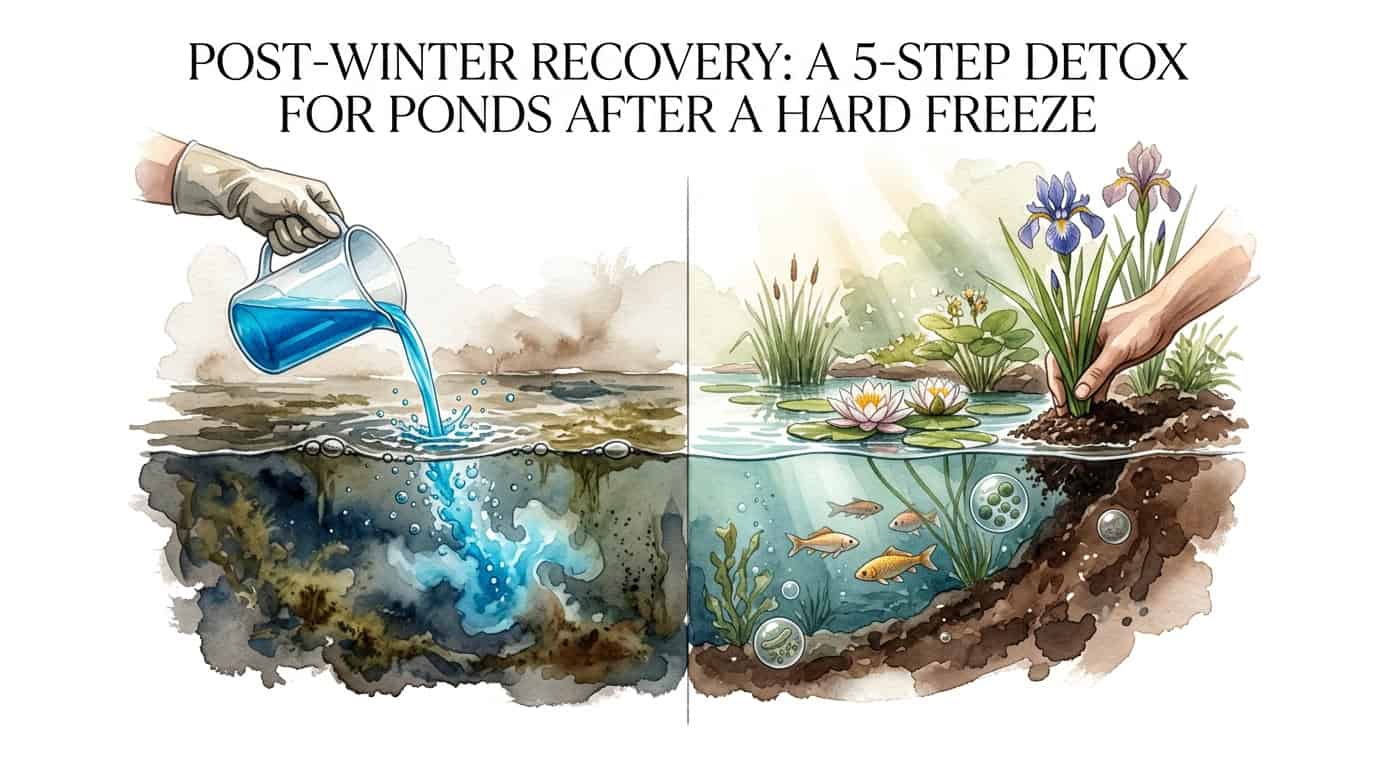
Spring ‘clear’ water is often just dead water. Your pond needs a detox, not a cover-up. Winter leaves behind a ‘nutrient debt’ of decaying organic matter. Don’t just dump chemicals; follow these 5 steps to kickstart your biological filter and prevent an algae explosion in May.
Visual clarity in early spring is frequently a deceptive metric. In cold water, microbial activity is suppressed, meaning suspended solids often settle, and algae growth is limited by temperature rather than nutrient availability. This creates an illusion of health that masks high concentrations of dissolved organics and dormant pathogens.
As water temperatures rise, the metabolism of the entire ecosystem accelerates. Without a systematic restoration of biological and mechanical systems, the sudden availability of nutrients—accumulated from months of “nutrient debt”—will trigger a rapid eutrophic state.
Post-Winter Recovery: A 5-Step Detox for Ponds After a Hard Freeze
Post-winter recovery is a systematic process of removing accumulated organic waste and restoring the nitrogen cycle to functional capacity. During a hard freeze, biological filtration enters a state of dormancy or significant decline. Nitrifying bacteria, specifically Nitrosomonas and Nitrobacter, see a 75% reduction in efficiency at temperatures between 46°F and 50°F.

This detox exists to bridge the gap between the end of winter dormancy and the full activation of the pond’s natural immune system. It is used in professional koi keeping and advanced water gardening to prevent “New Tank Syndrome” in established ponds. Real-world application involves transitioning the pond from a reductive environment (where waste accumulates) to an oxidative environment (where waste is processed).
Imagine a factory that has been mothballed for the winter. Before production can start, the machinery must be cleared of dust, the fuel lines checked, and the staff rehired. In a pond, the “dust” is the anaerobic sludge on the floor, the “fuel” is the water chemistry, and the “staff” are the beneficial bacteria colonies.
The Mechanics of Spring Nutrient Debt
Understanding the biochemical state of a pond in spring requires an analysis of Biological Oxygen Demand (BOD). Winter debris—leaves, dead aquatic plants, and fish waste—collects at the pond bottom. In the absence of active aerobic bacteria, this matter undergoes slow anaerobic decomposition, producing hydrogen sulfide, methane, and organic acids.
These compounds represent a “debt” because they require significant oxygen to neutralize once the water warms. If the detox is ignored, the warming water will cause a spike in BOD, leading to oxygen depletion just as fish metabolic rates increase. This imbalance is the primary cause of spring fish mortality.
Chemical equilibrium is also at risk. Melting snow and heavy spring rain are often acidic and devoid of minerals. This dilutes the pond’s Carbonate Hardness (KH), which is the “infrastructure” that stabilizes pH. Without sufficient KH, the biofilter cannot restart because nitrifying bacteria consume carbonates as a carbon source during the nitrification process.
Five Steps to Biological Restoration
The following protocol is designed to optimize mechanical efficiency and biological colonization. Execution should begin when water temperatures consistently reach 50°F (10°C).

Step 1: Mechanical Debris Extraction
Mechanical removal of physical waste is the most efficient way to reduce the organic load. Use a pond vacuum or a fine-mesh net to remove “muck” from the pond floor. Focus on “dead zones” where water circulation is lowest, as these areas host the highest concentrations of anaerobic bacteria.
Cleaning the skimmer and pre-filters is mandatory. Inspect mechanical filter media (sponges or brushes) and rinse them using pond water, not tap water. Chlorinated tap water will sterilize any surviving bacterial colonies, resetting the biological clock to zero.
Step 2: Water Chemistry Stabilization
Perform a comprehensive water test for pH, KH, Ammonia, and Nitrite. The goal is to establish a baseline. KH should be maintained at a minimum of 100-150 ppm (parts per million) to support the biofilter. If KH is low, add a carbonate buffer such as sodium bicarbonate or a specialized KH increaser.
Stability is more important than achieving a “perfect” number. Rapid fluctuations in pH—common in low-KH water—stress the fish’s osmoregulatory system and delay the recovery of nitrifying bacteria.
Step 3: Biological Seeding and Colonization
Nitrification is a two-step process: Nitrosomonas bacteria oxidize ammonia into nitrite, and Nitrobacter bacteria oxidize nitrite into nitrate. In spring, Nitrobacter is slower to recover than Nitrosomonas, which often leads to a “nitrite spike.”
Introduce cold-water specific bacterial strains. These products contain psychrophilic microbes that remain active at lower temperatures than standard summer blends. Seeding the filter media directly ensures the highest concentration of bacteria is located where oxygen and nutrient flow are most consistent.
Step 4: Aeration and Gas Exchange
Oxygen is the catalyst for the detox process. Increase aeration by restarting waterfalls or adding air stones. High Dissolved Oxygen (DO) levels promote the growth of aerobic bacteria and help “off-gas” toxic compounds like carbon dioxide and hydrogen sulfide that accumulated under the ice.
Target an Oxidation-Reduction Potential (ORP) of +150 mV to +250 mV. ORP is a metric that measures the water’s ability to cleanse itself. A negative ORP reading indicates a reducing, unhealthy environment where pathogens thrive.
Step 5: Gradual Metabolic Reintroduction
Do not begin heavy feeding immediately. Fish are poikilothermic, meaning their body temperature and metabolic rate are dictated by the surrounding water. At 50°F, their digestive enzymes are barely functional.
Start with low-protein, wheat-germ-based foods. Feed only small amounts once every two or three days. Monitor the ammonia levels 24 hours after feeding. If ammonia is detectable, stop feeding and increase the biological seeding until the filter can handle the waste load.
Benefits of Biological Restoration
Choosing a biological restoration over a chemical quick-fix provides long-term stability. While algaecides can clear water in 48 hours, they do nothing to address the underlying nutrient load. In fact, killing algae with chemicals adds to the organic debris as the dead algae cells decompose, fueling the next bloom.
Biological detox creates a competitive environment where beneficial bacteria out-compete algae for nutrients like orthophosphate and nitrate. This results in “polishing” the water at a molecular level, leading to higher clarity and better fish health.
Common Mistakes and Pitfalls
The most frequent error is the “Spring Scrub.” Draining the pond and pressure-washing the rocks until they are white destroys the beneficial biofilm that has taken years to develop. This forces the pond to start the nitrogen cycle from scratch, leading to “New Tank Syndrome” and massive ammonia spikes.
Another mistake is ignoring the “Aeromonas Alley.” This refers to the temperature range between 40°F and 60°F. In this window, opportunistic pathogens like Aeromonas and Pseudomonas become active while the fish’s immune system is still suppressed. A dirty pond during this phase is a recipe for ulcers and bacterial infections.
Limitations of the Detox Method
A biological detox is not an instant solution. It requires 2 to 6 weeks for a biofilter to reach full capacity. In systems that are severely undersized—where the pump flow rate does not turn over the pond volume at least once per hour—biological restoration will struggle to keep pace with the organic load.
Extreme weather shifts can also stall the process. A sudden cold snap after the detox has started can push bacteria back into dormancy, requiring a re-seeding of the filter media once temperatures stabilize again.
Practical Tips and Best Practices
Optimization of the system can be achieved by focusing on surface area. The efficacy of a biological filter is directly proportional to the Specific Surface Area (SSA) of the filter media.
- Media Selection: Use high-SSA media like Matala mats, K1 micro-media, or ceramic bio-rings. Avoid smooth gravel, which has low surface area for bacterial attachment.
- Flow Dynamics: Ensure “plug flow” through the filter, where water is forced through the media rather than bypassing it through paths of least resistance.
- UV Sterilizers: Keep UV lights off during the first 48 hours after adding liquid bacteria to allow the microbes to attach to the filter media without being neutralized.
Advanced Considerations: Measuring ORP
For serious practitioners, measuring Oxidation-Reduction Potential (ORP) provides the most accurate data on pond health. ORP measures the electronic charge of the water.
| ORP Level (mV) | Water Condition | Action Required |
|---|---|---|
| -100 to 0 | Highly Reductive / Anaerobic | Immediate aeration and debris removal. |
| 0 to +150 | Low Oxidative Capacity | Increase water changes and bio-seeding. |
| +150 to +250 | Healthy Ecosystem | Maintain current maintenance schedule. |
| +300 to +400 | Sterile / Highly Oxidized | Typical of ozone-treated systems; monitor fish stress. |
Monitoring ORP allows the pond keeper to see the impact of a water change or a filter cleaning in real-time. If the ORP drops significantly after feeding, it indicates the bio-load is exceeding the current filtration capacity.
Example Scenario: The 2,000 Gallon Recovery
Consider a 2,000-gallon koi pond that was neglected over winter. The floor has 2 inches of dark sludge. The water is clear, but testing reveals a KH of 40 ppm and an ammonia level of 0.5 ppm at 48°F.

The practitioner begins by vacuuming 50% of the floor, removing approximately 10 pounds of wet organic matter. They add 2 pounds of sodium bicarbonate to raise the KH to 120 ppm. Once the temperature hits 52°F, they seed the filter with a high-dose cold-water bacterial gel.
Within 10 days, the ammonia level drops to zero. By the time the water hits 60°F in May, the “nutrient debt” has been paid, and the pond avoids the typical pea-green algae bloom that affects neighboring ponds.
Final Thoughts
Pond maintenance is an exercise in managing biochemical energy. The spring detox is not about aesthetics; it is a mechanical and biological necessity to prepare the system for the high-metabolic demands of summer. By addressing the nutrient debt early, you prevent the systemic collapse that leads to algae explosions and fish disease.
Focus on the infrastructure of the water—the KH, the oxygen levels, and the bacterial colonies. When these foundational elements are optimized, water clarity becomes a natural byproduct of a balanced ecosystem. Consistent monitoring and incremental adjustments will always outperform the reactionary use of chemical additives.