

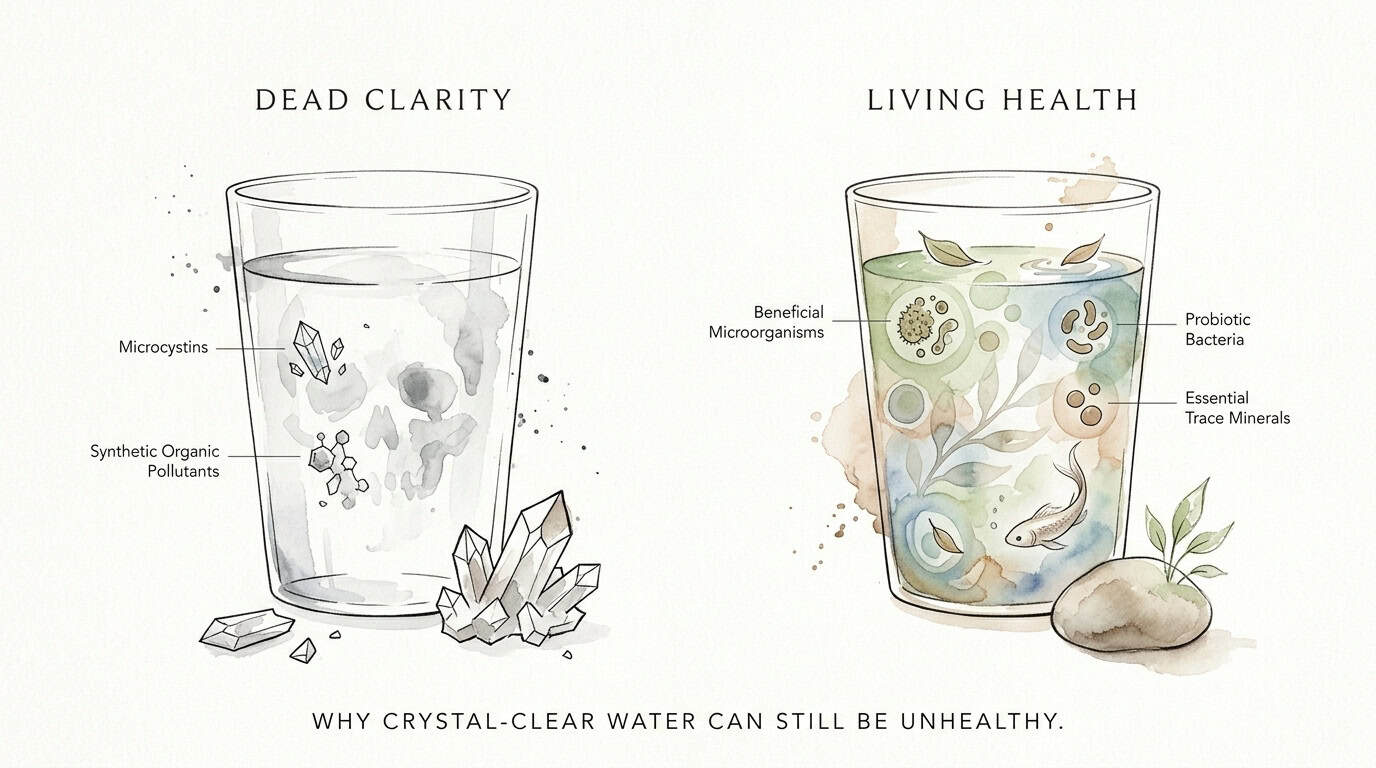
Visual clarity is a lie. You can have 10 feet of visibility and still have toxic ammonia levels. The ‘swimming pool look’ is often a sign of a sterile, dying system. True pond health is about biological activity, not just transparency. Learn what to look for beyond the surface.
Crystal-clear water is often misleading because it can harbor invisible toxic concentrations of ammonia, nitrites, or chemical imbalances that are lethal to aquatic life. High transparency frequently results from over-reliance on mechanical filtration or chemical sterilizers, which eliminate beneficial bacteria and microorganisms. True aquatic health depends on biological stability and nutrient processing rather than optical clarity, which fails to indicate dissolved gas levels or chemical toxicity.
Why Crystal-Clear Water Can Still Be Unhealthy
Visual transparency in an aquatic system indicates a lack of suspended solids and phytoplankton, but it provides zero data regarding dissolved chemical compounds. A pond can appear pristine while containing 5.0 ppm of un-ionized ammonia, a level sufficient to cause massive gill trauma and systemic organ failure in teleost fish. This discrepancy occurs because the molecules responsible for toxicity are sub-microscopic and do not scatter light in the visible spectrum.
The “swimming pool look” is frequently the result of an oligotrophic state forced by aggressive UV-C sterilization or chemical flocculants. While these methods remove the symptoms of an imbalanced system, such as algae blooms, they do not address the underlying nitrogenous waste load. In many cases, the very tools used to achieve clarity actively suppress the nitrifying bacteria populations required to convert toxic waste into harmless byproducts.

Biological health is measured through chemical parameters and microbial diversity rather than Secchi disk depth. A healthy system requires a complex web of heterotrophic and autotrophic bacteria to manage the carbon and nitrogen cycles. Without these living components, the water is effectively “dead”—chemically clear but biologically unstable and incapable of supporting long-term life.
How Chemical Toxicity Functions in Clear Systems
The primary mechanism of “clear water toxicity” is the failure of the nitrification process. This two-stage biological reaction relies on Nitrosomonas bacteria to oxidize ammonia (NH3) into nitrite (NO2-), and Nitrobacter or Nitrospira to further oxidize nitrite into nitrate (NO3-). If these bacterial colonies are undersized or suppressed by sterilization, ammonia levels rise rapidly despite the water remaining optically clear.
Ammonia toxicity is highly dependent on pH and temperature variables. As pH increases above 8.0, a larger percentage of total ammonia nitrogen (TAN) shifts from the relatively harmless ionized form (NH4+) to the highly toxic un-ionized form (NH3). Because clear water often lacks the buffering capacity provided by a robust biological community, pH swings can occur suddenly, turning a safe system into a lethal one in hours.
Nitrite toxicity, often called “Brown Blood Disease,” is another invisible threat. Nitrite enters the bloodstream of fish and binds to hemoglobin, creating methemoglobin, which is incapable of transporting oxygen. A pond with 0.5 ppm of nitrite can appear perfectly clear, yet the inhabitants may be effectively suffocating in a high-oxygen environment due to this internal chemical block.
Benefits of Prioritizing Biological Health Over Clarity
Focusing on biological stability creates a more resilient ecosystem that can withstand sudden environmental stressors. A system with a high “bio-load capacity” can process spikes in waste, such as a dead fish or overfeeding, without experiencing a catastrophic ammonia spike. This stability reduces the need for emergency water changes and chemical interventions.
Healthy systems foster diverse microbial populations, including beneficial biofilms and periphyton. These communities act as a secondary filtration layer, consuming excess nutrients and providing a natural food source for smaller aquatic organisms. The presence of these microorganisms also suppresses the growth of pathogenic bacteria like Aeromonas or Vibrio through competitive exclusion.

Maintenance requirements decrease significantly when the biological engine is optimized. Instead of frequently backwashing mechanical filters or replacing UV bulbs, the operator focuses on monitoring key metrics and supporting bacterial growth. A balanced ecosystem naturally regulates algae growth by outcompeting it for nutrients, leading to long-term clarity that is a byproduct of health rather than a forced aesthetic.
Challenges and Common Mistakes in Water Management
Over-filtration is a common pitfall where excessive mechanical and chemical media strip the water of essential trace elements and microorganisms. When the water becomes too sterile, the “food-to-mass” (F/M) ratio for nitrifying bacteria drops. This leads to a weak bacterial colony that cannot respond effectively to sudden increases in nitrogenous waste, resulting in “Old Tank Syndrome.”
Excessive use of UV-C sterilizers can mask serious filtration deficiencies. While UV-C is effective at killing single-celled algae (the cause of green water), it also destroys beneficial planktonic bacteria and enzymes. Operators often rely on UV-C as a crutch, ignoring the fact that their biological filter is undersized for the fish population. If the UV-C unit fails, the system lacks the biological infrastructure to prevent a total ecosystem collapse.
Inconsistent water testing is perhaps the most dangerous mistake. Relying on visual cues leads to a false sense of security. Technical practitioners must use high-quality liquid reagent kits or electronic sensors to measure TAN, Nitrite, Nitrate, KH (Carbonate Hardness), and Dissolved Oxygen. Optical clarity is an aesthetic preference; water chemistry is a survival requirement.
Limitations of Forced Clarity Methods
Forced clarity through the use of flocculants or coagulants has distinct practical boundaries. These chemicals work by clumping fine particles together so they can be caught by mechanical filters. However, these clumps can settle in “dead zones” of the pond, where they undergo anaerobic decomposition, releasing hydrogen sulfide (H2S) and other toxins back into the water column.
Sterile systems are highly vulnerable to “New Pond Syndrome” every time a change is made. Because the microbial population is kept artificially low, any addition of new livestock or a change in feed can overwhelm the system. The lack of a robust bio-buffer means that errors in management have immediate and often fatal consequences for the inhabitants.
High-transparency systems often suffer from increased light penetration, which can stress fish that lack adequate cover. In the absence of a balanced ecosystem that includes some organic staining (tannins) or minor turbidity, UV radiation can penetrate deeper into the water column, potentially causing stress or even physical damage to sensitive species.
Dead Clarity vs Living Health: A Technical Comparison
Understanding the difference between a sterile, clear system and a biologically healthy one requires looking at specific performance metrics. The following table highlights the divergence in system characteristics.
| Parameter | Dead Clarity (Sterile) | Living Health (Ecosystem) |
|---|---|---|
| ORP (Oxidation-Reduction Potential) | High (Artificial via chemicals/UV) | Moderate (Stable via biological activity) |
| Microbial Diversity | Near Zero | High (Biofilms, beneficial bacteria) |
| Nutrient Processing | Mechanical/Chemical Removal | Biological Conversion (Nitrogen Cycle) |
| System Resilience | Low (Prone to crashes) | High (Self-regulating) |
| Maintenance Focus | Component Replacement/Cleaning | Metric Monitoring/Bio-support |
Practical Tips for Maintaining Living Water
Invest in high-surface-area biological media to maximize nitrifying bacteria colonization. Materials like sintered glass, K1 media, or specialized ceramic foams provide thousands of square feet of surface area per cubic foot. This ensures that the bacterial colony is large enough to handle waste spikes even if the water flow is optimized for dwelling time rather than sheer volume.
Maintain Carbonate Hardness (KH) at levels above 100 ppm. Nitrifying bacteria consume inorganic carbon (bicarbonates) during the nitrification process. If KH drops too low, the biological filter will “stall,” causing ammonia to rise. Regular monitoring and the addition of buffers like sodium bicarbonate are essential for maintaining the biological engine.
- Test for ammonia and nitrite weekly, regardless of how clear the water appears.
- Provide adequate aeration to maintain dissolved oxygen (DO) above 6.0 mg/L, as nitrification is an oxygen-intensive process.
- Clean mechanical pre-filters frequently to prevent organic waste from breaking down into the water column before the bio-filter can process it.
- Avoid the use of broad-spectrum antibiotics or algaecides that can decimate beneficial bacterial colonies.
Advanced Considerations: ORP and Bio-Load Balancing
Advanced practitioners should use Oxidation-Reduction Potential (ORP) meters to gauge the “cleansing power” of the water. ORP, measured in millivolts (mV), indicates the water’s ability to break down organic waste. A healthy pond typically sits between 250mV and 400mV. If ORP drops below 200mV, it indicates a high organic load and a struggling biological filter, even if the water looks clear.
Optimizing the “contact time” or “dwell time” within the biological filter is critical for efficiency. If water moves through the media too quickly, the bacteria do not have enough time to pull nutrients from the water. Calculations should ensure that the entire pond volume passes through the bio-filter at a rate that allows for maximum nutrient uptake without creating anaerobic pockets.
Consider the role of heterotrophic bacteria in sludge management. While nitrifying bacteria handle ammonia, heterotrophic bacteria break down solid organic waste. Balancing these two populations is essential for preventing “muck” buildup. Some advanced systems use “active sludge” or specialized bioreactors to maintain a high concentration of these beneficial microbes in a controlled environment.
Example Scenario: The Illusion of the Pristine Koi Pond
Consider a 5,000-gallon koi pond equipped with a massive pressurized sand filter and a high-wattage UV sterilizer. The water is so clear that every pebble on the bottom is visible at a depth of six feet. The owner, assuming the system is perfect, adds five large koi. Within 48 hours, the fish are gasping at the surface and showing red streaks in their fins (septicemia).
Testing reveals ammonia levels at 4.0 ppm and nitrites at 1.0 ppm. The mechanical filtration and UV-C successfully removed all suspended particles, creating the illusion of health. However, because the system was “over-cleaned,” the biological filter lacked the established bacterial mass to process the sudden increase in ammonia from the new fish. The water was optically clear but chemically lethal.
In contrast, a similar pond with a bog filter and moderate mechanical filtration might have a slight amber tint from tannins and some visible biofilm on the rocks. When the same fish are added, the biological mass within the bog filter absorbs the nutrient spike immediately. The water may not be “crystal” clear, but the fish thrive because the chemical parameters remain at zero.
Final Thoughts
Visual clarity is a poor metric for assessing the safety or health of an aquatic environment. True mastery of pond management requires looking past the surface and understanding the complex chemical and biological interactions occurring in the water column. A clear pond can be a sterile graveyard, while a slightly “living” pond can be a thriving, resilient ecosystem.
Prioritize the establishment of a robust nitrogen cycle and maintain a healthy environment for beneficial microorganisms. Use technical tools like ORP meters and high-quality test kits to make data-driven decisions. By shifting the focus from aesthetics to biological performance, you create a system that is not only beautiful to look at but also capable of supporting a healthy, long-lived aquatic community.
The goal is to achieve “Living Clarity”—water that is clear because it is balanced, not because it has been sterilized. This approach requires patience and a deeper understanding of aquatic science, but the result is a low-maintenance, stable environment that truly mimics the best of nature’s engineering.
Frequently Asked Questions About Why Crystal-Clear Water Can Still Be Unhealthy
How can water be clear but have high ammonia levels?
Ammonia is a dissolved gas that does not scatter or absorb light in the visible spectrum. It is completely transparent to the human eye, even at lethal concentrations. Water clarity is usually a measurement of suspended solids like dirt or algae. If a system has strong mechanical filtration or UV-C sterilization, these solids are removed, but the dissolved ammonia remains if the biological filter is missing or failing. This creates a “toxic void” where the water looks clean but contains chemical toxins that destroy fish gill tissue and internal organs.

What are the first signs that clear water is actually toxic?
Because you cannot see the toxins, you must observe the behavior of the inhabitants. Fish in clear but toxic water often exhibit “flashing” (rubbing against surfaces), gasping at the surface (piping), or lethargy. You may also see physical symptoms like red streaks in the fins or cloudy eyes, which indicate stress and secondary infections. However, the only way to confirm toxicity before it becomes fatal is through regular chemical testing using liquid reagent kits for total ammonia nitrogen (TAN) and nitrites.
Can a UV sterilizer make a pond unhealthy?
A UV sterilizer itself isn’t inherently harmful, but its misuse can lead to an unhealthy system. UV-C is highly effective at killing planktonic algae and some pathogens, but it also kills beneficial bacteria and microorganisms that contribute to a balanced ecosystem. If a pond owner relies solely on UV-C for clarity, they may ignore the lack of a proper biological filter. This results in a sterile environment that lacks the resilience to handle waste spikes. Essentially, the UV-C masks the symptoms of an imbalanced system while potentially preventing the growth of a robust, protective biofilm.
Does clear water always mean the nitrogen cycle is working?
No, clarity and the nitrogen cycle are independent variables. A pond can be clear because it is brand new and has no waste yet, or because it is being chemically treated to remove particles. In both cases, the nitrogen cycle may not be established at all. Conversely, a healthy, fully-cycled pond might have a slight tint from tannins or beneficial algae but be chemically perfect. You cannot assume the nitrogen cycle is functioning without measuring the presence of nitrates (the end product of the cycle) and the absence of ammonia and nitrites.
What is the difference between sterile water and healthy water?
Sterile water is characterized by a lack of biological life at the microscopic level. It is often achieved through aggressive mechanical filtration, UV-C, and chemical additives. While it looks clear, it is fragile and prone to rapid chemical crashes. Healthy water, or “living water,” contains a diverse community of beneficial bacteria, fungi, and micro-organisms that actively process waste and outcompete pathogens. Healthy water may have a more “natural” appearance, but its chemical stability and ability to support complex life forms are far superior to a sterile system.