

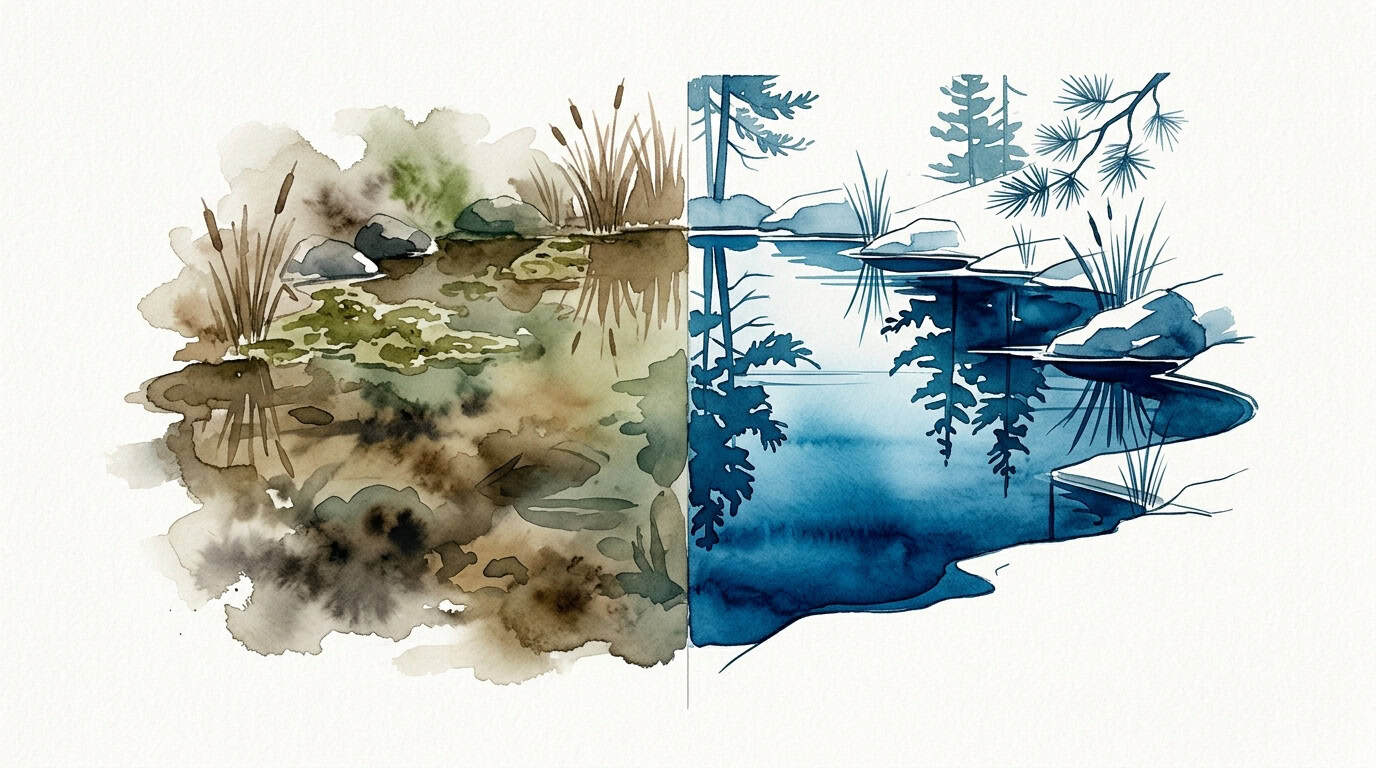
Is your pond an eyesore or a focal point? The right color makes all the difference. Blue creates a tropical resort vibe, while black turns your water into a high-end mirror. Which one fits your landscape? We break down the visual and thermal differences between the two most popular shades.
Choosing between blue and black pond dye depends on specific management goals. Blue dye, primarily composed of Acid Blue 9, optimizes aesthetic clarity by reflecting light to create a vibrant appearance while filtering wavelengths necessary for photosynthesis. Black dye utilizes a broad-spectrum blend to maximize light absorption, creating a mirror-like surface reflection and providing superior UV suppression. Both effectively inhibit algae growth by reducing solar energy penetration into the water column.
Blue vs. Black Pond Dye
Pond dyes are concentrated pigments designed to alter the optical properties of a water body. While often viewed as purely aesthetic additions, these products function as mechanical light filters that mitigate the proliferation of submerged aquatic vegetation and filamentous algae. By increasing the attenuation of specific light wavelengths, dyes reduce the energy available for photosynthesis in the euphotic zone.
Blue dye is the industry standard for decorative water features, imparting a “resort-style” look. It is chemically dominated by Acid Blue 9 (Brilliant Blue FCF), which is highly efficient at reflecting the blue end of the visible spectrum. Black dye, conversely, is a formulation of multiple pigments—often including Acid Blue 9 combined with red and yellow food-grade dyes—designed to achieve near-total absorption of incident light. This results in a reflective, “bottomless” appearance that masks suspended solids and debris.

How Light Attenuation Works in Aquatic Systems
The primary mechanism of pond dye is the reduction of Photosynthetically Active Radiation (PAR). Algae and submerged plants require light in the 400 to 700 nanometer range to fuel growth. When a dye is introduced, it selectively absorbs photons before they reach the plant cells.
Blue dyes are particularly effective at blocking the red and orange ends of the spectrum, which are critical for chlorophyll-a activation. Black dyes provide a denser filter, blocking a wider array of wavelengths including more of the UV spectrum. This shading effect restricts the growth of weeds like watermilfoil and pondweed to the extreme shallows, effectively shrinking the “productive” zone of the pond where nuisance growth can occur.
Benefits of Strategic Dye Application
Applying the correct dye provides measurable improvements to pond stability and maintenance efficiency:
- Algae Suppression: Both colors significantly decrease the rate of biomass accumulation by limiting light availability. This reduces the frequency of required algaecide treatments.
- Thermal Regulation: By blocking solar penetration, dyes can help maintain lower temperatures in the deeper layers of the water column. Cooler water has a higher dissolved oxygen capacity, which is critical for fish health during summer months.
- Predation Mitigation: Darkening the water increases the refractive index and reduces visibility from above, protecting koi and game fish from avian predators like herons.
- Visual Masking: For ponds with high turbidity or “mucky” bottoms, black dye effectively hides these imperfections by creating a reflective surface.
Common Challenges and Application Mistakes
The effectiveness of a dye program is often compromised by mechanical or environmental factors. One frequent error is applying dye to a pond that is already experiencing a severe algal bloom. If the water is already green, the dye will be unable to penetrate or disperse properly, often resulting in an unappealing, sludge-like appearance.
Another challenge is inaccurate volume calculation. Most dyes are rated for one surface acre with an average depth of four to six feet. Under-dosing results in insufficient light blocking, while over-dosing can lead to excessive light restriction that may harm beneficial phytoplankton, the foundation of the aquatic food web.
Limitations and Environmental Constraints
Pond dyes are not universal solutions. Their performance is limited by hydraulic and chemical variables:

- Water Turnover: Ponds with high flow-through or frequent overflows will lose dye concentration rapidly, making the treatment cost-prohibitive.
- Turbidity and Suspended Solids: If the water has high levels of suspended clay or silt, the dye molecules may bind to these particles, reducing their longevity and effectiveness.
- Emergent Vegetation: Dyes have no effect on plants that grow above the water surface, such as cattails or lilies, as these plants receive sunlight directly from the atmosphere rather than through the water column.
Comparison: Technical Specifications and Use Cases
| Feature | Blue Pond Dye | Black Pond Dye |
|---|---|---|
| Primary Component | Acid Blue 9 | Acid Blue 9 + Red/Yellow Blends |
| Light Interaction | Reflection (Vibrant Blue) | Absorption (Reflective Surface) | Moderate | High |
| Thermal Impact | Lower surface absorption | Higher surface absorption |
| Recommended Setting | Residential, Parks, Resorts | Wooded areas, Golf courses, Modern estates |
Practical Tips for Implementation
For optimal results, apply dye in the early spring before the first growth cycle begins. This proactive approach “sets the shade” before algae can establish a foothold. Wear protective gear, as concentrated dye will permanently stain skin, clothing, and porous concrete.
When applying, pour the liquid directly into the water at several points around the perimeter. Natural wind action and convection currents will typically distribute the dye evenly within 24 hours. For larger lakes, water-soluble packets can be tossed into the center to ensure deep-water coverage.
Advanced Considerations: Thermal Stratification
Experienced pond managers must consider the thermal impact of color choice. Black dye increases the absorption of solar energy at the surface. While this can lead to a warmer surface layer, it also accelerates thermal stratification—the separation of water into distinct temperature layers. This can be beneficial in deep ponds by keeping the lower “hypolimnion” cooler, but it also increases the risk of a “turnover” event if the layers mix suddenly due to heavy rain or wind, potentially leading to oxygen depletion.
Practical Application Scenario
Consider a two-acre golf course pond located in a wooded area with high organic runoff. A manager opting for **black pond dye** would achieve two goals: first, the mirror effect would highlight the surrounding trees, enhancing the landscape architecture. Second, the superior UV blocking would combat the high nutrient levels (from fertilizer runoff) that would otherwise fuel massive filamentous algae growth. In this scenario, black dye is a tool for both aesthetic masking and mechanical control.
Final Thoughts
Selecting between blue and black pond dye is a decision that impacts the biological and thermal stability of an aquatic ecosystem. Blue dye remains the most popular choice for general aesthetics, providing a clean and inviting appearance. Black dye serves as a specialized tool for high-end landscaping and aggressive light management.
Regardless of the color chosen, consistency is the primary driver of success. Maintaining a steady concentration throughout the growing season ensures that the light-blocking benefits remain effective, reducing the need for chemical intervention and promoting a balanced environment.
Frequently Asked Questions About Blue vs. Black Pond Dye
Does pond dye kill existing algae or weeds?
Pond dye is not a herbicide or algaecide; it is a preventative shading agent. It does not contain active chemical ingredients designed to kill plant tissue. Instead, it works by blocking the light energy required for photosynthesis. If your pond already has a significant growth of weeds or algae, you must first treat the area with an EPA-registered algaecide or herbicide. Once the existing biomass has cleared, the dye can be applied to prevent new growth from germinating or reaching the surface. Using dye as a preventative measure is significantly more efficient than attempting to use it as a corrective one.
Is black pond dye more effective at controlling algae than blue dye?
Technically, black dye offers a higher degree of light absorption across a broader spectrum of wavelengths. Because it is a more concentrated blend of pigments, it creates a denser “filter” that blocks more UV rays and PAR (Photosynthetically Active Radiation) than standard blue dyes. This makes it slightly more effective in very shallow ponds where sunlight can easily reach the bottom. However, in most managed ponds with depths of four feet or more, both colors provide sufficient light attenuation to significantly inhibit the growth of nuisance aquatic vegetation when maintained at the proper concentration levels.
Can I mix blue and black pond dye together?
Mixing blue and black pond dye is a common practice among professional pond managers to achieve a “Midnight Blue” or “Deep Blue” effect. This hybrid approach provides the vibrant reflection of blue dye while gaining the depth and masking properties of black dye. A common ratio is 3 parts blue to 1 part black, which results in a natural, deep-water look that is often seen on high-end golf courses. Since both dyes use similar food-grade pigments, they are chemically compatible and will not cause adverse reactions when combined in the same water body.
How long does the color typically last before I need to reapply?
The longevity of pond dye is primarily determined by water turnover and UV degradation. In a “closed” system with no significant inflow or outflow, a single application may last between four to eight weeks. However, heavy rainfall that causes the pond to overflow will wash out the pigment, requiring immediate replenishment. Additionally, intense sunlight will eventually break down the dye molecules over time. To maintain the necessary light-blocking threshold, it is recommended to perform small “touch-up” applications whenever you notice the color starting to fade or when a Secchi disk reading indicates increased light penetration.
Will pond dye stain my fish or the rocks around the pond?
Once the dye has been fully diluted into the water column, it will not stain fish, plants, or rocks. The pigments used are water-soluble and designed to remain in suspension. However, the concentrated form (straight from the bottle) is a powerful staining agent. If the concentrate is spilled on porous surfaces like limestone, concrete, or wooden docks during the application process, it will leave a permanent mark. It is vital to apply the dye close to the water’s surface to avoid splashing and to wear gloves to prevent temporary staining of the skin, which can take several days to wash off.