

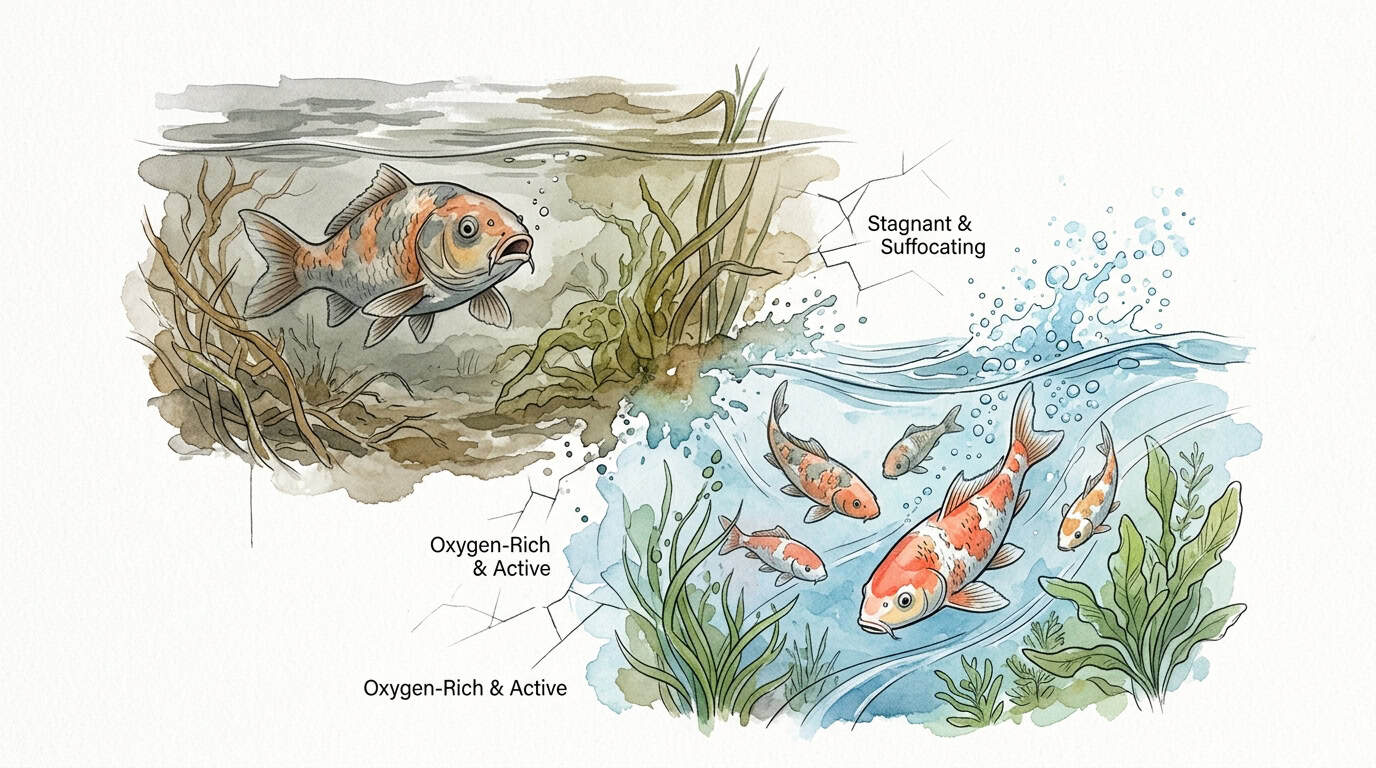
The number one killer of pond fish isn’t a predator—it’s a lack of movement. When water stops moving, life starts dying. Discover the 15 reasons your fish are at risk and how a dynamic system saves your investment.
Why Are My Pond Fish Dying? 15 Common Causes Explained
Aquatic environments are closed biological systems that require constant energy input to maintain equilibrium. In a natural ecosystem, vast volumes of water and constant geological or atmospheric interactions provide stability. In a backyard pond, the mechanical system must replicate these processes. Failure to maintain hydraulic movement leads to immediate chemical and biological degradation.
The following 15 causes represent the primary drivers of fish mortality in artificial pond environments, ranging from acute toxicological events to chronic physiological stressors.
1. Acute Hypoxia (Dissolved Oxygen Depletion)
Oxygen solubility in water is significantly lower than in the atmosphere. While air contains approximately 200,000 parts per million (ppm) of oxygen, a healthy pond rarely exceeds 10 ppm. When movement ceases, the surface tension of the water acts as a barrier, preventing atmospheric diffusion. Fish require a minimum of 5 mg/L (ppm) of Dissolved Oxygen (DO) to maintain metabolic function. Levels below 3 mg/L induce severe stress, and concentrations under 2 mg/L result in rapid asphyxiation, particularly in larger specimens with higher metabolic demands.

2. Total Ammonia Nitrogen (TAN) Toxicity
Fish excrete nitrogenous waste primarily as ammonia (NH3) through their gills. In a stagnant system, this waste accumulates in the immediate vicinity of the fish. Ammonia exists in two forms: unionized ammonia (NH3), which is highly toxic, and ionized ammonium (NH4+). The ratio of toxic NH3 increases as pH and temperature rise. Even concentrations as low as 0.02 ppm of unionized ammonia can cause gill membrane damage and neurological failure.
3. Nitrite Toxicity (Brown Blood Disease)
Nitrite (NO2) is the intermediate byproduct of the nitrification process. In systems with inadequate biological filtration or poor circulation, nitrite levels can spike. Nitrite enters the fish’s bloodstream and oxidizes the iron in hemoglobin, forming methemoglobin. This molecule cannot transport oxygen effectively, leading to functional hypoxia even if DO levels in the water are adequate. Clinical signs include chocolate-colored blood and gasping at the surface.
4. Thermal Stratification and Anoxic Zones
Without mechanical mixing, water separates into layers based on density and temperature. The upper layer (epilimnion) remains warm and oxygenated, while the bottom layer (hypolimnion) becomes cold and anoxic. In deep ponds, the hypolimnion accumulates hydrogen sulfide and methane from anaerobic decomposition. A sudden mixing event, such as a heavy rainstorm, can bring this toxic, oxygen-depleted water to the surface, causing a “pond flip” and immediate mass mortality.
5. Carbon Dioxide (CO2) Accumulation
Gas exchange is a two-way process. While movement brings oxygen in, it also allows carbon dioxide to escape (off-gassing). High levels of CO2 (hypercapnia) lower the pH of the fish’s blood, reducing its affinity for oxygen. This is particularly dangerous at night when plants and algae stop producing oxygen and begin respiring, further increasing CO2 concentrations.
6. pH Instability (Acidosis and Alkalosis)
The pH of a pond is influenced by the carbonate hardness (KH) and the concentration of dissolved CO2. In poorly circulated ponds, CO2 levels fluctuate wildly between day and night, causing “pH swings.” A shift of more than 0.2 units per hour is physiologically taxing. Extreme drops (acidosis) or spikes (alkalosis) damage the protective slime coat and gill tissues, leaving fish vulnerable to secondary infections.
7. Saprolegnia and Fungal Pathogens
Low-flow areas or “dead zones” in a pond accumulate organic detritus. These zones become breeding grounds for fungal spores like Saprolegnia. While healthy fish can often resist infection, those stressed by poor water quality or low oxygen succumb quickly. Fungal patches interfere with osmoregulation, leading to fluid imbalance and organ failure.

8. Parasitic Proliferation (Protozoan Outbreaks)
Parasites such as Ichthyophthirius multifiliis (Ich), Costia, and Chilodonella thrive in stagnant water where host-to-parasite contact is frequent. High-velocity water movement can disrupt the life cycle of certain parasites and ensures that chemical treatments are distributed evenly throughout the water column. Without movement, “hot spots” of parasite density can overwhelm a fish’s immune system.
9. Bacterial Hemorrhagic Septicemia
Poor water quality and high organic loads (measured as Dissolved Organic Carbon or DOC) promote the growth of opportunistic bacteria such as Aeromonas and Pseudomonas. These bacteria enter the fish through small lesions or gill membranes, causing internal bleeding, ulcers, and dropsy (abdominal swelling). This is a direct consequence of a system that cannot mechanically remove solid waste (feces and uneaten food).
10. Hydrogen Sulfide (H2S) Poisoning
In stagnant bottom sediments, anaerobic bacteria decompose organic matter, producing hydrogen sulfide gas. H2S is extremely toxic even at undetectable levels. If the water column is not actively circulated from the bottom up, this gas can build up and release in a single “burp,” instantly killing any fish in the vicinity.
11. Photosynthetic Oxygen Crashes
Ponds with heavy algae blooms rely on photosynthesis for daytime oxygen. However, during consecutive cloudy days or following an algae die-off (often caused by algaecides), the biological oxygen demand (BOD) of decomposing algae exceeds the production capacity. Without mechanical aeration to bridge the gap, the pond’s oxygen level can drop to zero in a matter of hours.
12. Excessive Nitrate Accumulation
While less toxic than ammonia or nitrite, nitrates (NO3) become harmful at concentrations exceeding 120 ppm in koi and goldfish. Chronic exposure to high nitrates suppresses the immune system and stunts growth. Dynamic systems often incorporate vegetative filtration (bog filters) or frequent water changes to export these final nitrogenous byproducts.
13. Gas Bubble Disease (Supersaturation)
This occurs when water becomes supersaturated with atmospheric gases, often due to air leaks in the suction side of a pump or a waterfall that plunges too deeply into a narrow space. The excess gas forms bubbles within the fish’s tissues and bloodstream, leading to embolism and death. It is a mechanical failure of the hydraulic design.
14. Chemical Runoff and Toxin Concentration
Stagnant ponds act as “sinks” for local runoff, including fertilizers (nitrates/phosphates) and pesticides. In an active system with an overflow and constant skimming, surface toxins are often removed before they can settle and concentrate. In a static pond, these chemicals accumulate until they reach lethal thresholds.
15. Osmotic Shock
Fish maintain a specific internal salt concentration (salinity) relative to their environment. Sudden changes in water chemistry—often caused by massive water changes without stabilization or the sudden melting of large ice volumes in winter—can cause osmotic shock. The fish’s cells either swell or shrink rapidly, leading to systemic organ failure.
How Dynamic Systems Work: The Physics of Gas Exchange
A dynamic pond system relies on the principle of surface renewal. Atmospheric oxygen enters the water through the air-water interface via molecular diffusion. However, diffusion is a slow process that only affects the top few millimeters of the water column. Mechanical movement, such as that provided by waterfalls, fountains, or air diffusers, physically breaks the surface tension.
The “skin” of the water is a high-tension membrane formed by cohesive hydrogen bonding between water molecules. To move gases effectively, this membrane must be ruptured. Aeration systems increase the surface area available for exchange. For example, a single air stone producing thousands of micro-bubbles creates a massive cumulative surface area compared to the flat surface of the pond.
Furthermore, the movement of water from the bottom to the top (vertical mixing) ensures that oxygen-rich water at the surface is transported to the depths, while CO2 and ammonia-laden water is brought to the surface to be stripped away. This process follows Henry’s Law, which states that the amount of dissolved gas in a liquid is proportional to its partial pressure above the liquid. By constantly exposing “spent” water to fresh air, the system maintains a high concentration gradient, driving efficient gas exchange.
Benefits of High-Turnover Filtration
The primary advantage of a dynamic system is the maintenance of high Redox Potential (ORP). ORP is a measure of the water’s ability to cleanse itself through oxidation. High oxygen levels and constant movement facilitate the rapid breakdown of organic pollutants by aerobic bacteria. These bacteria are up to 20 times more efficient than their anaerobic counterparts.
Implementing a high turnover rate—typically defined as circulating the entire pond volume 1 to 2 times per hour—ensures that metabolic wastes are delivered to the biological filter before they can accumulate in the pond. This prevents “dead spots” where pathogens and toxins can concentrate. Additionally, consistent movement prevents thermal layering, providing a uniform temperature environment that reduces physiological stress on the fish.
From a mechanical perspective, active movement also prevents the settlement of fine solids. In a stagnant pond, debris settles on the bottom, forming a “muck” layer that fuels algae growth and anaerobic activity. In a dynamic system, these solids remain in suspension and are eventually captured by mechanical pre-filters or skimmers, allowing for easy removal from the system.
Challenges and Common Hydraulic Mistakes
Designing an effective dynamic system requires precise hydraulic calculations. One of the most frequent errors is underestimating Total Dynamic Head (TDH). TDH is the sum of vertical lift (static head) and friction loss caused by pipes, elbows, and filtration equipment. If the TDH is calculated incorrectly, the pump will provide significantly less flow than the manufacturer’s rating, leading to inadequate turnover.
Another common pitfall is the improper placement of intakes and returns. A pond can have a high-flow pump but still suffer from stagnation if the water is merely “short-circuiting”—moving in a direct line from the return to the intake without circulating through the rest of the pond. This leaves large pockets of water unoxygenated and unfiltered.
Mistakes also occur in pipe sizing. Using pipes that are too narrow for the desired flow rate increases velocity and friction loss exponentially. For example, forcing 3,000 gallons per hour through a 1.5-inch pipe creates significantly more resistance than using a 2-inch pipe. This not only reduces efficiency but also places unnecessary strain on the pump motor, leading to premature failure.
Limitations of Mechanical Aeration
Mechanical movement is not a universal solution for all environmental constraints. The most significant limitation is the Oxygen Saturation Curve, which is inversely proportional to temperature. As water temperature increases, its physical capacity to hold dissolved oxygen decreases. At 30°C (86°F), water can hold roughly 40% less oxygen than at 10°C (50°F).
During extreme heatwaves, even the most vigorous aeration may struggle to maintain supportive DO levels if the biological oxygen demand (BOD) is too high. In these scenarios, mechanical systems must be supplemented by reducing the fish load, shading the pond, or utilizing specialized oxygen concentrators. Mechanical systems also rely on a continuous power supply; a failure of the pump during a hot summer night can result in a total fish kill within hours due to the narrow safety margins of warm water.
Practical Tips for System Optimization
To maximize the efficiency of your pond’s dynamic system, follow these technical best practices:

- Verify Turnover Rates: Aim for a minimum of one full pond volume turnover every 60 minutes. For heavily stocked koi ponds, increase this to two turnovers per hour.
- Calculate TDH: Use a head pressure chart to ensure your pump can deliver the required GPH at your specific elevation and pipe length.
- Utilize Bottom Drains: Relying solely on a skimmer leaves the bottom 90% of the water column stagnant. Incorporate a bottom drain to pull “heavy” waste-laden water into the filtration system.
- Aerate at Night: If you must limit aeration, prioritize the hours between midnight and sunrise when plants are consuming oxygen rather than producing it.
- Monitor KH (Carbonate Hardness): Maintain a KH of at least 100-150 ppm to provide a pH buffer, preventing the acid crashes that often occur in poorly circulated systems.
Advanced Considerations: The Role of ORP and DOC
Serious practitioners often monitor Oxidation-Reduction Potential (ORP) using electronic controllers. A healthy pond should maintain an ORP between 250mV and 400mV. If the ORP drops below 200mV, it indicates that the rate of organic accumulation is exceeding the system’s oxidative capacity, signaling the need for increased aeration or a water change.
Another advanced metric is Dissolved Organic Carbon (DOC). DOC manifests as a persistent yellow tint in the water or foam at the base of a waterfall. This “protein foam” is a sign of high surface tension caused by dissolved proteins and fats. A dynamic system can address this through the use of a protein skimmer (foam fractionator), which uses the physical property of air-water interface attraction to strip these microscopic pollutants from the water.
Example Scenario: Sizing a System for a 2,500-Gallon Pond
Consider a 2,500-gallon koi pond with a waterfall located 5 feet above the water level and 20 feet of 2-inch piping. To achieve a 1.5x turnover rate, we need a flow of 3,750 Gallons Per Hour (GPH) at the discharge point.
First, we calculate the Total Dynamic Head (TDH):
- Static Head: 5 feet (the height of the waterfall).
- Friction Loss: 20 feet of 2-inch pipe at 3,750 GPH adds approximately 1.5 feet of head.
- Fittings: Two 90-degree elbows add roughly 2 feet of equivalent pipe length.
- Total TDH: ~8.5 feet.
A pump rated at 5,000 GPH at 0 feet of head might only produce 3,200 GPH at 8.5 feet of head. This would result in a turnover rate of 1.28x, which is below our 1.5x target. To meet the technical requirement, a larger pump or more efficient plumbing (reducing elbows or increasing pipe diameter) is necessary to ensure the investment in fish is protected.
Final Thoughts
Maintaining a healthy pond is fundamentally a challenge of hydraulic engineering and biochemistry. The transition from a stagnant, suffocating environment to an oxygen-rich, active system is the single most important factor in preventing fish mortality. By understanding the 15 common causes of death and the underlying physics of water movement, you can create a resilient habitat that thrives even during environmental extremes.
Successful pond management requires moving beyond aesthetics and focusing on efficiency metrics. Regular testing of dissolved oxygen, ammonia, and pH, combined with a properly sized and maintained mechanical system, ensures that your aquatic investment remains secure. Continuous movement is not merely a feature of a pond; it is the life-support system that defines its success.
As you apply these principles, consider exploring related technologies such as variable-speed pumps for energy optimization or automated sensor arrays for real-time water quality tracking. The deeper your understanding of the pond’s mechanical requirements, the more predictable and rewarding the hobby becomes.