

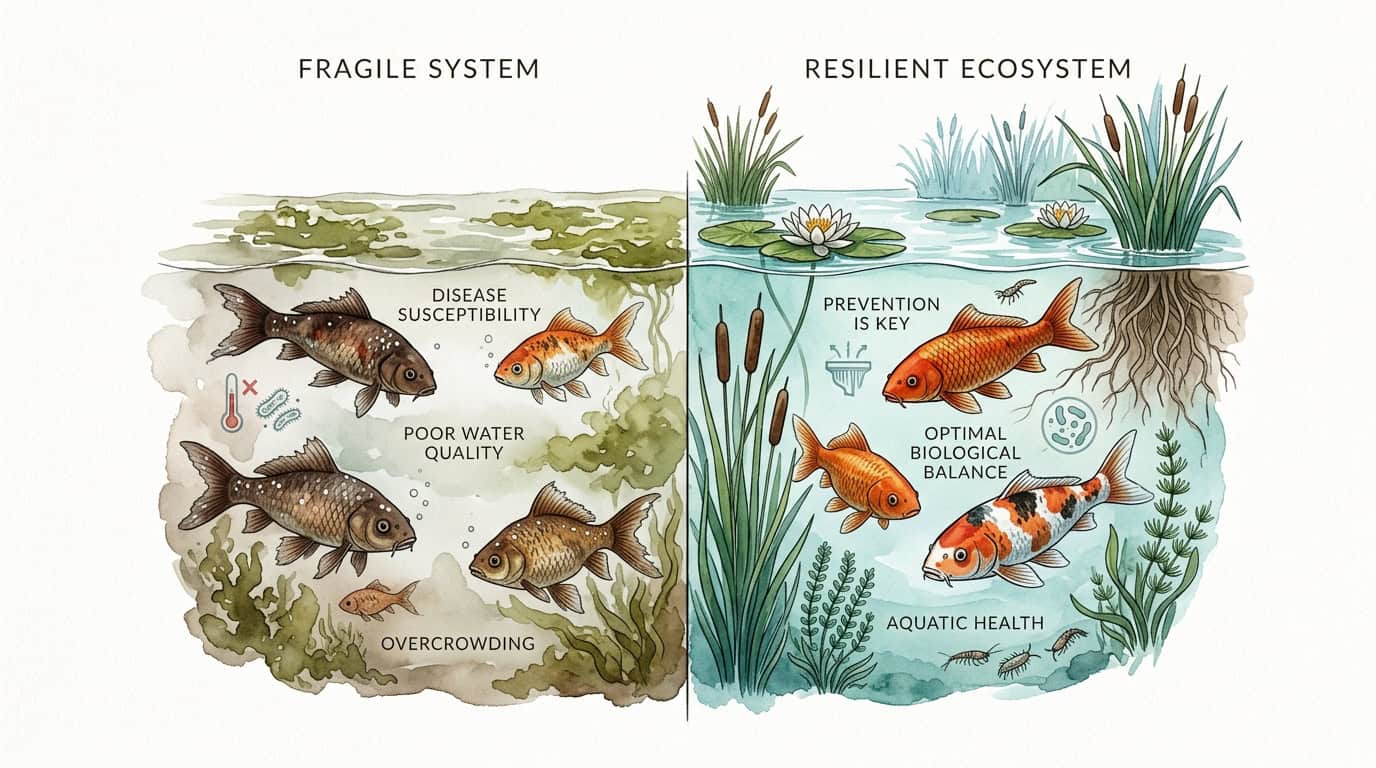
Is your pond a hospital or a habitat? Prevention is the only real cure. Fish disease is usually a symptom of a larger environmental problem. Learn the warning signs and how to build a resilient system that keeps pathogens at bay.
Aquatic health management in closed systems requires a shift from reactive treatment to proactive environmental engineering. Most pathogens exist in a latent state within the pond environment, only manifesting as clinical disease when the host’s immune system is compromised. Maintaining a resilient ecosystem depends on minimizing physiological stress and optimizing water chemistry parameters to suppress pathogen proliferation.
Fish health is an indicator of system efficiency. When environmental parameters such as dissolved oxygen, ammonia, and organic loading are optimized, the natural defenses of the fish are typically sufficient to prevent infection. This article provides a technical framework for identifying common diseases and implementing high-efficiency prevention strategies.
The Most Common Pond Fish Diseases And How To Prevent Them
Pond fish diseases are broadly categorized into parasitic, bacterial, fungal, and viral infections. Each category thrives under specific environmental conditions and requires distinct preventative measures. Understanding the biological requirements of these pathogens allows for the design of systems that are inhospitable to disease while remaining optimal for fish growth.

Parasitic infections, such as Ichthyophthirius multifiliis (Ich) and Costia, are among the most common issues in ornamental ponds. These protozoans typically target the skin and gills, leading to secondary infections if not controlled. Prevention involves high-turnover mechanical filtration and the use of UV sterilization to interrupt the pathogen’s life cycle during its free-swimming stages.
Bacterial diseases, particularly Columnaris (Flavobacterium columnare), often manifest as “fin rot” or “saddleback” lesions. These bacteria are opportunistic and exploit wounds or stress-induced immunosuppression. High organic loading in the water column provides the substrate necessary for bacterial blooms, making efficient waste removal a primary preventative tactic.
Viral threats like Koi Herpesvirus (KHV) and Spring Viremia of Carp (SVC) represent the most significant risk to biosecurity. Unlike bacteria or parasites, viruses cannot be “cured” with chemical additives once an infection is systemic. Prevention is achieved through strict quarantine protocols and the elimination of wild-fish vectors from the system.
Mechanics of Pathogen Proliferation and the Disease Triangle
Pathogen outbreaks occur at the intersection of three factors: a susceptible host, a virulent pathogen, and a supportive environment. This concept, known as the Disease Triangle, suggests that removing any one leg of the triangle prevents a clinical outbreak. In a pond setting, the environment is the factor most within the operator’s control.
Environmental stress is the primary driver of susceptibility. High levels of un-ionized ammonia (NH3) cause direct damage to gill lamellae, reducing gas exchange efficiency. As pH levels rise, the toxicity of total ammonia increases logarithmically. For every 1.0 increase in pH, the proportion of toxic un-ionized ammonia increases approximately tenfold.
Pathogens are also influenced by temperature. Ichthyophthirius multifiliis completes its life cycle in 3–4 days at 25°C (77°F), but may take up to 30 days at 10°C (50°F). Systemic prevention must account for these metabolic shifts, ensuring that UV dosages and chemical residuals are maintained at levels appropriate for the current thermal regime.

Engineering a Resilient Aquatic Environment
Preventing disease requires a focus on mechanical and biological filtration metrics. The goal is to minimize the concentration of Dissolved Organic Compounds (DOCs), which serve as fuel for heterotrophic bacteria and parasites. High DOC levels are directly correlated with lower Oxidation-Reduction Potential (ORP) and higher pathogen pressure.
Mechanical filtration must be the first line of defense. Utilizing a Rotary Drum Filter (RDF) or a high-efficiency sieve allows for the removal of solid waste before it breaks down into dissolved nutrients. Removing waste from the water column within minutes of production significantly reduces the biological oxygen demand (BOD) and limits the food source for opportunistic pathogens.
Biological filtration provides the necessary surface area for nitrifying bacteria (Nitrosomonas and Nitrospira). The Specific Surface Area (SSA) of the filter media determines the system’s carrying capacity. High-density media like K1 Micro or ceramic bio-media provide between 500 and 1000 m²/m³ of surface area, allowing for compact, high-efficiency nitrification even under heavy feeding regimes.
Specific Prevention Protocols
- UV Sterilization: Implementing a UV-C dose of at least 30,000 µWs/cm² is sufficient to kill most bacteria and algae. However, eradicating protozoan tomites may require dosages exceeding 150,000 µWs/cm².
- Oxidation-Reduction Potential (ORP): Maintaining an ORP between 250 mV and 400 mV indicates a “clean” system with high oxidative capacity, where pathogens are less likely to thrive.
- Oxygen Saturation: Dissolved oxygen (DO) should be maintained above 6.0 mg/L. High DO levels support the fish’s immune system and ensure that nitrifying bacteria function at peak efficiency.
Benefits of Proactive Disease Management
Operational efficiency increases when disease is prevented at the system level. High-resilience systems require fewer chemical interventions, which preserves the beneficial biofilm in biological filters. Many standard treatments, such as Malachite Green or high-dose Potassium Permanganate, can negatively impact nitrifying bacteria, leading to ammonia spikes after treatment.
Fish growth and longevity are significantly enhanced in stable environments. Chronic low-level stress from poor water quality leads to elevated cortisol levels in fish, which diverts energy from growth and reproduction toward metabolic maintenance. Eliminating these stressors allows for superior color development and skeletal growth.
Predictability is perhaps the greatest benefit. A well-engineered pond with consistent parameters allows the hobbyist or professional to identify subtle changes in fish behavior before they escalate into an emergency. Stable systems act as a buffer against environmental fluctuations, such as sudden temperature drops or heavy rain events.
Common Pitfalls and Management Mistakes
Over-reliance on chemical “quick fixes” is a frequent error. Adding medications to a pond with poor water quality only addresses the symptom, not the cause. If high ammonia levels caused the initial stress, adding an antibacterial agent will not prevent a recurrence once the medication dissipates.
Inadequate quarantine is another common failure point. Introducing new fish directly into an established population is the most common vector for pathogens. A proper quarantine period should last 14 to 40 days, allowing time for latent infections—especially those with temperature-dependent life cycles—to manifest.
Failure to calibrate water testing equipment leads to inaccurate data. Reagents in drop-test kits have expiration dates, and electronic probes (pH, ORP, DO) require regular cleaning and calibration with standard solutions. Decisions based on faulty data can lead to improper dosages and catastrophic fish loss.
Technical Limitations and Practical Boundaries
Biological systems have inherent limits. No amount of filtration can compensate for extreme overstocking. As fish density increases, the risk of horizontal transmission of pathogens rises exponentially. The “carrying capacity” of a pond is limited by both the oxygen transfer rate and the total surface area available for nitrification.
Environmental factors like source water quality also impose constraints. If the fill water contains high levels of chloramines or heavy metals, the system starts at a deficit. Pre-treating source water through activated carbon or ion-exchange resins is mandatory for maintaining a pristine environment.
Treatment efficacy is often limited by water chemistry. For instance, Chloramine-T is highly effective against bacterial infections but its toxicity increases in soft water with low pH. Conversely, Potassium Permanganate is rapidly neutralized by high organic loads, making it difficult to maintain a therapeutic concentration in a “dirty” pond.
Comparison: Targeted Treatments vs. Oxidative Management
| Feature | Targeted Treatments (e.g., Praziquantel) | Oxidative Management (e.g., PP, Ozone) |
|---|---|---|
| Mechanism | Specific interference with pathogen biology. | Non-specific oxidation of organic matter/pathogens. |
| Filter Impact | Usually negligible. | High; can damage nitrifying bacteria. |
| Cost | Higher for large volumes. | Relatively low. |
| Residue | May persist in the system. | Dissipates quickly after reaction. |
Practical Best Practices for Pathogen Control
Implementing a regular maintenance schedule is the foundation of prevention. Weekly 10–20% water changes help dilute pathogens and replenish essential minerals like calcium and magnesium, which are necessary for the fish’s slime coat production. Monitoring the Carbonate Hardness (KH) ensures that the pH remains stable, as a KH below 100 ppm can lead to dangerous pH swings.
Optimizing the turnover rate of the pond ensures that water is frequently passed through the filtration system. For a high-performance koi pond, a turnover rate of once per hour is the standard. This frequent cycling ensures that oxygen levels remain high throughout the pond and that waste is quickly moved to the mechanical filters.
Using a microscope for diagnosis is a best practice for serious practitioners. Skin scrapes and gill biopsies allow for the identification of specific parasites, preventing the use of unnecessary chemicals. Knowing whether a fish has Trichodina or Dactylogyrus (flukes) allows for a targeted, more effective treatment plan.
Advanced Considerations: Managing ORP and Ozone
Advanced pond managers often utilize Ozone (O3) to maintain ultra-clear water and low pathogen counts. Ozone is a powerful oxidant that directly destroys bacteria, viruses, and complex organic molecules. When managed via an ORP controller, ozone can maintain a precise redox level, ensuring that the water is “biologically thin” and unfavorable for pathogens.
Ozone systems must be carefully engineered to prevent residual O3 from entering the main pond, as it is toxic to fish. The use of a reaction chamber and a carbon post-filter ensures that only oxygen-enriched, purified water returns to the system. This level of optimization represents the pinnacle of preventative engineering.
Monitoring total ammonia nitrogen (TAN) in relation to temperature and pH is essential for understanding the actual toxicity of the water. Using a TAN table allows the operator to determine the “Safe Level” of ammonia. For instance, at a pH of 8.2 and 25°C, the toxic portion of ammonia is significantly higher than at a pH of 7.0 and 15°C.
Example Scenario: Managing a Protozoan Outbreak
Consider a 10,000-liter pond where fish are “flashing” (scraping against the sides), indicating a parasitic irritation. A skin scrape reveals a heavy infestation of Costia. The operator first checks water parameters and finds an ORP of only 150 mV and a nitrate level of 50 ppm, suggesting high organic loading.
Rather than simply adding medication, the operator first cleans the mechanical filters and performs a 30% water change to increase the ORP. They then apply a controlled dose of Potassium Permanganate at 1.5 grams per 1000 liters. The treatment is monitored with an ORP meter, ensuring the levels stay within the 475–525 mV range for four hours.

Following the treatment, the operator increases the UV-C wattage and adds supplemental aeration. This dual approach kills the active parasites while simultaneously correcting the environmental conditions that allowed the population to boom. The result is a total eradication of the pathogen with minimal stress on the biological filter.
Final Thoughts
Successful pond management is defined by the transition from a “Fragile System” to a “Resilient Ecosystem.” By focusing on high-efficiency mechanical waste removal, robust biological filtration, and consistent water chemistry monitoring, the risk of disease is dramatically reduced. Pathogens are a natural part of the aquatic environment, but they only become a threat when the system’s balance is compromised.
Building a resilient system requires technical discipline and a commitment to data-driven decision-making. Utilizing tools like ORP meters, UV sterilizers, and microscopes provides the clarity needed to manage complex biological interactions. These investments pay dividends in the form of healthy, vibrant fish and a stable, low-maintenance aquatic environment.
The goal is to create a habitat where the fish’s natural immune systems are the primary defense. When the environment is engineered for excellence, disease becomes a rare anomaly rather than a constant struggle. Experiment with these protocols, refine your system metrics, and enjoy the stability that comes with professional-grade pond management.