

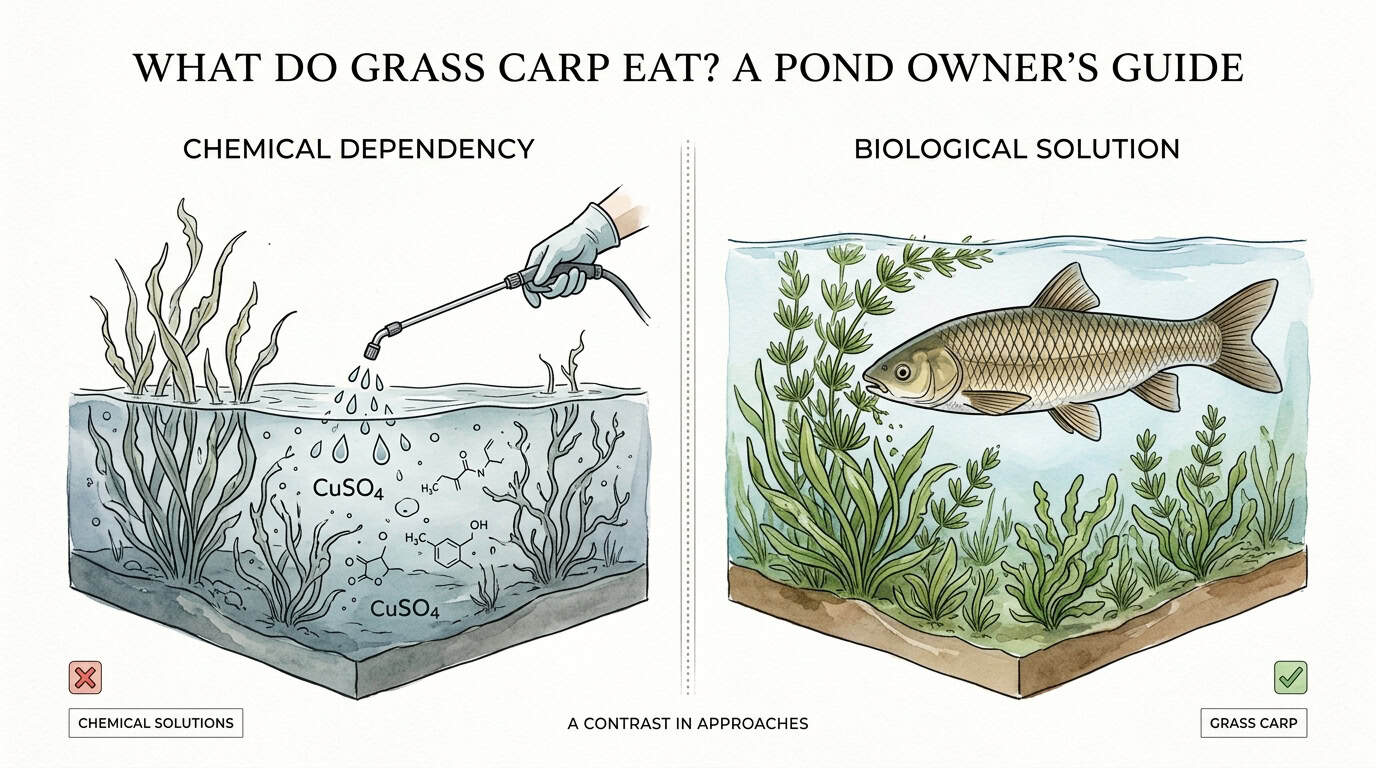
Stop spraying and start stocking. Meet the pond’s natural lawnmower. Tired of spending thousands on herbicides that only provide a temporary fix? Grass carp offer a biological solution to weed control that works while you sleep.
What Do Grass Carp Eat? A Pond Owner’s Guide
The grass carp (Ctenopharyngodon idella), also referred to as the white amur, is a highly specialized herbivorous fish utilized primarily for the biological management of aquatic macrophytes. Unlike many other carp species that disturb bottom sediments to forage for invertebrates, C. idella is an obligate herbivore after its juvenile stage, targeting specific vascular plants for caloric intake. Its digestive physiology is optimized for the breakdown of cellulose, though it lacks the true stomach found in many other teleost fish, relying instead on pharyngeal teeth to masticate plant matter before it enters a long, coiled intestine.
Effective pond management requires a precise understanding of the grass carp’s dietary hierarchy. These fish are selective browsers, not generalist consumers. Their consumption patterns are dictated by the physical structure of the plant, its nutritional density, and the presence of chemical deterrents or high cellulose-to-protein ratios. When introduced into a pond environment, grass carp will systematically deplete their preferred species before transitioning to secondary, less palatable options.
High-priority targets for grass carp include succulent, submersed species with minimal structural lignin. These include:

- Hydrilla (Hydrilla verticillata): Often considered the primary target for biological control due to its rapid growth and high palatability to C. idella.
- Naiads (Najas spp.): These are highly preferred and typically the first species to be eliminated from a system.
- Pondweeds (Potamogeton spp.): Including sago pondweed and leafy pondweed, though preference varies slightly by specific variety.
- Common Elodea (Elodea canadensis): A frequent target in temperate climates.
- Duckweed (Lemna minor): While consumed, the high reproductive rate of duckweed often requires higher stocking densities to achieve measurable control.
Conversely, certain aquatic plants are resistant to grass carp herbivory. Species with high lignin content, woody stems, or chemical defenses are generally avoided. These include Eurasian watermilfoil, water lilies (Nymphaea spp.), cattails (Typha spp.), and most forms of filamentous algae. Understanding this dietary preference is critical; stocking grass carp in a pond dominated by watermilfoil will likely result in the consumption of native beneficial plants while leaving the target weed untouched.
Biological Mechanism and Thermal Optimization
The efficiency of grass carp as a weed control agent is inextricably linked to water temperature and metabolic rate. As poikilothermic organisms, their consumption of biomass scales linearly with thermal increases until an optimal threshold is reached. Research indicates that steady feeding begins when water temperatures exceed 10°C (50°F), with intensive feeding and maximum growth occurring between 20°C and 28°C (68°F–82°F). During these peak periods, juvenile grass carp can consume between 50% and 300% of their body weight in aquatic vegetation daily.
This biological “mowing” process involves the mechanical shearing of plant tissue. The fish utilize their powerful pharyngeal teeth, located in the throat, to grind plant material against a specialized keratinized pad. This mechanical breakdown is necessary because grass carp do not produce cellulase, the enzyme required to digest plant cell walls. Instead, they rely on the mechanical rupture of cells and the subsequent action of intestinal microbiota to extract nutrients. Approximately 50% of the consumed plant matter is excreted back into the water column as partially digested organic waste, a factor that significantly influences pond nutrient dynamics.
Stocking size is a critical variable in ensuring survival and operational efficiency. In ponds containing established predator populations, specifically largemouth bass (Micropterus salmoides), grass carp must be stocked at a minimum length of 8 to 12 inches. Fish smaller than 8 inches are highly susceptible to predation, which can lead to a complete failure of the biological control strategy. Once they reach maturity, grass carp grow rapidly, often gaining several pounds per year, which increases their absolute consumption capacity even as their relative consumption (as a percentage of body weight) decreases.
Benefits of Biological Weed Management
Utilizing grass carp provides several quantifiable advantages over traditional mechanical and chemical control methods. The primary benefit is the transition from a high-maintenance “Chemical Dependency” model to a self-sustaining “Biological Solution.” This shift reduces the need for frequent human intervention and eliminates the cyclical “kill-and-regrow” pattern common with herbicide applications.
Economic efficiency is the most measurable metric of success. While the initial cost of purchasing and permitting triploid grass carp may be higher than a single gallon of herbicide, the amortized cost over the 5-to-10-year lifespan of the fish is significantly lower. Large-scale data suggests that for a moderately infested pond, the cost of biological control is approximately 10% to 20% of the cost of repeated chemical treatments over a decade. Furthermore, grass carp provide 24-hour maintenance, preventing the biomass accumulation that leads to seasonal oxygen depletion during plant decay.

Operational benefits include:
- Continuous Suppression: Unlike herbicides, which provide a pulse-style “knockdown” of vegetation, grass carp provide constant pressure, preventing the re-establishment of invasive species.
- Reduced Environmental Toxicity: Eliminating or reducing herbicide use minimizes the risk of off-target damage to terrestrial plants, livestock, and non-target aquatic organisms.
- Infrastructure Longevity: Biological control does not require the deployment of mechanical harvesters, which can damage pond liners and shoreline stabilization structures.
Challenges and Common Operational Failures
Failure in grass carp programs is rarely a result of the fish’s biology and almost always a result of management error. The most frequent pitfall is the misidentification of the target vegetation. If a pond owner stocks grass carp to control filamentous algae or water lilies, the fish will likely ignore the target and consume all other beneficial vegetation, potentially leading to increased turbidity and algal blooms.
Another significant challenge is “escapement.” Grass carp are riverine by nature and are strongly attracted to moving water. During heavy rain events, they will actively seek out spillways and overflow pipes. Without properly designed barriers or screens, a pond owner can lose their entire investment in a single afternoon. These barriers must be designed to allow the passage of debris while preventing the fish from jumping or being washed over the spillway.
The “overstocking” error is equally problematic. If too many fish are introduced, they may eradicate all aquatic vegetation. This leads to a total loss of habitat for juvenile sport fish and macroinvertebrates, and can cause the pond to transition into a “turbid state” where nutrients previously locked in plant tissue fuel massive blooms of planktonic algae. This shift can be difficult and expensive to reverse once the ecological balance is lost.
Limitations and Environmental Constraints
Grass carp are not a universal solution for all pond environments. One primary limitation is the legal and regulatory framework. In the United States, many states strictly mandate the use of triploid (sterile) grass carp to prevent the establishment of invasive populations in natural river systems. Obtaining the necessary permits and purchasing certified triploid fish from a licensed hatchery is a mandatory step that adds a layer of administrative complexity.
Environmental trade-offs must also be considered. Because grass carp only digest a portion of what they eat, their excrement acts as a continuous source of fertilizer for the water column. In nutrient-rich ponds, this can lead to a shift from a macrophyte-dominated system to an algae-dominated system. This phenomenon, known as a “trophic shift,” can reduce water clarity and increase the risk of cyanobacteria blooms. Consequently, grass carp are often less ideal for ponds where high aesthetic clarity or swimming use is the primary objective.
Furthermore, grass carp are ineffective in ponds with very low water temperatures or extremely low dissolved oxygen levels. Their metabolic efficiency drops sharply in cold climates, making them less suitable for high-altitude or northern regions where the growing season for aquatic plants exceeds the window of active fish feeding. In such cases, a hybrid approach combining biological and mechanical methods is often required.
Comparison: Chemical vs. Biological Control
The choice between chemical herbicides and biological agents depends on the specific goals of the pond manager. The following table compares the two methods across key performance indicators:
| Factor | Chemical Herbicides | Triploid Grass Carp |
|---|---|---|
| Speed of Action | Rapid (Days to Weeks) | Slow (Months to Years) |
| Selectivity | High (Species-specific formulas) | Low (Preference-based) |
| Long-term Cost | High (Annual/Bi-annual expense) | Low (One-time investment) |
| Effort Required | High (Regular application) | Low (Stock once) |
| Nutrient Impact | Sudden release (Decay) | Continuous recycling (Excrement) |
| Habitat Impact | Temporary removal | Long-term alteration |
While herbicides are superior for targeted, immediate “spot treatments,” grass carp excel at maintaining large-scale suppression of palatable biomass over extended periods. Practitioners often use a “knockdown” herbicide treatment to reduce the initial biomass of an infestation before stocking carp to provide long-term maintenance.
Practical Tips and Best Practices
Optimizing the performance of grass carp requires adherence to specific stocking protocols. First, conduct a thorough vegetation survey during the peak growing season (July/August) to identify the percentage of pond coverage. Use this data to calculate the required number of fish. Most state agencies recommend stocking rates based on “vegetated acres” rather than total surface acres.
For a pond with a moderate weed problem (30–60% coverage), a standard stocking rate is 5 to 10 fish per vegetated acre. In cases of heavy infestation (over 60% coverage), rates may increase to 15 or 20 fish per acre. It is generally advisable to start with a lower density and add more fish after two seasons if the desired level of control is not achieved. This “incremental stocking” approach prevents the total eradication of habitat.
Key best practices include:
- Screen All Outlets: Install a parallel-bar screen at the spillway. The spacing should be narrow enough to block the fish but wide enough to prevent clogging by floating debris.
- Stock Large Fish: Ensure all stocked carp are at least 10–12 inches long to maximize survival against predators.
- Record Keeping: Maintain a log of the date stocked, the number of fish, and the source. This is often required for permit compliance.
- Monitor Growth: Grass carp are most effective during their first 5 to 7 years of life. After reaching weights of 20–30 pounds, their metabolic rate slows, and their preference may shift. Plan for supplemental stocking every 5 years.
Advanced Nutrient and Ecosystem Considerations
Serious pond practitioners must account for the “internal nutrient loading” that occurs when grass carp are the primary control method. Aquatic plants act as “nutrient sinks,” locking up phosphorus and nitrogen in their tissue. When these plants are consumed, those nutrients are redistributed into the water column via fish waste. This increase in dissolved nutrients can fuel the growth of filamentous algae (Pithophora or Cladophora), which grass carp rarely eat.
To mitigate this risk, some managers implement a “multi-trophic” biological approach. This involves stocking tilapia (in warmer climates) alongside grass carp. While grass carp target the vascular plants, tilapia can help suppress the resulting algal blooms by consuming the nutrient-enriched phytoplankton and filamentous algae. This creates a more balanced biological filter that addresses multiple levels of the aquatic food web.
Additionally, consider the impact on the pond’s dissolved oxygen (DO) profile. A sudden collapse of vegetation caused by overstocking can lead to a “blackwater” event where decomposing plant matter and the resulting microbial surge consume all available oxygen. Because grass carp consume plants gradually, this risk is lower than with herbicides, but it remains a factor in shallow, stagnant systems with high biomass density.
Scenario: Quantitative Stocking Simulation
Consider a 5-acre farm pond with a confirmed infestation of Hydrilla and Southern Naiad. A visual survey indicates that approximately 60% of the pond is “topped out” with vegetation, representing 3 vegetated acres. The pond has an established population of 2–4 pound largemouth bass.
Step 1: Determine Stocking Rate. Based on the “moderate-to-heavy” infestation of highly palatable species, a rate of 10 fish per vegetated acre is selected. (3 vegetated acres x 10 fish/acre = 30 fish).
Step 2: Selection of Fish Size. Due to the presence of large bass, 12-inch triploid grass carp are specified to ensure 95%+ survival rates.
Step 3: Barrier Installation. A 1-inch bar-spaced screen is installed on the 24-inch overflow pipe to prevent loss during spring runoff.
Step 4: Evaluation. The manager monitors the pond for 18 months. By the second summer, the 30 fish (now weighing 5-8 pounds each) have reduced the Hydrilla coverage to 15%. This provides the ideal balance of open water for recreation and enough “edge habitat” for the bass to ambush prey. The total cost of the fish and permit was $600, compared to a projected $1,500 per year for herbicide treatments.

Final Thoughts
The integration of grass carp into a pond management strategy represents a move toward biological efficiency and long-term sustainability. By understanding the dietary preferences, metabolic requirements, and operational constraints of C. idella, pond owners can effectively manage invasive biomass with minimal recurring costs. Success depends on the precise identification of target species and the implementation of physical barriers to prevent fish loss.
While grass carp are a powerful tool, they are not a “set-and-forget” solution. Practitioners must remain vigilant regarding nutrient shifts and habitat loss, adjusting stocking densities as the pond ecosystem matures. For those dealing with high-lignin plants or severe algae issues, grass carp should be viewed as one component of an integrated pest management (IPM) plan rather than a standalone cure.
Effective management requires a data-driven approach. Start with a baseline vegetation survey, secure the necessary state permits for triploid fish, and monitor the results over a multi-year horizon. This methodical application of biological control will yield a healthier, more balanced aquatic environment that serves both ecological and recreational goals.