

Is your aeration only skin deep? Surface aerators are great for looks, but diffused aeration is the secret weapon for deep water health. See which one your pond’s oxygen profile actually requires.
Aeration systems are critical mechanical components for maintaining dissolved oxygen (DO) levels and preventing anaerobic conditions in aquatic environments. The choice between surface agitation and sub-surface diffusion is governed primarily by the physical dimensions of the water body and the specific oxygen demand of the benthic zone. Engineering a pond for long-term health requires a move beyond aesthetic preference toward an objective analysis of gas transfer efficiency and fluid dynamics.
Surface Aerator vs Diffused Aeration: Which Is Better for Your Pond?
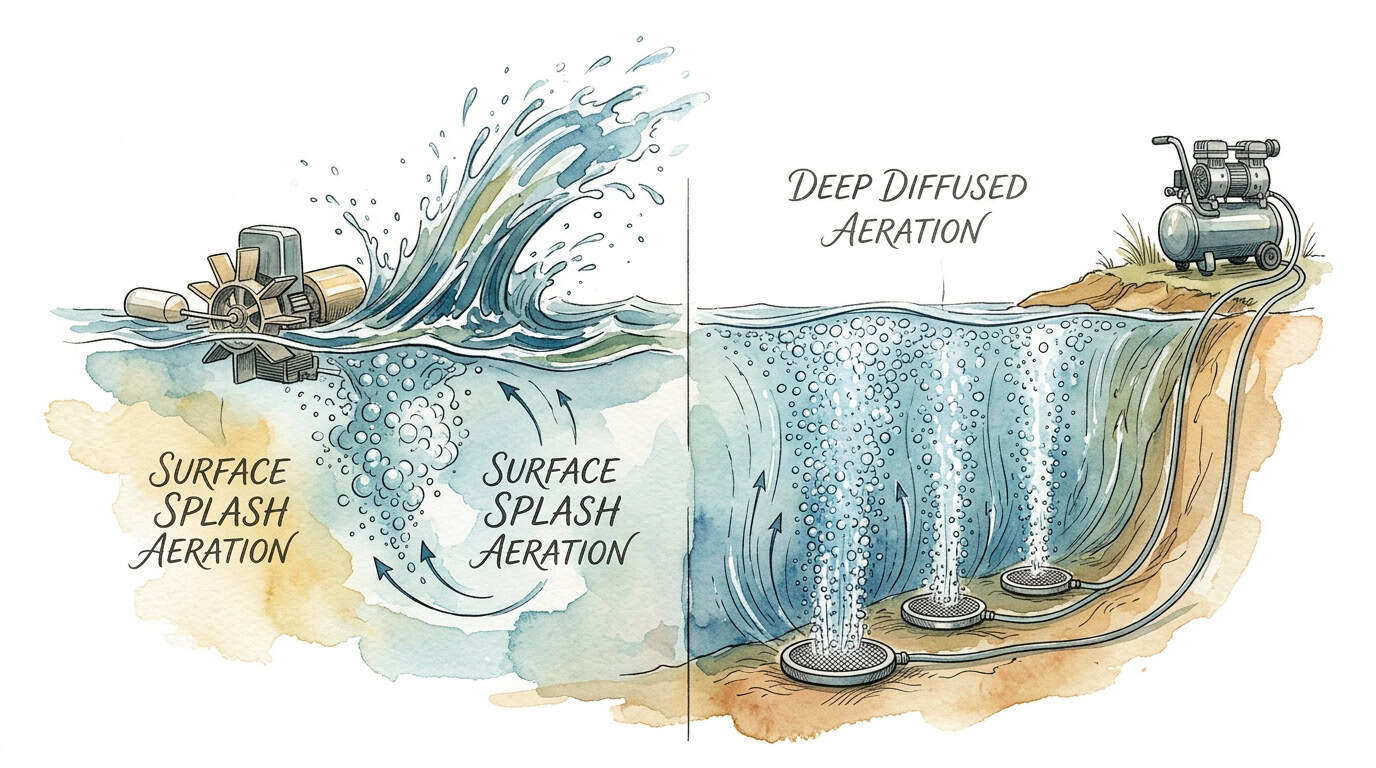
Surface aeration utilizes mechanical force to propel water into the atmosphere. This process increases the surface-area-to-volume ratio of the water droplets, facilitating rapid gas exchange with the air before they return to the basin. These systems are most effective in shallow environments where the vertical water column does not exceed 6 to 8 feet. In these shallow zones, the mechanical mixing provided by the impeller is sufficient to maintain a relatively homogeneous DO profile.
Diffused aeration operates on a fundamentally different principle. An on-shore compressor delivers air through weighted tubing to diffusers positioned at the benthic interface. As the air passes through porous membranes, it forms millions of micro-bubbles. These bubbles rise through the water column, transferring oxygen through their surface area while simultaneously inducing a vertical current. This “airlift” effect moves oxygen-depleted water from the bottom to the surface for atmospheric interaction. For depths exceeding 8 feet, diffused systems are technically superior due to their ability to address thermal stratification and benthic oxygen demand.

How It Works: The Mechanics of Gas Transfer
Standard surface splash systems rely on a high-speed motor and an impeller assembly. The motor, often submerged or protected by a float, rotates at 1,725 or 3,450 RPM. This rotation forces water upward through a nozzle or over a splash plate. The resulting droplets interact with the air, absorbing oxygen and venting accumulated gases like carbon dioxide and methane. The primary limitation is the “cone of influence.” A surface aerator primarily oxygenates the upper 2 to 4 feet of the water column, with mixing effectiveness dropping off sharply at greater depths.
Professional deep diffusion systems utilize a linear or rotary vane compressor to generate pressure. This compressed air is forced through a fine-pore diffuser membrane, typically made of EPDM or specialized ceramics. The efficiency of this system is directly proportional to the “hang time” of the bubbles. As bubbles rise from the bottom, they undergo a continuous mass transfer of oxygen into the water. The physical movement of the rising bubble column also creates a laminar flow that pulls cold, dense, deoxygenated water from the pond floor. This process, known as total lake destratification, ensures that the entire volume of the pond participates in the oxygen cycle.
Benefits and Technical Advantages
The primary advantage of diffused aeration is its Standard Aeration Efficiency (SAE). SAE measures the pounds of oxygen transferred per horsepower per hour. Fine bubble diffusers often achieve SAE ratings between 2.0 and 4.0, whereas surface aerators typically range from 1.5 to 2.5. This difference stems from the fact that it is mechanically more efficient to move air through water than it is to move water through air.
Diffused systems also offer superior operational flexibility. The compressor can be located hundreds of feet away from the water, allowing for easier maintenance and protection from the elements. Furthermore, because there are no electrical components in the water, the risk of stray current or mechanical damage from debris is eliminated. Surface aerators, conversely, provide immediate localized results and are highly effective at controlling surface algae and floating duckweed by maintaining constant surface tension disruption.
Challenges and Common Engineering Mistakes
A frequent error in pond management is the undersizing of the compressor in diffused systems. If the CFM (Cubic Feet per Minute) output is insufficient to overcome the hydrostatic pressure at the pond’s deepest point, the diffusers will not operate at peak efficiency. This leads to “localized aeration” where only the area immediately surrounding the diffuser is treated, leaving the rest of the pond prone to stratification.
For surface aerators, the most common mistake is ignoring the impact of pond shape. In long, narrow ponds or those with irregular shorelines, a single surface unit will leave “dead zones” where water remains stagnant. These stagnant areas become breeding grounds for anaerobic bacteria, leading to nutrient spikes and eventual fish kills. Engineers must also account for the high electrical demand of surface units, which often require 220V service and heavy-gauge underwater cabling to prevent voltage drop.

Limitations and Environmental Constraints
Depth is the ultimate constraint for surface aeration. In ponds deeper than 15 feet, a surface aerator cannot influence the bottom-most layer of water. This results in a permanent thermocline where the bottom water remains cold and devoid of oxygen. If a sudden weather event causes the pond to turn over, this deoxygenated water rises to the surface, potentially causing a catastrophic collapse of the aquatic ecosystem.
Diffused aeration faces limitations in very shallow water. If a pond is less than 4 feet deep, the bubbles do not have enough contact time with the water column to transfer significant amounts of oxygen. The “airlift” effect is also diminished in shallow basins, as the vertical distance is insufficient to generate a strong enough current to circulate the entire volume. In these scenarios, the mechanical agitation of a surface splash system is significantly more effective.
Standard Surface Splash vs Professional Deep Diffusion
When selecting between these two technologies, technical specifications must guide the decision. The following table compares the typical performance metrics of a 1-HP Standard Surface Splash unit against a 1-HP Professional Deep Diffusion system.
| Feature | Standard Surface Splash (1-HP) | Professional Deep Diffusion (1-HP) |
|---|---|---|
| Oxygen Transfer Rate (SOTR) | ~2.5 lbs O2/hr | ~3.5 – 4.5 lbs O2/hr |
| Maximum Effective Depth | 6 – 8 feet | 35 – 40 feet |
| Operating Pressure | Low (Atmospheric) | High (5 – 15 PSI) |
| Maintenance Interval | Frequent (Propeller cleaning) | Annual (Filter/Diaphragm) |
| Electrical Safety | In-water components | On-shore components |
| Visual Profile | Visible fountain/splash | Subtle bubble boil |
Practical Tips and Sizing Best Practices
Effective aeration requires precise sizing based on the total pond volume and the biological oxygen demand (BOD). For a diffused system, the rule of technical thumb is to provide at least 1.0 to 1.5 CFM of air for every surface acre of water at the required depth. If the pond is heavily stocked with fish or has significant organic sludge, this requirement may double.
Installers should ensure that diffusers are placed in the deepest parts of the pond to maximize the oxygen transfer window. For surface aerators, placement should be centralized or staggered in a way that maximizes current reach. It is also advisable to use a timer or a DO sensor to control the system. Running aeration 24/7 is often necessary during peak summer months, but during cooler periods, cycling the system can reduce mechanical wear and energy costs.
Advanced Considerations: The Physics of Solubility
The efficiency of any aeration system is influenced by Henry’s Law, which states that the amount of dissolved gas in a liquid is proportional to its partial pressure above the liquid. In deep water, the hydrostatic pressure increases the partial pressure of the air inside the bubbles, which in turn increases the rate of oxygen dissolution. This is why diffused aeration becomes exponentially more efficient as depth increases.
Another factor is the Alpha Factor, which represents the ratio of oxygen transfer in pond water compared to clean water. Organic matter, surfactants, and salinity can all lower the Alpha Factor, meaning the system must work harder to achieve the same DO levels. Serious practitioners should perform periodic DO profiling at various depths to confirm that the system is overcoming the specific benthic demand of the environment.
Example Scenario: A Two-Acre Retention Pond
Consider a two-acre retention pond with an average depth of 12 feet. A surface splash system would require multiple 2-HP units to achieve even marginal mixing at the bottom. The electrical cost for such a setup would be substantial, and the reach would still be limited.
Implementing a professional deep diffusion system with a 3/4-HP rocking piston compressor and four fine-pore diffusers would be the optimal choice. This configuration would deliver approximately 4.5 CFM of air. At a 12-foot depth, the oxygen transfer efficiency is roughly 19% per foot of rise. The resulting vertical current would move thousands of gallons per minute, ensuring that the entire 8-million-gallon volume is turned over at least once every 24 hours.
Final Thoughts
The choice between surface and diffused aeration is a matter of mechanical suitability for the environment. Surface aerators provide excellent shallow-water gas exchange and visual appeal, making them ideal for small decorative ponds and shallow lagoons. They are the primary tool for rapid surface degassing and maintaining high oxygen levels in the top layer of the water column.
Professional deep diffusion systems represent the industrial standard for deep-water management and overall ecosystem health. By addressing the pond from the bottom up, these systems eliminate thermal stratification and ensure that the vital benthic zone remains aerobic. This approach not only supports fish populations but also accelerates the natural decomposition of organic muck.
Selecting the correct system requires an objective assessment of depth, volume, and biological load. When engineered correctly, an aeration system serves as the heart of the aquatic environment, maintaining the delicate balance of dissolved gases necessary for a thriving ecosystem. Practitioners are encouraged to evaluate their specific depth profiles before investing in hardware to ensure the chosen technology meets the physical demands of the basin.