

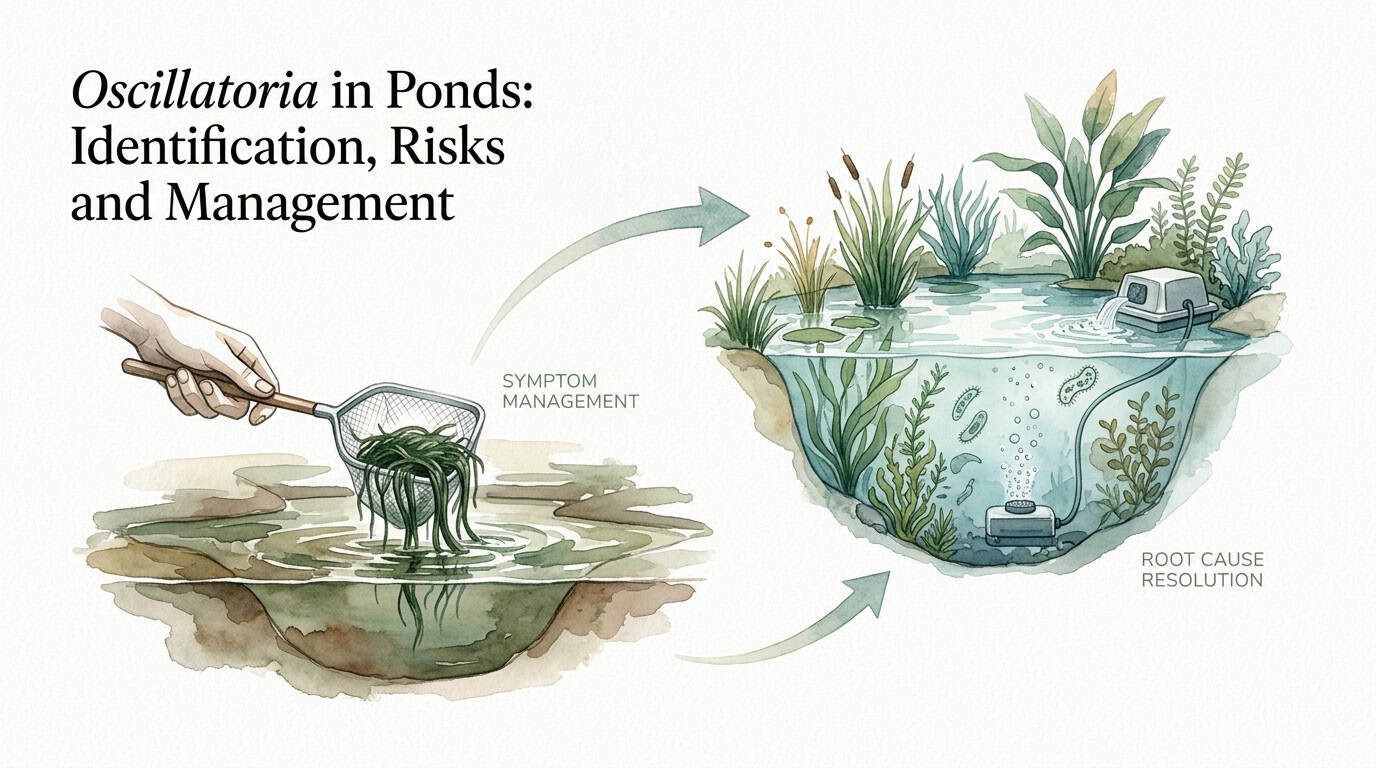
Oscillatoria ‘dances’ in the water, but its presence is no celebration. It’s time for a strategy. Oscillatoria isn’t just an eyesore; it can be a risk. Learn the strategic way to eliminate this blue-green invader.
Oscillatoria in ponds is identified by its filamentous, motile structure and dark, “spilled paint” benthic mats that frequently float to the surface. Managing this cyanobacterium requires a dual approach: immediate chemical oxidation to neutralize toxic potential and long-term nutrient sequestration to address the root cause of phosphorus enrichment. Risks include the production of hepatotoxins and neurotoxins, alongside severe nocturnal oxygen depletion that threatens aquatic life and overall ecosystem stability.
Oscillatoria in Ponds: Identification, Risks and Management
Oscillatoria is a genus of filamentous cyanobacteria categorized within the order Oscillatoriales. This organism is primarily recognized for its unbranched trichomes that exhibit a characteristic gliding or oscillating motion. This rhythmic movement allows the colony to reorient itself relative to light sources, optimizing photosynthetic efficiency across varying depths.
In real-world pond environments, Oscillatoria typically manifests as dense, leathery mats on the sediment surface. These mats are often dark green, blue-green, or brownish-black. Over time, oxygen bubbles produced during photosynthesis become trapped within the fibrous matrix of the mat, providing buoyancy. This process causes large sections of the benthic mat to detach and float to the surface, creating unsightly and potentially hazardous scums.

Understanding Oscillatoria is critical for pond managers because it occupies a niche that combines benthic stability with planktonic dispersal. Unlike many green algae, Oscillatoria is a prokaryotic organism with a robust metabolic toolkit, allowing it to thrive in high-nutrient (eutrophic) conditions where other species may struggle.
How to Identify and Manage Oscillatoria
Identification of Oscillatoria begins with macroscopic observation. Managers should look for mats that appear “spongy” or “felt-like” rather than slimy or hair-like. When these mats float, they often maintain a cohesive structure, resembling dark patches of fabric or spilled oil.
Microscopic confirmation is necessary for precise identification. Under 400x magnification, Oscillatoria appears as a series of discoid cells stacked like a roll of coins. These cells are typically wider than they are long. A key diagnostic feature is the absence of a visible mucilaginous sheath, which distinguishes it from related genera like Lyngbya. The terminal cells of the filament may be rounded, capitate, or slightly tapered, depending on the specific species.
Management follows a systematic protocol of chemical control and physical modification. Effective treatment often involves the application of copper-based algaecides. Chelated copper formulations are preferred because they remain in solution longer and are less likely to precipitate out in hard water.
Oxidation is another viable strategy. Using sodium carbonate peroxyhydrate or liquid hydrogen peroxide provides an immediate “kill” by disrupting the cell membranes of the cyanobacteria. This method is advantageous because it leaves no chemical residue, breaking down into water and oxygen.
Physical management focuses on disrupting the stagnant conditions that Oscillatoria prefers. Installing bottom-diffused aeration increases dissolved oxygen at the sediment-water interface. This process alters the redox potential, helping to keep phosphorus bound to the sediment rather than releasing it into the water column to fuel further growth.

Benefits of Strategic Oscillatoria Management
Implementing a rigorous management plan for Oscillatoria yields measurable improvements in pond chemistry and biological health. The primary benefit is the reduction of cyanotoxins. By controlling the population, managers mitigate the risk of microcystins and anatoxins entering the food web or affecting local wildlife and pets.
Improved dissolved oxygen (DO) stability is another significant advantage. Oscillatoria mats consume high amounts of oxygen during respiration at night. Removing these mats prevents the extreme DO “crashes” that often lead to fish kills. This stabilization supports a more diverse community of beneficial aerobic bacteria and zooplankton.
Nutrient availability is also impacted. Managing Oscillatoria through sequestration agents like aluminum sulfate (alum) or lanthanum-modified clay reduces the bioavailable phosphorus. This creates a competitive disadvantage for cyanobacteria while allowing more desirable aquatic plants or planktonic algae to establish a balanced ecosystem.
Challenges and Common Mistakes in Management
The most frequent error in Oscillatoria control is treating only the surface mats while ignoring the benthic biomass. Because the majority of the population often resides on the pond floor, surface-only applications of algaecides result in rapid re-infestation. A comprehensive treatment must ensure the chemical reaches the sediment-water interface.
Timing is a significant challenge. Applying algaecides during a massive bloom can cause a sudden release of intracellular toxins and a rapid decline in oxygen as the biomass decomposes. This “pulse” of mortality can be more damaging than the bloom itself.
Failure to address alkalinity levels before copper application is another common mistake. In ponds with very low alkalinity (below 50 ppm), copper can become highly toxic to fish. Conversely, in high-alkalinity water, standard copper sulfate precipitates rapidly, losing its effectiveness against the target cyanobacteria.
Resistance to treatment can occur if sub-lethal doses are consistently applied. This selective pressure allows more resilient strains of Oscillatoria to dominate the pond, eventually requiring higher concentrations or more expensive chemical rotations to achieve control.
Limitations of Current Control Methods
Environmental constraints often limit the efficacy of management strategies. For example, chemical treatments are significantly less effective in cold water (below 60°F) because the metabolic rate of the cyanobacteria slows down, reducing the uptake of the algaecide.
Pond morphology also plays a role. In very deep ponds, achieving uniform aeration to the bottom can be cost-prohibitive. If the pond has high “muck” or organic sediment accumulation, the internal loading of phosphorus may be so great that standard sequestration doses are insufficient to stop the growth.
Budgetary limitations are a practical boundary. While mechanical harvesting or dredging offers a long-term solution by removing the nutrient-rich sediment, the high cost often forces managers to rely on repetitive chemical “symptom management” which may be less efficient over several years.
Technical Comparison: Oscillatoria vs. Lyngbya
A technical comparison of these two common filamentous cyanobacteria reveals critical differences in management requirements.
| Characteristic | Oscillatoria | Lyngbya |
|---|---|---|
| Sheath Presence | Absent or very thin | Thick, rigid, and clear |
| Motility | Active oscillation and gliding | Minimal to none |
| Chemical Resistance | Moderate | High (due to protective sheath) |
| Preferred Habitat | Nutrient-rich sediment/stagnant | Benthic, often in flowing or calm water |
| Primary Risk | Toxins and oxygen depletion | Severe aesthetic and toxin issues |
Lyngbya is generally more difficult to treat because its thick sheath acts as a physical barrier to algaecides. Oscillatoria, lacking this barrier, is more susceptible to copper and peroxide but replicates faster under optimal nutrient conditions.
Practical Tips for Pond Operators
Monitoring the pond during early morning hours provides the most accurate assessment of Oscillatoria activity. This is when the mats are typically located on the bottom before oxygen production begins to lift them.
Maintaining a consistent N:P (Nitrogen to Phosphorus) ratio is a key best practice. Ratios below 15:1 often favor cyanobacteria like Oscillatoria. Increasing the nitrogen through controlled biological means or reducing the phosphorus can shift the pond toward a more desirable green algae community.
Application of algaecides should be done in sections. Treating no more than one-third to one-half of the pond at a time allows the remaining pond volume to maintain adequate oxygen levels for the fish population during the decomposition phase.
Testing water alkalinity is a mandatory step before any copper application. This data point dictates the dosage and the specific formulation required. If the alkalinity is too low, consider using a non-copper based algaecide like a peroxyacetic acid formulation to protect sensitive fish species.
Advanced Considerations in Cyanobacteria Control
Advanced management involves the study of the sediment’s redox potential. When the bottom of the pond becomes anaerobic (oxygen-depleted), iron-bound phosphorus is released into the water. This phenomenon, known as internal loading, can sustain Oscillatoria blooms even if external nutrient runoff is eliminated.
Ultrasound technology is an emerging advanced technique. High-frequency sound waves can cause cavitation within the cells or collapse the gas vesicles that allow Oscillatoria to regulate its buoyancy. While effective, the success of ultrasonic units is highly dependent on the “line of sight” and the presence of obstructions like heavy aquatic vegetation.
Biological competition is another advanced strategy. Using specific strains of beneficial bacteria can out-compete Oscillatoria for nutrients. These bacteria consume the organic matter on the pond floor, reducing the habitat available for benthic mat formation.
Scenario Analysis: 1-Acre Eutrophic Pond
Consider a 1-acre pond with an average depth of 5 feet and a history of dark green surface scums appearing in July. Water testing reveals phosphorus levels at 150 ppb (highly eutrophic) and alkalinity at 120 ppm.

In this scenario, the operator should first apply a chelated copper algaecide at a rate of 0.5 to 1.0 ppm to the benthic mats. This should be followed 48 hours later by a phosphorus binding agent like alum to lock down the released nutrients. Within two weeks, a bottom-diffused aeration system should be installed to prevent the recurrence of anaerobic conditions at the sediment surface. This mechanical optimization ensures that the chemical treatment is not just a temporary fix but part of a long-term stabilization effort.
Final Thoughts
Effective management of Oscillatoria requires a move away from reactive treatments and toward a systematic understanding of pond limnology. This cyanobacterium is a highly adapted survivor that capitalizes on nutrient imbalances and stagnant water columns. Identification must be precise, focusing on the unique motile filaments and benthic mat structures that define the genus.
Reducing the risks associated with toxins and oxygen crashes is achieved through a combination of chemical oxidation and mechanical aeration. These tools work in tandem to eliminate the current population and prevent the environmental conditions that favor its return. Data-driven decisions, particularly regarding water chemistry and nutrient ratios, are the hallmark of a successful long-term strategy.
Pond managers are encouraged to view Oscillatoria as a biological indicator of excessive nutrient loading. Addressing the root cause through sediment management and phosphorus sequestration provides the most efficient path toward a healthy, clear, and safe aquatic environment. Continuous monitoring and incremental adjustments to the management plan will yield the highest level of ecological stability.
Frequently Asked Questions About Oscillatoria in Ponds: Identification, Risks and Management
What is the most effective way to identify Oscillatoria without a microscope?
Identification without a microscope relies on observing the texture and behavior of the mats. Oscillatoria typically forms dark, dense mats on the pond bottom that eventually float to the surface in leathery clumps. These mats often have a “spilled paint” appearance, appearing dark green or almost black. Unlike many types of green algae that feel slimy or look like fine hair, Oscillatoria mats are more cohesive and spongy. Another indicator is a strong, earthy, or musty odor coming from the water, which is caused by the production of compounds like geosmin. While these signs are strong indicators, microscopic verification of the “coin-stack” cell structure is the only way to be 100% certain.
Why is Oscillatoria considered more dangerous than common green algae?
The danger lies in its classification as a cyanobacterium rather than a true alga. Many species of Oscillatoria have the genetic capability to produce cyanotoxins, including microcystins and anatoxins. These toxins can cause skin irritation, liver damage, or neurological issues in humans and animals if they come into contact with or ingest the water. Furthermore, Oscillatoria is extremely efficient at consuming oxygen during the night. Because it often grows in massive benthic mats, it can deplete the dissolved oxygen near the pond floor and throughout the water column rapidly. This leads to hypoxic conditions that can result in sudden and total fish kills, which are less common with standard green algae.
Can Oscillatoria be controlled permanently with a single algaecide treatment?
A single treatment is rarely a permanent solution. Algaecides like copper sulfate or hydrogen peroxide are effective at killing the existing biomass, but they do not address the underlying nutrients that allowed the Oscillatoria to bloom in the first place. When the cyanobacteria die, they decompose and release their stored phosphorus and nitrogen back into the water, which can trigger a follow-up bloom within weeks. Long-term control requires a multi-faceted approach that includes nutrient sequestration to lower phosphorus levels and mechanical aeration to improve water circulation. Without these preventative measures, the pond remains a high-risk environment for recurring infestations.
How does aeration help specifically in managing Oscillatoria?
Aeration works by disrupting the habitat and changing the chemistry of the pond floor. Oscillatoria thrives in stagnant, stratified water where the bottom is low in oxygen. Bottom-diffused aeration moves oxygen-rich surface water down to the sediment, which helps beneficial aerobic bacteria break down organic “muck.” This process also helps keep phosphorus chemically bound to the sediment minerals, making it unavailable for the cyanobacteria to use as fuel. Additionally, the physical movement of the water makes it more difficult for Oscillatoria to form stable, buoyant mats. By eliminating the stagnant conditions and reducing nutrient availability, aeration serves as a powerful mechanical tool for long-term prevention.
Is it safe to use copper-based treatments if I have fish in my pond?
Copper-based treatments can be safe, but they require careful calculation and monitoring. The toxicity of copper to fish is heavily dependent on the water’s alkalinity. In water with low alkalinity (under 50 ppm), copper becomes much more toxic to fish, particularly sensitive species like trout or koi. In these cases, chelated copper or non-copper alternatives like peroxide-based algaecides are safer options. It is also critical to treat the pond in sections. If you kill too much Oscillatoria at once, the resulting decomposition will use up all the oxygen in the pond, causing the fish to suffocate regardless of the chemical’s direct toxicity. Always test your water parameters before application.