

Pond Talk is an Amazon Associate. As an Amazon Associate we earn from qualifying purchases.
Stop letting the summer sun steal your water and kill your fish. An open pond is a thirsty pond. In high heat, an exposed surface can lose inches of water daily. Duckweed creates a biological barrier that cuts evaporation by up to 30% while keeping your ecosystem cool and resilient. Using this aquatic plant is not just about aesthetics; it is a calculated mechanical strategy to manage the thermodynamics of a closed water system.
Thermal energy transfer in a pond occurs primarily through solar radiation. When sunlight hits an exposed water surface, the energy increases the molecular kinetic energy of the water, leading to phase changes from liquid to vapor. Duckweed acts as a physical shield, intercepting these photons before they reach the water column. This process mitigates the rising temperatures that can lead to oxygen depletion and stress for aquatic life.
Understanding the mechanics of water loss is the first step toward building a more efficient system. This guide focuses on the technical application of duckweed as a tool for water conservation and thermal regulation. It examines the biological requirements of the plant, the physics of evaporation, and the practical steps required to maintain a balanced, sheltered ecosystem.

How To Stop Pond Evaporation
Pond evaporation is a physical process where water transforms into gas at the surface interface. In a standard backyard pond or agricultural reservoir, this loss is driven by three main variables: surface area, air temperature, and wind speed. An exposed pond maximizes the interaction between these variables, leading to rapid volume reduction. To stop or slow this process, the pond manager must interrupt the transfer of energy at the surface level.
Duckweed (Lemnoideae) is a family of small floating flowering plants that thrive in still or slow-moving water. These plants are uniquely suited for evaporation control because they form a dense, interlocking mat on the surface. Unlike submerged plants that only interact with the water column, duckweed creates a boundary layer between the water and the atmosphere. This layer acts as an insulator and a reflective barrier.
In real-world applications, duckweed is used in wastewater treatment, aquaculture, and decorative koi ponds. Its primary function in these systems is nutrient sequestration and temperature control. By covering the surface, the plant prevents the sun from penetrating deep into the water, which keeps the lower layers of the pond significantly cooler than the ambient air temperature during peak solar hours.
How It Works: The Mechanics of Biological Shading
The effectiveness of duckweed in preventing evaporation relies on several biological and physical principles. The first is the high albedo of the plant mat. Chlorophyll-rich leaves reflect a portion of the solar spectrum, particularly in the infrared range, which is responsible for heat. This reflection ensures that less energy is absorbed by the pond system.
The second mechanism is the reduction of surface tension and wind-water interaction. Wind blowing across an open water surface creates ripples, which increases the effective surface area available for evaporation. A dense mat of duckweed stabilizes the surface. It prevents the wind from directly contacting the water molecules, effectively neutralizing the evaporative effect of air movement across the pond.
Evapotranspiration is a factor to consider, as the plants themselves release a small amount of water through their stomata. However, the net water loss through duckweed transpiration is significantly lower than the direct evaporation loss from an exposed surface. This is because the plant mat creates a humid microclimate directly above the water, which saturates the air and slows further moisture loss.
To implement this system, the pond must have low-flow areas. Duckweed is easily moved by currents and wind. If a pond has high-volume waterfalls or skimmers, the duckweed will be pushed to one side or sucked into filtration units. Installing floating barriers or “corrals” using PVC pipe or foam tubing allows the manager to position the duckweed over the areas with the highest solar exposure while keeping mechanical equipment clear.
Benefits of Utilizing Duckweed Barriers
The primary benefit of duckweed is the measurable reduction in water replacement costs and labor. For large-scale systems, reducing evaporation by 30% translates to thousands of gallons of water conserved over a single season. This is particularly critical in regions with water restrictions or high utility costs.
Thermal stability is a secondary but equally vital benefit. Rapid temperature fluctuations are a major stressor for fish and beneficial bacteria. A covered pond experiences a dampened diurnal temperature cycle. The water warms up more slowly during the day and retains heat more effectively at night, creating a more predictable environment for biological processes.
Nutrient management is another technical advantage. Duckweed is a hyper-accumulator of nitrogen and phosphorus. These nutrients are often the root cause of algae blooms. By outcompeting algae for both light and food, duckweed keeps the water clear. As the duckweed grows, it can be harvested and used as a high-protein feed for livestock or as a nitrogen-rich compost additive, effectively turning pond waste into a usable resource.
Challenges and Common Mistakes
The most frequent mistake in managing duckweed is allowing it to cover 100% of the surface area. While this maximizes evaporation control, it creates a significant risk for the ecosystem. At night, plants stop producing oxygen and begin consuming it through respiration. If the surface is completely sealed, the gas exchange between the water and the atmosphere is restricted. This can lead to a “crash” where dissolved oxygen levels drop below the threshold required for fish survival.

Another challenge is the rapid doubling time of the species. Under optimal conditions, duckweed can double its biomass in 16 to 48 hours. This exponential growth can quickly overwhelm a pond, clogging filters and mechanical skimmers. If the pump intake becomes blocked, the resulting drop in flow can lead to pump failure and a total loss of filtration.
Maintenance neglect is a common pitfall. Many pond owners view duckweed as a “set and forget” solution. In reality, it requires consistent harvesting. If the mat becomes too thick, the lower layers of the plant die due to lack of light. This dead organic matter then sinks to the bottom, increasing the biological oxygen demand (BOD) and contributing to sludge buildup.
Limitations: When Duckweed Is Not Ideal
Duckweed is not a universal solution for every water feature. In high-wind environments without physical windbreaks, the plants will be constantly pushed against the leeward bank. This leaves the majority of the pond exposed while creating a rotting mass of vegetation in the corners. In such cases, mechanical covers or shade sails may be more effective.
Water chemistry also plays a role in duckweed viability. While it is a hardy plant, it prefers a pH between 6.0 and 8.0. If the pond is highly alkaline or has extreme mineral hardness, the duckweed may struggle to thrive. Additionally, very high-flow systems, such as trout raceways or ponds with large aeration fountains, generate too much surface turbulence for the plant to form a stable mat.
Aesthetics can be a limitation for some users. While many appreciate the natural look of a green pond, others find the appearance of “pond scum” undesirable. This is a subjective factor, but for professional or public-facing displays, the visual impact of a floating plant mat must be balanced against its functional benefits.
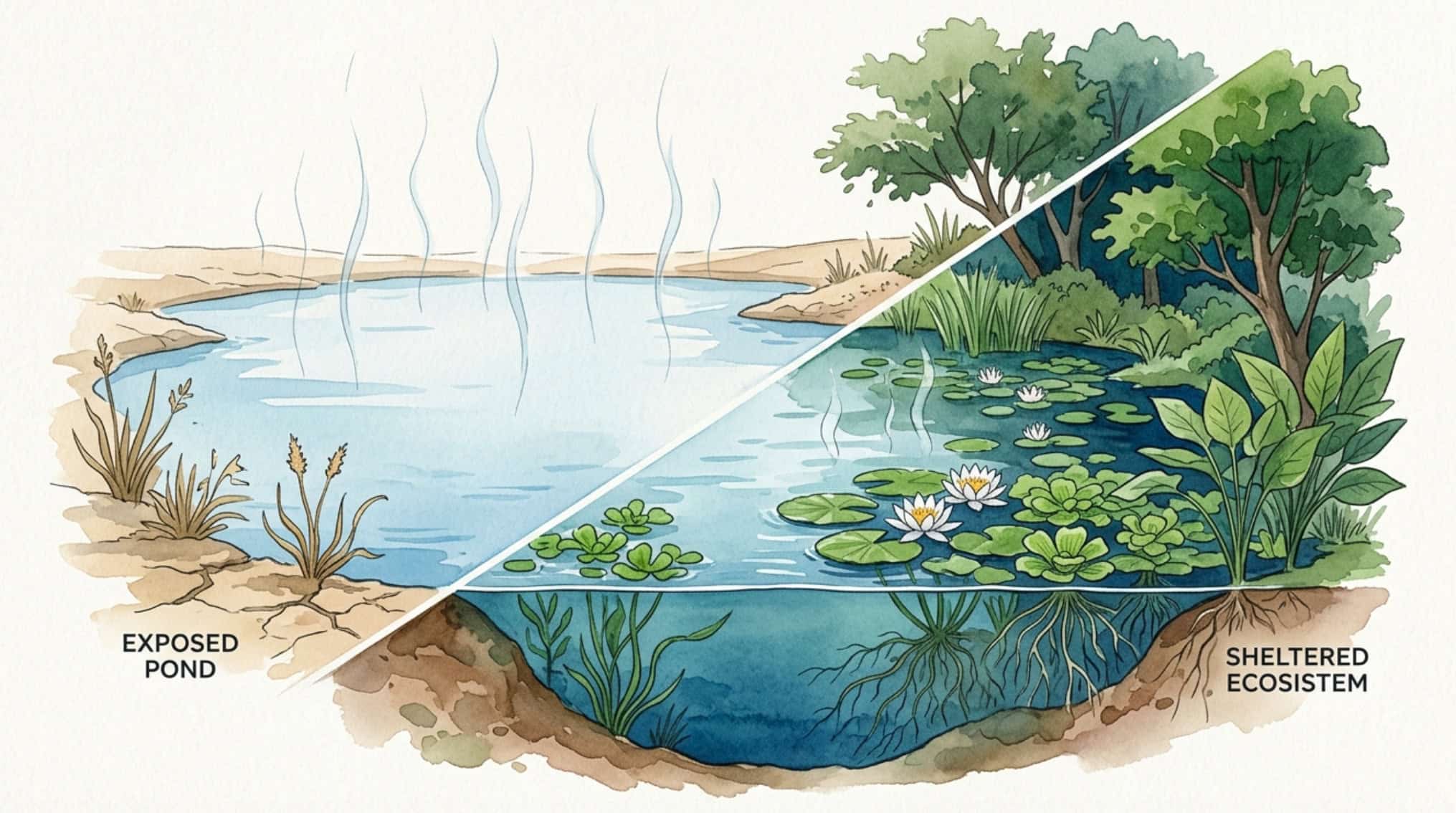
Comparison: EXPOSED POND vs SHELTERED ECOSYSTEM
The following table compares the operational metrics of a standard exposed pond versus one utilizing a managed duckweed biological barrier.
| Feature | Exposed Pond | Sheltered Ecosystem (Duckweed) |
|---|---|---|
| Evaporation Rate | High (Maximized) | Reduced by 20% to 30% |
| Temperature Swings | Erratic (Diurnal spikes) | Stable (Dampened) |
| Algae Growth | Frequent blooms | Suppressed (Light/Nutrient blocking) |
| Maintenance Type | Water top-offs & chemical treatments | Mechanical harvesting & biomass removal |
| Oxygen Exchange | Unrestricted | Moderated (Requires careful management) |
| Nutrient Levels | Accumulating (Nitrates/Phosphates) | Declining (Bio-sequestration) |
Practical Tips for Implementation
Begin by introducing a small starter culture of duckweed during the spring when water temperatures reach at least 60 degrees Fahrenheit. This allows the colony to establish itself before the peak heat of summer. Use a floating ring or a section of plastic mesh to contain the plants in a specific quadrant of the pond. This prevents them from drifting into the skimmer or pump intake.
Monitor the coverage daily. The ideal coverage for most ecosystems is between 50% and 70% of the surface area. This provides enough open water for gas exchange while offering significant shade and evaporation protection. Use a fine-mesh net to remove excess plants once or twice a week.
Optimize the harvest by checking the health of the fronds. Healthy duckweed is bright green and firm. If the plants begin to turn yellow or white, it indicates a nutrient deficiency or heat stress. In very high-heat scenarios, a light misting of the surface during the evening can help cool the plant mat and prevent desiccation.
Ensure that your aeration system is adequate. Since the surface mat restricts some natural oxygen diffusion, using a bottom-mounted air stone or a subsurface aerator is a best practice. This ensures that the water column remains oxygenated regardless of the surface coverage.
Advanced Considerations for Large Systems
For those managing larger reservoirs or aquaculture setups, scaling duckweed coverage requires a more technical approach. Consider the “fetch” of the pond—the distance the wind can blow across the water without obstruction. On large bodies of water, duckweed will naturally aggregate at the edges. To combat this, install a series of floating baffles. These are long, weighted lines that sit on the surface, dividing the pond into cells. Each cell contains its own colony of duckweed, ensuring uniform coverage.
Advanced practitioners should also track Total Dissolved Solids (TDS). As water evaporates, minerals are left behind, increasing the concentration of salts and metals. While duckweed helps reduce the rate of evaporation, it does not remove the minerals already in the water. Periodic water changes or the addition of reverse osmosis water may still be necessary to prevent mineral toxicity in a closed system.
Integration with automated harvesting systems is another advanced strategy. In industrial or large-scale agricultural ponds, mechanical skimmers can be programmed to remove a specific volume of biomass daily. This biomass is then dried and processed into pelletized feed. This creates a circular economy where the pond’s “waste” becomes a valuable input for other agricultural operations.
Examples and Scenarios
Consider a 2,500-gallon koi pond located in a semi-arid climate. During July, the average daily water loss through evaporation is approximately 1.5 inches. Given a surface area of 200 square feet, this pond loses roughly 187 gallons of water per week. Over a four-month summer period, that is nearly 3,000 gallons of water.
By introducing a managed duckweed cover over 60% of the surface, the evaporation rate is reduced by 25%. This saves approximately 46 gallons per week, or 736 gallons over the season. More importantly, the peak water temperature is reduced from 82 degrees Fahrenheit to 76 degrees Fahrenheit. This 6-degree difference significantly increases the oxygen-carrying capacity of the water, preventing the “gasping” behavior often seen in koi during heatwaves.
In another scenario, a small farm pond used for livestock watering suffers from chronic blue-green algae blooms. The high nutrient runoff from the surrounding fields feeds the algae, making the water toxic to animals. By seeding the pond with duckweed, the farmer creates a “biological sponge.” The duckweed grows rapidly, consuming the excess nitrogen and shading out the toxic algae. The farmer harvests the duckweed every two weeks, providing high-protein supplemental feed for chickens while maintaining a safe water source for the cattle.
Final Thoughts
Managing pond evaporation through biological means is an exercise in efficiency and ecological balance. Duckweed is not a magical fix, but a functional component of a well-engineered water system. It provides a physical barrier against solar radiation, stabilizes water temperatures, and acts as a continuous nutrient filter.
Success with this method requires an understanding of the trade-offs between surface coverage and gas exchange. By maintaining a disciplined harvesting schedule and utilizing physical barriers to protect mechanical equipment, you can significantly reduce the water demands of your pond. This approach transforms an exposed, vulnerable water feature into a resilient, sheltered ecosystem.
The transition from a high-maintenance open pond to a stabilized duckweed-sheltered system takes time and observation. Experiment with different levels of coverage and monitor your water parameters closely. As you dial in the balance, you will find that the pond requires fewer chemical interventions and less frequent top-offs, allowing the biology of the system to do the heavy lifting of maintenance for you.
Amazon and the Amazon logo are trademarks of Amazon.com, Inc, or its affiliates.