

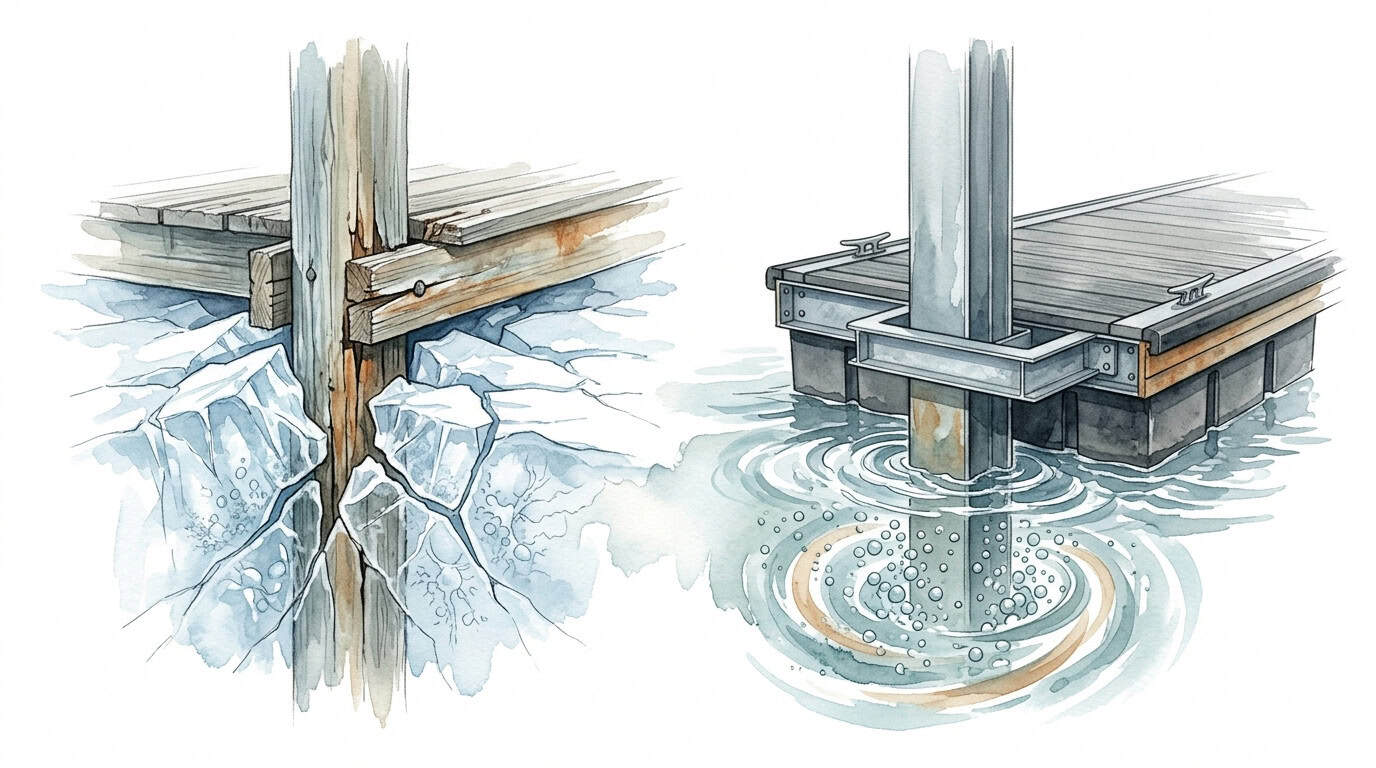
One winter freeze can cost more than a decade of prevention. Winter doesn’t have to be a death sentence for your marina. Stop ‘ice jacking’ and pressure damage before it starts with these preventative strategies.
To prevent ice from damaging marina docks, install active de-icing systems like sub-surface bubblers or high-velocity circulators to maintain open water around pilings. These systems disrupt thermal stratification, bringing warmer 39°F (4°C) water to the surface to prevent freezing. Complement these mechanical solutions with physical barriers, such as HDPE pile sleeves, to reduce the vertical friction that causes “ice jacking” during water level fluctuations.
Protecting a marina from ice requires a technical understanding of fluid dynamics and thermal physics. It is not merely about moving water; it is about strategic heat transfer. In deep water, thermal stratification keeps a reservoir of warmer, denser water at the bottom, which can be leveraged to keep the surface liquid even in sub-zero ambient temperatures.
Failure to implement these systems leads to “ice jacking,” where the frozen surface layer adheres to pilings and lifts them out of the seabed as water levels rise. Lateral expansion of ice sheets can also exert thousands of pounds of pressure per square foot, crushing dock frames and shearing bolts. Implementing a resilient system ensures the longevity of the infrastructure and prevents catastrophic structural failure.

Preventing ice damage involves a multi-layered approach that addresses the mechanical forces of ice formation and movement. The primary objective is to maintain a “buffer zone” of open water between the ice sheet and the dock components. This is achieved by utilizing the thermal properties of the water column to suppress freezing or by using physical barriers to mitigate the grip of the ice.
Active prevention systems typically fall into two categories: diffused air systems (bubblers) and mechanical circulators. Bubblers use a shore-based compressor to pump air through weighted, perforated tubing laid on the bottom. As the bubbles rise, they create a “curtain” of moving water that pulls the warmer, denser 39°F (4°C) water from the basin floor to the surface. This thermal transfer is highly efficient for protecting long perimeters or linear dock structures.
Mechanical circulators, or agitators, use a submerged electric motor and propeller to create a high-velocity jet of water. This jet is directed toward the surface or specific pilings to prevent ice from taking hold. These units are best suited for deep-water marinas or localized areas with high ice-shove risk. Physical mitigation, such as pile sleeves and sacrificial “ice break” structures, provides a secondary defense by ensuring that if ice does form, its vertical and lateral forces are dissipated rather than transferred directly to the dock’s structural members.
Mechanics of Ice-Induced Structural Failure
Understanding the physics of ice damage is critical for engineering an effective prevention strategy. Ice damage is rarely the result of a single event but rather the cumulative effect of three distinct mechanical processes: ice jacking, lateral expansion, and ice shove.
Ice Jacking (Vertical Displacement)
Ice jacking is the most destructive force in many marinas. When water freezes around a piling, it creates a rigid bond. If the water level rises—due to tides, wind-driven seiches, or barometric pressure changes—the ice sheet acts as a massive lever, pulling the piling upward. Because the soil friction holding the piling in the seabed is often less than the lifting force of the ice, the piling is incrementally removed from its foundation. Once the water level recedes, the piling does not necessarily return to its original depth, eventually leading to a complete collapse of the dock section.
Lateral Expansion Pressure
As water transitions from liquid to solid, it expands by approximately 9% to 10% in volume. In a confined marina basin, this expansion generates lateral pressure that can reach up to 30,000 PSI (pounds per square inch). This force is capable of buckling steel frames, shearing mounting hardware, and crushing timber components. Without a “relief zone” of open water, the dock structure becomes the primary resistance point for this expanding mass.

Ice Shove and Abrasion
Ice shove occurs when large sheets of ice are moved by wind or currents. A single acre of 12-inch thick ice weighs over 1,300 tons. When this mass moves at even a fraction of a knot, the kinetic energy is immense. It can “bulldoze” docks off their moorings or abrade the surface of timber pilings, stripping away protective treatments and structural fibers. This abrasion reduces the cross-sectional area of the piling over time, compromising its load-bearing capacity.
Active De-Icing Systems: Bubblers vs. High-Velocity Circulators
Choosing the correct active system depends on the marina’s depth, water volume, and specific infrastructure layout. Both systems aim to disrupt the surface-freezing process, but they utilize different mechanical principles.
Diffused Air Bubbler Systems
Bubbler systems consist of an onshore air compressor connected to weighted, self-sinking “bubbler tubing” installed along the bottom of the marina. These systems are highly effective for protecting long perimeters and linear dock configurations.
- Mechanical Principle: Small bubbles (1–3mm) rising through the water column create a localized upward current (plume). This plume carries warmer water from the lower strata to the surface.
- Efficiency: Bubblers are generally more energy-efficient for large-scale applications because they do not require a submerged electrical motor at every point of protection.
- Control: They provide a “curtain” of open water, which is more predictable and less prone to creating hazardous, large-scale thin ice areas compared to circulators.
Submerged Mechanical Circulators
Mechanical circulators are high-powered units that use a propeller to move a specific volume of water at high velocity. They are often suspended from the dock or mounted on pilings using specialized brackets.
- Mechanical Principle: The propeller creates a focused jet of water (thrust). This thrust can be directed horizontally to keep a large area open or vertically to target a specific piling or boat hull.
- Flow Rate: A 1 HP circulator can move over 1,400 GPM (gallons per minute), making it ideal for deep water where the thermal reservoir is large.
- Flexibility: These units can be angled to deal with complex dock geometries or to push ice floes away from the marina entrance.
Engineering Standards for System Deployment
Successful ice prevention is an engineering challenge that requires precise sizing and placement. Over-specifying a system leads to excessive energy costs and hazardous thin-ice conditions, while under-specifying leads to system failure and structural damage.
The primary metric for de-icing is the “BTU transfer rate.” To prevent ice, the system must bring enough thermal energy to the surface to offset the heat loss to the atmosphere. In freshwater, the water is at its maximum density at 39.2°F (4°C). The goal is to move this 39°F water to the surface where the ambient air might be 0°F (-18°C). If the water column is too shallow (less than 4–5 feet), there may not be enough thermal energy to maintain open water, necessitating higher-frequency operation or supplemental heat sources.
Placement of bubbler lines should follow the “contour of protection.” Lines are typically laid 2 to 3 feet away from the pilings on the “ice side” to ensure the rising plume creates a buffer. For circulators, a “staggered” approach is often used, where units are placed every 30 to 50 feet, depending on their horsepower and the expected ice thickness. In saltwater environments, the freezing point is lower (approx. 28.4°F), and tidal movement must be factored into the installation depth to prevent the units from becoming exposed during low tide.
Material Resiliency and Structural Design
Physical dock design can significantly mitigate the impact of ice, reducing the reliance on active mechanical systems. Incorporating resilient materials and flexible engineering allows the dock to “work with” the ice rather than against it.
Pile Sleeves and Coatings: HDPE (High-Density Polyethylene) sleeves are a highly effective passive defense against ice jacking. These sleeves are installed around the piling at the water line. Because HDPE has a very low coefficient of friction, the ice cannot grip the piling securely. When the water level rises, the ice sheet slides up the sleeve rather than lifting the pile. Specialized epoxy coatings can also reduce the “adfreeze” strength of ice on steel pilings.
Articulated Dock Systems: Floating docks designed for cold regions should feature articulated joints. These joints allow individual dock sections to move independently as the ice shifts, preventing the “domino effect” of a single failure points destroying an entire pier. Removing “finger” docks—the smaller piers that protrude from the main walkway—during winter can also reduce the total surface area exposed to lateral expansion forces.
Flexible Anchorage: Traditional pile-anchored docks are the most vulnerable to jacking. Using “H-beam” sliders or cable anchoring systems allows the dock to rise and fall with the ice sheet without exerting vertical pull on the pilings. These systems require regular inspection to ensure that cables have not been frayed by moving ice floes.
Environmental and Regulatory Constraints
Operating de-icing equipment is subject to environmental regulations that vary by jurisdiction. Marina operators must balance structural protection with ecological stewardship and public safety.
One primary concern is “siltation.” High-velocity circulators, if positioned too close to the bottom or at an incorrect angle, can kick up sediment (turbidity). This not only harms aquatic life by reducing oxygen levels and burying spawning grounds but can also “undermine” the very pilings the system is trying to protect by eroding the soil at the base. Bubbler systems are generally preferred in shallow, silt-heavy environments because they move water with less localized velocity.
Public safety and liability are also critical factors. Active de-icing creates areas of thin or open water that may not be easily visible to snowmobilers, ice fishers, or pedestrians. Many states and provinces require specific signage and lighting to warn of “Thin Ice” or “Open Water.” Some municipalities also limit the size of the open water area to prevent it from becoming a navigational hazard or disrupting the local microclimate.
System Sizing and Performance Metrics
| Metric | Diffused Air (Bubbler) | Mechanical Circulator |
|---|---|---|
| Energy Consumption | Low (0.5 – 1.5 Amps/unit) | Moderate to High (5.0 – 11.0 Amps) |
| Effective Range | Linear (100+ feet per line) | Radial (30 – 60 foot diameter) |
| Minimum Depth | 2 – 3 Feet | 4 – 6 Feet |
| Installation Complexity | High (Laying bottom lines) | Low (Plug-and-play mounting) |
| Maintenance Needs | Low (Compressor filters) | Moderate (Zinc anodes/seals) |
Operational Best Practices for Marina De-Icing
Maximizing the efficiency of a de-icing system requires more than just turning it on. Operational optimization reduces energy costs and extends the mechanical life of the equipment.
- Use Thermostats and Timers: Running a de-icer 24/7 is rarely necessary and can be counterproductive. A thermostat should be set to activate the system only when the air temperature drops below 32°F (0°C). Timers can be used to run the system during the coldest hours (typically 2:00 AM to 7:00 AM), which is often enough to keep ice from establishing a thick, dangerous sheet.
- Monitor Water Depth: In tidal areas or reservoirs with fluctuating levels, the depth of the de-icer must be adjusted. If a circulator is too shallow, it will draw in air and lose thrust; if it is too deep, the “plume” of warm water may dissipate before reaching the surface.
- Sacrificial Anodes: For circulators with metal components, sacrificial zinc anodes must be inspected and replaced annually, especially in brackish or saltwater. Electrolysis can destroy a motor housing faster than the ice can.
- Strategic Clearance: The goal is to maintain approximately 1 to 2 feet of open water around each piling. Creating a “lake-sized” opening is inefficient and can allow wind-driven ice floes to gain momentum and crash into the dock.
Advanced Considerations: Remote Monitoring and Automation
Serious practitioners are moving toward automated “SCADA” (Supervisory Control and Data Acquisition) systems for marina management. These systems use submerged sensors to monitor water temperature at various depths and air temperature in real-time. If the thermal reservoir at the bottom is exhausted, the system can automatically adjust the flow rates or alert the operator to a potential failure.
Remote monitoring is also vital for power management. A single tripped breaker during a deep freeze can result in thousands of dollars in damage within 24 hours. Modern de-icing controllers can send SMS or email alerts if a motor fails or if the power is interrupted. Scaling these systems for large marinas requires calculating the “total amperage load” to ensure the existing electrical infrastructure can handle the simultaneous startup of multiple 1 HP motors, which have a high “inrush” current.
Practical Scenario: Calculating System Requirements
Consider a marina with a 200-foot linear walkway and 20 pilings. The water depth is 8 feet, and the average winter temperature is 15°F. Using a diffused air system, the operator would require approximately 400 feet of weighted bubbler tubing (to allow for looping around pilings) and a 3/4 HP rocking piston compressor. This setup would consume roughly 5.5 Amps and provide a continuous curtain of open water along the entire structure.
Alternatively, using circulators, the operator would need roughly five 1/2 HP units spaced 40 feet apart. While the initial installation is faster, the total energy consumption would be approximately 25 Amps—nearly five times the power of the bubbler system. For this specific scenario, the bubbler system is the more efficient mechanical choice for long-term operational cost reduction.
Final Thoughts
Preventing ice damage to marina docks is a matter of proactive mechanical intervention. By understanding the forces of ice jacking and expansion, and by leveraging the thermal stratification of the water column, operators can effectively insulate their infrastructure against winter’s most destructive effects. The choice between bubbler systems and high-velocity circulators should be dictated by site-specific data, including water depth, total perimeter length, and electrical capacity.

A well-engineered system not only saves the immediate cost of structural repairs but also preserves the structural integrity of the pilings and foundations for decades. Regular maintenance, coupled with modern automation and sensing technology, allows for a precise, “low-friction” winter season that ensures the marina is ready for operation the moment the spring thaw begins.
Frequently Asked Questions About How to prevent ice from damaging marina docks
What is the most effective de-icing method for a shallow marina?
In shallow water (less than 4 feet), diffused air bubbler systems are typically the most effective. Because shallow basins lack a significant thermal reservoir of warmer water at the bottom, high-velocity circulators can struggle to find enough heat to prevent freezing. Bubbler systems create a constant “curtain” of rising air that provides more consistent surface agitation, which is essential when thermal stratification is minimal. Additionally, bubblers are less likely to disturb bottom sediment in shallow areas, which prevents environmental damage and piling erosion.
Can I leave my floating dock in the water if I use a de-icer?
Yes, floating docks can remain in the water provided they are equipped with a properly sized and positioned de-icing system and are designed for articulation. The key is to ensure the de-icer maintains a clear “moat” of open water around the dock’s perimeter and its anchoring pilings. This prevents the dock from being “locked” into the ice sheet, which could otherwise lead to crushing damage from lateral expansion or jacking damage if water levels fluctuate. It is also recommended to disconnect any rigid shore connections and replace them with flexible links during the winter months.
How much does it cost to run a marina de-icing system monthly?
The cost of operation is primarily determined by the total amperage of the motors and the local price of electricity. A standard 1/2 HP circulator draws approximately 5 Amps. At a rate of $0.12 per kWh, running one unit 24/7 would cost roughly $43 per month. However, by using a thermostat and timer to limit operation to only 6 hours during the coldest parts of the night, that cost can be reduced to approximately $11 per month. For large marinas with multiple units, bubbler systems often provide a lower total cost of ownership due to their lower total amperage requirements per foot of protected area.
Do bubblers work in saltwater marinas?
Bubbler systems and circulators are both effective in saltwater, but they require specific adjustments for the marine environment. Saltwater freezes at a lower temperature (approx. 28.4°F) than freshwater (32°F), meaning the de-icing system must be robust enough to operate in harsher conditions. In saltwater, components are also susceptible to rapid corrosion and biofouling. It is critical to use “marine-grade” equipment with stainless steel components and to regularly inspect sacrificial zinc anodes on circulator motors to prevent galvanic corrosion from destroying the unit during the winter.
Is it better to point a circulator up at the surface or horizontally?
The optimal orientation depends on the specific goal. For protecting a localized area, such as a single piling or boat hull, pointing the circulator vertically or at a slight angle toward the surface is most effective as it directly targets the “adfreeze” zone. For creating a larger area of open water in a marina slip, pointing the circulator horizontally or at a shallow angle allows the thrust to move a larger volume of water across a wider area. However, horizontal placement must be monitored to ensure the jet does not reach the bottom and cause siltation or undermining of the infrastructure.