

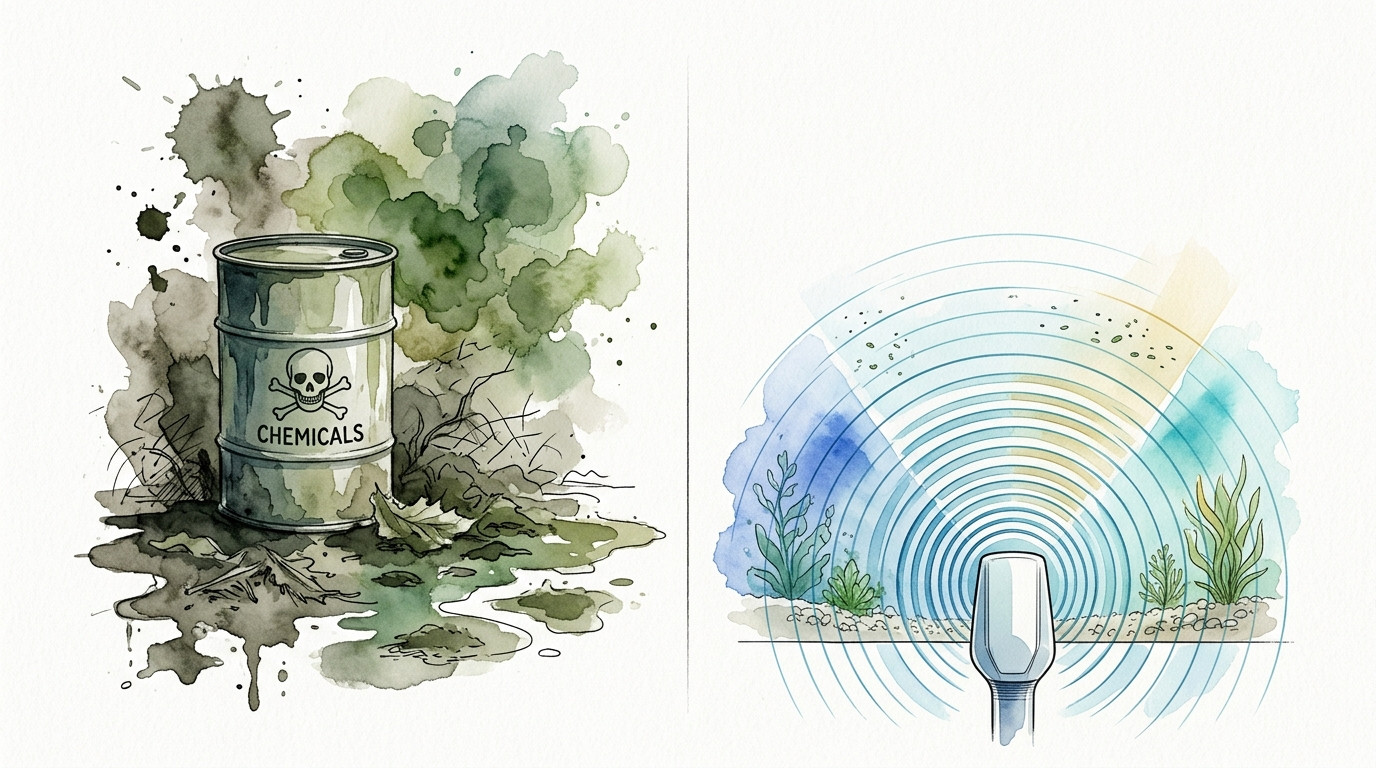
Traditional methods spray and pray; precision technology targets the cell walls directly. Why treat the symptom when you can prevent the cause? Discover how ultrasonic frequencies are disrupting the algae lifecycle without a single drop of herbicide.
Yes, ultrasound can prevent algae growth before it starts by emitting high-frequency sound waves that create pressure changes in the water. These waves target the gas vesicles of blue-green algae, causing them to collapse and making the algae sink to the bottom where they cannot photosynthesize [1.1.1, 1.2.1]. This proactive, chemical-free method disrupts the algae’s lifecycle, effectively stopping blooms from forming in ponds, lakes, and reservoirs [1.1.4, 1.3.1].
Managing aquatic environments requires a shift from reactive chemical shock to proactive mechanical prevention. For decades, the standard response to an emerald tide has been the application of copper-based algaecides. While effective in the short term, these chemicals often trigger a massive release of cyanotoxins and disrupt the broader ecosystem [1.1.4, 1.4.3]. Ultrasonic technology offers a mechanical alternative that neutralizes the primary mechanism of algal survival—buoyancy [1.1.1, 1.2.7]. By integrating this technology into a water management strategy, operators can maintain ecological balance while significantly reducing the need for chemical intervention [1.4.4, 1.5.2].
Can Ultrasound Prevent Algae Before It Starts?
The efficacy of ultrasonic technology in preventing algae lies in its ability to intervene during the early stages of the growth cycle. Algae, particularly cyanobacteria (blue-green algae), rely on specialized internal structures called gas vesicles or vacuoles to regulate their position in the water column [1.1.1, 1.2.4]. During the day, they float to the surface to capture sunlight for photosynthesis. At night, they sink to nutrient-rich lower layers to absorb phosphorus and nitrogen [1.1.1, 1.2.1].

Ultrasonic systems emit specific sound frequencies that create a “sonic barrier” within the upper water layers [1.2.1, 1.5.7]. When these sound waves align with the critical structural resonance of the gas vesicles, they induce a mechanical collapse [1.1.8, 1.2.4]. Without these air-filled compartments, the algae lose their ability to float and sink into the aphotic zone—the deeper, darker layers of the water where sunlight cannot penetrate [1.2.1, 1.3.1].
In real-world situations, this technology is utilized in drinking water reservoirs, wastewater treatment plants, and recreational lakes [1.1.4, 1.3.7]. Rather than waiting for a bloom to become visible to the naked eye, ultrasonic transducers operate continuously, maintaining a suppressive environment that prevents the rapid cell division necessary for a bloom event [1.2.1, 1.5.7]. This mechanical suppression is comparable to a persistent, low-energy filter that keeps the population below the threshold of environmental harm [1.1.4, 1.2.1].
How Ultrasonic Algae Control Works: The Mechanics of Buoyancy Disruption
The process of ultrasonic prevention is a precise mechanical operation. Understanding the underlying principles requires a look at the cellular architecture of cyanobacteria and the physics of sound propagation in water.
Acoustic Resonance and Gas Vesicle Collapse
The primary target of ultrasonic waves is the gas vesicle, a hollow protein structure that provides buoyancy [1.1.1, 1.2.4]. These vesicles are incredibly small but structurally rigid. Ultrasonic transducers generate sound waves that travel through the water and strike these vesicles at their natural resonance frequency [1.1.8, 1.1.9]. This causes the vesicle walls to vibrate intensely until the structural integrity fails, resulting in a microscopic rupture [1.1.8, 1.5.7].
Frequency Programs and Programmatic Variety
Modern ultrasonic systems do not emit a single, static tone. Algae are highly adaptive, and different species respond to different frequency ranges [1.2.1, 1.5.4]. High-end systems utilize a “blend” of over 2,000 distinct frequencies [1.1.7, 1.5.6]. These programs alternate between frequencies targeting blue-green algae, green algae, and diatoms [1.1.7, 1.3.7]. By constantly varying the acoustic output, the system prevents the algae from developing a resistance to the treatment—a common issue with chemical algaecides [1.4.3, 1.5.4].
The Photic Zone and Metabolic Starvation
Once the gas vesicles are collapsed, the algae sink. In most water bodies, the light required for photosynthesis only penetrates a few meters deep. When the algae are trapped in the darker bottom layers, their metabolic activity slows significantly [1.2.1, 1.3.1]. They can no longer produce the energy needed for rapid reproduction. Over a period of several days to weeks, the algae exhaust their stored nutrients and die naturally [1.1.1, 1.5.7]. This process is gradual, which prevents the sudden depletion of dissolved oxygen that occurs when chemicals cause a massive, simultaneous die-off [1.2.7, 1.4.3].

Benefits of Ultrasonic Prevention
Choosing ultrasonic technology over traditional methods provides several measurable advantages in terms of cost, environmental impact, and labor efficiency.
- Chemical-Free Operation: Ultrasonic systems eliminate the need for copper sulfate or other toxic algaecides, making the water safer for humans, pets, and wildlife [1.1.4, 1.4.1].
- Selective Targeting: Low-power ultrasound can be tuned to affect specific algal structures without harming fish, plants, or beneficial zooplankton [1.1.1, 1.3.1, 1.3.5].
- Continuous Suppression: Because the systems are mechanical and can be solar-powered, they provide 24/7 protection against bloom formation, whereas chemicals only work for a short period after application [1.2.1, 1.2.7, 1.4.3].
- Minimal Operational Costs: After the initial investment, the energy consumption of a typical transducer is remarkably low, often costing less than $10 per year in electricity [1.4.1].
- Prevention of Cyanotoxins: By stopping the bloom before it reaches high concentrations, the risk of toxic releases (such as microcystin) is drastically reduced [1.1.4, 1.3.3].
Challenges and Common Mistakes
While ultrasound is a powerful tool, its success depends on proper deployment and a clear understanding of the technology’s mechanical nature.
Failure to Account for Line-of-Sight: Sound waves in water behave similarly to light. They cannot travel through solid objects such as large rocks, islands, or dense mats of surface vegetation [1.2.8]. A common mistake is placing a single transducer in a complex, irregularly shaped pond and expecting total coverage. If the sound cannot reach an area, the algae in that “shadow” will continue to grow [1.2.8].
Late Deployment: Many operators wait until a bloom is fully established before turning on the ultrasonic system. While ultrasound can help manage an existing bloom, it is fundamentally a preventative technology [1.2.3]. Treating a massive, thick mat of algae requires more energy and time than suppressing a nascent population. Ideally, the system should be active well before the peak growing season starts [1.2.1, 1.5.7].
Neglecting Maintenance: Transducers sit in water, which means they are susceptible to biofouling. If the face of the transducer becomes covered in slime or mineral deposits, the efficiency of the sound transmission will drop [1.5.8]. Regular cleaning and the use of anti-fouling coatings are necessary to ensure the system remains effective.
Limitations of Ultrasonic Technology
No single technology is a universal cure for every aquatic issue. Ultrasound has realistic constraints that must be considered during the planning phase.
Species Resistance
Certain types of algae do not use gas vesicles for buoyancy and are therefore less susceptible to ultrasound [1.2.3, 1.2.8]. Species like Euglena or certain filamentous green algae have more robust cell walls and different flotation mechanisms. In these cases, ultrasound might only provide partial control, requiring a secondary management strategy [1.2.3, 1.2.8].
Environmental Factors
High levels of suspended solids or high turbidity can scatter and absorb sound waves, reducing the effective range of the transducer [1.3.6, 1.3.8]. Similarly, in very shallow water (less than 1 meter), the sound waves may reflect off the bottom too frequently, leading to interference patterns that diminish the system’s effectiveness [1.1.5].
Nutrient Load
Ultrasound manages the algae population, but it does not remove nutrients like phosphorus and nitrogen from the water [1.2.3, 1.3.1]. If a water body receives continuous, heavy runoff from agricultural land, the underlying cause of the algae growth remains. In these extreme “hyper-eutrophic” conditions, ultrasound may struggle to keep up with the explosive growth rate supported by the excess nutrients [1.1.4, 1.3.1].
Comparing Methods: Sonic Barrier vs. Chemical Shock
To understand the value of ultrasound, it is helpful to compare it directly to the traditional method of chemical treatment across several performance metrics.
| Feature | Standard Chemical Shock | Precision Sonic Barrier (Ultrasound) |
|---|---|---|
| Action Type | Reactive (kills existing cells) | Preventative (disrupts lifecycle) |
| Environmental Impact | High (risk of toxin release and fish kills) | Negligible (safe for non-target species) |
| Labor Requirement | High (regular manual application) | Low (automated operation) |
| Operational Cost | Variable (based on chemical prices) | Low (minimal electricity use) |
| Long-Term Efficacy | Decreases (algae develop resistance) | Maintains (dynamic frequency programs) |
Practical Tips for Implementation
If you are considering an ultrasonic system, follow these best practices to ensure optimal results.
- Map the Water Body: Before buying equipment, create a detailed map of your pond or reservoir. Identify “blind spots” where the sound waves might be blocked by structures [1.2.8].
- Overlap Transducer Ranges: For larger areas, ensure that the signal from one transducer overlaps with another. This prevents “dead zones” where algae can survive and seed new growth.
- Monitor Water Quality: Use sensors to track parameters like pH, dissolved oxygen, and phycocyanin levels [1.3.1, 1.3.3]. Many advanced ultrasonic systems now come with integrated sensors that automatically adjust the sound frequency based on real-time data [1.3.1, 1.5.4].
- Start Early: Install the system in the spring when water temperatures begin to rise but before the first bloom is visible [1.2.1, 1.5.7]. This allows the sonic barrier to establish control while the algae population is at its lowest density.
Advanced Considerations: AI and IoT Integration
The next generation of ultrasonic algae control is moving toward fully autonomous systems. Advanced platforms now incorporate Internet of Things (IoT) connectivity, allowing operators to monitor their water quality from a smartphone or computer [1.5.4].
These systems use machine learning algorithms to analyze incoming water quality data. If the sensors detect an increase in chlorophyll-a or a specific change in water temperature that favors cyanobacteria, the system can automatically switch to a more aggressive frequency program [1.3.1, 1.5.4]. This level of precision ensures that energy is only spent on the specific frequencies needed at that exact moment, maximizing both efficiency and effectiveness. Furthermore, solar-powered buoys equipped with these sensors can operate in remote areas of large reservoirs without the need for expensive electrical infrastructure [1.2.7, 1.3.1].
Example: Protecting a Drinking Water Reservoir
Consider a municipal drinking water utility in New Jersey that faced recurring blooms of Microcystis. These blooms produced geosmin, an organic compound that gives water an earthy, unpleasant taste and smell [1.1.4]. Traditionally, the utility spent thousands of dollars on algaecides every summer, which often caused the algae to rupture and release even more geosmin into the water [1.4.3].
By installing a series of solar-powered ultrasonic buoys, the utility created a continuous sonic barrier across the reservoir. Within the first season, the utility reported an 89% reduction in algae growth [1.4.4]. Because the ultrasound prevented the bloom from forming rather than killing a massive population at once, geosmin levels remained below the detection limit. The utility also reduced its chemical usage costs by 22%, proving that mechanical prevention can be both environmentally and financially superior [1.4.4].
Final Thoughts
The transition from chemical to mechanical algae control represents a significant advancement in sustainable water management. By focusing on prevention rather than reaction, ultrasonic technology addresses the root cause of algal blooms—the ability of these organisms to dominate the water column through buoyancy.
While the initial investment in ultrasonic hardware can be significant, the long-term benefits of reduced labor, lower operational costs, and a healthier ecosystem are undeniable. As technology continues to evolve with AI-driven adjustments and better solar efficiency, ultrasound will likely become the standard for managing critical water resources.
Experimenting with these systems requires a technical mindset and a willingness to monitor water quality data closely. For those who prioritize data-driven, chemical-free solutions, ultrasonic prevention offers a clear path toward pristine, balanced water.
Frequently Asked Questions About Can Ultrasound Prevent Algae Before It Starts?
Does ultrasound kill all types of algae instantly?
No, ultrasound is not an “instant kill” solution. It is primarily a preventative technology designed to disrupt the buoyancy of specific species, primarily blue-green algae (cyanobacteria) [1.1.1, 1.2.1]. While it can also affect green algae and diatoms by vibrating their cell walls, the process of population decline typically takes several days to several weeks [1.5.7]. It works by making the algae sink to the bottom where they cannot access sunlight, eventually leading to metabolic starvation and natural death [1.2.1, 1.3.1]. For this reason, it is most effective when started early in the season before a bloom becomes visible.
Is the sound from the device harmful to fish or humans?
Low-power ultrasonic systems are designed to operate at frequencies and intensities that are safe for non-target organisms [1.1.1, 1.3.5]. Most commercial units use non-cavitation ultrasound, which means the sound waves are not powerful enough to create the tiny, heat-generating bubbles that could damage larger biological tissues [1.5.7]. Independent studies have shown no significant behavioral or physiological impact on fish, tadpoles, or aquatic plants [1.3.5, 1.4.4]. Because the sound is at a frequency well above the human hearing range, it is also completely silent to people standing near the water.

Will an ultrasonic device work in a very shallow pond?
Ultrasound effectiveness can be limited in shallow water, generally defined as less than one meter deep [1.1.5]. In very shallow environments, the sound waves hit the bottom and the surface too frequently, causing interference and scattering that reduces the range and consistency of the signal [1.1.5]. Additionally, because the goal is to make the algae sink below the photic zone, the water must be deep enough that the bottom is significantly darker than the surface. If the entire water column is illuminated by sunlight, sinking the algae will not prevent photosynthesis.
Can algae develop a resistance to ultrasonic waves?
While algae are highly adaptive, modern ultrasonic systems use dynamic frequency programs to prevent resistance [1.2.1, 1.5.4]. These systems emit thousands of different frequencies in a specific sequence, constantly changing the mechanical stress applied to the algal cells [1.1.7, 1.5.6]. This “moving target” approach makes it nearly impossible for a single strain of algae to adapt. However, if a system uses only a single, static frequency, it is possible for resistant species or strains to eventually dominate the environment [1.5.4]. Choosing a high-quality system with diverse frequency programs is critical for long-term success.
What happens to the algae after they sink to the bottom?
Once the algae sink, they enter a state of reduced metabolic activity because they can no longer photosynthesize [1.2.1, 1.3.1]. Over time, the cells die and are decomposed by naturally occurring benthic bacteria [1.1.1, 1.5.7]. Because this process happens gradually as individual cells die off, it does not cause the massive, sudden spike in ammonia or the extreme oxygen depletion that occurs after a chemical treatment [1.2.7, 1.4.3]. The nutrients contained within the algae cells are slowly released and recycled back into the sediment, often leading to a more stable and balanced nutrient cycle over several seasons.