
Pond Talk is an Amazon Associate. As an Amazon Associate we earn from qualifying purchases.
Can a tiny floating leaf outperform a $500 mechanical filter system? Your pond’s nitrogen problem isn’t a lack of expensive tech; it’s a lack of biology. Duckweed sucks up nitrates and phosphates faster than any machine ever could, leaving you with clear water and zero electricity costs.
Biological filtration is often overlooked in favor of complex mechanical systems that require constant power and maintenance. While a pressurized bead filter or a high-end UV sterilizer manages particulates and pathogens, they do not remove the end products of the nitrogen cycle. Duckweed acts as a living biological reactor that physically extracts dissolved nutrients from the water column and incorporates them into harvestable biomass.
This article examines the technical application of the Lemnaceae family as a primary tool for nutrient sequestration. We will analyze the efficiency of passive purification systems and provide the data necessary to integrate these organisms into a comprehensive water management strategy.

Duckweed For Nitrate Removal
Duckweed, primarily of the genus Lemna, Spirodela, and Wolffia, represents one of the most efficient nutrient recovery systems in nature. In a closed aquatic system, such as a pond or aquaculture tank, nitrogen accumulates in the form of nitrates following the aerobic oxidation of ammonia and nitrite by nitrifying bacteria. While nitrates are less toxic than ammonia, high concentrations lead to eutrophication and invasive algal blooms.
This plant operates as a phytoremediator, a term used in environmental engineering to describe organisms that stabilize or remove contaminants from soil or water. In municipal wastewater treatment, duckweed is utilized to reduce Biological Oxygen Demand (BOD) and Total Suspended Solids (TSS). Its ability to thrive in nutrient-rich environments makes it an ideal candidate for domestic pond management where nitrate levels often exceed 40 ppm.
The efficiency of this species is tied to its high surface area-to-volume ratio and its ability to absorb nutrients through both its roots and the underside of its fronds. Unlike submerged plants that must compete for carbon dioxide in the water, duckweed has direct access to atmospheric CO2. This eliminates carbon as a limiting factor, allowing for rapid nutrient uptake and biomass doubling in as little as 16 to 48 hours under optimal conditions.
How It Works: The Mechanics of Nutrient Uptake
Nitrogen uptake in duckweed occurs through two primary pathways: the absorption of ammonium (NH4+) and nitrate (NO3-). Although the plant can utilize both, it shows a distinct physiological preference for ammonium. This is because ammonium can be directly assimilated into amino acids with less energy expenditure than nitrate, which requires a multi-step reduction process.
The reduction of nitrate involves the enzymes nitrate reductase and nitrite reductase. Once the nitrate enters the plant cells, it is reduced to nitrite and then to ammonium before being synthesized into glutamine. This biochemical process effectively “locks” the nitrogen into the plant’s cellular structure. As long as the plant is growing, it is actively removing these elements from your water.
Phosphorus removal follows a similar biological trajectory. Duckweed exhibits “luxury consumption,” a phenomenon where the plant absorbs phosphorus in excess of its immediate growth requirements. It stores these phosphates in its tissues, making it an excellent tool for controlling the primary driver of string algae and cyanobacteria. To maintain this removal rate, the system must remain in a state of constant growth, which necessitates regular harvesting.
Benefits of Biological Nutrient Sequestration
Utilizing a biological system for water purification offers measurable advantages over purely mechanical or chemical interventions. The primary benefit is the conversion of waste into a secondary resource. Instead of flushing nitrate-rich water during a water change, the nutrients are converted into high-protein biomass that can be repurposed as organic fertilizer or livestock feed.
Passive purification operates with zero energy input. While a mechanical filter requires a pump to move water through a media bed, duckweed utilizes solar energy to drive its metabolic processes. This reduces the total operational cost of the pond and provides a fail-safe during power outages. If a pump fails, the duckweed continues to process nitrates, preventing a spike in toxicity.
Furthermore, the physical presence of a duckweed mat provides significant thermal insulation and light attenuation. By covering the water surface, it reduces the penetration of UV radiation into the water column. This lowers the overall water temperature during peak summer months and inhibits the growth of submerged algae that rely on the same light spectrum for photosynthesis.
Challenges and Common Mistakes
The most significant challenge in managing duckweed is controlling its logarithmic growth rate. In an unmanaged state, a duckweed colony can cover the entire surface of a pond within days. This creates an anaerobic environment by preventing atmospheric oxygen exchange at the surface. If the water surface is completely sealed, dissolved oxygen levels will crash, leading to the death of fish and aerobic bacteria.
Another common error is the failure to harvest. Many pond owners view duckweed as a “set and forget” solution. However, once the plant dies, it sinks to the bottom and decomposes. This decomposition process releases all the sequestered nitrogen and phosphorus back into the water, effectively neutralizing the benefits of the plant’s growth phase. Harvesting is the only way to ensure the permanent removal of nutrients from the system.
Nutrient imbalances can also lead to system failure. While duckweed is robust, it requires a full spectrum of micronutrients, including iron, potassium, and magnesium. If these are depleted, the plant will turn yellow (chlorosis) and its growth will stall. A stalled colony does not remove nitrates efficiently. Regular testing of water parameters is required to ensure the biological engine has the fuel it needs to operate.
Limitations and Environmental Constraints
Duckweed is not a universal solution and has specific environmental boundaries. High-flow environments are generally unsuitable for Lemnaceae. In ponds with large waterfalls or high-turnover pumps, the plants are often pushed into corners or sucked into skimmers. This mechanical stress can damage the fronds and prevent the formation of a stable, nutrient-absorbing mat.
Temperature also plays a critical role in efficiency. Most species of duckweed thrive between 68°F and 86°F (20°C to 30°C). When temperatures drop below 45°F (7°C), the plant enters a dormant state or produces turions—heavy, starch-filled buds that sink to the bottom to overwinter. During these periods, biological nitrate removal ceases entirely, and the system must rely on other forms of filtration.
Finally, the presence of certain fish species can limit the effectiveness of this method. Koi, goldfish, and grass carp are known to consume duckweed at a rate that may exceed its growth. In a heavily stocked pond, the fish may eat the entire colony before it can achieve a significant reduction in nitrate levels. In such cases, a separate bog filter or a protected floating “refugium” is required to allow the plant to grow undisturbed.
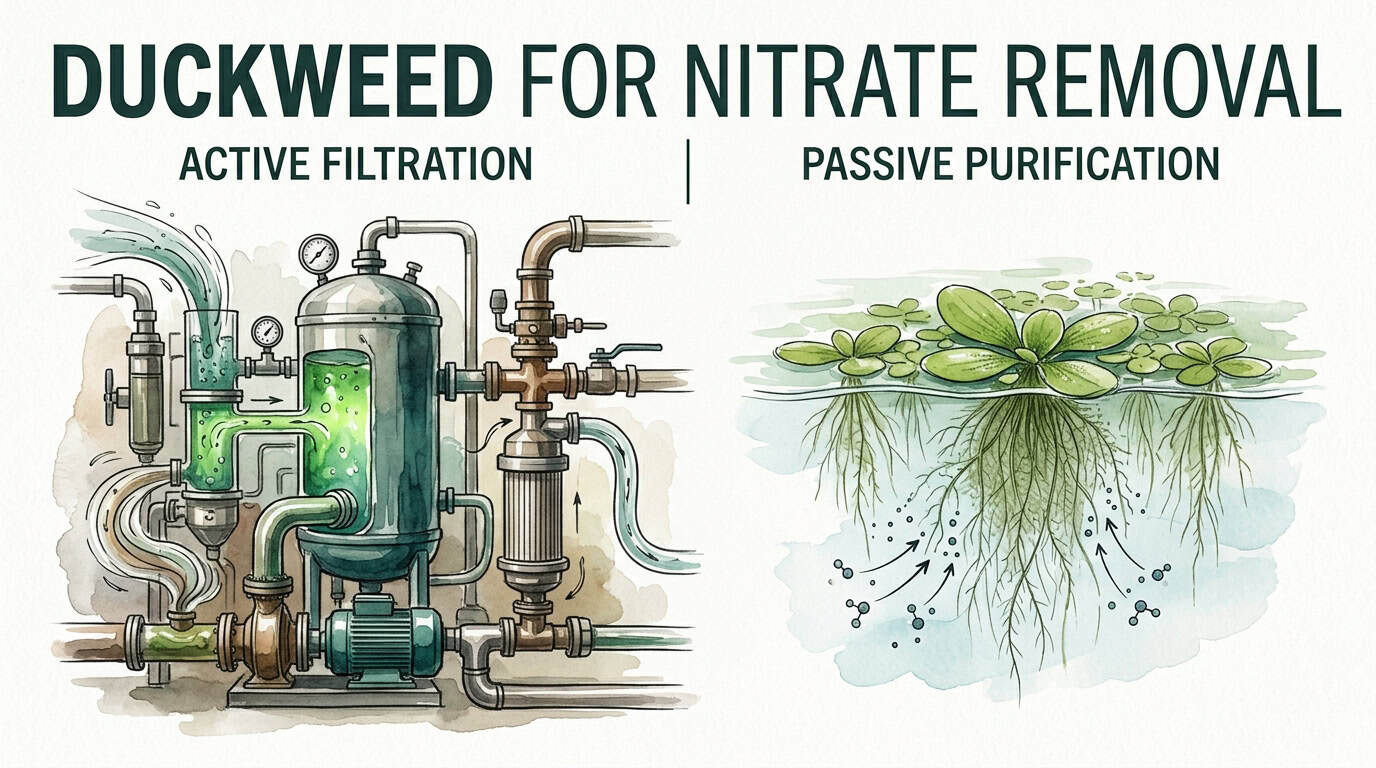
Comparison: Active Filtration vs. Passive Purification
The following table compares the performance metrics of traditional mechanical/biological filtration (Active) versus a duckweed-based purification system (Passive).
| Feature | Active Mechanical Filtration | Passive Duckweed Purification |
|---|---|---|
| Energy Consumption | High (Continuous pump power) | Zero (Solar-driven) |
| Nitrate Removal | Minimal (Requires water changes) | High (Biomass sequestration) |
| Maintenance | Backwashing and media cleaning | Regular harvesting |
| Initial Cost | $200 – $2,000+ | $10 – $50 (Starter culture) |
| Scalability | Limited by pump/filter size | High (Scales with surface area) |
| Byproduct | Waste sludge (disposed) | High-protein biomass (valuable) |
As the data suggests, active filtration is superior for removing physical debris and maintaining high oxygen levels through turbulence. However, passive purification is significantly more efficient at the chemical removal of dissolved nutrients. A hybrid system often yields the highest water quality.
Practical Tips for Implementation
To successfully implement a duckweed nutrient recovery system, start by containing the plants. Using floating PVC rings or hula hoops prevents the duckweed from being drawn into skimmers or scattered by surface agitation. This containment allows you to monitor the growth rate and calculate the exact amount of biomass you are producing.
Establish a strict harvesting schedule. A common rule of thumb is to harvest 30% to 50% of the surface cover once the mat becomes crowded. Overcrowding leads to stacking, where plants grow on top of each other. Stacking reduces the surface area available for nutrient absorption and can cause the lower layers to die and rot. Use a fine-mesh net to remove the excess and transition it immediately to a compost pile.
Monitor your pH levels closely. Duckweed is most efficient at absorbing nutrients in slightly acidic to neutral water (pH 6.5 to 7.5). High alkalinity can inhibit the uptake of certain micronutrients. If you notice a decline in growth despite high nitrate levels, check your iron levels. Adding a chelated iron supplement can often restart a stalled colony.
Advanced Considerations for Practitioners
For those looking to maximize efficiency, the species selection is critical. *Lemna minor* is the most common and hardy, but *Spirodela polyrhiza* (Giant Duckweed) has a higher protein content and deeper root systems, which can provide more surface area for beneficial microbes. In high-temperature environments, *Wolffia* species may be more resilient but are more difficult to harvest due to their microscopic size.
Consider the carbon-to-nitrogen (C:N) ratio of your system. In some high-nitrate ponds, the limiting factor for duckweed growth is actually inorganic carbon. If the pond has low alkalinity and limited gas exchange, the plants may deplete the available CO2 during the day. Introducing a source of carbon or increasing aeration (without disturbing the floating mat) can boost the growth rate and, consequently, the nitrate removal rate.
Integration with other biological systems can create a “treatment train.” For example, water can flow from a mechanical pre-filter into a duckweed basin, and then through a submersed macrophyte bed (such as Anacharis). This multi-stage approach targets different nutrients at different concentrations, resulting in near-distilled water quality.
Calculated Example: Nitrate Reduction Scenario
Consider a 1,000-gallon pond with a nitrate level of 50 ppm. To reduce this concentration, we must calculate the required biomass removal. 50 ppm in 1,000 gallons equates to approximately 189 grams of pure nitrate.
Duckweed is roughly 5% nitrogen by dry weight. If you harvest 10 kilograms (22 lbs) of wet duckweed (which is approximately 90% water), you are removing 1 kilogram of dry matter. That 1 kilogram of dry matter contains 50 grams of nitrogen.
By removing 10kg of wet duckweed, you have reduced the nitrogen in that 1,000-gallon pond by roughly 13 ppm. Repeating this harvest cycle four times would theoretically bring the nitrate levels to near zero, assuming no new nitrogen is added to the system through fish food or waste. This demonstrates the quantitative power of biological removal.
Final Thoughts
The use of duckweed for nitrate removal represents a shift from mechanical intervention to biological management. By understanding the metabolic requirements of the Lemnaceae family, pond owners can create a self-sustaining nutrient sink that replaces expensive chemical resins and frequent water changes. This is not a “magic” solution but a calculated application of botany and chemistry.
Consistency in harvesting is the primary variable that determines success. Without the physical removal of the plant matter, the system remains a closed loop where nutrients are merely cycled rather than extracted. When managed correctly, the result is a high-clarity environment with stable water chemistry.
Practitioners should view duckweed as a component of a larger ecological engine. Whether used as a primary filter or a supplemental nutrient scrubber, its efficiency in sequestering nitrogen and phosphorus is unmatched by current mechanical standards. Integrating this biological tool requires minimal investment but yields significant long-term returns in water stability and ecosystem health.
Amazon and the Amazon logo are trademarks of Amazon.com, Inc, or its affiliates.