

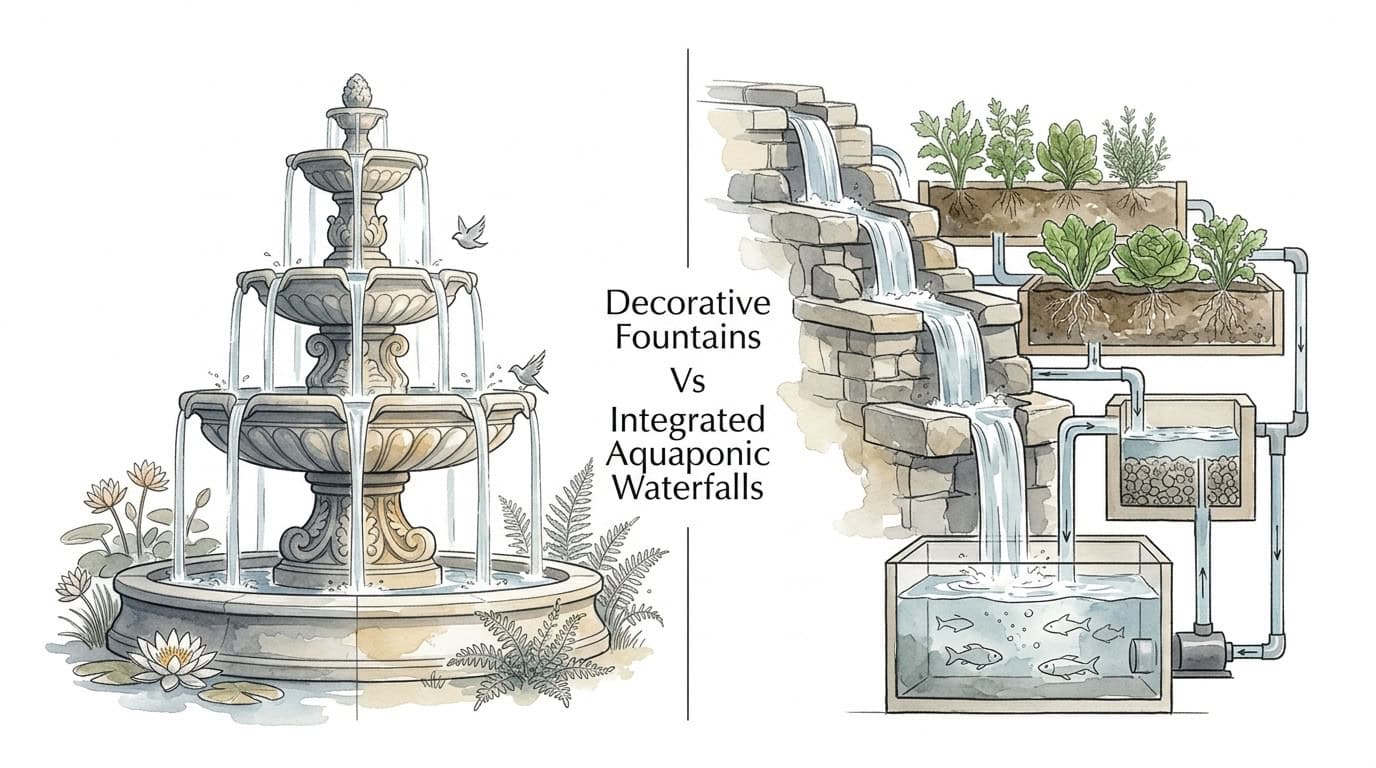
Is your water feature just a decoration, or is it the hardest working employee in your garden? A single-purpose fountain costs money and electricity just to look nice. A multi-use hydro-engine filters your pond, grows your food, and cools your patio microclimate all at once. It’s time to demand more from your backyard water.
The primary difference between decorative fountains and integrated aquaponic waterfalls lies in their functional purpose: decorative fountains are closed-loop aesthetic features designed for visual and auditory impact, often requiring chemical treatment to maintain water clarity. In contrast, integrated aquaponic waterfalls act as biological “engines” or bio-reactors that facilitate the nitrogen cycle, provide high-efficiency aeration, and deliver nutrients to plants, transforming a landscape cost into a productive ecosystem that generates biomass and mechanically filters the water.
Decorative Fountains Vs Integrated Aquaponic Waterfalls
A decorative fountain is an architectural focal point where water is recirculated through a basin using a submersible pump. These systems are defined by their controlled flow patterns, such as tiered sprays, bubbling urns, or wall-mounted spouts. In the Southwest and other arid regions, they are frequently used for their psychological cooling effect and sculptural beauty. However, because they lack biological filtration, they often rely on algaecides or UV clarifiers to prevent stagnation and biofouling.
An integrated aquaponic waterfall is a functional component of a recirculating aquaculture system (RAS). It mimics the turbulence of a mountain stream to maximize gas exchange. Instead of merely splashing for show, the water is directed over biological media or through gravel-filled tiers where nitrifying bacteria (Nitrosomonas and Nitrobacter) reside. These systems convert toxic ammonia from fish waste into nitrates, which are then sequestered by plants. This process makes the waterfall an active mechanical and biological filter rather than a passive ornament.

Mechanical Systems and Operational Logic
The mechanical efficiency of these features is measured by the hydraulic loading rate (HLR) and the oxygen transfer efficiency. Decorative fountains typically operate with low head pressure, meaning the pump does not have to lift water very high. This allows for energy-efficient operation in small scales, with tabletop models drawing as little as 2.5 to 25 watts. Large garden fountains may scale up to 500 watts, but the energy expenditure is strictly for kinetic display.
Integrated waterfalls require higher head pressure to lift water to the top of the bio-filtration tiers. A professional-grade waterfall pump, such as an asynchronous submersible unit, might move 4,000 to 7,000 gallons per hour (GPH). The operational logic here is turnover rate: to maintain a healthy aquaponic environment, the entire volume of the pond should ideally pass through the waterfall filter once every hour. High-performance “Bakki Showers” or trickle towers, which are industrial versions of these waterfalls, may even target a turnover rate of 1.5 to 2 times the total pond volume per hour to ensure maximum bioconversion.
Bioconversion and Aeration Metrics
Biological surface area (BSA) is the critical metric for aquaponic waterfalls. For every gram of fish feed added to the system daily, approximately 0.03 square meters of biological surface area is required to house the bacteria needed for nitrification. A decorative fountain provides negligible BSA. An integrated waterfall, however, utilizes the internal surface area of rocks, lava stones, or specialized plastic media (like K1 Micro) to provide thousands of square feet of “living space” for microbes.
Aeration is the second critical performance metric. Dissolved oxygen (DO) levels should remain above 5 mg/L for fish health and bacterial efficiency. While fountains provide surface-level gas exchange, integrated waterfalls create a “crashing” effect that drives atmospheric oxygen deep into the water column. This turbulence also facilitates degassing, allowing harmful carbon dioxide and nitrogen gases to escape the water. Studies indicate that high-turbulence waterfalls can increase DO levels significantly more effectively than smooth-flow decorative spillways.
The Microclimate cooling Effect
Both systems contribute to evaporative cooling, but the mechanics differ. Decorative fountains often use fine mist or high-pressure sprays, which increase the surface area of water droplets in the air. This makes them highly effective at localized cooling through rapid evaporation. In a hot-arid climate, a misting fountain can reduce ambient temperatures by up to 3.5 degrees Celsius in the immediate vicinity.
Aquaponic waterfalls provide a more consistent “thermal mass” cooling effect. As water tumbles over rocks, it cools the stones, which then act as heat sinks. This creates a more stable patio microclimate. Furthermore, the transpiration of the plants integrated into the waterfall tiers adds a secondary layer of cooling. This dual-action cooling (evaporation + transpiration) is a hallmark of the “engine” approach to landscaping.

Operational Benefits and System Advantages
The transition from a decorative fountain to an integrated waterfall offers several measurable advantages:
- Nutrient Sequestration: Instead of using chemicals to kill algae, the waterfall feeds nitrates to edible plants like watercress, mint, or kale.
- Mechanical Pre-filtration: Many integrated waterfalls include a “skimmer” or “settlement chamber” that captures large debris before it can decompose on the pond floor.
- Extended Pump Life: Industrial-grade waterfall pumps are designed for 24/7 continuous duty, whereas cheap decorative pumps often fail under the stress of high-solids water.
- Sound Masking: The white noise produced by a multi-tiered waterfall is superior to the rhythmic splash of a fountain for masking traffic or neighborhood noise.
Challenges and Common Engineering Pitfalls
Designing a functional hydro-engine is more complex than placing a fountain. One frequent mistake is insufficient “liner overlap.” In waterfalls, water often “wicks” out through the sides of the rocks, leading to significant water loss. This is not evaporation; it is a mechanical leak. Builders must ensure the EPDM liner extends high behind the stone structure to contain the splash.
Another pitfall is the use of limestone or other reactive rocks in an aquaponic waterfall. These stones can leach minerals into the water, spiking the pH and interfering with the plants’ ability to absorb nutrients. Professional systems prioritize inert stones like granite or river basalt. Finally, failing to account for “head pressure” (the vertical height the water is lifted) often leads to undersized pumps. A pump rated for 3,000 GPH at zero height may only deliver 1,200 GPH at a 5-foot head.
Limitations and Environmental Constraints
Integrated aquaponic waterfalls are not ideal for every scenario. In ultra-compact urban balconies, the weight of the water and stone structure—often exceeding 500 pounds for even a small setup—can pose structural risks. Additionally, these systems require a “biological load” (fish) to function. If you do not want the responsibility of maintaining livestock, the biological engine will stall, and the system will eventually require the same chemical maintenance as a decorative fountain.
Power availability is another constraint. While a 10-watt fountain can run on a small solar panel, a high-head waterfall pump often requires a dedicated 120V or 240V GFCI outlet. In regions with extremely high electricity costs, the 24/7 operation of a 300-watt pump can add $40 to $60 to a monthly utility bill, necessitating the use of high-efficiency variable-speed pumps to remain cost-effective.
Technical Comparison: Ornament vs. Engine
| Feature | Decorative Fountain | Integrated Aquaponic Waterfall |
|---|---|---|
| Primary Function | Aesthetic / Auditory | Bio-filtration / Food Production |
| Water Treatment | Chemical (Algaecides/UV) | Biological (Nitrogen Cycle) |
| Power Consumption | Low to Moderate (2W – 150W) | Moderate to High (100W – 800W) |
| Dissolved Oxygen | Surface level exchange only | High-turbulence saturation |
| Maintenance Type | Nozzle cleaning / Basin scrubbing | Plant harvesting / Filter backwashing |
| System Complexity | Plug-and-play | Hydraulic and Biological design |
Practical Tips and Best Practices
To optimize an aquaponic waterfall, start with the pump. Select a variable-flow pump that allows you to tune the GPH to the needs of your biofilter. During peak summer heat, you can increase the flow to boost oxygenation; in the winter, you can throttle it back to save energy.
Integrate “mechanical stages” before the waterfall. A simple sieve or brushes can catch fish solids, preventing the waterfall stones from becoming clogged with muck. This ensures that the bacteria have access to clean, oxygenated water, which significantly improves the nitrification rate. Additionally, use a “waterfall weir” or “bio-fall” box at the top of the feature. This acts as a reservoir that slows the water down just enough to pass through filter mats before it cascades over the edge.
Advanced Considerations for Serious Practitioners
For those scaling up to a production-level “hydro-engine,” consider the specific surface area (SSA) of your media. Moving Bed Bio-Reactors (MBBR) can be integrated into the waterfall reservoir to maximize bacterial colonization. If the goal is maximum nitrate removal, ensure the hydraulic loading rate is calibrated to the plant density. Leafy greens like lettuce prefer a lower HLR of approximately 1.2 to 2.4 meters per day to prevent root damage, while fruiting plants can handle higher flows.
Thermodynamic monitoring is also useful. Use an infrared thermometer to check the temperature of the waterfall rocks. If the rocks are absorbing too much solar radiation, they can act as heaters, warming the water to dangerous levels for fish. Strategic shading or the use of light-colored stones can mitigate this “heat island” effect within the water feature.
Application Scenario: The Backyard Conversion
Imagine a standard 1,000-gallon backyard pond with a 50-watt decorative fountain. The water is often green with algae, requiring weekly doses of clarifier. The owner decides to replace the fountain with a 3-tiered aquaponic waterfall. The new system uses a 150-watt variable-speed pump lifting water 4 feet into a biological weir filled with lava rock.
Within three weeks, the “bio-engine” has cycled. The ammonia levels drop to zero as the nitrifying bacteria colonize the lava rock. The owner plants watercress in the crevices of the waterfall. By mid-summer, the water is crystal clear because the watercress is out-competing the algae for nutrients. The pond is now cooler, the fish are more active due to the 20% increase in dissolved oxygen, and the owner is harvesting fresh greens every week. The higher electricity cost is offset by the elimination of chemical expenses and the production of food.
Final Thoughts
Shifting from a decorative mindset to an engineering mindset changes the way we value outdoor spaces. A fountain is a consumption-based luxury; an integrated aquaponic waterfall is a production-based asset. One requires constant cleaning and chemical intervention, while the other utilizes natural biological processes to maintain its own health and clarity.
Investing in a water feature that functions as a hydro-engine ensures that every watt of electricity and every gallon of water is working toward a healthier microclimate and a more sustainable home ecosystem. Whether you are a beginner looking to add a small feature or a serious practitioner designing a large-scale system, demanding more than just “pretty” from your water is the first step toward true garden efficiency.
Frequently Asked Questions About Decorative Fountains Vs Integrated Aquaponic Waterfalls
Does an aquaponic waterfall use more electricity than a fountain?
Generally, an aquaponic waterfall does consume more electricity because it requires a pump with a higher “head height” and flow rate. While a decorative fountain might only need to move 200–500 gallons per hour with minimal lift, an aquaponic waterfall typically requires moving the entire volume of the pond through a filter box once every hour. This often necessitates pumps in the 150-watt to 300-watt range, compared to the 25-watt to 75-watt pumps found in smaller decorative units. However, the use of modern, high-efficiency variable-speed pumps can significantly bridge this gap, allowing the user to reduce power consumption during periods of low biological demand.
Can I turn my existing decorative fountain into an aquaponic system?
Conversion is possible but requires mechanical modifications. Most decorative fountains lack the space for biological media and the oxygenation levels needed for an aquaponic cycle. To convert one, you must add a “bio-box” or a media-filled reservoir at the top of the water’s path. You must also ensure the pump can handle the additional weight and resistance of the filter media. If the fountain is made of resin or concrete, you must verify that the materials are “fish-safe” and won’t leach toxic chemicals or drastically alter the pH. Most practitioners find it more efficient to build a dedicated waterfall weir that integrates directly into the pond’s plumbing.
Which system is better for controlling algae in a backyard pond?
The integrated aquaponic waterfall is vastly superior for algae control. Algae thrives on excess nutrients (nitrates and phosphates) and sunlight. A decorative fountain adds oxygen but does nothing to remove the nutrients that feed algae. An aquaponic waterfall, however, uses plants to sequester those nutrients. By growing watercress, mint, or other aquatic plants directly in the waterfall flow, you starve the algae of its food source. This biological competition, combined with the mechanical filtration provided by the waterfall’s media, results in much clearer water without the need for the algaecides often required by decorative fountains.
Is an aquaponic waterfall louder than a decorative fountain?
Yes, aquaponic waterfalls are typically louder because they involve a larger volume of water “crashing” over rocks to facilitate gas exchange. This creates a broader spectrum of white noise, which is excellent for masking unwanted environmental sounds like traffic or neighbors. Decorative fountains tend to produce a more rhythmic, “tinkling” or “splashing” sound that is lighter and more suited for quiet courtyards. If sound is a concern, you can tune a waterfall’s volume by adjusting the rock placement and the pump’s flow rate, allowing you to choose between a gentle babble and a more dramatic, roaring cascade.
Do I need fish for an integrated aquaponic waterfall to work?
For the “aquaponic” aspect to function as a biological engine, fish are essential. The fish provide the ammonia that the bacteria in the waterfall convert into plant nutrients. Without fish, there is no “fuel” for the engine, and the plants in the waterfall tiers will eventually suffer from nutrient deficiencies. If you prefer not to have fish, the feature essentially reverts to being a decorative waterfall. In that case, you would need to manually add fertilizers to keep the plants alive, which increases the risk of algae blooms and defeats the self-sustaining nature of the integrated ecosystem.