

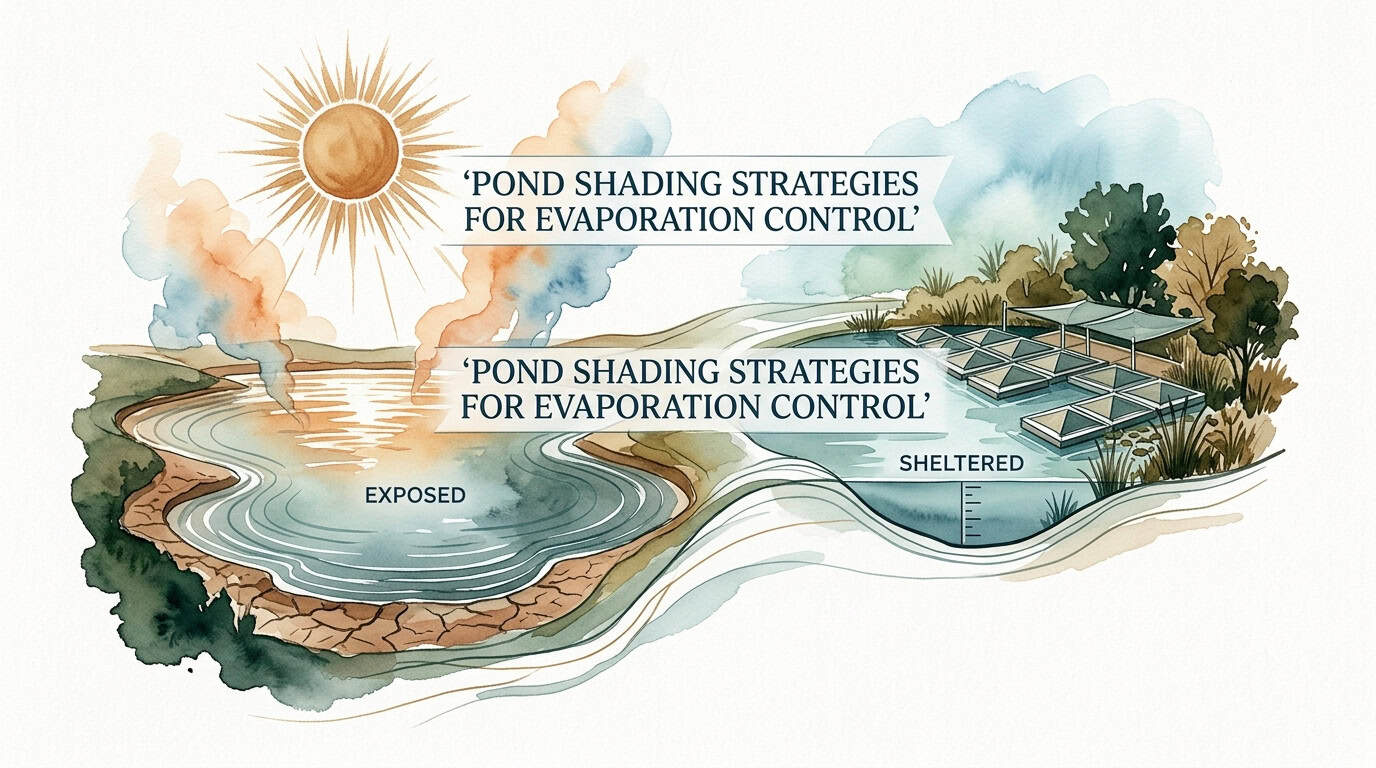
The sun is stealing 30% of your pond water every summer—here is how to hide it. We treat ponds like swimming pools, placing them in the brightest spot possible. But an exposed pond is a thirsty pond. By sheltering your water under a biological canopy, you stop evaporation, kill algae growth, and create a sanctuary for fish. Protect your water.
Pond shading strategies for evaporation control involve deploying physical or biological barriers to intercept solar radiation and reduce wind velocity at the water-air interface. These techniques function by lowering the water’s surface temperature and disrupting the vapor pressure gradient, which can decrease evaporative loss by 50% to 98% depending on the coverage density. Implementation typically includes modular floating covers, suspended shade sails, or high-density aquatic plant canopies to stabilize hydraulic levels and water chemistry.
Pond Shading Strategies For Evaporation Control
Evaporation control is the systematic reduction of water mass transfer from a liquid surface to the atmosphere. In open-air storage systems, such as agricultural reservoirs, industrial cooling ponds, and decorative water features, evaporation represents the primary source of uncontrolled water loss. Shading strategies target the energy inputs that drive this phase change: solar flux and thermal energy.
Solar radiation provides the latent heat of vaporization required for water molecules to transition into a gaseous state. When a pond remains exposed, the top layer of water absorbs shortwave radiation, increasing the kinetic energy of the molecules. Shading strategies create a thermal barrier that reflects or absorbs this energy before it reaches the liquid surface. In real-world industrial applications, preventing this loss is critical for maintaining chemical concentrations and preventing the accumulation of dissolved solids that can occur when water volume decreases while mineral content remains static.

Physics of Evaporative Loss and Shading Mechanisms
Evaporation is driven by the difference in vapor pressure between the water surface and the ambient air. Several mechanical and thermal principles govern how shading mitigates this process. Solar radiation is the most significant variable; direct sunlight can provide enough energy to evaporate several inches of water per week in arid climates.
Shading systems work through three primary mechanisms:
- Radiation Shielding: Physical barriers block UV and infrared spectrums, preventing the volumetric heating of the water column.
- Thermal Decoupling: Floating covers create an insulating boundary layer, maintaining a cooler surface temperature even when ambient air temperatures are high.
- Aerodynamic Resistance: Covers and riparian shading reduce wind speed directly above the water. Wind removes the saturated “boundary layer” of air, replacing it with drier air that accelerates further evaporation.
The efficiency of these systems is often measured against the Penman-Monteith equation, which calculates evapotranspiration based on temperature, humidity, and wind. Shading effectively “cheats” these variables by creating a controlled microclimate immediately above the water line.
How to Implement Pond Shading Strategies
The implementation of shading requires a technical assessment of the pond’s surface area, wind exposure, and intended use. Different strategies offer varying levels of mechanical efficiency.
Suspended Shade Structures
Suspended structures, such as shade sails or permanent pergolas, are installed at a height of 2 to 6 feet above the water level. High-density polyethylene (HDPE) mesh with a 70% to 95% UV-block rating is the industry standard. These systems allow for continuous gas exchange, which is vital for fish-heavy ecosystems. Installation requires secure anchor points capable of withstanding high wind loads, as the fabric acts as a large sail.
Modular Floating Covers
Modular systems consist of thousands of individual floating elements—often called “shade balls” or “hexagonal discs.” These are typically manufactured from UV-stabilized HDPE. Once deployed, they self-organize to cover up to 99% of the surface area. This method is highly effective for industrial reservoirs because it adapts to fluctuating water levels without mechanical adjustment.

Biological Canopies
Biological shading utilizes floating aquatic plants like Nymphaeaceae (water lilies), Lemnoideae (duckweed), or Azolla. For maximum evaporation control, a coverage of 60% to 70% of the surface is recommended. While less efficient than synthetic covers—typically reducing evaporation by approximately 25% to 45%—plants provide additional benefits through nutrient uptake and natural filtration.
Benefits of Strategic Shading
Quantifiable benefits of pond shading extend beyond simple water retention. Strategic cooling impacts the entire chemical and biological profile of the pond.
Thermal Stability
Shaded ponds exhibit significantly lower diurnal temperature fluctuations. Cooling the water by just 4 to 5 degrees Fahrenheit increases the water’s capacity to hold dissolved oxygen, which is critical for preventing summer fish kills. In industrial settings, this thermal stability reduces the energy required for cooling systems.
Suppression of Photosynthetic Organisms
Algae blooms require sunlight to fuel photosynthesis. By limiting Photosynthetically Active Radiation (PAR), shading naturally inhibits the growth of string algae and cyanobacteria. This reduces the need for chemical algaecides and minimizes the mechanical load on filtration systems.
Liner Longevity
Exposed pond liners, particularly those made of PVC or EPDM, are susceptible to UV degradation and thermal stress. Shading the water’s edge prevents the material from becoming brittle and cracking, extending the operational lifespan of the pond’s containment system by several years.
Challenges and Common Mistakes
Implementation failures often stem from a lack of consideration for the pond’s biological requirements or mechanical stressors.
Oxygen Depletion and Gas Exchange
The most significant risk associated with full-surface floating covers is the restriction of gas exchange. Ponds rely on the water-air interface to release carbon dioxide and absorb oxygen. If a cover is too dense and there is no active aeration (such as a bottom-diffused aerator), the pond can become anaerobic, leading to the death of aerobic bacteria and aquatic life.
Organic Load Management
While shading prevents algae, it can inadvertently increase the organic load if not managed correctly. Shade sails placed under deciduous trees may catch falling leaves, which eventually decay and sink into the pond, causing nutrient spikes. Structural shading must be designed to allow for easy debris removal.
Incorrect Material Selection
Using non-UV-stabilized plastics for shading is a frequent error. Standard agricultural plastic or low-grade tarps will degrade within a single season under intense solar exposure, shedding microplastics into the water and losing their structural integrity.
Limitations and Environmental Constraints
Shading is not a universal solution and faces specific environmental boundaries.
Wind-Induced Drift
In high-wind environments, modular floating covers like shade balls can migrate to the leeward side of the pond, leaving the windward side exposed. This “clumping” significantly reduces the effective shading area. In such regions, fixed suspended covers or anchored floating grids are required.
Scale and Cost-Effectiveness
For massive agricultural reservoirs spanning several acres, the capital expenditure for physical covers may exceed the value of the water saved. In these scenarios, riparian shading—planting tall trees on the southern and western banks—is a more viable, albeit slower-maturing, strategy.
Comparative Analysis of Shading Materials
Efficiency varies based on material density, reflectivity (albedo), and coverage percentage. The following table compares common strategies based on technical performance metrics.
| Strategy Type | Material | Evaporation Reduction (%) | Gas Exchange Capacity | Lifespan (Years) |
|---|---|---|---|---|
| Modular Floating Balls | UV-Stabilized HDPE | 85% – 92% | Low (Requires Aeration) | 20+ |
| Hexagonal Discs | HDPE / Polypropylene | 95% – 98% | Very Low | 25+ |
| Shade Sails (90% Block) | Woven HDPE Mesh | 50% – 65% | Excellent | 5 – 10 |
| Floating Plants | Natural Biology | 25% – 45% | Moderate | Seasonal |
| Solar Panels (Floating) | Photovoltaic Modules | 30% – 50% | Moderate | 25+ |
Practical Tips and Best Practices
Maximizing the efficiency of a shading system requires adherence to specific installation and maintenance protocols.
- Orientation: For suspended structures, prioritize shading the southwest quadrant of the pond. This area receives the most intense solar radiation during the hottest part of the day (2:00 PM to 5:00 PM).
- Coverage Ratios: Aim for a minimum of 60% surface coverage. This is the “Goldilocks zone” where evaporation is significantly curtailed without completely suffocating the pond’s natural cycles.
- Color Choice: Use lighter-colored materials for floating covers when possible. White or light grey covers have a higher albedo, reflecting heat away from the water, whereas black covers may absorb heat and transfer it to the upper water column.
- Anchor Testing: If using shade sails, ensure anchors are rated for at least double the local peak wind gust speed. A 10×10 foot sail can generate several hundred pounds of force during a storm.
Advanced Considerations: The Humidity Shell
Serious practitioners often look beyond simple shading to the concept of the “humidity shell.” This involves using a combination of vertical windbreaks and overhead shading to create a dome of high-humidity air over the pond. Since the rate of evaporation is inversely proportional to the relative humidity of the air immediately above the surface, trapping moisture-laden air can further reduce losses.
This is achieved by installing a 3-foot perimeter of tall grasses or shrubs (windbreaks) around a shaded pond. The windbreak prevents the “sweeping” effect of dry air, while the shade sail prevents the sun from heating and lifting that humid air away. This synergy can result in a 15% – 20% improvement in water retention over shading alone.
Scenario: Agricultural Reservoir Management
In a practical application, consider a 1-acre agricultural pond in a semi-arid region losing 60 inches of water annually to evaporation—approximately 1.6 million gallons. By deploying a modular hexagonal cover system with 95% coverage, the operator can reduce this loss to roughly 80,000 gallons per year.
The initial investment in HDPE modules may be significant, but the ROI is calculated through the cost of replacement water, the preservation of pump equipment (due to higher water levels), and the reduction in filtration maintenance from suppressed algae growth. In many jurisdictions, this level of water conservation also qualifies for specialized agricultural grants or tax credits.
Final Thoughts
Implementing pond shading strategies for evaporation control is a mechanical necessity for efficient water management. Whether through advanced HDPE modular systems or strategic biological canopies, the goal is the same: to decouple the water surface from the atmospheric drivers of evaporation.
Successful systems balance the need for radiation shielding with the requirements for gas exchange and structural durability. By selecting the right materials and coverage density, pond operators can significantly stabilize their aquatic environments and preserve their most valuable resource. Experimenting with a combination of structural and biological solutions often yields the best results for long-term sustainability.

Frequently Asked Questions About Pond Shading Strategies For Evaporation Control
Do black shade balls actually heat up the water?
Black shade balls are designed with UV-stabilized carbon black to absorb radiation and protect the plastic from degradation. While the balls themselves can become quite hot, they do not significantly heat the bulk water. Because they are hollow and air-filled, they act as an insulator. The heat they absorb is largely dissipated back into the atmosphere rather than conducted into the water column. Studies on large-scale reservoirs have shown that water temperatures under black shade balls typically remain several degrees cooler than exposed water because the total solar energy reaching the liquid is reduced by over 90%.
Can floating plants increase water loss through transpiration?
This is a common concern among aquatic managers. While it is true that plants lose water through a process called transpiration, the net effect of a floating plant canopy is almost always a reduction in total water loss. The broad leaves of species like water lilies provide significant shading that lowers the surface temperature and blocks wind, which outweighs the amount of water the plants “breathe” out. Research indicates that a 60% coverage of floating plants can reduce total evaporative and transpirative loss by approximately 25% to 40% compared to a completely exposed surface.
How do I maintain oxygen levels in a shaded pond?
Shading reduces the amount of natural oxygen produced by submerged plants and algae via photosynthesis. To prevent an oxygen crash, particularly in ponds with fish, you must ensure adequate gas exchange. This is typically achieved by leaving 30% of the surface area uncovered or by installing a sub-surface aeration system. Bottom-diffused aerators are highly recommended as they break the thermal stratification often caused by shading, bringing oxygen-poor water from the bottom to the surface to be re-oxygenated without increasing the evaporation rate as much as a surface fountain would.
What is the most cost-effective shading material for a large pond?
For large-scale applications where modular covers are budget-prohibitive, professional-grade shade cloth made of woven HDPE is the most cost-effective option. It offers a high ROI because of its relatively low cost per square foot and its ability to reduce evaporation by up to 65%. When selecting a shade cloth, look for a “monofilament” weave rather than a tape-style weave, as monofilament is significantly more durable against wind and heavy rain. Properly tensioned shade sails can last up to a decade, making them a very efficient mid-term investment for water conservation.
Will shading my pond affect its natural ecosystem?
Shading will shift the balance of your pond’s ecosystem, generally favoring a “clear water” state. By reducing sunlight, you will see a decrease in algae and some submerged aquatic weeds. This can be beneficial for water clarity and fish health, as it prevents the oxygen swings associated with heavy algae growth. However, if you shade 100% of the pond, you will kill off the beneficial submerged plants that provide habitat. A balanced approach of 60% to 75% shade is usually ideal for maintaining a healthy, functioning biological community while still achieving significant evaporation control.