

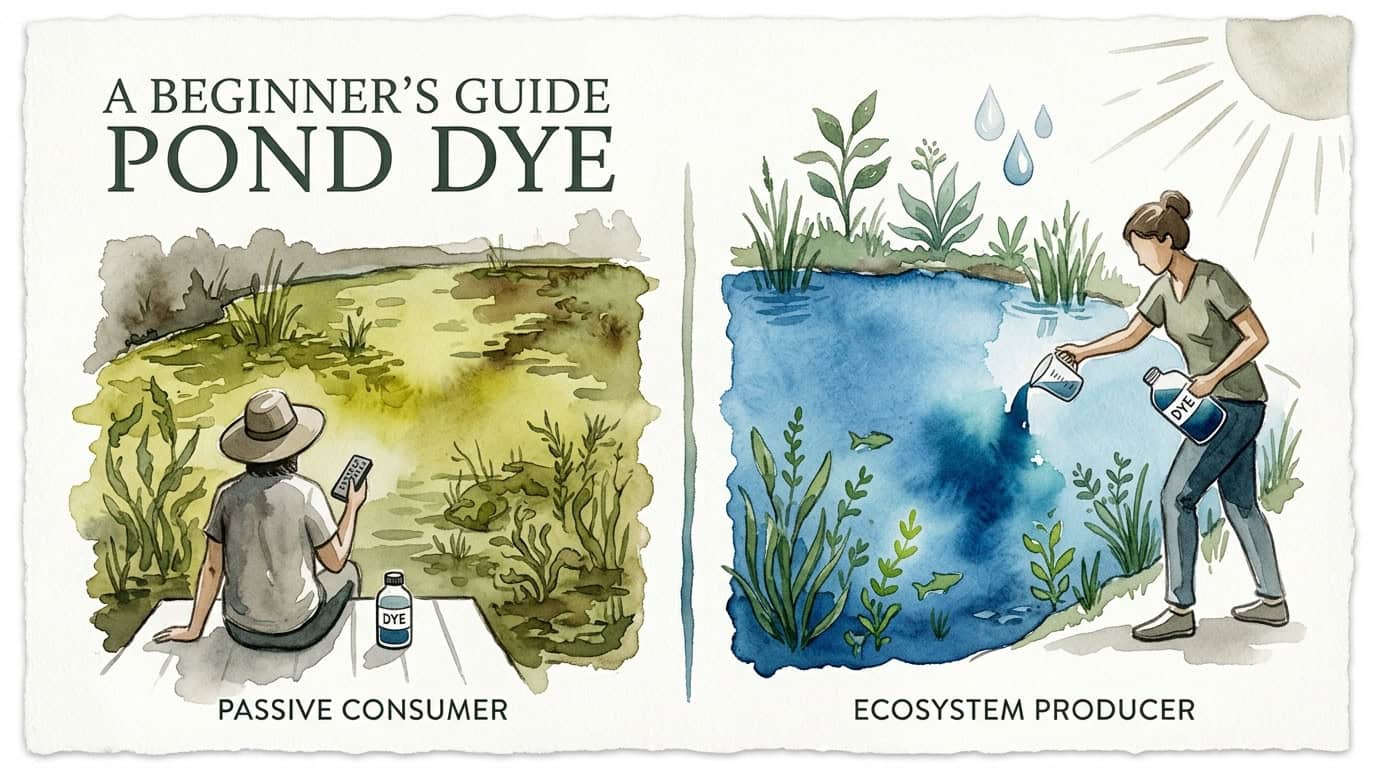
Are you just buying dye, or are you managing an ecosystem? Discover the shift from guessing to mastering your water’s health. Most beginners treat pond dye like food coloring. Experts treat it like a biological shield. Learn how to transform your pond from a maintenance headache into a self-regulating asset with our beginner’s guide.
Pond dye is a concentrated aquatic tint designed to manage water quality by filtering specific wavelengths of sunlight. It functions as a light-attenuation tool that limits the Photosynthetically Active Radiation (PAR) reaching the pond floor, effectively inhibiting the growth of submerged weeds and algae. When applied correctly, this biological shield stabilizes water temperatures and reduces the visibility of prey for avian predators, ensuring a controlled and sustainable aquatic environment.
A Beginner’s Guide to Pond Dye
Pond dye is a specialized chemical formulation used primarily to manage the optical properties of a water body. It is not merely a cosmetic additive; it is a management tool for controlling the energy input into an aquatic system. These dyes are typically composed of food-grade colorants, such as Acid Blue 9 and Acid Yellow 23, which are concentrated to provide maximum opacity and light filtration.
In real-world applications, pond dye is used in golf course water hazards, ornamental landscape ponds, and private fishing lakes. Its existence is predicated on the need to disrupt the natural photosynthetic cycle that leads to eutrophication—a state where excess nutrients and sunlight cause explosive plant growth. By tinting the water, managers can artificially create a “deep water” effect in shallow areas, preventing the sun from fueling the growth of unwanted vegetation.

Consider the analogy of sunglasses for your pond. Just as sunglasses protect your eyes from UV damage and glare, pond dye shields the benthos (the bottom level of the pond) from the full intensity of solar radiation. This simple mechanical change to the water’s transparency has cascading effects on the entire ecosystem’s thermal and biological stability.
How the Light Attenuation Process Works
The primary mechanism of pond dye is the absorption and scattering of light. Specifically, most pond dyes are formulated to block light in the 400 to 700-nanometer range, which is known as the Photosynthetically Active Radiation (PAR) spectrum. Plants and algae require this specific energy to perform photosynthesis. When the dye molecules are suspended in the water column, they intercept this energy before it reaches the weeds growing at the bottom.
To apply pond dye effectively, users must follow a specific sequence of operations. First, the volume of the pond must be calculated in acre-feet. An acre-foot is the volume of water required to cover one acre of land to a depth of one foot, which equals 325,851 gallons. Most commercial dyes are designed to treat one acre-foot per quart or gallon, depending on the concentration.
The dye should be applied at multiple points around the shoreline or near an aerator to ensure even distribution. The natural movement of the water, driven by wind or mechanical aeration, will disperse the dye throughout the entire volume within 24 to 48 hours. It is critical to apply the dye early in the spring, before the peak growing season begins, to establish a preventive barrier.
Benefits of Systematic Dye Application
Implementing a consistent pond dye program offers measurable advantages for water body management. The most significant benefit is the reduction in manual or chemical weed control requirements. By limiting the light available for growth, the pond owner reduces the biomass of filamentous algae and submerged macrophytes like pondweed or milfoil.
Thermal regulation is another technical advantage. Darker water absorbs heat differently than clear water. While the surface may warm slightly more, the deeper layers remain cooler because the sunlight is blocked from penetrating deep into the water column. This temperature stratification can help maintain higher dissolved oxygen levels in the lower reaches of the pond, which is essential for the health of bottom-dwelling organisms and beneficial aerobic bacteria.

Predation control is an often-overlooked benefit. Refractive properties of tinted water make it difficult for birds of prey, such as herons and ospreys, to accurately locate and strike fish. For owners of trophy fish or ornamental koi, this provides a functional layer of security that does not require physical netting or unsightly barriers.
Challenges and Technical Pitfalls
The most common mistake in pond dye application is miscalculating the water volume. If the dosage is too low, the light attenuation will be insufficient to stop photosynthesis, rendering the treatment ineffective. Conversely, over-application is rarely harmful to the biology but results in unnecessary expenditure and an unnaturally opaque appearance that may not meet aesthetic goals.
Dilution from environmental factors presents a constant challenge. Heavy rainfall events and high water turnover rates can flush the dye out of the system. In ponds with significant inflow and outflow, the “half-life” of the dye is significantly shortened. Managers must monitor the color intensity and perform “touch-up” doses to maintain the required concentration.
Staining is a practical risk during the application process. In its concentrated form, pond dye will permanently or semi-permanently stain skin, clothing, and porous dock materials. Professional applicators use specialized equipment or water-soluble packets to mitigate this risk. If using liquid concentrates, pouring the product directly into the water from a low height or into a prop-wash is the standard procedure to avoid splashing.
Limitations and Environmental Constraints
Pond dye is not a universal solution and has specific environmental limitations. It is not an algaecide or a herbicide. If a pond is already choked with weeds, applying dye will not kill them. In fact, if the weeds reach the surface, they are no longer dependent on light penetrating through the water, making the dye ineffective for control.
Dye is also unsuitable for moving water systems, such as streams or ponds with a high flushing rate (e.g., a pond that turns over its entire volume every 24–72 hours). The cost of maintaining the dye concentration in these systems is prohibitive. Furthermore, in very deep ponds where sunlight naturally does not reach the bottom, the dye serves only an aesthetic purpose and provides no biological benefit regarding weed suppression.
There are also ecological trade-offs. While blocking light reduces unwanted weeds, it also reduces the growth of phytoplankton, which forms the base of the aquatic food web. In ponds managed specifically for high-production fish yields, over-application of dye can inadvertently limit the growth of the microscopic organisms that small fish feed on, potentially impacting the entire food chain.
Comparison: Liquid Concentrates vs. Soluble Packets
The choice between liquid and solid delivery systems depends on the scale of the operation and the available equipment.
| Feature | Liquid Concentrates | Water-Soluble Packets |
|---|---|---|
| Ease of Distribution | Excellent; mixes rapidly with water. | Moderate; requires time to dissolve and drift. |
| Risk of Staining | High; requires careful handling. | Low; no direct contact with the dye. |
| Storage Efficiency | Lower; bulkier containers. | High; compact and lightweight. |
| Cost per Acre-Foot | Generally lower for bulk purchases. | Slightly higher due to specialized packaging. |
| Precision | High; can be measured to the ounce. | Fixed increments based on packet size. |
Practical Tips for Precision Management
To achieve the best results, start with a baseline measurement of your pond’s clarity using a Secchi disk. A Secchi disk is a simple black-and-white tool lowered into the water to measure the point at which it disappears from sight. For effective weed control, aim to maintain a Secchi disk reading of 18 to 24 inches.
Apply dye during calm weather conditions. High winds can push the dye to one side of the pond before it has a chance to mix vertically, leading to uneven shading. If you have an aeration system, turn it on at full capacity during application. The bubbles will create a vertical current that pulls the dye from the surface down to the bottom, ensuring the entire water column is treated.
Maintain a logbook of your applications. Note the date, the amount of dye used, and the weather conditions (specifically rainfall) following the application. Over time, this data will allow you to predict exactly when your pond will need a “booster” dose, moving you from reactive maintenance to a proactive schedule based on your specific ecosystem’s metabolism.
Advanced Considerations for Serious Practitioners
Advanced pond management involves understanding the “compensation point.” This is the depth at which the energy produced by photosynthesis equals the energy consumed by plant respiration. By using dye to raise the compensation point closer to the surface, you effectively shrink the “euphotic zone” (the area where plants can grow). Serious practitioners calculate the extinction coefficient of the water to determine the exact amount of dye needed to achieve a specific depth of light penetration.
Another advanced consideration is the interaction between dye and dissolved oxygen (DO). While dye helps keep water cooler (which holds more oxygen), a sudden drop in light can cause a minor die-off of existing algae. In a pond that is already oxygen-stressed, this decomposition can lead to a DO sag. In such cases, it is critical to ensure mechanical aeration is running to offset the biological oxygen demand (BOD) created by the dying organic matter.
Finally, consider the color spectrum. Blue dye is the standard for general light blocking, but Black or “Twilight” dyes (a mix of blue and black) provide a more reflective, mirror-like surface. These darker dyes are more effective at blocking a wider range of the spectrum and are often used in professional landscaping where a high-end, reflective aesthetic is required alongside maximum weed suppression.
Example: Calculating Dosage for a Rectangular Pond
Imagine a rectangular pond that measures 200 feet long and 100 feet wide, with an average depth of 6 feet. To determine the amount of dye needed, follow these steps:
1. Calculate Surface Acreage: 200 ft x 100 ft = 20,000 square feet. Since one acre is 43,560 square feet, the pond is 20,000 / 43,560 = 0.46 acres.
2. Calculate Acre-Feet: 0.46 acres x 6 feet (average depth) = 2.76 acre-feet.
3. Determine Dye Requirement: If the product label specifies 1 quart per acre-foot, you will need 2.76 quarts.
Rounding up to 3 quarts ensures full coverage and accounts for minor dilution. Applying this amount in early March will establish the protective barrier before the sun reaches its peak intensity in late spring, preventing the initial germination of weed seeds on the pond floor.
Final Thoughts
Pond dye represents a fundamental shift from treating symptoms to managing the environment. By controlling light, you control the primary energy source that fuels pond degradation. This mechanical approach is often safer and more cost-effective than repetitive applications of chemical herbicides, providing a long-term solution for maintaining water clarity and health.
The key to success lies in precision. Accurate volume calculation, timely application, and consistent monitoring turn pond dye from a simple colorant into a powerful biological shield. As you become more familiar with your pond’s specific needs, you can refine your dosage and timing to achieve a perfect balance between aesthetics and ecosystem performance.
Experimenting with different dye colors and concentrations will help you discover the ideal settings for your unique water body. Whether you are protecting a fishing stock or maintaining a pristine landscape, mastering pond dye is an essential skill for any serious water manager.

Frequently Asked Questions About A Beginner’s Guide to Pond Dye
Does pond dye kill existing weeds or algae?
Pond dye is a preventive tool rather than a curative one. It does not contain herbicidal or algaecidal properties that kill plants upon contact. Instead, it works by blocking the sunlight necessary for photosynthesis. If weeds have already grown to the surface or established a dense mat, the dye will be ineffective because those plants can still access sunlight above the tinted water. For the best results, the dye should be applied early in the spring before growth begins, or after existing weeds have been removed or treated with an appropriate herbicide.
Is pond dye safe for fish, pets, and wildlife?
Most commercial pond dyes are formulated using food-grade dyes, such as Acid Blue 9 and Acid Yellow 23, which are certified by the FDA for use in food, drugs, and cosmetics. When used at the recommended concentrations, these dyes are non-toxic to fish, birds, livestock, and dogs. They do not accumulate in fish tissue and do not interfere with the oxygen exchange at the water’s surface. However, it is always advisable to look for products that are “NSF Certified” or specifically labeled as safe for potable water and aquatic life to ensure the highest safety standards.
How long does a single application of pond dye last?
The longevity of pond dye typically ranges from four to eight weeks, though this varies significantly based on environmental conditions. Factors that shorten its lifespan include heavy rainfall, which dilutes the concentration, and high water turnover from springs or streams. Additionally, UV radiation from the sun gradually breaks down the dye molecules over time. To maintain the “biological shield” effectively, managers should monitor the water’s color and add small “booster” doses whenever a noticeable fade occurs, rather than waiting for the color to disappear completely.
Will pond dye stain my dock, boat, or swimming area?
In its concentrated form (straight from the bottle), pond dye will stain almost any porous surface it touches, including wood, concrete, and clothing. However, once the dye has been fully dispersed and diluted in the pond water, it will not stain skin, fur, or equipment. Swimmers can typically use the pond within 24 hours of application without risk of turning blue. To avoid accidental staining during the application process, professionals recommend wearing gloves, staying downwind, and pouring the liquid close to the water surface or using water-soluble packets.
Can I use pond dye in a pond that has a lot of water flowing through it?
Using pond dye in high-flow systems is generally not recommended due to inefficiency. If a pond has a constant inflow and outflow (such as a pond built on a stream or one that overflows frequently), the dye will be flushed out along with the water. In technical terms, if the “residence time” of the water is less than two weeks, the cost of constantly replenishing the dye becomes prohibitive. Dye is most effective in “closed” systems or ponds with minimal turnover, where the chemical concentration can remain stable for extended periods.