

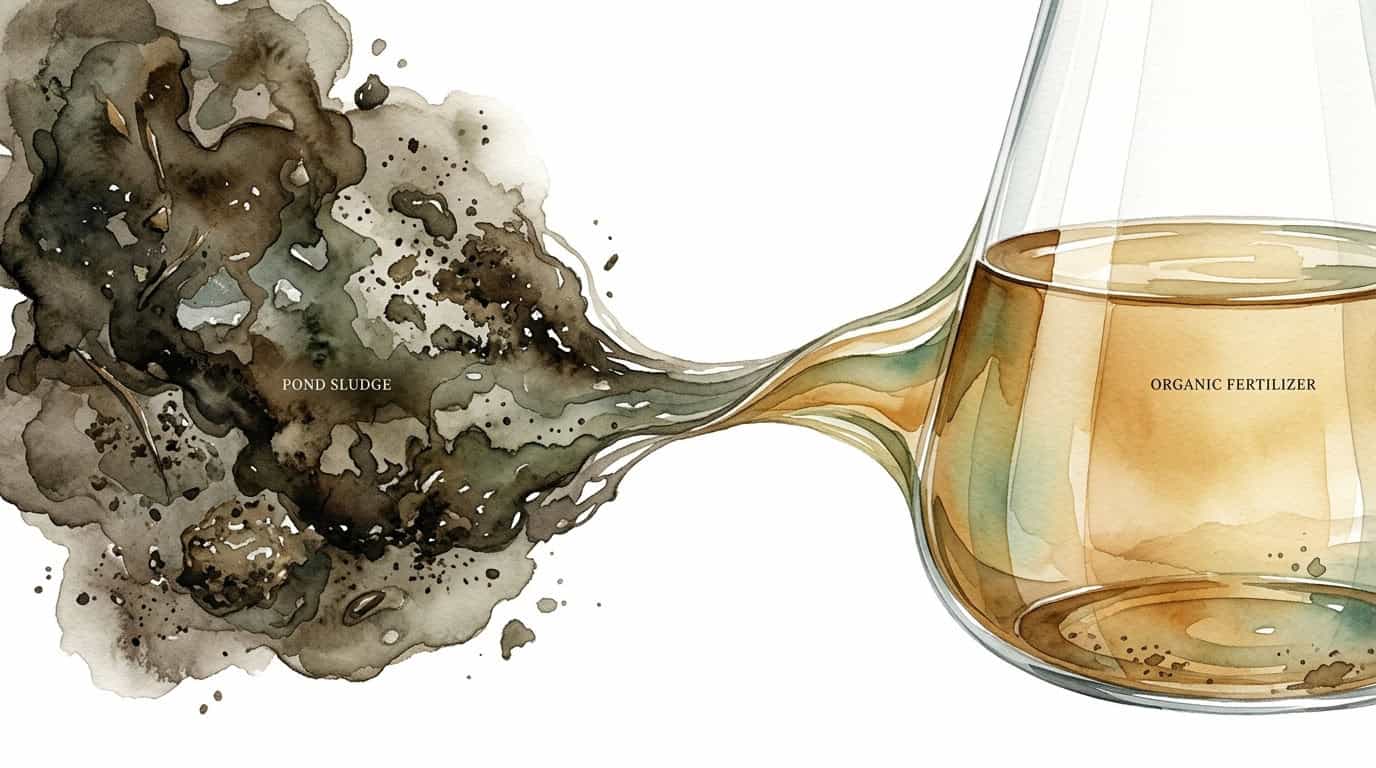
Turning pond sludge into organic fertilizer involves the mechanical extraction of benthic sediment—accumulated organic waste, fish excrement, and decomposed plant matter—and its subsequent stabilization for soil application. This material serves as a concentrated source of nitrogen (approx. 0.17% to 0.5%), phosphorus, and chelated trace minerals. When processed via composting or controlled drying, this byproduct enhances soil cation exchange capacity and microbial diversity, providing a sustainable alternative to synthetic chemical inputs.
Is the messiest part of your pond maintenance actually the secret to a prize-winning vegetable garden? Most small pond owners treat filter cleaning as a chore to be discarded. But that thick, smelly sludge is actually a highly concentrated organic fuel. Instead of washing it down the drain, learn how to harvest this nutrient-dense ‘tea’ to supercharge your garden beds. Your plants will thank you, and your pond stays cleaner.
Turning Pond Sludge Into Organic Fertilizer
Pond sludge, technically identified as benthic sediment or organic muck, is a semi-solid matrix comprising unconsumed feed, metabolic fish waste, and decaying autochthonous organic matter. In any closed aquatic system, gravity drives these solids to the anaerobic zone at the pond floor. While these materials represent a waste stream that can trigger eutrophication and dissolved oxygen depletion in the water column, they are a high-value resource for terrestrial agriculture.
This substance exists as a biological reservoir of macronutrients (Nitrogen, Phosphorus, Potassium) and micronutrients (Iron, Magnesium, Zinc). In real-world agricultural contexts, sediment recovery is a recognized method for nutrient cycling. Instead of allowing organic carbon to sequester and potentially release toxic hydrogen sulfide within the pond, the material is transferred to the soil where aerobic bacteria can further mineralize the nutrients for plant uptake.

Mechanical Extraction and Processing Systems
Effective utilization of pond sediment requires systematic extraction and stabilization. The mechanical removal of sludge can be categorized by the scale of the system and the desired moisture content of the final product.
Extraction Methods
Mechanical vacuums and specialized sludge remover sets utilize perforated intake manifolds (typically 10mm to 20mm apertures) to lift sediment-laden water. Data suggests that a 15mm perforated pipe configuration can achieve a collection rate of approximately 1.85 kg of sludge-water mixture per 5 liters of fluid pumped. For larger retention basins, hydro-raking or hydraulic dredging is required to remove hundreds of pounds of bottom muck in a single operation.
Solid-Liquid Separation
Direct application of raw sludge-water is inefficient due to transportation weights. Solid-liquid separation techniques include sedimentation (gravity settling), mechanical dewatering (belt presses or centrifuges), and evaporation beds. In small-scale systems, simple filtration through fine mesh or permitting the sludge to settle in a secondary decanting tank is often sufficient to reach a solids concentration of 5% to 8%.
Stabilization and Composting
Raw sludge is frequently anaerobic and high in ammonia, which can cause phytotoxicity if applied directly to sensitive root systems. Composting is the standard stabilization protocol. High-nitrogen sludge (the “green” component) is layered with high-carbon “brown” materials such as wheat straw, woodchips, or dried leaves at a 1:2 ratio. This process facilitates the transition from anaerobic to aerobic bacterial dominance, neutralizing odors and stabilizing the nutrient profile.
Chemical and Biological Advantages of Benthic Sediment
Benthic sediment offers a more complex chemical profile than typical urea-based fertilizers. Technical analysis often reveals a Carbon-to-Nitrogen (C/N) ratio ranging from 17.4 to 28.4, which falls within the ideal range for rapid nitrogen availability and soil microbial stimulation.
Nutrient Mineralization
The phosphorus found in pond sludge is often bound in the form of iron phosphate, making it a slow-release source that is less prone to leaching than synthetic orthophosphates. Studies indicate that total nitrogen in fish pond sludge typically hovers around 0.179%, with phosphorus levels exceeding 50 ppm. While these percentages appear lower than NPK 10-10-10 fertilizers, the organic matter content (often 30% to 50%) significantly improves soil structure and water retention.

Microbial Stimulation
The “sludge tea” produced during filter backwashing is teeming with nitrifying bacteria and beneficial fungi. When introduced to garden soil, these microorganisms catalyze the breakdown of other organic amendments, increasing the overall bioavailability of soil-bound minerals. This creates a bio-stimulant effect that exceeds the measurable NPK value of the sludge itself.
Risk Mitigation: Pathogens, Ammonia, and Heavy Metals
Utilizing biological waste streams necessitates a strict adherence to safety protocols to prevent environmental contamination or crop damage.
Pathogenic Load
Ponds that receive runoff from livestock areas or host large populations of migratory waterfowl (such as geese) carry a risk of E. coli and other fecal coliforms. Thermal composting, where the core of the pile reaches 140°F (60°C) for at least three days, is required to achieve Grade A biosolid status and ensure the destruction of human and plant pathogens.
Ammonia and Phytotoxicity
Fresh sludge contains high concentrations of ammonia and urea. Direct contact with foliage or young roots can lead to “leaf burn” or osmotic stress. Stabilization through a 30-day aerobic aging period allows for the nitrification of ammonia into nitrate, the preferred nitrogen form for most vegetable crops.
Heavy Metal Accumulation
Urban retention tanks and decorative ponds in industrial zones may accumulate heavy metals such as Lead (Pb), Cadmium (Cd), and Mercury (Hg). These elements adsorb onto the organic particles in the sludge. For edible crops, periodic laboratory testing of the sediment is recommended to ensure concentrations do not exceed EPA Part 503 standards for land application.
Application Limitations and Environmental Constraints
Sludge is not a universal solution for every gardening scenario. Specific constraints must be evaluated before large-scale integration.
- Soil pH Impacts: Most pond sediments are slightly alkaline or neutral. Continuous application to acid-loving plants (e.g., blueberries, azaleas) may lead to iron chlorosis as the soil pH drifts upward.
- Salt Accumulation: If the pond has been treated with medicinal salts (Sodium Chloride) or pond dyes, the resulting sludge may have a high electrical conductivity (EC). Rinsing the sediment or diluting it with rainwater is necessary to prevent soil salinization.
- Runoff Potential: Because sludge is rich in phosphorus, applying it to frozen or saturated ground can lead to nutrient runoff into local waterways, ironically contributing to the same eutrophication issues the pond manager is trying to avoid.
DIRTY SLUDGE vs LIQUID FERTILIZER
The choice between raw pond waste and commercial synthetic liquids involves trade-offs in efficiency, cost, and bioavailability.
| Metric | Pond Sludge (Stabilized) | Commercial Liquid (Synthetic) |
|---|---|---|
| Nutrient Delivery | Slow-release / Mineral-bound | Immediate / Water-soluble |
| Soil Structure | Increases Organic Carbon | No impact on physical structure |
| Microbial Load | High beneficial bacterial count | Typically sterile or dormant |
| Application Cost | Near-zero (Byproduct) | High (Price per gallon) |
| Trace Minerals | Broad spectrum (Fe, Mg, Zn, S) | Usually limited to NPK+Micros |
| Ease of Use | Moderate (Requires processing) | High (Standardized dosing) |
Optimization Protocols and Best Practices
Maximum efficiency is achieved through controlled application and blending. Data-driven gardening suggests the following optimization techniques:
- Dilution Ratio: For direct liquid application (fertigation), dilute the concentrated sludge-water at a 1:10 ratio with dechlorinated water. This prevents oxygen-stripping in the soil and minimizes odors.
- Depth of Application: When using semi-solid muck, incorporate it into the top 4–6 inches of soil. Surface application (mulching) is less efficient as nitrogen can be lost to the atmosphere via ammonia volatilization.
- Blending with Biochar: Research demonstrates that adding 1% biochar to pond sediment compost increases the final nitrogen and carbon content, significantly improving root growth metrics (up to 38% in some trials).
Advanced System Integration
Serious practitioners may consider integrating sludge management into more complex biological cycles.
Vermicomposting
Introducing red wiggler worms to partially stabilized pond sludge accelerates the conversion process. The worms consume the organic matrix and associated bacteria, producing vermicast that is significantly higher in plant-available nutrients than standard compost. This method also helps reduce the “mucky” texture of the sludge, making it easier to handle.
Closed-Loop Fertigation
Advanced pond filtration systems can be plumbed directly into garden irrigation lines. By using a vortex separator, solids are concentrated and periodically flushed into a holding tank. This tank, aerated to maintain aerobic conditions, provides a continuous supply of nutrient-rich water for garden use, eliminating the need for manual sludge hauling.
Quantitative Efficiency Scenario
Consider a 1,000-gallon ornamental koi pond. Over a single growing season, a typical fish load can generate approximately 50 to 100 lbs of wet sludge.
1. **Extraction:** Using a pond vacuum, 80 lbs of 90% moisture sludge is collected.
2. **Dehydration:** Through gravity settling, the volume is reduced to 20 lbs of 60% moisture “cake.”
3. **Composting:** The cake is mixed with 40 lbs of shredded cardboard.
4. **Output:** After 60 days of decomposition, the result is approximately 35 lbs of premium organic compost with an estimated NPK value of 1-0.5-0.5.
This yield is sufficient to fertilize a 100-square-foot vegetable patch for an entire season without additional nitrogen inputs, representing a significant reduction in operational costs.
Final Thoughts
Pond sludge represents the ultimate closing of the nutrient loop. By viewing maintenance waste as a chemical resource rather than a disposal problem, pond owners can significantly enhance the health of their terrestrial landscapes. The technical requirements for processing—aerobic stabilization, pathogen control, and mechanical separation—are minor compared to the ecological and financial benefits of producing high-grade organic fertilizer on-site.
Success in this endeavor depends on moving away from the “dump and forget” mentality. Proper monitoring of pond inputs, such as fish feed quality and external runoff, ensures that the resulting fertilizer is safe and effective. As the global shift toward sustainable, circular agriculture continues, the ability to harvest and refine benthic nutrients becomes an essential skill for the modern gardener and aquarist alike.
Frequently Asked Questions About Turning Pond Sludge Into Organic Fertilizer
How can I tell if my pond sludge is safe to use on edible vegetables?
The safety of pond sludge depends primarily on the inputs of the aquatic system. If your pond is a closed system (like a backyard liner pond) where you control the feed and no industrial runoff or heavy pesticides are present, the sludge is generally safe after proper stabilization. However, it is mandatory to compost the sludge first if you have waterfowl or if the pond receives runoff from areas treated with herbicides. For the highest safety margins, use a thermal composting method to ensure the pile reaches 140°F, which neutralizes common pathogens like E. coli and Salmonella. If you suspect heavy metal contamination from urban street runoff, a basic soil/sediment test from a local agricultural extension is recommended before applying to root crops or leafy greens.
Can I apply raw sludge directly to my garden without composting?
While direct application is possible, it is not recommended for most garden scenarios. Raw sludge is often anaerobic, meaning it lacks oxygen and contains high levels of ammonia and hydrogen sulfide. These compounds can be toxic to plant roots and may cause immediate “nitrogen burn.” Furthermore, the wet, dense nature of raw sludge can seal the soil surface, preventing gas exchange and leading to soil compaction. If you must apply it directly, do so in the late fall as a “sheet compost” layer, spreading it thinly and tilling it into the soil so it can stabilize over the winter months. For active growing seasons, always dilute the sludge-water significantly or compost it with carbon-rich materials first.
Why does pond sludge smell so bad, and will the smell attract pests to my garden?
The characteristic “rotten egg” smell of pond sludge is caused by hydrogen sulfide gas, a byproduct of anaerobic decomposition (decomposition in the absence of oxygen). This occurs at the bottom of the pond where oxygen levels are zero. Once the sludge is removed and exposed to the air, or mixed into a well-aerated compost pile, the anaerobic bacteria die off and are replaced by aerobic bacteria, which do not produce foul odors. To prevent attracting pests like rodents or flies, never leave raw sludge sitting in open buckets. Instead, immediately mix it with “brown” materials like straw or woodchips and bury it within the center of a compost pile, or till it directly into the soil and cover it with a layer of mulch.
Does pond sludge provide enough nutrients to replace my regular fertilizer?
Pond sludge is an excellent source of nitrogen, phosphorus, and micronutrients, but its NPK ratio is lower and slower-acting than synthetic fertilizers. It functions more as a soil conditioner and a slow-release nutrient source. For heavy feeders like tomatoes or corn, you may still need to supplement with higher-potassium sources like wood ash or kelp meal. However, the organic matter in sludge improves the Cation Exchange Capacity (CEC) of your soil, meaning it helps your soil “hold onto” nutrients more effectively, reducing the total amount of supplemental fertilizer you need over time. Think of sludge as the foundation of your soil health rather than a 1:1 replacement for high-octane liquid chemicals.

Can I use sludge from a pond that has been treated with algaecides or salt?
Caution is required if you have recently treated your pond with chemicals. Most modern algaecides (like those based on copper sulfate) can accumulate in the sediment and may inhibit the growth of certain sensitive land plants or beneficial soil fungi. If you have used medicinal salt (Sodium Chloride) to treat fish, the sludge may have a high salinity that could dehydrate your plants. If you’ve used such treatments, it is best to wait several months for the chemicals to break down or to dilute the sludge heavily with fresh water before garden application. Always check the labels of any pond additives for “plant safety” or “irrigation” warnings before recycling the waste stream into your garden.