

Is it a weed to be wasted, or the fuel that grows your record-breaking fish? Not all ‘weeds’ are bad. American Pondweed is a native powerhouse that provides oxygen and cover. Learn how to manage it so it fuels your ecosystem instead of ruining your swim.
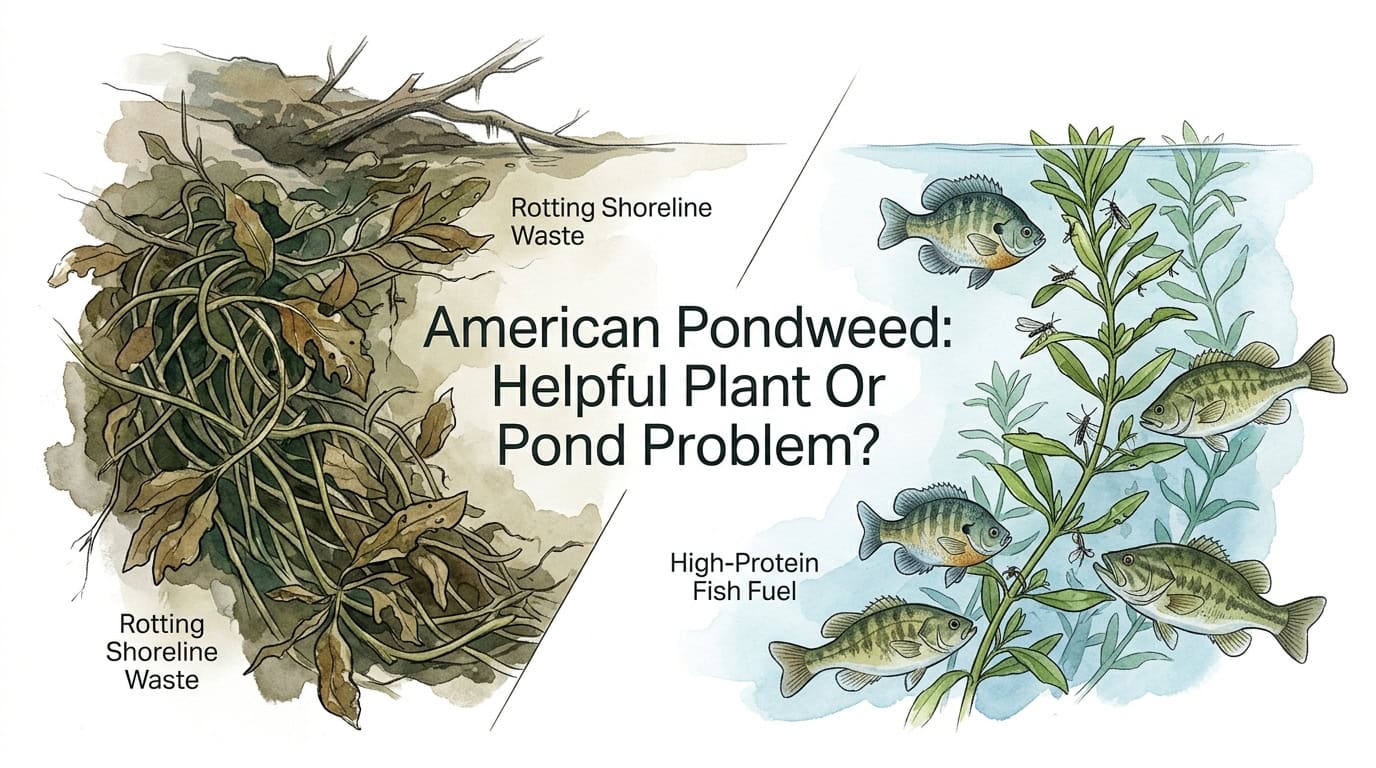
American Pondweed: Helpful Plant Or Pond Problem?
American Pondweed (Potamogeton nodosus) is a native, perennial aquatic macrophyte widespread throughout North American freshwater systems. This species is characterized by its dimorphic leaf structure, possessing both submerged and floating leaves. The submerged leaves are typically thin, translucent, and lanceolate, while the floating leaves are leathery, elliptical, and measure between 4 to 7 inches in length. These plants anchor themselves to the benthos via a robust system of creeping rhizomes, which facilitates both nutrient uptake from the sediment and lateral expansion across the pond floor.
Ecologically, P. nodosus serves as a primary producer and a critical component of the littoral zone. It thrives in water depths up to 8 feet, provided that light penetration is sufficient to support photosynthesis at the substrate level. In managed aquatic systems, it is often viewed through two lenses: a beneficial habitat for trophy fish production or a nuisance “weed” that obstructs recreational activities. The distinction between these two roles depends entirely on the density of the biomass and the specific management objectives of the waterbody.
Unlike invasive species such as Curly-leaf Pondweed (Potamogeton crispus), American Pondweed is a native component of the ecosystem. It provides a stable environment for macroinvertebrate colonization and serves as a direct food source for waterfowl. Its growth cycle typically peaks in mid-to-late summer, producing seed-bearing spikes that emerge above the water surface for wind pollination before retracting to mature sub-surface.

How American Pondweed Functions within the Trophic Pyramid
The mechanical and biological function of American Pondweed revolves around nutrient sequestration and habitat architecture. The plant acts as a biological filter, aggressively absorbing orthophosphates and nitrogenous compounds from the water column and sediment. This sequestration limits the nutrient availability for planktonic and filamentous algae, effectively acting as a mitigation strategy against harmful algal blooms. Scientific data suggests that a healthy stand of pondweed can significantly reduce the turbidity of a waterbody by stabilizing bottom sediments with its rhizome network.
Beyond nutrient cycling, the physical structure of P. nodosus creates a complex three-dimensional matrix. This matrix provides refuge for small forage fish, such as bluegill and fathead minnows, protecting them from excessive predation while simultaneously offering a substrate for the growth of periphyton—a mixture of algae, cyanobacteria, and microbes. This periphyton, along with the macroinvertebrates (such as Odonata larvae and gastropods) that inhabit the stems, forms the high-protein foundation of the fish food web.
Oxygenation is another critical mechanical function. During peak daylight hours, the photosynthetic activity of American Pondweed releases significant volumes of dissolved oxygen (DO) directly into the water. However, pond managers must monitor the biomass density, as the respiratory demands of the plant at night can lead to localized oxygen depletion if the volume of plant material exceeds the pond’s carrying capacity.
Benefits of Maintaining Native Pondweed Populations
Maintaining a controlled population of American Pondweed offers several measurable advantages for pond health and fisheries management. These benefits are centered on ecosystem stability and the optimization of the energy transfer from primary producers to apex predators.
- Nutrient Competition: By locking up phosphorus and nitrogen in its tissue, P. nodosus prevents these nutrients from fueling nuisance algae growth.
- Sediment Stabilization: The root and rhizome systems prevent wind-induced suspension of fine particulates, maintaining higher water clarity.
- Forage Production: The surface area provided by the leaves and stems supports a higher density of aquatic insects, which are essential for the rapid growth of juvenile game fish.
- Fish Cover: The floating leaves provide shade, which can lower water temperatures in the immediate vicinity and provide ambush points for larger predators like Largemouth Bass.
For practitioners focused on trophy fish production, the presence of American Pondweed is often superior to a “clean” pond bottom. Data indicates that ponds with 20% to 30% littoral vegetation coverage exhibit higher fish growth rates compared to ponds with zero vegetation, primarily due to the increased availability of high-protein prey items.
Challenges and Common Management Mistakes
Excessive biomass accumulation remains the primary challenge with American Pondweed. When growth exceeds 40% of the pond’s surface area, the plant transitions from a benefit to a liability. Common mistakes in management often stem from a lack of technical understanding regarding the plant’s life cycle and the chemical reactions involved in its removal.

One frequent error is the “all-or-nothing” approach to eradication. Stripping a pond of all native vegetation often results in a massive nutrient surge. As the plants die and decompose, they release stored phosphorus back into the water, which is almost immediately consumed by filamentous algae, leading to a “green soup” effect. Furthermore, the decomposition process consumes dissolved oxygen, which can stress or kill fish populations during periods of high water temperature.
Identification errors are also common. Managers often confuse American Pondweed with invasive species. Misidentification can lead to the application of incorrect herbicides or the implementation of management strategies that unintentionally facilitate the spread of more aggressive invaders. It is essential to confirm the presence of elliptical floating leaves and alternate leaf arrangements to verify P. nodosus before proceeding with a management plan.
Limitations and Environmental Constraints
The efficacy of American Pondweed as a management tool is limited by several environmental factors. Water depth is the most significant constraint; once water exceeds 8 to 10 feet, light attenuation typically prevents the plant from establishing a viable root system. Consequently, pondweed is exclusively a littoral zone inhabitant and cannot manage nutrients in deep-water basins.
Turbidity also plays a critical role. In ponds with high levels of suspended solids or existing heavy planktonic algae blooms, the lack of light penetration will cause P. nodosus to die off. This creates a negative feedback loop: without the plants to stabilize the sediment and absorb nutrients, the water becomes more turbid, further preventing plant regrowth. Additionally, in systems with high populations of common carp or other benthivorous fish, the constant uprooting of rhizomes can prevent the establishment of healthy pondweed stands.
Comparison: Biomass Management Strategies
When deciding how to handle American Pondweed, managers must choose between allowing the plant to cycle naturally, removing it mechanically, or controlling it chemically. The following table compares the efficiency and impact of these approaches.
| Factor | Natural Cycling | Mechanical Removal | Chemical Control |
|---|---|---|---|
| Nutrient Impact | Nutrients remain in system | Removes nutrients from system | Releases nutrients upon decay |
| Oxygen Risk | Moderate (nighttime respiration) | Very Low | High (during decomposition) |
| Labor Intensity | Zero | High | Low |
| Cost Efficiency | High | Low (Equipment/Labor) | Moderate (Chemical costs) |
| Longevity | Permanent | Seasonal | Varies by active ingredient |
This comparison highlights the technical superiority of mechanical removal for nutrient reduction, as it is the only method that physically exports phosphorus and nitrogen from the aquatic ecosystem. This is the difference between “Rotting Shoreline Waste” (chemical/natural decay) and “High-Protein Fish Fuel” (living biomass that supports the food web).
Practical Tips for Active Management
Effective management of American Pondweed requires a data-driven approach. The following practices are recommended for maintaining an optimized balance within the ecosystem:
- Monitor Coverage: Aim for a target coverage of 20% to 25% of the pond’s surface area. Use a grid-based visual assessment to determine when intervention is necessary.
- Strategic Thinning: Instead of clearing large swaths, create “lanes” or “pockets.” This maintains habitat for fish while allowing for boat navigation and fishing access.
- Timing: If mechanical removal is used, perform the operation in early summer before the plant sets seeds. This reduces the reproductive potential for the following season.
- Export Biomass: Always move raked or cut pondweed away from the shoreline. Allowing it to rot at the water’s edge will leach nutrients back into the pond, defeating the purpose of removal.
Advanced Considerations for Pond Managers
For serious practitioners, the use of specialized chemical agents and biological controls may be necessary. Chemical control of Potamogeton nodosus is best achieved using active ingredients such as Endothall, Diquat, or Fluridone. Endothall is particularly effective as a contact herbicide that works well in spot treatments without affecting the entire waterbody. Diquat provides rapid “burn-down” of the foliage but requires careful application to avoid oxygen crashes.
Biological control via Triploid Grass Carp (Ctenopharyngodon idella) is another technical option. These sterile fish are highly efficient at consuming pondweed. Stocking rates must be calculated precisely—usually 5 to 10 fish per vegetated acre—to prevent the carp from over-consuming and stripping the pond of all beneficial cover. It is also important to note that Grass Carp have a feeding preference; they will often consume American Pondweed before moving on to less palatable species like Eurasian Watermilfoil, making them a targeted biological tool.
Finally, consider the stoichiometric balance of the pond. If the Nitrogen-to-Phosphorus (N:P) ratio is skewed, it can favor algae over pondweed. Maintaining a healthy population of macrophytes like P. nodosus helps stabilize this ratio by sequestering excess phosphorus, which is often the limiting nutrient in freshwater systems.
Example Scenario: The 1-Acre Trophy Bass Pond
Consider a 1-acre pond with a maximum depth of 12 feet and an average depth of 6 feet. Without vegetation, the pond is prone to late-summer filamentous algae blooms. By introducing or managing a 0.25-acre stand of American Pondweed along the shallow northern shoreline, the manager achieves the following:
First, the 0.25 acres of pondweed sequesters approximately 2 to 5 pounds of phosphorus during the growing season. This prevents the growth of roughly 1,000 to 2,500 pounds of wet algae biomass. Second, the pondweed stand supports an estimated 50,000 to 100,000 additional macroinvertebrates, providing a caloric surplus for the bluegill population. This surplus translates into better growth rates for the apex predator, the Largemouth Bass. If the pondweed begins to exceed the 0.25-acre boundary, the manager employs a mechanical weed harvester or hand-raking for 4 hours in late June, physically removing the excess nutrients and maintaining the structural integrity of the habitat.
Final Thoughts
American Pondweed is a native biological asset that, when managed with technical precision, serves as the engine for a productive and clear aquatic ecosystem. It is not merely a “weed” to be eradicated, but a tool for nutrient sequestration and habitat complexity. By shifting the focus from total elimination to balanced maintenance, pond owners can optimize their waterbodies for both aesthetic clarity and trophy-grade fish production.
Successful management requires consistent monitoring of biomass density and a willingness to employ mechanical or chemical interventions when the 30% coverage threshold is breached. Practitioners should prioritize the physical removal of biomass whenever possible to ensure that nutrients are exported rather than recycled. Experimenting with targeted thinning and monitoring the resulting impact on fish growth rates will provide the data necessary to fine-tune your specific ecosystem.