

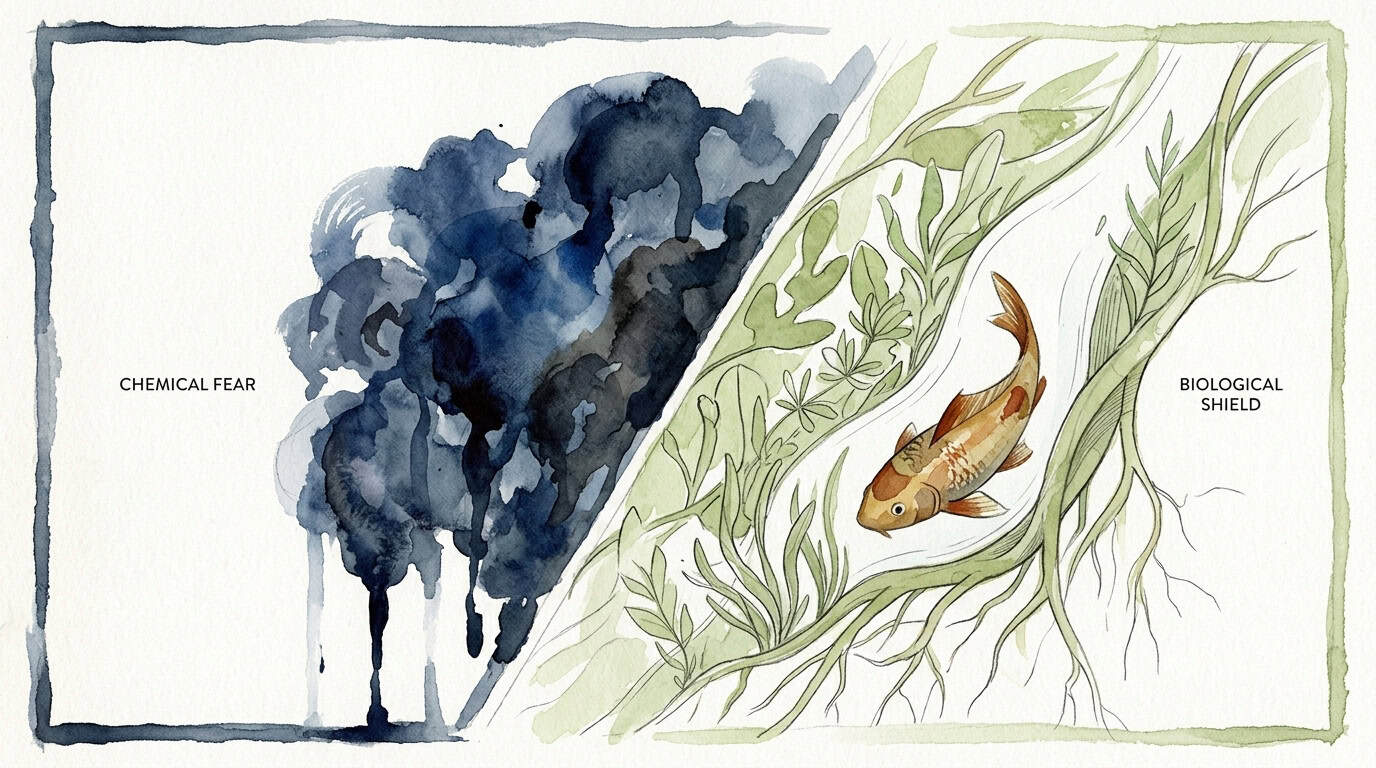
Is it dye, or is it a security system for your fish? The answer might surprise you. Most pond dyes are food-grade and safer for your fish than the UV rays they are currently swimming in. In fact, dye acts as a ‘sunblock’ that protects fish from predators and heat stress. Here is the safety breakdown.
High-quality pond dyes are safe for fish because they are composed of food-grade colorants, specifically Acid Blue 9 and Acid Yellow 23, which exhibit extremely low toxicity. At the standard application concentration of 1 part per million (ppm), these dyes are far below the lethal concentration (LC50) levels of 1,000 ppm for sensitive species like rainbow trout. By filtering specific light wavelengths, pond dyes reduce environmental stress and predation without interfering with fish physiology.
Is Pond Dye Safe for Fish?
Pond dye is a concentrated water-soluble colorant designed to modify the optical properties of a body of water. Primarily used in managed aquatic systems such as golf course ponds, farm reservoirs, and decorative water features, these dyes serve as a non-chemical means of controlling the aquatic environment.
The primary components of professional-grade pond dyes are Acid Blue 9 (also known as FD&C Blue No. 1) and Acid Yellow 23 (Tartrazine or FD&C Yellow No. 5). These substances are widely utilized in the food, cosmetic, and pharmaceutical industries, ensuring a high safety profile for multi-trophic aquatic organisms.

In real-world applications, pond dye exists to manage the energy input into an ecosystem. By darkening the water, the dye effectively reduces the volume of the euphotic zone—the layer of water where sunlight is sufficient for photosynthesis. This makes it a critical tool for practitioners managing nuisance plant growth and fish health in a single system.
The Mechanics of Light Attenuation in Aquatic Systems
Pond dyes function through the principle of light attenuation. When added to water, the dye particles absorb and scatter specific wavelengths of solar radiation, particularly in the Photosynthetically Active Radiation (PAR) spectrum, which ranges from 400 to 700 nanometers.
Most aquatic dyes are formulated to target the red and blue ends of the visible spectrum. These specific wavelengths are the primary energy sources for chlorophyll-a, the pigment used by algae and submerged aquatic vegetation (SAV) for photosynthesis. By filtering out these “growth” wavelengths, the dye limits the energy available for primary producers at the bottom of the pond.
The process follows the Beer-Lambert Law, which states that the intensity of light decreases exponentially with the depth and concentration of the absorbing substance. In a dyed pond, the “1% light level”—the depth beyond which most plants cannot survive—is significantly shallower than in a clear pond. This mechanical shading prevents the germination of weed seeds on the pond floor and slows the proliferation of filamentous algae.
Quantifiable Benefits of Aquatic Colorants
The implementation of a pond dye program offers measurable improvements in fish survival and environmental stability. Beyond the aesthetic “blue” or “black” appearance, the technical advantages include:
- Predation Mitigation: High-quality dyes reduce the visual transparency of the water, making it difficult for avian predators like Great Blue Herons or terrestrial predators like raccoons to track fish movement. This is particularly effective in shallow ponds where fish have limited vertical escape routes.
- Thermal Regulation: By absorbing solar energy at the surface, pond dyes can help maintain cooler temperatures in the lower reaches of the water column. Cooler water has a higher saturation point for dissolved oxygen, which is critical for fish metabolic efficiency during peak summer months.
- UV Radiation Shielding: Just as humans use sunblock, fish benefit from the filtration of harmful ultraviolet rays. Excessive UV exposure can lead to tissue damage and suppress the immune systems of certain ornamental species like Koi.
- Metabolic Stress Reduction: Fish in dyed water often exhibit lower cortisol levels. The perceived security of “darker” water reduces the startle response and allows for more consistent feeding patterns.
Common Challenges and Operational Errors
Despite the high safety margin, improper application of pond dyes can lead to systemic inefficiencies or biological imbalances.

Oxygen Depletion: The most significant risk associated with pond dye is the indirect reduction of dissolved oxygen (DO). Since the dye inhibits photosynthesis, the amount of oxygen produced by aquatic plants and phytoplankton as a byproduct of their growth cycle is reduced. In a heavily stocked pond with high organic loading, this can lead to a DO “crash,” especially during consecutive cloudy days when no new oxygen is being generated.
Over-Application: Exceeding the recommended dosage can result in an “inky” appearance that prevents fish from locating forage. In competitive environments where fish rely on visual cues for feeding, excessive darkness can lead to reduced growth rates and poor body condition.
Staining and Surface Film: Concentrated dye is highly adhesive to porous surfaces. Applying dye directly to rocks, docks, or concrete without immediate dilution can lead to permanent discoloration. Furthermore, improper mixing can lead to temporary surface films that hinder gas exchange at the air-water interface.
Limitations and Environmental Constraints
Pond dye is not a universal solution for all aquatic issues. Practitioners must recognize its boundaries to avoid wasted resources.
Dyes are not algaecides or herbicides. They do not kill existing weeds or algae; they only prevent new growth by shading. If a pond is already choked with vegetation, applying dye will have a negligible effect until the existing biomass is physically removed or chemically treated.
Environmental factors like water exchange rates also limit effectiveness. In ponds with high “flow-through” (where water is constantly entering and exiting), the dye will be diluted and washed out quickly, making the cost-per-day of treatment prohibitively high. Additionally, dyes are less effective in very shallow water (less than 2 feet deep), as enough light may still penetrate the short distance to the bottom to fuel weed growth.
Technical Comparison: Delivery Methods
The efficacy of a pond dye program is often determined by the delivery method chosen. The table below compares the three primary formats:
| Format | Dispersion Rate | Ease of Use | Maintenance Requirement |
|---|---|---|---|
| Liquid Concentrate | High (Rapid) | Medium (Requires pouring) | Low |
| Soluble Packets (WSP) | Medium | High (No-mess) | Low |
| Powder / Granular | Low (Requires mixing) | Low (Dust risk) | Medium |
Liquid concentrates are generally preferred for professional applications due to their nearly instantaneous dispersion, while Water-Soluble Packets (WSP) are optimized for small-scale ornamental pond owners who wish to avoid contact with the concentrated dye.
Practical Tips for Precision Application
To maximize fish safety and product efficiency, follow these technical best practices:
- Calculate Pond Volume: Do not guess the size of the pond. Use the formula: Length (ft) x Width (ft) x Average Depth (ft) / 43,560 to determine Acre-Feet. Most dyes are dosed at 1 quart per 1 acre-foot of water.
- Phase the Application: Apply the dye in the early spring before the water temperature reaches 50°F (10°C). This preempts the initial growth surge of filamentous algae.
- Maintain Aeration: If using dye in a pond with high fish density, ensure a mechanical aeration system (bottom-diffused or surface fountain) is operational to compensate for the reduction in photosynthetic oxygen production.
- Monitor Color Density: Use a Secchi disk to measure transparency. Once the disk disappears at a depth of 18–24 inches, the dye concentration is optimized for most managed ponds.
Advanced Considerations: Toxicology and Regulatory Standards
For practitioners operating in sensitive environments, understanding the toxicological data is paramount. The “No Observed Effect Level” (NOEL) for Acid Blue 9 in various fish species is significantly higher than the concentrations found in dyed ponds.
Regulatory certifications such as NSF/ANSI Standard 60 are critical. This certification ensures the dye is safe for use in water that may eventually be used for drinking or irrigation. When selecting a product, verifying the presence of an EPA registration number or NSF seal provides a layer of quality assurance that the product is free from heavy metal contaminants like lead or arsenic, which are sometimes found in industrial-grade (non-food-grade) dyes.
Furthermore, consider the impact on the benthic community. Studies indicate that while shading reduces the biomass of macroinvertebrates that rely on algae for food, it does not typically cause species extinction within the pond, as most managed systems have enough shallow-edge habitat to sustain these populations.
Operational Scenario: 1-Acre Farm Pond
Imagine a 1-acre farm pond with an average depth of 4 feet, stocked with Bluegill and Largemouth Bass. The owner is experiencing an early-season bloom of Chara (muskgrass).
The total volume is 4 acre-feet. The owner applies 1 gallon of professional blue dye. Within 24 hours, the PAR levels at the 3-foot depth drop by 85%. The Chara, deprived of its primary energy source, fails to reach the surface. The Bass, no longer blinded by the glare of the shallow sun, increase their hunting efficiency. By maintaining this concentration throughout the summer, the owner reduces the need for copper-based algaecides, which have a much higher potential for fish toxicity.
Final Thoughts
Pond dye represents a proactive, mechanical approach to aquatic management that prioritizes the long-term health of the fish population. By acting as a solar filter, it mitigates the primary drivers of pond instability—excessive heat, UV damage, and runaway plant growth.
While the “biological shield” provided by the dye is highly effective, it must be integrated into a broader management strategy that includes proper aeration and nutrient control. When applied with technical precision, pond dye is not merely a cosmetic additive; it is a vital component of a stable and secure aquatic ecosystem.
Experimenting with different hues—such as black for high reflectivity or teal for a natural appearance—can help you fine-tune the environment to the specific needs of your fish and the aesthetic goals of your property.
Frequently Asked Questions About Is Pond Dye Safe for Fish?
How long does pond dye stay in the water before it becomes unsafe?
Pond dye does not become “unsafe” over time; rather, it loses its effectiveness. The dye molecules are biodegradable and are gradually broken down by sunlight (photodegradation) and microbial activity. Typically, a single application lasts 4 to 8 weeks depending on water movement and rainfall. As the dye fades, the UV protection and shading benefits diminish, which may allow algae to return. It is perfectly safe to “top off” the color periodically to maintain the desired concentration. There is no cumulative toxicity risk because the food-grade components do not bioaccumulate in fish tissue.
Can pond dye kill my fish if I use too much?
While the dye itself is non-toxic, “overdosing” a pond can indirectly harm fish by causing an oxygen crash. If the water is made so dark that all photosynthesis stops in a pond with high fish density and no mechanical aeration, the dissolved oxygen levels may drop below the 5 mg/L threshold required for fish survival. This is a result of the lack of oxygen production, not chemical poisoning. Always ensure your pond has adequate aeration if you plan to maintain a high dye concentration or a high biomass of fish.
Will pond dye stain the fish or change their color?
No, pond dye will not stain your fish. Once the dye is diluted in the pond at the recommended 1 ppm concentration, it is far too weak to adhere to the protective slime coat of a healthy fish. The colorants are water-soluble, meaning they stay in the water column rather than binding to organic tissues. Your fish will look darker while they are swimming in the dyed water due to the change in light refraction, but if you were to catch one and place it in clear water, it would retain its natural coloration immediately.

Is it safe to swim in a pond that has been dyed?
Yes, it is entirely safe to swim in a pond treated with food-grade aquatic dye once it has fully dispersed. Dispersion usually takes between 24 and 48 hours depending on the size of the pond and the amount of water movement. Because these dyes are formulated from the same ingredients used in sports drinks and candies, they do not pose a risk to human skin or health. However, it is advisable to wait until the dye is fully mixed to avoid temporary staining of skin or swimwear that might occur if you swim through a concentrated “cloud” of dye.
Does pond dye affect the growth of lily pads and other desirable plants?
Pond dye is non-selective, meaning it blocks light for all plants. However, its impact depends on the depth of the plant. Floating plants like lily pads and emergent plants like cattails are unaffected because they receive sunlight directly from the air. Submerged plants that grow from the bottom, such as pondweed or Chara, will experience stunted growth because the dye filters the light before it reaches them. This is usually the desired effect, but if you have rare submerged ornamental plants, you should use dye sparingly to ensure they receive enough PAR to survive.