

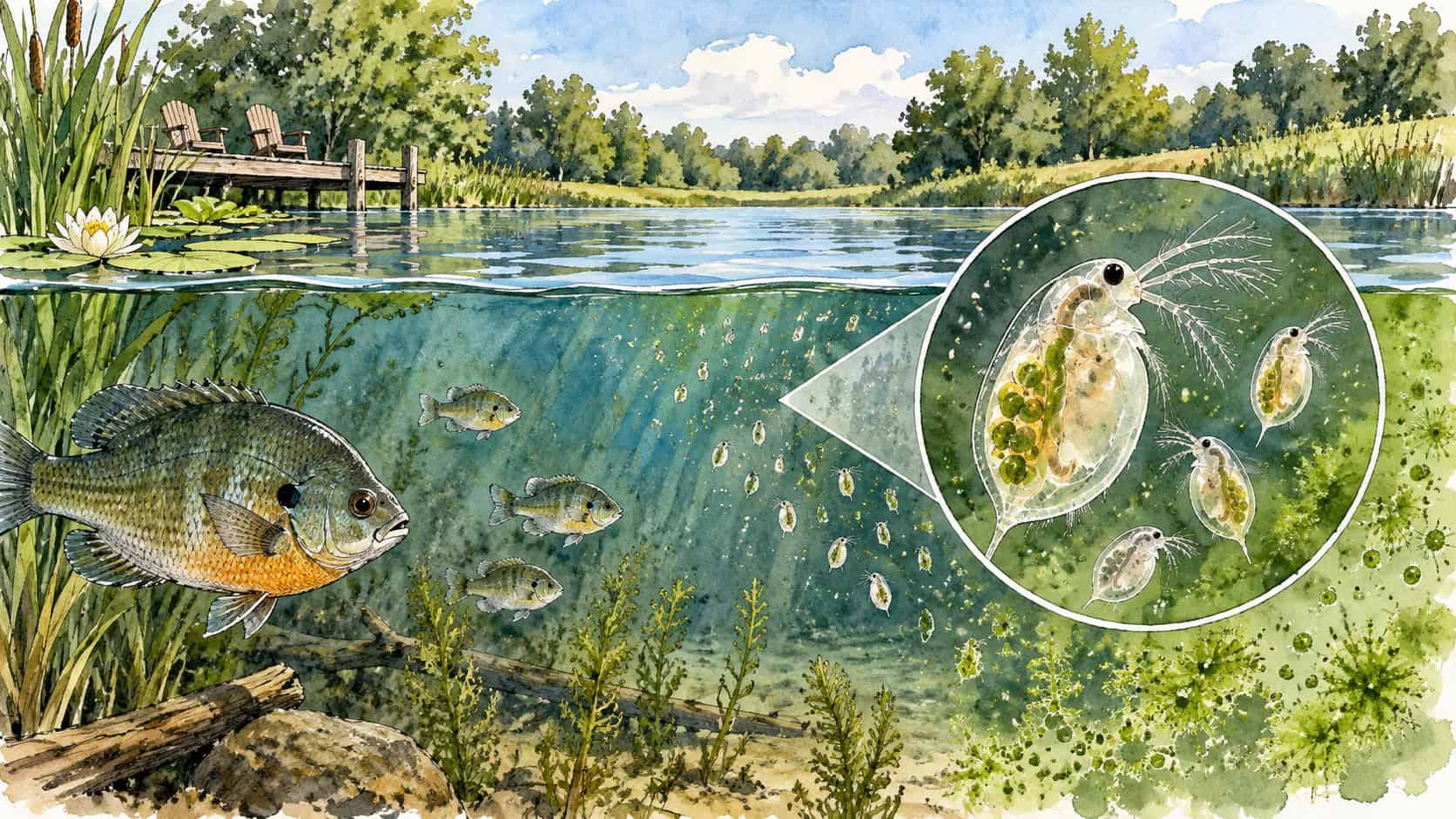
Scoop up a jar of pond water and it may look like nothing more than green or slightly cloudy water. Look at that same water under magnification and you may discover an entire ecosystem swimming around.
Among the most interesting inhabitants are Daphnia, tiny freshwater crustaceans commonly called water fleas.
They aren’t insects, and they aren’t parasites. They’re zooplankton—and they occupy one of the most important positions in a pond’s food web.
Daphnia eat microscopic algae. Fish eat Daphnia.

That sounds simple, but the consequences can be surprisingly large. When Daphnia populations become abundant, their grazing can sometimes remove enough phytoplankton from the water to noticeably improve water clarity.
So could these tiny animals actually help control algae in a pond?
Yes—but there’s quite a bit more to the story.
What Exactly Are Daphnia?
Daphnia are small freshwater crustaceans found in ponds, lakes and wetlands around the world. Most are only a few millimeters long.
They’re often called water fleas because of the jerky, hopping motion they make as they swim through the water.
Put one under a microscope and it’s a remarkable little animal. Because many Daphnia are nearly transparent, you may be able to see the heart beating, food moving through the digestive tract and even developing eggs inside the body.

But the characteristic that matters most to pond owners is how they feed.
Daphnia are filter feeders.
As they move through the water, specialized appendages create currents that bring suspended food particles toward them. Much of that food consists of microscopic algae and other organic particles.
A single Daphnia obviously isn’t going to make much difference in a pond.
Millions of them can.
Daphnia Are One of a Pond’s Natural Algae Grazers
Most pond owners think about algae from the bottom up.
Phosphorus and nitrogen enter the pond. Sunlight provides energy. Algae use those resources to grow.
Daphnia introduce another force working in the opposite direction.
Nutrients + sunlight → phytoplankton → Daphnia → fish
Ecologists call this grazing pressure.
As phytoplankton reproduce, Daphnia and other zooplankton consume some of them. When the grazing population becomes large enough, it can substantially affect both the abundance and types of phytoplankton in the water.
This isn’t just theoretical.
Research involving Nebraska farm ponds found that when large crustacean zooplankton—including Daphnia—became dominant, phytoplankton remained at low levels and water clarity became exceptionally high.
Researchers studying lakes have observed the same basic phenomenon. Strong Daphnia populations can sometimes produce what limnologists call a clear-water phase, when heavy grazing causes phytoplankton abundance to fall and water transparency to increase.
That’s a tremendous ecological effect from an animal most pond owners never see.
Can Daphnia Really Clear Green Pond Water?
They can under the right circumstances.
But this is where we need to be careful.
Daphnia aren’t little swimming algae-control machines that consume anything green.
Phytoplankton include an enormous variety of organisms. Some are excellent food for Daphnia. Others are too large, form colonies or filaments, have shapes that make them difficult to consume, or simply aren’t very nutritious.
As grazing pressure increases, Daphnia may therefore change which algae dominate the water rather than eliminating phytoplankton altogether.

This helps explain something pond owners see all the time: two ponds with apparently similar nutrient levels can look completely different.
The amount of algae in the water isn’t controlled by nutrients alone.
It’s the result of a biological tug-of-war between how quickly phytoplankton are being produced and how quickly they’re being consumed, lost or replaced.
Daphnia can be an important player in that contest.
What About Blue-Green Algae?
This is where claims about using Daphnia for algae control can become misleading.
Blue-green algae are actually cyanobacteria, and Daphnia do not respond equally to all cyanobacteria.
Some cyanobacteria can be consumed. Others form colonies or filaments that make grazing difficult. Certain cyanobacteria can also be poor-quality food or produce compounds that interfere with Daphnia feeding, growth or reproduction.
There are circumstances in which large Daphnia populations have suppressed cyanobacteria, particularly when the grazers become abundant before a bloom takes over.
But that’s very different from saying Daphnia will control an established harmful algae bloom.
They may not.
If a pond has a suspected harmful cyanobacterial bloom, adding Daphnia isn’t a treatment strategy I would rely on.
Why Doesn’t Every Pond Have Huge Populations of Daphnia?
This is probably the more interesting question.
Food may be abundant. Conditions may appear favorable. Yet Daphnia populations can still remain relatively low.
One major reason is simple:
Everything wants to eat them.
Daphnia occupy a nearly perfect position in the aquatic food chain. They’re large enough to provide a useful meal but small enough for many young fish and other aquatic animals to consume.
Newly hatched fish rely heavily on zooplankton. As fish grow, many species continue feeding on larger zooplankton when it’s available.
That means a pond can have plenty of food for Daphnia while simultaneously having tremendous predation pressure keeping their population down.
And that creates an interesting chain reaction.
More small fish can mean fewer large Daphnia.
Fewer Daphnia can mean less grazing pressure.
Less grazing pressure can mean more phytoplankton.
This is one of the classic examples of a trophic cascade—a change higher in the food web producing effects farther down the chain.
Fish Can Indirectly Affect How Green a Pond Becomes
This relationship has been studied extensively in lake management.
If large numbers of plankton-eating fish suppress the larger zooplankton, phytoplankton may experience less grazing pressure.
Change the fish community and the opposite can sometimes happen.
Fewer plankton-eating fish can allow larger zooplankton such as Daphnia to become more abundant. Increased grazing can then reduce phytoplankton and increase water clarity.
The intentional manipulation of these relationships is known as biomanipulation.
It’s an intriguing concept because it demonstrates that water quality isn’t controlled only by what enters the pond.
It’s also affected by who eats whom after those nutrients enter the ecosystem.
For the average pond owner, that doesn’t mean you should immediately start changing your fish population to control algae. Fish populations should be managed primarily around the goals of the fishery.
But it does illustrate why pond ecology is rarely as simple as adding one product to solve one problem.
Daphnia Are Extremely Important to Young Fish
From a fisheries standpoint, Daphnia may be even more important as food than they are as algae grazers.
Phytoplankton capture energy from sunlight.
Daphnia eat phytoplankton.
Young fish eat Daphnia.
Larger fish eat the smaller fish.
In a very real sense, Daphnia help package microscopic plant production into a form that fish can use.
A newly hatched fish can’t eat a bluegill pellet or chase down a minnow. It needs appropriately sized prey, and zooplankton fill that role during a critical period of its life.
That’s why a productive green pond isn’t necessarily an unhealthy pond.
Some phytoplankton production supports zooplankton production, which in turn supports fish production.
The goal isn’t sterile, crystal-clear water.
The goal is a functioning food web.
Should You Buy Daphnia and Put Them in Your Pond?
You can buy live Daphnia cultures, which naturally raises the question:
Why not just stock more of them?
For most established ponds, I wouldn’t make that my first move.
The question isn’t whether you can physically put Daphnia into the water. Of course you can.
The question is whether the pond will allow that population to become established.
If fish predation is already keeping large-bodied zooplankton scarce, adding a container of Daphnia may accomplish little more than feeding the fish.
If poor water quality or unsuitable conditions are limiting them, adding more animals doesn’t correct the underlying problem.
And if a healthy zooplankton community is already present, stocking additional Daphnia may be unnecessary.
Before trying to add Daphnia, I’d be much more interested in understanding what is already happening in the pond.
How Can You Tell If Daphnia Are Already There?
You may be able to see evidence of zooplankton without any specialized equipment.
Fill a clear glass or jar with pond water and hold it toward a bright light.
Look closely.
If you see tiny specks moving independently through the water rather than simply drifting with it, you’re probably looking at some type of zooplankton.
Identifying Daphnia specifically is easier with magnification.
An inexpensive microscope opens up an entirely different view of pond water. A sample that looked empty to the naked eye may contain Daphnia, copepods, rotifers, protozoans, algae and numerous other organisms.
It’s one of the easiest ways to appreciate just how biologically active pond water really is.
Does Clear Water Mean You Have Lots of Daphnia?
Not necessarily.
Water clarity can be affected by phytoplankton, suspended clay, organic particles, tannins, aquatic plants and other factors.
A pond can be clear because zooplankton are heavily grazing phytoplankton.
It can also be clear because the pond has very low fertility and isn’t producing much phytoplankton in the first place.
Those are two completely different situations.
That’s another reason I don’t like using water clarity by itself as a measure of pond health.
Clearer isn’t always better.
Greener isn’t always worse.
The reason behind the condition matters.
What Happens When a Pond Has Too Many Nutrients?
Daphnia can consume algae.
They can’t make phosphorus disappear.
That’s an important distinction.
When a pond receives a continuous supply of phosphorus and nitrogen from fertilizer runoff, eroding soil, animal waste, septic sources, decaying vegetation or accumulated organic matter, phytoplankton production can become extremely high.
At some point the system can simply produce algae faster than grazing organisms can keep up.
Think of Daphnia as one of the pond’s natural checks on phytoplankton growth—not as a substitute for nutrient management.
If excessive nutrients continue entering the pond, fixing that source is usually much more important than trying to increase the number of algae grazers.
Where Does Aeration Fit?
Aeration doesn’t produce Daphnia and shouldn’t be promoted as a direct method of increasing their population.
Its contribution is broader.
Proper aeration helps maintain dissolved oxygen and circulate the water column. It can provide a more stable aerobic environment for fish,