

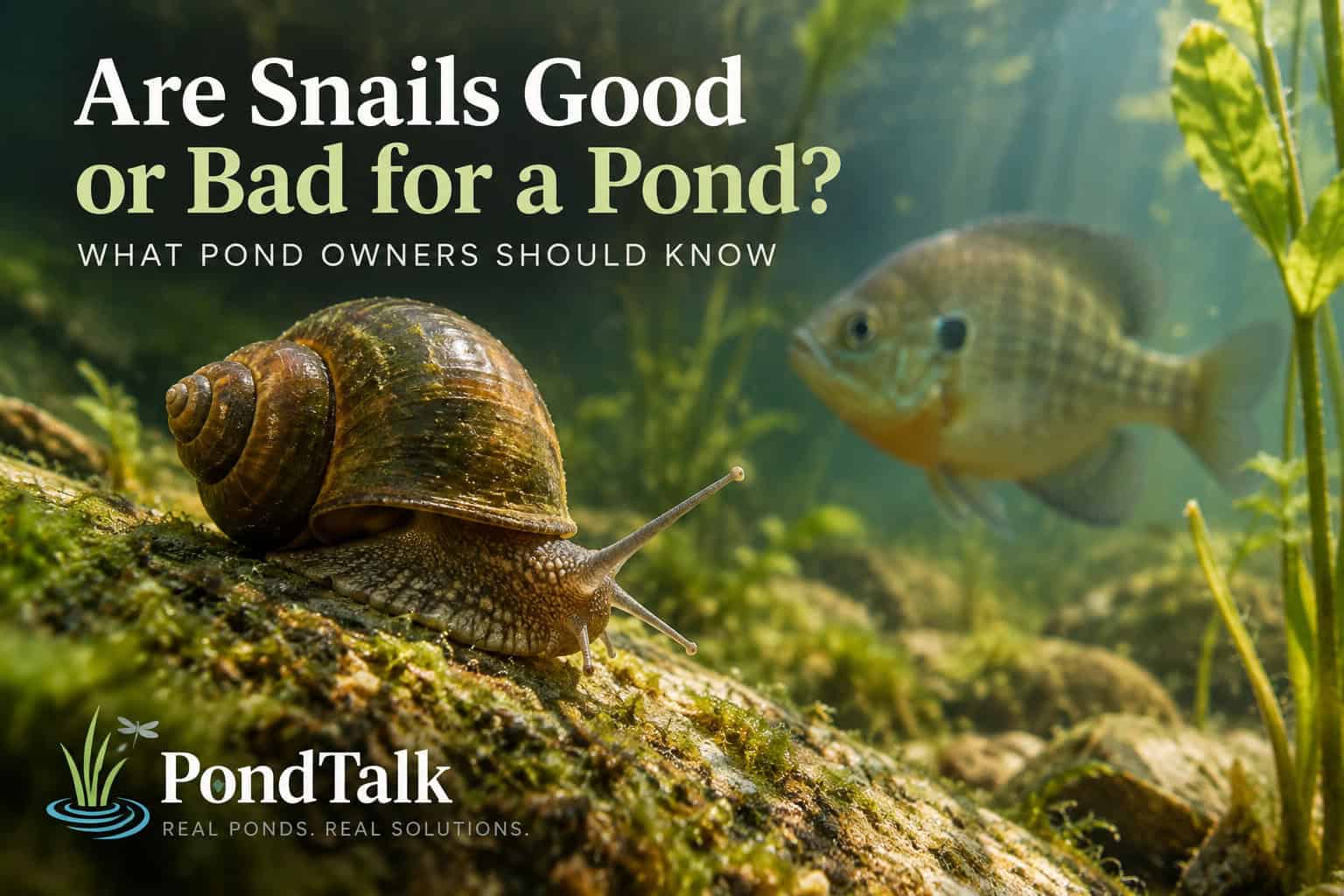
Find a few snails crawling across the rocks or plants in your pond and you probably won’t give them much thought. Find hundreds of them and you may start wondering whether you have a problem.
The answer isn’t as simple as “snails are good” or “snails are bad.”
Snails are a normal part of many freshwater ecosystems. They graze on algae and biofilm, consume decaying organic material, recycle nutrients and become food for other pond animals.
But unusually large snail populations can also be a sign that your pond is providing them with an unusually large food supply. And in fishing ponds, some aquatic snails play another important role that pond owners should understand: they can serve as intermediate hosts for parasites that infect fish.

So before trying to eliminate snails, it helps to understand why they’re there.
Article at a Glance
- A moderate population of pond snails is usually normal and can be beneficial. Snails consume biofilm, algae and decomposing organic material while contributing to the pond food web.
- A sudden explosion in snail numbers is often a symptom rather than the real problem. Abundant algae, aquatic vegetation, biofilm and decaying organic matter can provide both food and habitat for snails.
- Snails can help graze algae, but they aren’t an algae-control solution. They primarily consume algae growing on surfaces and aren’t likely to solve green water or a serious filamentous algae problem.
- Snails recycle nutrients; they don’t remove them from the pond. Nutrients contained in algae and organic debris are incorporated into snail biomass and waste and eventually continue through the pond’s nutrient cycle.
- Some aquatic snails are part of the life cycle of fish parasites. Yellow, black and white grubs found in pond fish are trematodes that commonly use snails and fish-eating birds as additional hosts.
- If snail numbers become excessive, look for the cause before reaching for a treatment. Reducing excessive organic material, algae or aquatic vegetation may be more useful than simply trying to kill the snails.
Are Pond Snails Good or Bad?
Usually, they’re neither.
They’re simply another member of the pond ecosystem.
A healthy pond contains an enormous community of organisms that most pond owners rarely notice: bacteria, fungi, protozoans, zooplankton, aquatic insects, worms, mussels, snails, crayfish, fish and many others.
Each occupies a niche.
Snails are particularly important as grazers and recyclers. Many species crawl across rocks, plants, liner, wood and other submerged surfaces, scraping off algae and the thin biological layer known as biofilm.

Other snails consume decaying leaves, dead plant material and other organic matter.
And snails themselves become food for fish, turtles, crayfish, waterfowl and other animals.
In other words, seeing snails doesn’t mean something is wrong with your pond.
Seeing far more snails than you used to is more interesting.
What Do Snails Actually Eat?
It depends on the species, but common freshwater snails may consume:
- Algae growing on submerged surfaces
- Biofilm
- Decaying aquatic plants
- Fallen leaves and other plant debris
- Bacteria and microorganisms associated with decomposing material
- Leftover fish food and other organic material
This explains why snails sometimes become extremely abundant in nutrient-rich ponds.
Think about it from the snail’s perspective.
If the pond suddenly produces more algae, plant growth and organic debris, you’ve essentially increased the amount of snail food.
More food can support more snails.
That doesn’t necessarily mean the snails caused the problem.
The snail population may simply be responding to conditions already present in the pond.
Do Snails Clean a Pond?
Yes—but this needs some qualification.
Snails can help process organic material and keep submerged surfaces cleaner by grazing on biofilm and certain types of algae.
But describing them as tiny pond “vacuum cleaners” can be misleading.
When a snail eats algae or decaying plant material, those nutrients don’t disappear from the pond.
Some become snail tissue. Some are excreted as waste. Eventually, when the snail dies or is eaten, those nutrients continue moving through the food web.
This is an important principle in pond management:
Nutrient recycling isn’t the same thing as nutrient removal.
Snails can contribute to a healthier functioning ecosystem without actually exporting phosphorus or nitrogen from the pond.
Will Pond Snails Control Algae?
They can help with certain algae, but don’t expect miracles.

Snails are generally most useful as grazers of algae and biofilm attached to:
- Rocks
- Plant stems and leaves
- Pond liner
- Wood
- Other submerged surfaces
They aren’t going to clear a serious planktonic algae bloom that has turned the water green.
And a handful of snails won’t eliminate a large mat of filamentous algae covering the shoreline.
In fact, a pond producing lots of algae may eventually support more snails because it’s producing more food for them.
Snails should therefore be viewed as participants in the pond’s natural algae-control system—not as a stand-alone treatment for an algae problem.
Why Does My Pond Suddenly Have So Many Snails?
This is probably the more useful question.
A population increase means conditions have become favorable for reproduction and survival.
Look for changes such as:
More algae or biofilm.
More growth on rocks, plants and other surfaces means more grazing opportunities.
Excessive aquatic vegetation.
Dense vegetation provides both food and habitat for snails. Oklahoma State University notes that snails thrive where aquatic vegetation is abundant.
Accumulating organic matter.
Leaves, dead algae, dying plants and other material create additional food as they decompose.
Heavy fish feeding.
Uneaten fish food and the nutrients introduced by feeding can increase biological productivity.
Few snail predators.
Changes in fish or other predator populations may allow snail numbers to increase.
This is why simply asking, “How do I kill the snails?” may miss the more important question:
What’s allowing so many snails to live here in the first place?
Do Pond Snails Carry Parasites?
They can, and this is particularly important in fishing ponds.
Several trematode parasites that infect freshwater fish use aquatic snails as part of their life cycle.
Pond owners sometimes encounter these parasites as yellow grubs, black grubs or white grubs in bluegill and other fish.
The life cycle is fascinating—and a little unpleasant.
A simplified version looks like this:
Fish-eating bird → snail → fish → fish-eating bird
Fish-eating birds such as herons, kingfishers, egrets and cormorants can introduce parasite eggs into the pond. A larval stage infects an aquatic snail. Another stage later leaves the snail and infects fish.
When an infected fish is eaten by the appropriate bird host, the cycle can begin again.
Oklahoma State University describes aquatic snails as the next host after fish-eating birds introduce yellow-grub parasites to a pond. Kentucky fisheries managers similarly note that digenetic trematodes generally require snails and fish-eating birds in addition to fish to complete their life cycles.
That doesn’t mean every snail carries parasites.
It also doesn’t mean that discovering snails is a reason to eliminate them.
Parasites are themselves part of natural aquatic ecosystems. But if you’re seeing significant grub infestations in your fish, snail abundance becomes more relevant.
Are Fish With Yellow or Black Grubs Dangerous to Eat?
The sight of grubs in a bluegill fillet can certainly ruin your appetite.
Fortunately, the common yellow-grub parasites described by Oklahoma State aren’t considered a human health risk. Kentucky fisheries guidance similarly states that proper cleaning and cooking renders these common trematode parasites harmless to people.
Heavily infected fish may still be undesirable to eat simply because of their appearance.
If parasite problems become significant, management generally focuses on interrupting the parasite’s life cycle rather than attempting to treat infected fish.
What Fish Eat Pond Snails?
One fish deserves special mention:
Redear Sunfish—the “Shellcracker”
There’s a reason redear sunfish are commonly called shellcrackers.
Snails and other mollusks are an important part of their diet, and redear possess specialized crushing surfaces in their throat that allow them to crack hard shells.
Oklahoma State describes their diet as including insects, snails, mussels, zooplankton and fish and notes that redear may help control yellow-grub parasites.
Kentucky fisheries managers specifically recommend redear sunfish as one possible way of reducing snail populations where trematode problems occur.
That makes redear particularly interesting in bass-bluegill fishing ponds.
However, don’t add a new fish species to an established pond solely because you’ve spotted some snails. Fish stocking decisions should consider pond size, existing fish populations, climate and your overall fishery-management goals.
Should I Add Snails to My Pond?
This depends heavily on what kind of pond we’re talking about.
Small Water Gardens and Ornamental Ponds
In a backyard water garden, selected snail species may be deliberately introduced to graze biofilm and algae.
But be careful.
Plants purchased for water gardens can also bring along snails—or snail eggs—without you realizing it. Once introduced, some species reproduce very rapidly.
There’s also a larger ecological concern: never move snails, plants, fish or other aquatic organisms from one natural water body to another.
Doing so can spread invasive species, parasites and diseases.
Larger Natural and Fishing Ponds
There’s usually little reason to deliberately stock snails.
If the habitat is appropriate, native aquatic snails will often establish themselves naturally.
Rather than trying to engineer the snail population, concentrate on creating a balanced pond ecosystem.
When Are There Too Many Snails?
There’s no magic number.
Ten snails might look like a lot in a tiny backyard pond and be meaningless in a one-acre pond.
Instead, look at what else is happening.
Are snails covering virtually every surface?
Has their population suddenly exploded?
Is aquatic vegetation excessive?
Is organic muck accumulating?
Are you seeing large numbers of fish infected with yellow or black grubs?
Are snails congregating around the shoreline?
That last observation deserves special attention. Snails and crayfish leaving the water can sometimes occur when dissolved oxygen becomes dangerously low. Penn State Extension includes snails and crayfish gathering around the pond edge among signs associated with oxygen-related fish-kill events.
In that situation, the snails aren’t the problem.
They’re potentially telling you something about the water.
How Can You Reduce Pond Snails Naturally?
If snail populations really are excessive, start by changing the conditions supporting them.
1. Reduce Excess Organic Matter
Remove excessive leaves and dead vegetation where practical, particularly in smaller ponds.
Preventing unnecessary organic accumulation also reduces the material that ultimately becomes pond muck.
2. Address Excessive Aquatic Vegetation
A healthy amount of vegetation is beneficial.
A pond choked with plants is another matter.
Dense vegetation provides excellent snail habitat. Fisheries guidance from both Oklahoma and Kentucky identifies vegetation management as one method of reducing snail abundance where parasite problems exist.
The goal shouldn’t be a sterile pond.
It’s balance.
3. Avoid Overfeeding Fish
If you’re feeding koi, catfish, bluegill or other fish, feed only what they consume.
Excess food ultimately becomes nutrients and organic matter whether snails eat it directly or not.
4. Manually Remove Snails in Small Ponds
In a backyard water garden, physical removal may be perfectly practical.
It’s much less practical in a half-acre or five-acre pond.
5. Consider Natural Predation
In appropriate fishing ponds, redear sunfish can consume significant numbers of snails and may already be a desirable part of the fish community.
Again, stocking decisions should be based on the entire fishery rather than treating redear as biological snail pesticide.
Should You Use Chemicals to Kill Pond Snails?
Usually, this wouldn’t be my first approach.
Some pond-management publications discuss copper sulfate as a means of reducing aquatic snails when serious fish-parasite problems occur. Oklahoma State, for example, discusses copper sulfate as one possible component of yellow-grub management.
But intentionally killing a large population of aquatic organisms creates another issue:
Everything you kill becomes organic material that must decompose.
Decomposition consumes oxygen.
That’s particularly important during hot weather, when warm water already holds less dissolved oxygen and pond organisms may be consuming oxygen rapidly.
Before considering a chemical treatment, I’d want to know why the snail population became excessive and whether the snails themselves are actually causing a problem.
Often, they’re not.
Do Pond Snails Mean My Pond Is Dirty?
No.
Snails live in very healthy natural ponds.
Their presence alone tells you little about water quality.
A very large population, however, tells you that the pond is supporting a large amount of snail food and habitat.
That’s information worth paying attention to.
Are Pond Snails Good for Fish?
They can be.
Snails are part of the natural food web and are eaten by several fish species, most notably redear sunfish.
At the same time, certain snails can serve as intermediate hosts for fish parasites.
These aren’t contradictory statements.
Natural ecosystems are full of organisms that provide benefits in one ecological relationship and participate in less desirable relationships in another.
Should You Get Rid of Pond Snails?
In most ponds, probably not.
A reasonable population of snails is simply part of the ecosystem.
If you suddenly have thousands of them, don’t immediately reach for something that kills snails.
Investigate the pond.
Look at algae growth.
Look at aquatic vegetation.
Look at accumulated organic matter.
Look at fish feeding.
And if you’re seeing grubs in your fish, consider whether snails are contributing to the parasite life cycle.
The most useful lesson may be surprisingly simple:
Snails are often a symptom—not the problem.
A healthy pond isn’t one without snails. It’s a pond where snails, fish, plants, algae, microorganisms and all the other members of the aquatic community remain reasonably balanced.
And sometimes the smallest creatures in the pond can tell us quite a bit about how that system is working.
Frequently Asked Questions About Pond Snails
Are snails good for a pond?
Generally, yes. Snails graze on algae and biofilm, consume decaying organic material, recycle nutrients and provide food for other animals. Excessive populations, however, can indicate unusually abundant food or habitat.
Will snails eat pond algae?
Many freshwater snails eat attached algae and biofilm growing on rocks, plants and other submerged surfaces. They generally won’t solve green water or a major filamentous algae problem.
Why do I suddenly have hundreds of snails?
An increase in food and habitat is a common explanation. Increased algae, biofilm, aquatic vegetation, decaying plant material and other organic matter can support larger snail populations.
Do pond snails carry diseases or parasites?
Some aquatic snails serve as intermediate hosts for trematode parasites responsible for yellow, black and white grubs in freshwater fish. That doesn’t mean every pond snail carries parasites.
What fish eat pond snails?
Redear sunfish are especially well known for eating snails and other mollusks, which is why they’re commonly called “shellcrackers.”
Should I kill the snails in my pond?
Usually not simply because they’re present. If numbers become excessive, first investigate the conditions supporting the population and determine whether the snails are actually causing a problem.