

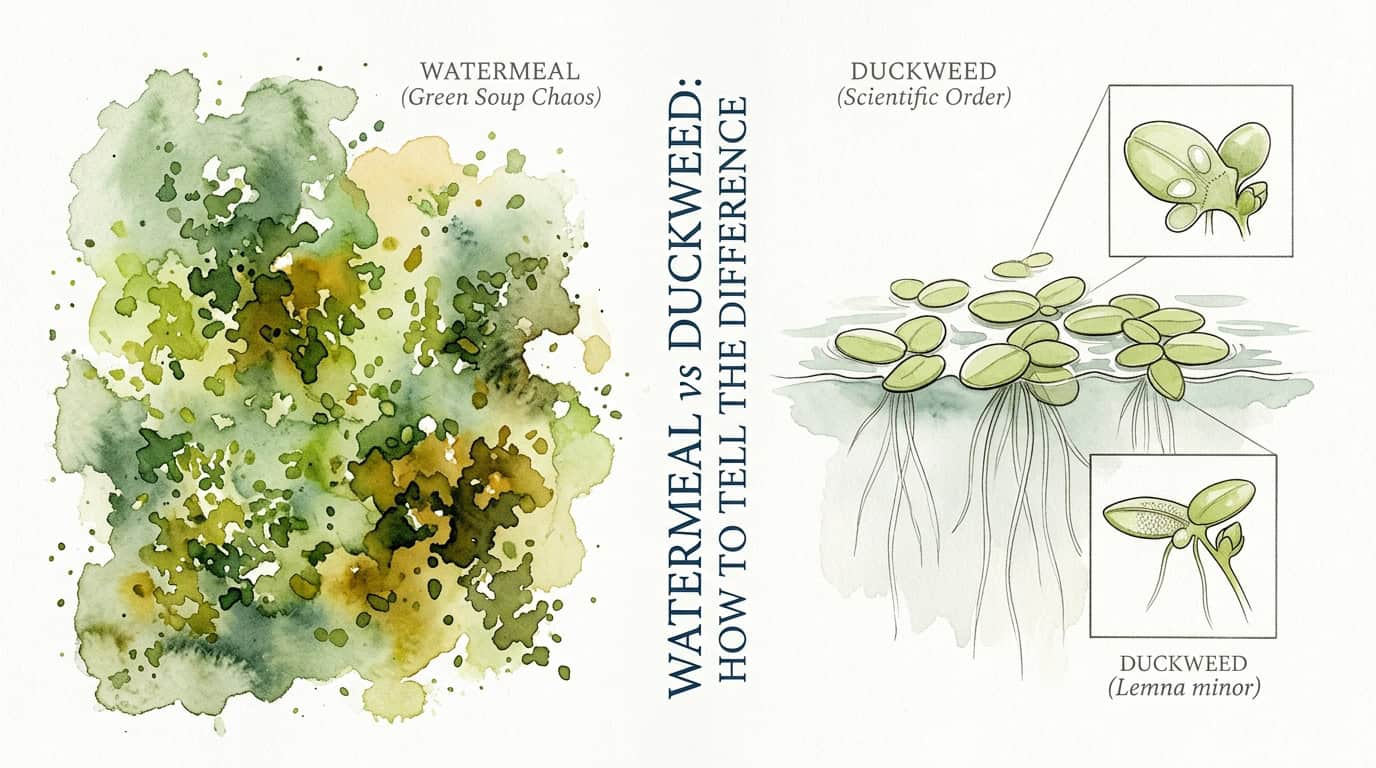
They look identical from the bank, but the treatment for each is completely different. If it feels like sand between your fingers, you’re dealing with Watermeal—the world’s smallest flowering plant. If it has a root, it’s Duckweed. Mistake one for the other, and your management strategy will fail.
Proper management of a pond surface requires moving away from the conceptual “green soup chaos” and toward a rigorous scientific order. Achieving control over floating aquatic vegetation (FAV) necessitates a precise understanding of the morphological and physiological differences between the genera Wolffia (Watermeal) and Lemna (Duckweed). Failure to differentiate these organisms often leads to the misapplication of herbicides, resulting in wasted capital and the potential for increased chemical resistance in the aquatic environment.
This technical analysis explores the biological distinctions, chemical control efficiencies, and mechanical management protocols required to maintain a balanced aquatic ecosystem.
Watermeal vs Duckweed: How To Tell The Difference
Effective identification is the primary bottleneck in aquatic vegetation control. While both plants appear as a green carpet on the surface, their structural engineering is fundamentally different.

Watermeal (Wolffia spp.) is the world’s smallest flowering plant, with individual fronds measuring between 0.2 and 1.5 millimeters. In technical terms, it is a rootless, globular body that lacks the complex vascular tissue found in larger aquatic macrophytes. When handled, it maintains a distinct, granular texture similar to cornmeal or coarse sand. This lack of a root system means the plant absorbs nutrients directly through its underside from the water column, a factor that complicates systemic herbicide uptake.
Duckweed (Lemna minor and Spirodela polyrhiza) is significantly larger, typically ranging from 2 to 6 millimeters in diameter, roughly the size of a pencil eraser. Morphologically, Duckweed is more complex; it possesses a distinct frond and at least one hair-like root (rhizoid) that hangs below the surface. This root system, while not anchored to the soil, provides a larger surface area for nutrient absorption and acts as a conduit for systemic chemical treatments.
The ecological niche for both plants is stagnant or slow-moving freshwater with high nutrient loading, specifically nitrogen (N) and phosphorus (P). These plants often coexist, but Watermeal is generally more aggressive in nutrient-dense environments, often outcompeting Duckweed in the late summer months as water temperatures peak and flow rates decrease.
Biological Mechanisms: Growth and Reproduction
The reproductive efficiency of Lemnaceae is among the highest in the plant kingdom. Understanding these mechanics is essential for timing intervention strategies.
Asexual reproduction, known as budding, is the primary driver of population growth. Daughter fronds develop from pockets within the mother frond and are eventually released as independent units. In optimal conditions—water temperatures between 65°F and 80°F with high phosphorus concentrations—populations can double in biomass every 48 to 72 hours. This exponential growth rate means that a negligible 5% surface coverage can transition to 100% coverage in less than three weeks if left unmanaged.
Overwintering is achieved through the production of turions. Turions are specialized, starch-heavy buds that are denser than water. As autumn temperatures drop, the plant shifts its metabolic focus from vegetative growth to turion synthesis. These buds sink to the benthos (pond bottom), where they remain dormant in the sediment. When temperatures rise in the spring, the starch is metabolized into gas, providing the buoyancy required for the turions to float to the surface and initiate the next growth cycle. This “seed bank” in the muck makes single-season eradication nearly impossible without long-term sediment management.

Chemical Management: Contact vs. Systemic Protocols
Chemical intervention must be calibrated to the specific genus present. Applying the wrong mode of action often results in “top-kill” without total eradication, leading to rapid regrowth.
Systemic Herbicides: Fluridone
Fluridone is the gold standard for Watermeal control but requires extreme precision. It is a carotenoid synthesis inhibitor that prevents the plant from protecting its chlorophyll from sunlight. Without this protection, the plant essentially bleaches and dies.
The technical challenge with Fluridone is the required exposure time. To be effective against Watermeal, concentrations must be maintained at 10 to 30 parts per billion (ppb) for a minimum of 45 to 90 days. Because Watermeal lacks a root system, it must absorb the chemical slowly through its frond. If the pond has high outflow or if significant rainfall dilutes the concentration, the treatment will fail. Fluridone is best applied in early spring when growth is just beginning, allowing the chemical to work before the biomass becomes too dense to penetrate.
Contact Herbicides: Diquat and Flumioxazin
Diquat and Flumioxazin (often sold under trade names like Reward or Clipper) are fast-acting contact herbicides. They work by disrupting cell membranes upon contact. Diquat is generally effective against Duckweed, providing “burn down” within 48 hours. However, Watermeal is notably resistant to Diquat because its small, rounded shape and waxy surface limit the herbicide’s ability to adhere and penetrate.
Flumioxazin is more effective for mixed populations. It is a PPO inhibitor that works quickly in high-light conditions. When treating Watermeal with contact herbicides, a non-ionic surfactant is mandatory. The surfactant breaks the surface tension of the water, allowing the chemical to coat the granular fronds rather than bead off. Even with high-quality surfactants, contact treatments often require multiple applications at 10-to-14-day intervals to address plants that were shielded by the surface mat during the initial spray.
Ecological Benefits and Nutrient Sequestration
While often viewed as a nuisance, these plants serve as highly efficient bioremediation tools when managed correctly. Their ability to sequester nutrients from the water column is statistically significant.
Studies indicate that Lemna minor can remove up to 140 mg of Nitrogen per square meter per day and approximately 3.47 mg of Phosphorus per square meter per day. This makes them valuable for wastewater treatment or agricultural runoff ponds. The protein content of harvested Duckweed can reach 40% of its dry weight, making it a viable alternative for animal feed or aquaculture.
The challenge lies in the “tipping point” of the ecosystem. At low densities, these plants provide cover for fry and food for waterfowl. At high densities, they block 99% of sunlight, halting photosynthesis in submerged plants and phytoplankton. This leads to a collapse in dissolved oxygen (DO) levels, resulting in hypoxic conditions and subsequent fish kills. Managing these plants is less about total eradication and more about maintaining a density that optimizes nutrient removal without compromising oxygen exchange.
Challenges and Resistance Mechanisms
Resistance is an emerging threat in the aquatic management industry. Repeated use of the same chemical class can select for biotypes that are physiologically immune to standard dosing.
One specific concern is Diquat-resistant Duckweed (Landoltia punctata). In certain regions, populations have developed the ability to sequester the herbicide before it can disrupt the photosynthetic pathway. This resistance often develops in ponds that receive frequent, low-dose “maintenance” sprays rather than a full, lethal dose.
Another challenge is the “shading effect.” In a mature infestation, the floating mat can be several inches thick. A surface application of herbicide will only kill the top layer. The bottom layers remain protected and immediately begin to utilize the nutrients released by the decaying plants above them. This creates a cycle of decay and regrowth that is difficult to break without mechanical intervention.
Limitations: When Treatments Fail
Environmental variables frequently dictate the success of a management plan. No chemical or mechanical strategy is a universal solution.
High-flow systems, such as ponds with active springs or those located on a main drainage line, are poor candidates for systemic herbicides like Fluridone. The chemical will be flushed out long before it achieves the 45-day minimum exposure threshold. In these environments, mechanical harvesting or frequent contact treatments are the only viable options.
Water chemistry also plays a role. Highly turbid water with suspended clay particles can deactivate Diquat almost instantly, as the chemical molecules bind to the clay and become biologically unavailable. Similarly, extremely high pH levels (above 8.5) can cause Flumioxazin to break down rapidly through hydrolysis, reducing its efficacy by 50% or more within hours of application.
Technical Comparison: Wolffia vs. Lemna
| Metric | Watermeal (Wolffia) | Duckweed (Lemna) |
|---|---|---|
| Average Size | 0.2 – 1.5 mm | 2.0 – 6.0 mm |
| Root System | Absent | Single or multiple rhizoids |
| Texture | Gritty / Sand-like | Smooth / Leaf-like |
| Primary Chemical | Fluridone / Flumioxazin | Diquat / Penoxsulam |
| Resistance Level | High (to Diquat) | Moderate |
| Growth Rate | Doubles in 48-72 hours | Doubles in 48-96 hours |
Practical Tips and Best Practices
Implementation of a successful control program requires a multi-faceted approach. Data-driven decisions always yield better results than reactive spraying.
- Mechanical Pre-Treatment: If coverage is greater than 50%, use a skimming net or mechanical harvester to remove as much biomass as possible before applying chemicals. This reduces the nutrient load and prevents oxygen depletion caused by massive plant decay.
- Aeration Management: These plants thrive in stagnant water. Installing a surface aerator or a diffused air system creates surface turbulence. Watermeal, in particular, struggles to maintain a dominant mat in moving water. Surface agitation also increases dissolved oxygen, helping to buffer against the impact of decaying vegetation.
- Nutrient Remediation: Treat the cause, not just the symptom. Using lanthanum-modified clay or alum to bind reactive phosphorus in the sediment can starve the floating plants of their primary fuel source. Maintaining a phosphorus level below 30 ppb significantly slows the growth rate of both genera.
- Surfactant Selection: For contact herbicides, use a methylated seed oil (MSO) or a non-ionic surfactant. These additives are critical for penetrating the waxy cuticle of the frond.
Advanced Considerations: Scaling and Long-Term Stability
Large-scale aquatic systems require a shift from “spot-treating” to “systemic management.” For lakes larger than five acres, the cost of Fluridone can be prohibitive. In these cases, aquatic managers often utilize “bump treatments.” This involves an initial application followed by smaller supplemental doses every three weeks to maintain the concentration at a specific ppb threshold.
Professional-grade monitoring equipment, such as a spectrophotometer, can be used to test water samples for herbicide concentration during the treatment window. This ensures the chemical levels remain within the “effective zone” (15-20 ppb for Watermeal) without overspending on excess product.
Thermal stratification also affects chemical distribution. In the summer, a pond may have a warm upper layer (epilimnion) and a cold bottom layer (hypolimnion). Herbicides applied to the surface may not mix into the deeper water, leading to uneven concentrations. Understanding the thermocline depth is essential for calculating the total volume of water to be treated.
Scenario Analysis: A 1-Acre Pond Management Plan
Consider a 1-acre pond with an average depth of 4 feet, resulting in 4 acre-feet of water volume. The pond is 100% covered in a mix of Duckweed and Watermeal.
A technician identifies the Watermeal as the dominant species. Using the scientific order approach, the plan begins with a 25% mechanical harvest to create “breathing room” in the water column. Following the harvest, the technician applies Fluridone at a rate of 30 ppb. For 4 acre-feet, this requires approximately 5.4 ounces of active ingredient (depending on the product concentration).

Because the pond has a small overflow pipe, the technician installs a temporary block to prevent water loss for 30 days. After 45 days, the Watermeal begins to turn white (chlorosis). A follow-up spot treatment of Flumioxazin is applied to the remaining Duckweed clusters around the edges. By day 90, the surface is clear, and the technician initiates a phosphorus binding treatment to prevent the turions in the sediment from successfully re-establishing the population the following year.
Final Thoughts
Managing Watermeal and Duckweed is an exercise in precision biology and mechanical optimization. These organisms are not merely “weeds” but opportunistic colonizers that exploit high-nutrient, low-energy aquatic environments. Success in controlling them depends entirely on the accuracy of the initial identification and the consistency of the chemical or mechanical pressure applied.
Remember that the goal is not just a clear surface, but a stable water column. Aggressive chemical treatment without regard for oxygen levels can be more damaging than the plants themselves. By balancing nutrient reduction, mechanical removal, and targeted herbicide application, it is possible to transform a degraded pond back into a functional aquatic asset.
Experimentation with different aeration patterns and nutrient binders will deepen your understanding of your specific water body. Every pond is a unique chemical reactor; treat it with the scientific rigor it deserves.