

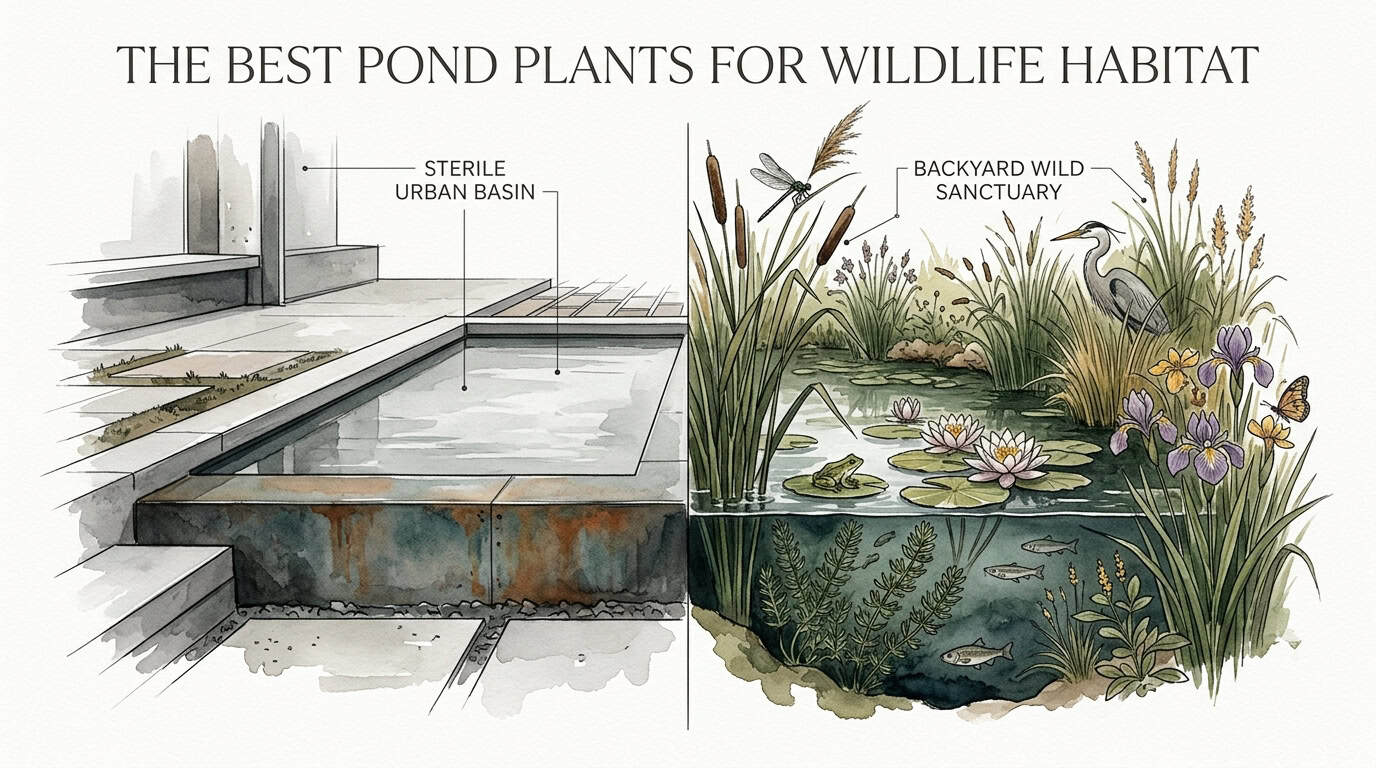
Your backyard pond can be more than a decoration; it can be an oasis. Habitat loss is the #1 threat to local wildlife. Choosing the right native pond plants allows you to turn a ‘water feature’ into a thriving ecosystem for birds, frogs, and pollinators. Here’s what to plant first.
The Best Pond Plants For Wildlife Habitat
Aquatic vegetation serves as the biological infrastructure of a pond ecosystem. Unlike ornamental non-natives, native pond plants have evolved specific physiological mechanisms to manage local nutrient cycles and provide specialized niche habitats for indigenous fauna [1.4.9]. These plants are categorized by their growth habit and position in the water column: submerged, emergent (marginal), and floating [1.4.1].
Submerged plants, often termed oxygenators, perform the critical function of increasing dissolved oxygen (DO) through underwater photosynthesis. Species such as Ceratophyllum demersum (Hornwort) are highly efficient at this process, often raising DO levels significantly while sequestering nitrogen and phosphorus directly from the water column [1.2.1, 1.2.5]. These plants provide dense cover for aquatic macroinvertebrates and amphibian larvae, which form the base of the pond’s food web [1.4.6].
Emergent or marginal plants grow in the shallow perimeter with their roots submerged and foliage extending above the surface. Sagittaria latifolia (Arrowhead) and Pontederia cordata (Pickerelweed) are primary examples that act as biological filters [1.4.4, 1.5.5]. These species stabilize shoreline sediments, prevent erosion, and provide essential perching sites for dragonflies and damselflies, which utilize the stems for molting and egg-laying [1.3.1].

Floating plants like Nymphaea odorata (Fragrant Water Lily) provide surface coverage that regulates water temperature. Maintaining 50-70% surface coverage is a standard metric for reducing thermal stress on aquatic life and inhibiting the growth of planktonic algae through light limitation [1.4.1, 1.4.8]. These plants offer resting platforms for amphibians and foraging surfaces for various pollinator species [1.4.5].
Top Native Species for Technical Performance
- Ceratophyllum demersum (Hornwort): A rootless submerged plant that excels in nutrient sequestration. It can increase dissolved oxygen by up to 150% in controlled environments and reduces Chemical Oxygen Demand (COD) [1.2.5, 1.5.9].
- Pontederia cordata (Pickerelweed): An emergent species capable of removing heavy metals such as cadmium and lead from the water. Its dense root systems also facilitate the removal of organic compounds like phenols [1.5.5, 1.5.7].
- Sagittaria latifolia (Arrowhead): Highly effective at absorbing excess nitrogen and phosphorus. It produces edible tubers that serve as a high-energy food source for waterfowl [1.4.4, 1.4.8].
- Typha latifolia (Cattail): A powerful phytoremediator that can reduce Biochemical Oxygen Demand (BOD) by over 60% within 60 days. It should be managed in smaller ponds due to its aggressive growth rate [1.5.9].
How It Works: Bioremediation and Gas Exchange
The mechanical efficiency of a wildlife pond depends on the interaction between plant physiology and microbial activity. Aquatic plants facilitate a process known as phytoremediation, where they absorb, sequester, or detoxify pollutants [1.5.2, 1.5.9]. This system operates through several interconnected mechanical cycles.
The Nitrogen Cycle and Nutrient Uptake
Nitrogen and phosphorus enter the pond via runoff, atmospheric deposition, and organic decomposition [1.1.4]. High concentrations of these nutrients can lead to eutrophication, characterized by oxygen-depleting algal blooms. Native plants compete with algae for these resources, utilizing nitrogen (primarily in the form of ammonium or nitrate) to build biomass [1.1.8, 1.1.9]. Some species can achieve a 14% daily dry weight increase under optimal nutrient loading [1.1.9].
Dissolved Oxygen (DO) Dynamics
Submerged macrophytes release oxygen directly into the water as a byproduct of photosynthesis. This oxygen is vital for fish, invertebrates, and aerobic bacteria that decompose organic matter [1.2.1, 1.2.9]. During daylight hours, oxygen levels peak as photosynthesis outpaces respiration. Monitoring DO levels reveals that healthy planted systems maintain a stable aerobic environment, preventing the anaerobic conditions that cause the release of hydrogen sulfide and other foul-smelling gasses [1.2.6, 1.4.1].
The Rhizosphere Effect
Roots of emergent plants create a micro-environment known as the rhizosphere. In this zone, plants transport oxygen from the foliage down to the roots, supporting specialized colonies of aerobic bacteria in an otherwise anaerobic substrate [1.1.5, 1.5.5]. These microbes are responsible for nitrification, breaking down toxic ammonia into nitrites and subsequently into relatively harmless nitrates that the plants then absorb [1.1.1].
Benefits of Native Plant Systems
Implementing a native plant-based habitat provides measurable ecological and maintenance advantages over mechanical systems. These benefits are quantified through increased biodiversity metrics and reduced energy requirements for water filtration [1.3.1, 1.4.5].

Energy Efficiency: A properly balanced pond uses biological filtration to maintain water clarity, reducing or eliminating the need for high-wattage pumps and UV clarifiers. This transition lowers the operational cost and carbon footprint of the water feature [1.4.1].
Habitat Complexity: Native plants provide a multi-layered structural environment. This structural diversity is a primary driver for species richness. Studies indicate that intermediate-sized ponds with diverse vegetation harbor the highest densities of amphibian larvae and aquatic invertebrates [1.3.6].
Thermal Regulation: Floating leaves and shoreline shading prevent rapid fluctuations in water temperature. Stable temperatures are critical for the metabolic processes of cold-blooded organisms and the solubility of dissolved oxygen [1.2.3, 1.4.2].
Challenges and Common Pitfalls
Maintenance of a wildlife pond requires managing the natural process of eutrophication. Eutrophication is the gradual enrichment of the water with nutrients, leading to increased biomass and eventual pond infilling [1.1.4]. Failing to manage this process can result in a “dead” pond with low oxygen and high silt levels.
Nutrient Overloading: Excessive runoff from fertilized lawns or the introduction of high-protein fish food can overwhelm the plants’ sequestration capacity. This imbalance leads to rapid algal proliferation and a subsequent crash in dissolved oxygen levels as the algae decompose [1.1.2, 1.1.4].
Species Selection Errors: Introducing non-native or invasive species can lead to a monoculture that provides poor habitat value. Invasive plants often outcompete natives but fail to support the local insect and larval populations that depend on specific host plants [1.1.3, 1.5.6].
Incorrect Planting Depth: Each plant category has a specific “hydrologic zone” or inundation tolerance. Planting emergent species too deep (over 12 inches for most) can lead to root rot and plant failure, while submerged plants require sufficient light penetration to survive at greater depths [1.4.7].
Limitations of Plant-Based Habitats
Biological systems have operational boundaries that must be respected for successful habitat creation. These limitations are often related to scale and external nutrient inputs.
Scale Constraints: Small, shallow ponds (less than 2 feet deep) are subject to rapid temperature swings and high evaporation rates. These factors can concentrate salts and nutrients, making it difficult for some sensitive native species to thrive without supplemental water [1.4.2].
Seasonal Cycling: In temperate climates, plant metabolic rates drop during winter. As plants die back, they release stored nutrients back into the water [1.1.1, 1.1.4]. This “nutrient pulse” can cause winter or early spring algal blooms if not managed through the removal of dead organic material in the autumn.
Light Requirements: Most high-performance aquatic plants require a minimum of 4-6 hours of direct sunlight for effective photosynthesis [1.4.2, 1.4.6]. Ponds located in deep shade will have lower dissolved oxygen production and slower nutrient uptake rates, potentially requiring mechanical aeration to support fish populations.
Sterile Urban Basin vs Backyard Wild Sanctuary
Comparing a traditional ornamental basin to a native wildlife sanctuary reveals significant differences in ecological output and maintenance requirements. The following table highlights the technical variations between these two approaches.
| Feature | Sterile Urban Basin | Backyard Wild Sanctuary |
|---|---|---|
| Primary Filtration | Mechanical/Chemical (UV, Sand) | Biological (Native Macrophytes) |
| Nutrient Management | Regular Algaecide/Water Changes | Phytoremediation & Sequestration |
| Wildlife Support | Low (High predacious fish load) | High (Insects, Amphibians, Birds) |
| Dissolved Oxygen | Provided by Pumps/Fountains | Provided by Submerged Photosynthesis |
| Operational Cost | High (Electricity/Chemicals) | Low (Self-sustaining biomass) |
Practical Tips for Implementation
Designing a functional wildlife pond involves more than simply placing plants in water. Success is contingent upon proper placement and substrate selection.
Substrate Selection: Avoid using standard potting soil or sandy soil, as nutrients will leach out and fuel algal blooms. Use a heavy clay loam or specialized aquatic compost. Capping the substrate with a layer of pea gravel prevents fish from disturbing the root systems and keeps the water clear [1.1.8, 1.4.3].
Planting Containers: Utilize aquatic planting baskets with mesh sides. These allow for gas exchange and nutrient absorption through the root mass while containing the spread of aggressive species like cattails or certain rushes [1.4.3].
Zonal Distribution: Organize the pond into three zones. Zone 1 (0-6 inches) is for marginals like Pickerelweed. Zone 2 (6-18 inches) is for deep-water emergents like Arrowhead and Water Lilies. Zone 3 (18+ inches) is reserved for submerged oxygenators like Hornwort [1.4.7].
Patience with Establishment: Native plants may take a full growing season to establish their root systems. During this phase, avoid using chemical fertilizers, which can shock the local microbiology. If supplemental nutrients are required, use slow-release aquatic fertilizer tabs pushed deep into the root zone [1.1.8].
Advanced Considerations: Phytoremediation Kinetics
For serious practitioners, optimizing a pond for specific water quality targets involves understanding the kinetics of nutrient removal. The rate of nitrogen uptake is influenced by the concentration of the nutrient and the total surface area of the submerged foliage [1.1.9, 1.2.7].
Biomass Harvesting: In a closed system, plants eventually reach a saturation point where they can no longer store additional nutrients. Periodically harvesting a portion of the plant biomass (thining out the excess) physically removes the stored nitrogen and phosphorus from the system, effectively “resetting” the biological filter [1.1.7].
Synergistic Microbial Associations: Certain plants, such as Pontederia cordata, facilitate specialized microbial communities that can break down complex organic pollutants like pesticides. Increasing the diversity of emergent species ensures a broader range of microbial partners, enhancing the overall bioremediation capacity of the pond [1.5.5, 1.5.9].

Example: A 500-Gallon Wildlife Habitat Setup
A standard 500-gallon pond (approximately 8ft x 6ft x 2ft) requires a specific plant load to achieve biological balance. This setup serves as a baseline for scaling up to larger features.
Zone 1 (Perimeter): 10-12 1-gallon pots of Pontederia cordata and Iris virginica. These provide the primary shoreline stabilization and pollinator attraction [1.4.6].
Zone 2 (Deep Marginals): 3-5 2-gallon pots of Sagittaria latifolia. These act as the heavy-duty nutrient filters, processing runoff before it reaches the deep center [1.4.4].
Zone 3 (Submerged): 10-15 “bunches” of Ceratophyllum demersum weighted at the bottom. These ensure DO levels remain above 5 mg/L, the threshold required for most aquatic animal life [1.2.5, 1.2.9].
Surface Coverage: 2-3 Nymphaea odorata plants to cover approximately 60% of the surface area. This configuration minimizes the risk of eutrophication and maintains a stable thermal gradient [1.4.1].
Final Thoughts
Creating a wildlife habitat through native pond plants is an exercise in applied ecology. By replacing mechanical filtration with biological systems, you foster a self-regulating environment that supports a high degree of biodiversity. The technical success of these ponds depends on selecting the right species for their specific roles in the nitrogen and oxygen cycles [1.1.4, 1.4.5].
Managing the pond as a dynamic system rather than a static ornament allows for the natural processes of bioremediation to flourish. Regular monitoring of water clarity and plant health will provide the feedback needed to make adjustments. Over time, the pond will transition into a resilient sanctuary that requires minimal intervention [1.4.1, 1.5.9].
Experimenting with different native combinations can further deepen your understanding of local wetland dynamics. As these plants establish, they provide the necessary infrastructure for a complex web of life to return to your landscape, effectively mitigating the impacts of habitat loss one backyard at a time.