

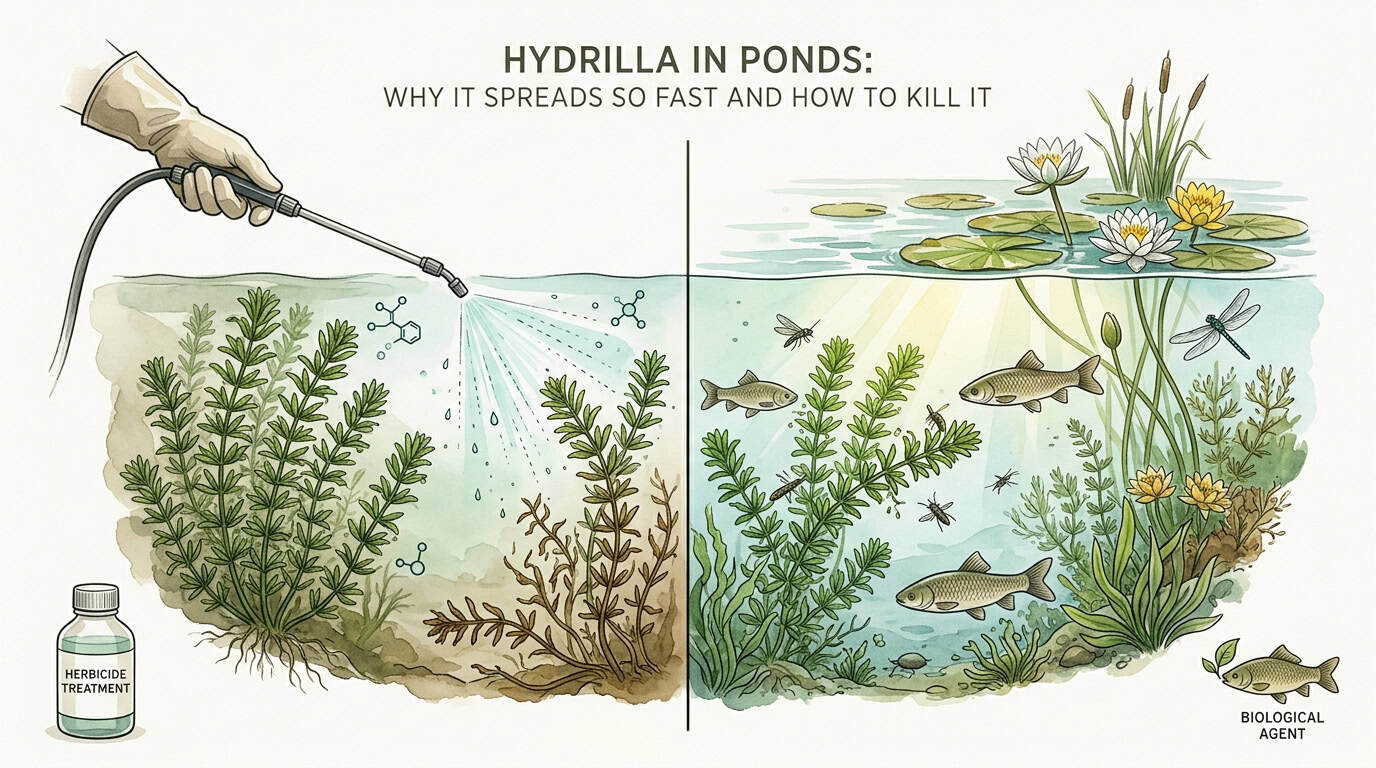
Are you a customer of the chemical industry, or the manager of a biological system? Hydrilla grows an inch a day and survives on almost no light. If you just spray it, it comes back from the tubers. You need a production-minded strategy to end the cycle. Managing a pond infested with Hydrilla verticillata requires more than a reactive purchase of herbicides. It demands an understanding of the mechanical and biological levers that drive this plant’s exponential growth.
Reactive management treats the pond as a series of isolated problems. A manager acting as a biological producer treats the pond as a complex system of energy and nutrient flows. This article examines the technical specifications of Hydrilla and provides a data-driven framework for long-term eradication.
Hydrilla In Ponds: Why It Spreads So Fast And How To Kill It
Hydrilla is a submersed, rooted aquatic plant often described as the “perfect weed” due to its multiple reproductive pathways. It can survive in oligotrophic to eutrophic water conditions and thrives in a wide range of pH levels, typically favoring a pH near 7.0. The plant is structurally optimized for rapid biomass production, capable of doubling its total weight every two weeks under optimal summer conditions.
Growth rates of one inch per day allow the plant to reach the surface quickly. Once it reaches the air-water interface, it branches profusely to create thick, intertwined mats. These mats intercept nearly 100% of incoming solar radiation, effectively shading out native vegetation and creating a monoculture. A single acre of heavily infested water can contain over 10 tons of wet plant biomass.

Eradication is difficult because of the subterranean tubers. These small, potato-like structures form at the ends of rhizomes and can stay dormant in the sediment for up to 10 years. Traditional contact herbicides may kill the visible green tissue, but they do nothing to neutralize the tuber bank. True control requires a strategy that prevents new tuber formation while exhausting the existing supply over several seasons.
The Biological Mechanics of Spread
Fragmentation is the primary method of lateral spread. A single stem fragment containing as few as two leaf whorls can settle in a new area and establish a colony. Boat propellers, water currents, and wildlife are common vectors for these fragments.
Tubers and turions facilitate chronological spread. Turions are axillary buds that detach and overwinter on the sediment surface. Tubers are produced within the hydrosoil and are significantly more resilient. Data shows that a single monoecious Hydrilla plant can produce over 6,000 tubers per square meter of sediment. These structures are the biological “savings account” that funds the next year’s invasion.
The Mechanics of Hydrilla Control: How to Do It
Achieving successful control requires a multi-year commitment to disrupting the plant’s life cycle. Managers must select tools based on the specific biotype present and the physical characteristics of the water body.
Step 1: Identification and Biotype Verification
Two distinct biotypes exist in the United States: dioecious and monoecious. Dioecious Hydrilla (only female flowers) is common in southern latitudes and behaves as a perennial. Monoecious Hydrilla (both male and female flowers on one plant) is common in northern latitudes and behaves more like an annual, dying back in winter and reappearing from tubers in spring. Identifying the biotype is critical for timing herbicide applications.
Step 2: Assessing the Tuber Bank
Soil sampling provides an estimate of the infestation’s severity. Core samples of the sediment reveal the density of tubers per square meter. This data serves as a baseline for measuring the success of the management program over time. Eradication is only achieved when the tuber count reaches zero.

Step 3: Selecting Control Agents
Systemic herbicides are the gold standard for large-scale management. Fluridone is the most common choice. It works by inhibiting carotenoid synthesis. Without carotenoids, the plant’s chlorophyll is destroyed by sunlight, leading to starvation. This process is slow, often requiring 60 to 90 days of “concentration exposure time” (CET).
Contact herbicides like Endothall or Diquat are used for rapid biomass reduction. These are effective for clearing boating lanes or preparing a pond for biological controls, but they do not provide long-term suppression. Combining contact and systemic treatments can sometimes improve efficacy in high-flow areas.
Benefits of a Systemic Management Approach
Shifting from a “Chemical Consumer” mindset to a “Biological Producer” mindset yields measurable improvements in pond health and budget efficiency. Systemic management focuses on the root cause rather than the symptoms.
Long-term cost reduction is the most significant advantage. While a systemic herbicide treatment may have a higher initial price point, it reduces the frequency of applications over a five-year period. Reactive “spot spraying” often costs more in labor and material over time because the plant returns every season.
Ecosystem stability is another critical benefit. Rapidly killing 10 tons of biomass with contact herbicides causes a massive drop in dissolved oxygen as the plant material decomposes. This often leads to fish kills. Systemic treatments kill the plant slowly, allowing the ecosystem to adjust and preventing dangerous oxygen sag.
Nutrient management is also improved. Dense Hydrilla mats trap nutrients and prevent vertical mixing. Removing the Hydrilla through a controlled process allows for better nutrient cycling and can prevent secondary issues like toxic cyanobacteria blooms.
Challenges and Common Mistakes
Inconsistent herbicide concentrations are the most frequent cause of failure. Fluridone requires a consistent parts-per-billion (ppb) level to be maintained for months. Water exchange from heavy rains or leaking dams can dilute the chemical, allowing the Hydrilla to recover. Monitoring concentration levels via laboratory analysis is the only way to ensure success.
Ignoring the tuber bank is a strategic error. Many pond owners stop treatment as soon as the water looks clear. However, if the tubers remain, the plant will reappear within 12 months. Treatment must continue for several years until the sediment is exhausted of viable reproductive structures.
Improper timing of application can waste resources. For monoecious Hydrilla, treatment should begin in early spring when the first tubers sprout. For dioecious Hydrilla, fall treatments can be effective because the plant is actively translocating nutrients (and herbicides) to its roots to prepare for winter.
Limitations and Environmental Constraints
Water exchange rates limit the use of certain systemic herbicides. In ponds with high turnover—such as those fed by large streams or springs—maintaining a static concentration of fluridone is nearly impossible. In these scenarios, granular formulations or frequent “bump” treatments are required, which increases complexity and cost.
Non-target impacts are a reality of broad-spectrum herbicides. Fluridone can affect other submerged plants like lilies or native pondweeds. Managers must weigh the benefits of Hydrilla removal against the temporary loss of native biodiversity. Using low-dose “pulse” treatments can sometimes increase selectivity, sparing more resilient native species.
Permitting and regulatory restrictions vary by state. Many states require specific licenses for applying aquatic herbicides, especially near potable water intakes or in public waters. Always verify local regulations before initiating a treatment plan.
Comparing Management Strategies
Choosing the right strategy depends on the desired outcome and the physical constraints of the pond. The following table compares the two primary philosophies of pond management.
| Factor | Chemical Consumer (Reactive) | Biological Producer (Systemic) |
|---|---|---|
| Primary Tool | Contact Herbicides (Diquat/Endothall) | Systemic Herbicides + Biological Controls |
| Speed of Results | Fast (3–7 days) | Slow (60–90 days) |
| Impact on Tubers | None | High (prevents new production) |
| Labor Intensity | High (frequent re-application) | Medium (monitoring and precision) |
| Long-term Cost | Variable (often higher) | Predictable (lower over 5 years) |
Practical Tips for Effective Eradication
Monitoring water chemistry is vital during the treatment process. High pH levels (above 8.5) can sometimes interfere with the efficacy of certain herbicides. Test the water before and during application to ensure the environment supports the chemical’s mechanism of action.
Utilizing biological controls can provide a “safety net.” Triploid grass carp are sterile, herbivorous fish that find Hydrilla highly palatable. Stocking them at a rate of 5 to 15 fish per acre (depending on infestation density) can provide years of constant grazing pressure. This is especially effective at consuming the small sprouts that emerge from dormant tubers between herbicide cycles.
Installation of fish barriers is mandatory when using grass carp. These fish will follow the flow of water and can easily escape during heavy rain events. Grated barriers on spillways and overflow pipes must have gaps no larger than two inches to retain the fish while allowing water to pass.
Advanced Considerations for Serious Practitioners
Concentration Exposure Time (CET) is the most important metric in aquatic herbicide science. For fluridone, the target is usually 5 to 20 ppb for a minimum of 60 days. Professional managers use “FasTEST” or similar immunoassay services to check these levels every two weeks. If the concentration drops below the threshold, a “bump” application is performed to restore the level.
Genetic resistance is an emerging concern in certain regions, particularly Florida. Some Hydrilla populations have developed a reduced sensitivity to fluridone. If a standard treatment fails despite proper CET maintenance, genetic testing of the plant tissue may be necessary to identify resistant strains. In these cases, alternative systemic herbicides like Penoxsulam or Florpyrauxifen-benzyl should be used.
Sediment composition influences tuber longevity. Organic, silty bottom sediments tend to preserve tubers longer than sandy or clay bottoms. Understanding the “hydro-soil” interface helps in predicting how many years of treatment will be required.
Eradication Scenario: The 5-Year Plan
A typical 1-acre pond with 60% Hydrilla coverage and a history of reactive spraying requires a structured transition to systemic management.

Year 1: Biomass Reduction and Systemic Start. In early spring, apply a contact herbicide to knock back the standing biomass. This reduces the nutrient load and clears the water column. Follow this immediately with a fluridone treatment, maintaining 10-15 ppb for 90 days. Stock 10 triploid grass carp (10-12 inches in length) to begin grazing.
Year 2: Tuber Exhaustion. Monitor for regrowth in April. If sprouts appear, repeat the systemic treatment at a lower dose (5-10 ppb). The grass carp will now be large enough to handle most of the new growth. Perform a tuber count in the fall to measure progress.
Year 3-4: Maintenance and Grazing. By the third year, the visible Hydrilla should be gone. The grass carp remain the primary control, eating any remaining sprouts from the dormant tuber bank. No herbicide should be needed if the carp are healthy and the barriers are intact.
Year 5: Final Evaluation. Conduct a final sediment core survey. If no tubers are found, the system is considered eradicated. Native plants may now be introduced to fill the ecological niche and prevent a new invasion.
Final Thoughts
Hydrilla is not a problem that can be solved with a single spray. It is a biological system that must be out-engineered. Successful managers move beyond the “Chemical Consumer” model and adopt the role of a “Biological Producer,” focusing on long-term efficiency and systemic health.
The key to victory lies in the soil. Until the subterranean tuber bank is exhausted, the threat remains. Using a combination of systemic herbicides, precise monitoring, and biological controls like triploid grass carp creates a multi-layered defense that Hydrilla cannot overcome.
Applying these principles allows you to reclaim your pond and restore its ecological balance. Start with a clear assessment of your tuber density and commit to a multi-year strategy. The transition from reactive to proactive management is the only path to permanent eradication.