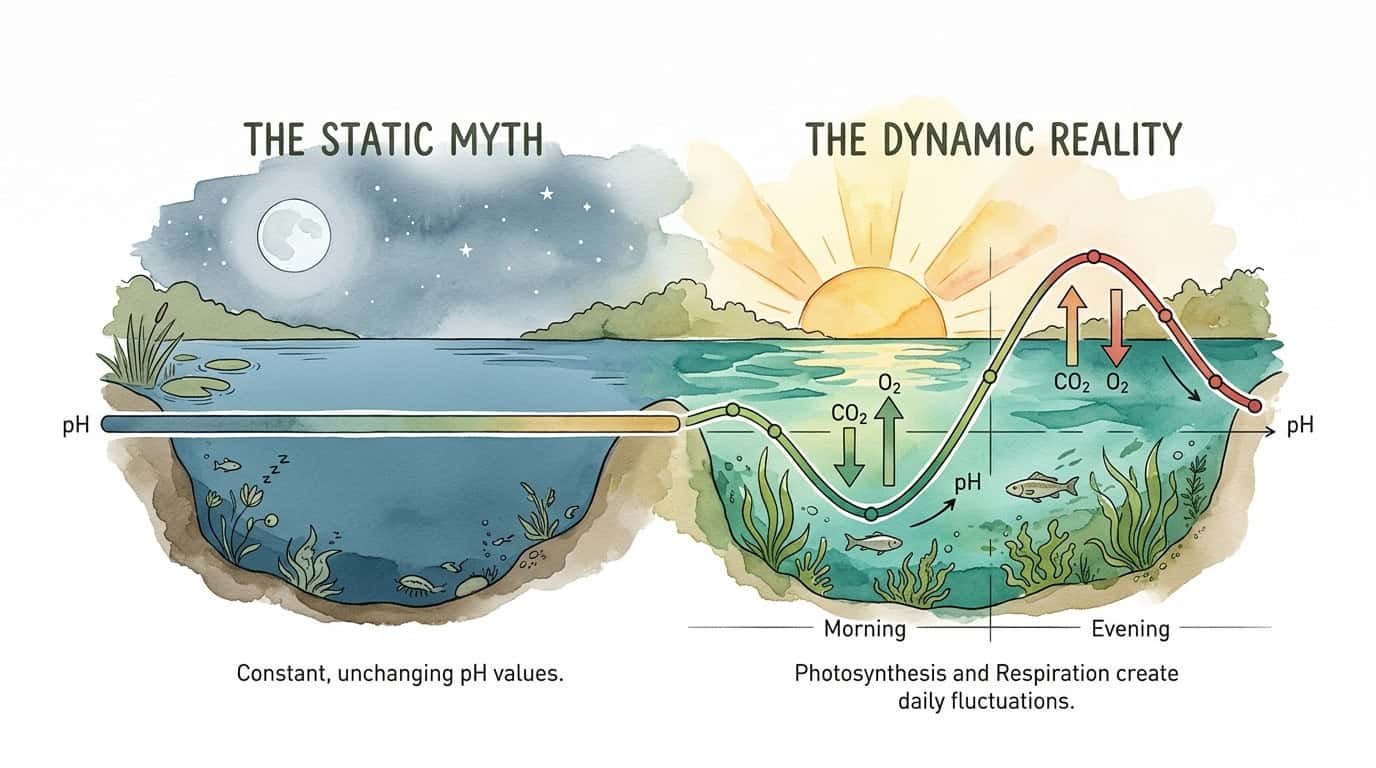
Pond pH changes between morning and evening due to the diurnal cycle of photosynthesis and respiration. During daylight, aquatic plants and algae consume dissolved carbon dioxide (CO2) for photosynthesis, which reduces the concentration of carbonic acid and raises the pH. At night, photosynthesis ceases but respiration continues, releasing CO2 back into the water, which forms carbonic acid and lowers the pH.
If you only test your pond pH at noon, you’re missing half the story. Pond chemistry is a living, breathing cycle. Learn why pH swings from dawn to dusk and what it tells you about your algae levels.
Aquatic environments are characterized by dynamic equilibrium. Monitoring chemical parameters at a single point in time provides a static data point that fails to capture the underlying metabolic activity of the ecosystem. Understanding the magnitude of these diurnal fluctuations is critical for managing fish health and biological filtration efficiency.
Why Pond pH Changes Between Morning and Evening
The primary driver of diurnal pH fluctuation is the net flux of dissolved inorganic carbon. In a functional pond ecosystem, the biological components—fish, plants, algae, and bacteria—constantly exchange gases with the water column. The concentration of these gases, specifically carbon dioxide, dictates the acidity or alkalinity of the environment through the carbonate-bicarbonate buffer system.
Pond water usually reaches its lowest pH value just before sunrise (dawn) and its highest value in the late afternoon (dusk). This phenomenon occurs because the rate of carbon dioxide removal during the day exceeds the rate of production, while the reverse is true at night. In systems with high primary productivity, such as those with significant algae blooms, the pH can swing from a neutral 7.0 at dawn to a highly alkaline 9.5 or 10.0 by sunset.
This cycle is not merely a chemical curiosity; it indicates the trophic state of the pond. A stable pH with minimal fluctuation suggests a well-balanced system with moderate biological load or high buffering capacity. Conversely, wide swings indicate excessive biomass or a lack of chemical stability, both of which pose physiological risks to aquatic life.
The Carbonic Acid Equilibrium Mechanism
The chemical relationship between carbon dioxide and water is the fundamental mechanism behind pH shifts. When CO2 dissolves in water, a small fraction reacts to form carbonic acid (H2CO3). This weak acid then dissociates into hydrogen ions (H+) and bicarbonate ions (HCO3-).
The concentration of hydrogen ions determines the pH level. During the day, intense solar radiation fuels photosynthesis in phytoplankton and submerged macrophytes. These organisms sequester dissolved CO2 to synthesize glucose. This removal of CO2 “pulls” the chemical reaction to the left, consuming hydrogen ions in the process. As the concentration of H+ ions decreases, the pH rises.
At night, the absence of light terminates the photosynthetic process. However, every living organism in the pond, including the plants and algae themselves, continues to respire. Respiration releases CO2 into the water, which “pushes” the reaction to the right, increasing the concentration of hydrogen ions and lowering the pH. This continuous back-and-forth movement is the heartbeat of pond chemistry.
The Role of Carbonate Hardness (KH)
Carbonate Hardness, or alkalinity, acts as the primary defense against extreme pH fluctuations. It represents the concentration of carbonate and bicarbonate ions available to neutralize acids. In technical terms, KH provides “buffering capacity.”
Water with high KH contains a large reservoir of bicarbonate ions that can absorb or release hydrogen ions as needed to maintain stability. When CO2 levels rise at night, the buffer reacts with the resulting carbonic acid to prevent a sharp drop in pH. In ponds with low KH (typically below 50 ppm or 3 dKH), the water lacks this resistance, leading to rapid and dangerous pH crashes or spikes.
Maintaining an adequate KH level is essential for the nitrifying bacteria in biological filters. These bacteria consume carbonates as they process ammonia into nitrate. If KH is depleted, the pH becomes unstable, and the biological filter may fail, leading to toxic ammonia accumulation.
Impact of Algae Biomass
The magnitude of the pH swing is directly proportional to the amount of photosynthetic biomass in the pond. Algae, particularly unicellular phytoplankton (green water) and filamentous “string” algae, are the most aggressive consumers of CO2.
In a pond with an active algae bloom, the massive surface area of the algal cells allows for rapid gas exchange. On a sunny day, these organisms can strip almost all dissolved CO2 from the water by early afternoon. This leads to a precipitous rise in pH. If the bloom is dense enough, the algae may even begin to use bicarbonate as a carbon source when CO2 is exhausted, further driving the pH upward.
High afternoon pH is often the first warning sign of an impending algae crash. When the algae population outstrips the available nutrients or oxygen, it can die off suddenly. The subsequent decomposition by bacteria releases massive amounts of CO2 and consumes dissolved oxygen, causing the pH to plummet and potentially suffocating the fish.
Ammonia Toxicity and pH Interaction
One of the most dangerous consequences of afternoon pH spikes is the alteration of ammonia toxicity. Total ammonia in a pond exists in two forms: ionized ammonium (NH4+) and un-ionized ammonia (NH3).
Un-ionized ammonia (NH3) is highly toxic to fish, while ammonium (NH4+) is relatively harmless. The ratio of these two forms is determined primarily by pH and temperature. As pH increases, the equilibrium shifts, and a larger percentage of total ammonia is converted into the toxic NH3 form.
A pond with a total ammonia reading of 1.0 ppm might be safe at a morning pH of 7.2. However, if the afternoon pH rises to 9.0, that same 1.0 ppm of ammonia becomes lethal. This “stealth” toxicity is a frequent cause of unexplained fish loss in ponds that appear clean but suffer from wide pH swings.
Management and Optimization Strategies
Stabilizing the diurnal pH cycle requires a combination of chemical buffering and biological management. The goal is to minimize the “swing” rather than chasing a specific, static number.
Increasing the KH is the most effective way to dampen pH fluctuations. Adding sodium bicarbonate (baking soda) or calcium carbonate (crushed coral or limestone) increases the buffering capacity. Aim for a KH level between 100 ppm and 200 ppm for most koi and goldfish ponds to ensure long-term stability.
Managing the algae population is equally important. Reducing nutrient inputs—specifically phosphates and nitrates—limits the growth of the biomass responsible for the CO2 flux. Utilizing ultraviolet (UV) clarifiers and increasing the density of higher plants can help compete with algae for resources, leading to a more regulated carbon cycle.
Common Challenges and Mistakes
A frequent error among pond owners is the use of “pH Down” chemicals in the afternoon. These products are typically strong acids that provide only a temporary fix. Because the high pH is driven by CO2 depletion, adding acid does not address the underlying cause and can lead to a “pH crash” at night when natural respiration adds even more acidity to the water.
Another common mistake is failing to test the source water. If tap water has very low KH, every water change effectively reduces the pond’s buffering capacity. Always test both the pond and the replacement water to ensure you are not inadvertently destabilizing the system during routine maintenance.
Over-aeration can also influence pH in unexpected ways. While aeration is vital for oxygenation, extremely vigorous surface agitation can “gas off” CO2 more quickly during the day, potentially contributing to higher daytime pH levels in poorly buffered systems. However, the benefits of oxygenation almost always outweigh this minor trade-off.
Limitations of pH Testing
Relying solely on liquid reagent tests or paper strips has inherent limitations. These methods are subject to human error in color interpretation and may lack the precision required to detect subtle shifts before they become problematic. Furthermore, they only provide a “snapshot” of a specific moment.
Environmental factors such as heavy rainfall can also skew results. Rain is naturally acidic (due to atmospheric CO2) and contains zero KH. A heavy downpour can dilute the pond’s buffer and cause an immediate drop in pH that is unrelated to the biological cycle. In these instances, the diurnal rhythm may be temporarily masked by external chemical inputs.
Comparative Analysis: Low KH vs. High KH Ponds
| Parameter | Low KH Pond ( | High KH Pond (> 120 ppm) |
|---|---|---|
| Morning pH (Dawn) | 6.0 – 6.5 | 7.4 – 7.6 |
| Evening pH (Dusk) | 9.5 – 10.5 | 8.0 – 8.4 |
| pH Swing Magnitude | Severe (3.0 – 4.0 units) | Minimal (0.4 – 0.8 units) |
| Fish Stress Level | High (Osmoregulatory strain) | Low (Stable environment) |
| Filter Efficiency | Unstable (Nitrification stalls) | Optimized (Consistent activity) |
Practical Testing Protocol
To accurately assess the health of a pond, a dual-test protocol is necessary. Take one set of readings at sunrise and another set in the late afternoon. Record the pH, KH, and temperature for both sessions.
Compare the two pH values. If the difference is greater than 1.0 unit, the system is under-buffered or over-populated with algae. Immediate intervention to increase KH is recommended. If the swing is less than 0.5 units, the pond is demonstrating excellent chemical stability.
For serious practitioners, electronic pH monitors with data logging capabilities are superior to manual testing. These devices can capture the entire curve of the 24-hour cycle, revealing exactly when the pH begins to climb and identifying the peak stressors for the inhabitants.
Technical Example: The Algae Bloom Scenario
Consider a 2,000-gallon pond with a moderate fish load and a developing “green water” algae bloom. The KH is measured at a low 40 ppm.
At 6:00 AM, the pH is 7.2. The fish are active, and the CO2 levels are high from a night of respiration. As the sun rises, the algae begin intensive photosynthesis. By 2:00 PM, the algae have consumed the available CO2 and the pH has climbed to 9.2. Total ammonia is 0.5 ppm.
At pH 7.2, 0.5 ppm of ammonia is negligible. However, at pH 9.2, the fraction of toxic un-ionized ammonia increases by nearly tenfold. The fish begin to show signs of stress—clamped fins and lethargy—not because of the pH itself, but because of the ammonia toxicity triggered by the pH shift. Increasing the KH to 150 ppm would have kept the evening pH below 8.2, maintaining a safe environment despite the algae bloom.
Final Thoughts
The diurnal pH cycle is an inescapable reality of pond ownership. It is a direct reflection of the metabolic balance between CO2 production and consumption. While a minor swing is natural, extreme fluctuations indicate a lack of buffering capacity or excessive biological activity that must be addressed to ensure a stable habitat.
Stabilizing the system involves maintaining adequate carbonate hardness and managing the factors that drive primary productivity. By shifting focus from “attaining a number” to “minimizing the swing,” pond managers can create a more resilient ecosystem that protects fish from ammonia toxicity and osmoregulatory stress.
Consistent monitoring and a data-driven approach to water chemistry allow for proactive management. Understanding the mechanical and chemical drivers of the morning-to-evening shift is the first step in moving beyond basic maintenance toward true aquatic optimization.
Frequently Asked Questions About Why Pond pH Changes Between Morning and Evening
What is the safe range for a daily pH swing in a fish pond?
A natural and safe pH swing is generally considered to be within 0.3 to 0.8 units over a 24-hour period. While fish can tolerate wider ranges if the change is gradual, swings exceeding 1.0 unit cause significant osmoregulatory stress. This stress forces the fish to expend energy maintaining internal ion balance rather than on growth or immune function. Stability is more critical than the specific pH value; a pond that stays consistently at 8.2 is safer for fish than one that bounces between 7.0 and 9.0 daily.
How does carbonate hardness (KH) actually stop pH from changing?
Carbonate hardness acts as a chemical sponge for hydrogen ions. When algae consume CO2 during the day, the KH buffer releases hydrogen ions to replace those being lost, preventing the pH from rising too fast. Conversely, when CO2 increases at night and forms carbonic acid, the bicarbonate ions in the KH buffer “soak up” the excess hydrogen ions, preventing the pH from dropping. Without this buffering capacity, there is nothing to neutralize these shifts, leading to the rapid pH fluctuations commonly seen in “soft” water ponds.
Does a high pH in the afternoon mean I have too much algae?
High afternoon pH is a primary indicator of high primary productivity, which is usually caused by algae. If your pH is reaching 9.0 or higher by 4:00 PM, it is almost certain that your pond has a significant algae biomass consuming CO2. While some algae are beneficial for oxygenation and nutrient cycling, excessive levels drive extreme chemical shifts. Reducing the algae through nutrient management, UV sterilization, or increased shade will typically result in a lower and more stable afternoon pH reading.
Can aeration help stabilize the pH swing?
Aeration has a stabilizing effect but cannot replace chemical buffering. During the night, aeration helps “gas off” the excess CO2 produced by respiration, which prevents the pH from dropping too low. During the day, it helps atmospheric CO2 dissolve back into the water, which can technically slow down the pH rise. However, the rate of CO2 consumption by a dense algae bloom usually far exceeds the rate at which aeration can replenish it. Aeration should be used as a secondary support tool alongside proper KH maintenance.
Why is my morning pH higher than my evening pH?
This is an abnormal “reversed” cycle and usually indicates a failing ecosystem or a specific chemical intervention. If the afternoon pH is lower than the morning, it may suggest that the rate of decomposition (organic waste breaking down) is so high that it overwhelms photosynthesis, or that the phytoplankton population has crashed. It can also occur if you are dosing acidic water treatments late in the day. A reversed cycle is a serious warning sign of high organic loading and low dissolved oxygen levels, requiring immediate investigation of the biological filter and aeration system.