

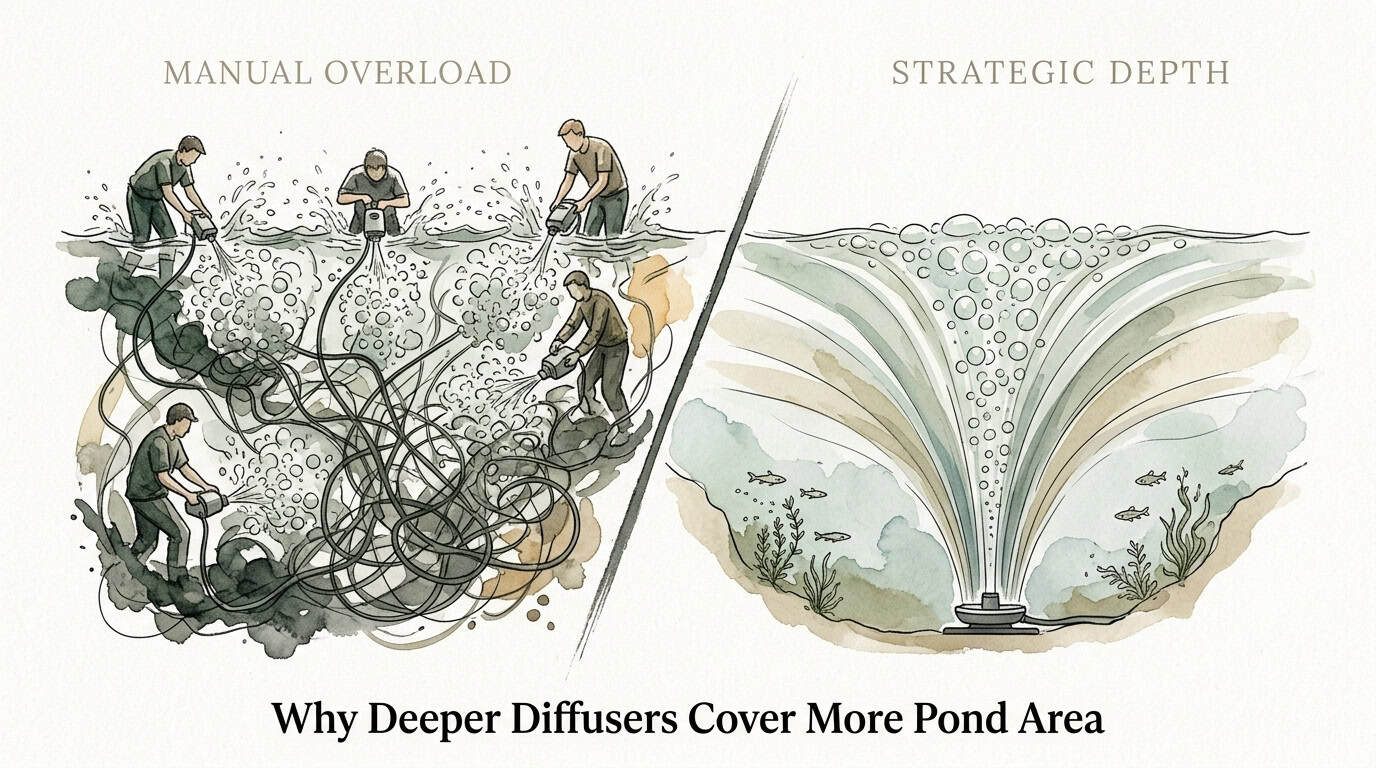
Stop working harder by adding more pumps. One diffuser placed strategically at the right depth can move 4x the water of three shallow ones. It’s not about how many diffusers you have; it’s about where you put them. See how physics does the heavy lifting when you place your aeration in the deep zone.
Deeper diffusers cover more pond area because they leverage a taller water column to facilitate entrainment. As air bubbles rise from a greater depth, they expand due to decreasing hydrostatic pressure and drag surrounding water upward, creating a widening “lifting cone.” This extended vertical travel time increases the volume of water displaced and enhances oxygen transfer, allowing a single deep diffuser to circulate more water than multiple units in shallower sections.
Why Deeper Diffusers Cover More Pond Area
Subsurface aeration relies on the mechanical action of air bubbles to move large volumes of water from the pond floor to the surface. This process is primarily driven by the “airlift” effect. When a diffuser releases air at the bottom of a pond, the bubbles do not simply rise; they act as a buoyant engine. These bubbles transfer kinetic energy to the surrounding liquid, pulling oxygen-depleted bottom water toward the surface.
The efficiency of this water movement is directly proportional to the depth of the diffuser. In a shallow environment, bubbles reach the surface quickly, leaving little time for the plume to expand or for significant water entrainment to occur. In deeper water, the bubble plume has more room to spread. This creates a broader “cone of influence” at the surface. A diffuser at 15 feet of depth generates a much wider circulation cell than one at 5 feet, meaning a single deep-seated unit can often treat a surface area that would otherwise require three or four shallow diffusers.

Real-world applications of this principle are seen in lake management and industrial wastewater treatment. Professionals prioritize placing diffusers in the deepest basins of a water body to maximize the “turnover” rate—the frequency with which the entire volume of the pond is exposed to the atmosphere for gas exchange.
How Deep Placement Drives Aeration Efficiency
The mechanics of deep-water aeration are governed by fundamental laws of physics, specifically regarding gas expansion and fluid dynamics. Understanding these principles explains why depth is the most critical variable in system design.
Boyle’s Law and Bubble Expansion
Boyle’s Law states that the pressure and volume of a gas have an inverse relationship. As bubbles rise from the pond floor, the hydrostatic pressure exerted by the water column decreases. This causes the bubbles to expand in size. A bubble released at 33 feet of depth (approximately 2 atmospheres of pressure) will double in volume by the time it reaches the surface. This expansion increases the surface area of the bubble and the amount of water it can displace.
The Entrainment Ratio
Entrainment refers to the process where the rising bubble plume “drags” the surrounding water along with it. Technical studies indicate that for every cubic foot of air injected at depth, hundreds of cubic feet of water are moved. The entrainment ratio improves as depth increases. Because the bubbles travel a longer distance, they have more time to accelerate the water column. This results in a higher “Standard Oxygen Transfer Rate” (SOTR) because more water is being brought into contact with the atmosphere.
Henry’s Law and Oxygen Solubility
Henry’s Law dictates that the amount of dissolved gas in a liquid is proportional to the partial pressure of that gas above the liquid. In deeper water, the pressure is higher, which forces more oxygen from the bubble into the water. This increases “Oxygen Transfer Efficiency” (OTE). While surface aerators only agitate the top layer of water, deep diffusers provide oxygenation throughout the entire vertical rise.
Advantages of Deep-Water Diffuser Placement
Strategic placement at depth offers measurable mechanical and biological benefits that shallow systems cannot replicate. These advantages center on energy conservation and ecosystem stability.

- Increased Water Turnover: Deeper diffusers create larger circulation cells. This ensures that “dead zones” at the bottom of the pond are eliminated.
- Thermal Destratification: Ponds naturally stratify into temperature layers. Deep aeration breaks the thermocline, mixing cooler, nutrient-rich bottom water with warmer surface water.
- Reduced Equipment Requirements: Because one deep diffuser moves more water, you need fewer compressors and less overall horsepower to achieve the same results as a shallow system.
- Muck Reduction: By delivering oxygen directly to the benthic layer (the pond bottom), you support aerobic bacteria that consume organic “muck” 20–30 times faster than anaerobic bacteria.
- Winter Safety: In cold climates, deep aeration keeps a hole open in the ice more effectively than shallow units, allowing toxic gases like hydrogen sulfide to escape.
Common Pitfalls in Deep Aeration Setup
While deep placement is more efficient, it presents specific mechanical challenges. Failure to account for the increased pressure at depth is a frequent cause of system failure.
Hydrostatic pressure increases by approximately 1 PSI for every 2.31 feet of depth. A diffuser at 20 feet of depth creates nearly 9 PSI of backpressure. If the compressor is not rated for this pressure, it will overheat, and the airflow (CFM) will drop significantly. Many beginner-grade “linear diaphragm” pumps are only rated for 5–8 feet of depth; forcing them deeper leads to premature diaphragm rupture.
Friction loss in the airline is another common error. As air travels through long runs of thin tubing, it loses energy. This adds to the total system backpressure. When combined with the pressure from water depth, an undersized airline can cause the compressor to work at its maximum limit, shortening its lifespan and reducing aeration output.
Constraints and Limits of Depth-Based Aeration
Strategic depth has its limits. There are scenarios where placing a diffuser at the absolute maximum depth is counterproductive or technically unfeasible.
One significant constraint is the compressor type. For depths exceeding 8–10 feet, specialized “rocking piston” compressors are required. These units are more expensive than shallow-water diaphragm pumps and require more frequent maintenance of seals and valves. If the budget does not allow for a high-pressure compressor, you are forced to place diffusers in shallower water, sacrificing coverage area.
Oxygen “stripping” is another technical boundary. If a pond is exceptionally deep (over 40–50 feet), the amount of oxygen remaining in the bubble can actually decrease as it rises if the water is already saturated at the surface. Furthermore, in very deep reservoirs, the energy required to push air down may exceed the biological benefits gained, leading to a point of diminishing returns in energy efficiency (SAE).
Manual Overload vs Strategic Depth
Comparing a high-quantity shallow setup to a high-efficiency deep setup reveals significant differences in operational costs and effectiveness.
| Feature | Manual Overload (Shallow) | Strategic Depth (Deep) |
|---|---|---|
| Number of Diffusers | 3–5 Units | 1–2 Units |
| Coverage Diameter | 30–50 feet per unit | 120–150 feet per unit |
| Compressor Type | Multiple Linear Diaphragm | Single Rocking Piston |
| Energy Consumption | High (multiple motors) | Optimized (single high-efficiency motor) |
| Water Turnover | Surface-focused | Full-column circulation |
| Maintenance Load | High (multiple units to service) | Low (one central station) |
Best Practices for Diffuser Depth Optimization
Maximizing the “cone of influence” requires more than just dropping a diffuser in a hole. It involves precise calculation and mapping of the pond’s bathymetry.
First, perform a depth survey. Use a weighted line or a portable sonar unit to find the deepest pockets of the pond. These basins are where the “Strategic Depth” placement should occur. Avoid placing diffusers on steep slopes, as the bubble plume may “slide” up the incline rather than rising vertically, which reduces the entrainment of bottom water.
Second, size the airline for the total distance. If the compressor is located more than 100 feet from the pond, upgrade from 1/2-inch to 3/4-inch weighted tubing. This minimizes friction loss and ensures the maximum CFM (Cubic Feet per Minute) reaches the diffuser.
Third, monitor the “boil” at the surface. A healthy aeration system should create a gentle, steady rolling action at the surface, not a violent splash. A violent splash indicates the diffuser might be too shallow or the airflow is too high for the depth, leading to wasted energy.
Technical Considerations for High-Pressure Aeration
Operating at depth moves the aeration system into the realm of high-pressure engineering. This requires a shift in how you maintain and monitor the equipment.
Heat management is the primary concern for high-pressure compressors. Compressing air to 10–15 PSI generates significant heat. Ensure the compressor cabinet is well-ventilated and positioned in the shade. Excessive heat will harden rubber gaskets and piston seals, leading to a loss of compression.
Pressure gauges are mandatory for deep systems. Installing a gauge at the compressor allows you to monitor the “health” of the system. If the PSI begins to rise over time, it indicates that the diffuser pores are clogging with mineral deposits or bio-film. If the PSI drops, it indicates a leak in the airline. Without a gauge, these issues go unnoticed until the compressor fails or the pond suffers an oxygen crash.
Quantifying the Depth-to-Volume Ratio
To illustrate the impact of depth, consider a standard 1-acre pond. If this pond has a maximum depth of 6 feet, a typical aeration system might require three diffusers and a 1/2 HP compressor to achieve full turnover. This setup is inefficient because the short vertical rise limits the water entrainment of each bubble.
If that same 1-acre pond has a deep basin of 15 feet, a single high-efficiency diffuser powered by a 1/4 HP rocking piston compressor can often move the same volume of water. The bubbles traveling from 15 feet have 2.5 times the distance to expand and pull water. This reduction in horsepower directly translates to a 50% reduction in monthly electricity costs while providing superior destratification of the bottom layers.
The “45-degree rule” is a helpful estimation tool. Generally, the surface area covered by a diffuser’s circulation cell is a circle with a diameter roughly equal to 2 to 3 times the depth of the diffuser. A diffuser at 5 feet covers a 10–15 foot diameter; a diffuser at 20 feet covers a 40–60 foot diameter.
Final Thoughts
Efficient pond management is a matter of working with fluid dynamics rather than against them. By placing diffusers in the deepest sections of a water body, you utilize the natural expansion of air bubbles to drive massive water movement. This approach minimizes the mechanical burden on your compressors and maximizes the biological benefits to your pond’s ecosystem.
Relying on strategic depth reduces the total number of components in your system, which simplifies maintenance and lowers long-term operational costs. It shifts the focus from “adding more air” to “moving more water,” which is the true metric of successful aeration.
Serious practitioners should prioritize accurate bathymetric mapping and high-pressure-rated equipment. When you align your hardware with the physics of the water column, you achieve a level of clarity and health in your pond that shallow, brute-force systems can never match.

Frequently Asked Questions About Why Deeper Diffusers Cover More Pond Area
Can a diffuser be placed too deep in a pond?
Placement depth has a functional limit dictated by compressor capability and gas physics. Most rocking piston compressors are rated for a maximum of 30–40 feet. Beyond this depth, the backpressure becomes so great that airflow is significantly restricted, and the motor may overheat. Furthermore, in extremely deep reservoirs, the bubbles may lose too much oxygen to the water before reaching the middle layers, or they may “strip” other beneficial gases. For most private ponds and lakes, staying between 8 and 25 feet provides the optimal balance of water movement and equipment longevity.
Does deeper placement require a more expensive air pump?
Deep-water aeration requires a rocking piston compressor, which is generally more expensive than the linear diaphragm pumps used for shallow water. While a diaphragm pump is quiet and energy-efficient for depths under 6–8 feet, it cannot overcome the hydrostatic pressure of deeper water. A rocking piston compressor is designed to handle pressures of 10–30 PSI, making it essential for deep placement. Although the initial investment is higher, the increased efficiency of a deep-water system often allows you to use a single compressor where multiple shallow units would have been necessary, potentially lowering the total system cost.
How do I calculate the coverage area based on depth?
Coverage area is estimated by the diameter of the circulation “boil” created at the surface. A common engineering guideline is that for every foot of depth, the diffuser will influence a surface diameter of approximately 6 to 10 feet, depending on the airflow rate. For example, a diffuser at 15 feet of depth can reliably circulate a surface area 90 to 150 feet in diameter. In contrast, at 5 feet of depth, that same diffuser may only cover a 30 to 50-foot diameter. Increasing depth effectively multiplies the surface area treated by each individual diffuser station.
Will deeper aeration disturb the bottom muck and make the water cloudy?
Properly sized deep aeration creates a “laminar flow” where water moves steadily without causing high-velocity turbulence. While the initial startup of a system in a pond with heavy organic buildup may temporarily cause cloudiness as gases are released, a well-placed diffuser should not “vacuum” the bottom. Fine-bubble diffusers are specifically designed to produce a gentle lifting action. Over time, the increased oxygen at the bottom allows aerobic bacteria to digest the muck, leading to improved water clarity rather than increased turbidity.
Why is water movement more important than just adding bubbles?
The primary goal of aeration is “turnover,” not just the diffusion of oxygen from the bubbles themselves. Most oxygen enters a pond through the surface-to-air interface. The bubbles from a diffuser act as a mechanical pump to bring low-oxygen water from the bottom up to this interface. Because deeper diffusers entrain more water during their longer ascent, they move a much larger volume of the pond’s total mass. This creates a more uniform environment, prevents thermal stratification, and ensures that the entire pond—not just the surface—remains healthy and oxygenated.