
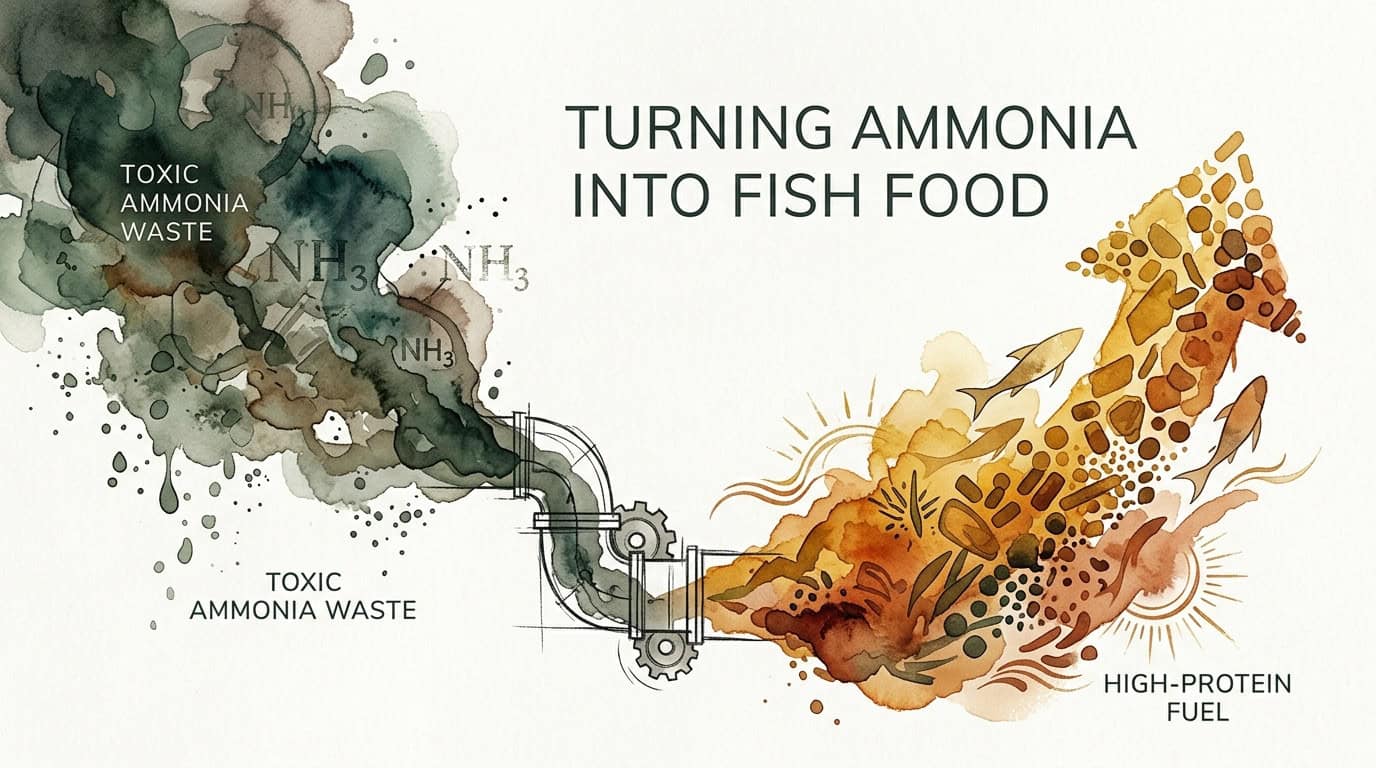
Turning Ammonia Into Fish Food

Photo of author
By Mark Washburn

Mark is a pond management specialist with over 20 years in the field. His wealth of experience will help you with your pond!


Turning Ammonia Into Fish Food: Technical Guide to Nutrient Recovery

What if the very toxins threatening to kill your fish could be transformed into their favorite high-protein meal? Ammonia is the #1 killer in backyard ponds, but for Euglena, it is the primary building block for growth. Strategic management of a Euglena population turns a waste product into a high-grade protein source that feeds the rest of your food web. It’s not a pollution problem; it’s a missed harvest opportunity.

Ammonia conversion into fish food occurs through biological nitrogen assimilation, where microorganisms like Euglena gracilis or nitrifying bacteria-fed biofloc utilize dissolved nitrogen to synthesize cellular protein. This process shifts nitrogen from a toxic dissolved state into solid biomass. When these organisms are consumed by fish or intermediary zooplankton, the once-lethal ammonia is recycled back into the food chain as a nutrient-dense protein source, effectively closing the nutrient loop in aquatic systems.

Turning Ammonia Into Fish Food

The concept of turning ammonia into fish food involves a shift from conventional filtration to nutrient recovery. In a standard aquaculture or pond setup, ammonia (NH3/NH4+) is viewed as a waste product that must be oxidized into nitrate (NO3-) via nitrifying bacteria. While this prevents acute toxicity, it results in the accumulation of nitrates, which eventually require water changes or specialized anaerobic denitrification to remove. This represents a linear waste model where energy and nutrients are discarded.

Bio-assimilation, conversely, treats ammonia as a valuable nitrogen source for microbial protein synthesis. Organisms like Euglena gracilis, a mixotrophic protist, possess the metabolic pathways to rapidly absorb ammonium ions from the water column. These organisms utilize the nitrogen to build amino acids, which form the basis of their cellular structure. This biomass is then consumed by filter-feeding fish or small invertebrates like Daphnia, which are in turn eaten by larger fish. This transforms a chemical threat into a biological asset.

This process is common in high-intensity biofloc technology (BFT) and “green water” culture systems. In these environments, the microbial community becomes a supplemental feed source. Data indicates that systems employing active nutrient recovery can reduce external feed requirements by 10% to 30%, depending on the species and the density of the microbial population. This optimization focuses on the mechanical and biological efficiency of the nitrogen cycle within a closed or semi-closed loop.

How It Works: The Biochemistry of Nitrogen Recovery

The conversion process relies on the GS-GOGAT pathway (Glutamine Synthetase-Glutamate Synthase). When ammonium is present in the water, Euglena and other microalgae transport these ions across their cell membranes. Unlike nitrate, which requires energy-intensive reduction before it can be used, ammonium is already in a reduced state. This makes it the energetically preferred nitrogen source for many aquatic microorganisms.

Control of the Carbon-to-Nitrogen (C:N) ratio is the primary mechanism for managing this process. Microbes require a specific balance of carbon and nitrogen to synthesize protein. In a typical fish pond, nitrogen is abundant due to excretion, but carbon may be a limiting factor. Adding a carbohydrate source, such as molasses or starch, increases the C:N ratio. This stimulates heterotrophic and mixotrophic bacteria and protists to “mop up” the excess ammonia to balance their internal chemistry, leading to a surge in high-protein biomass.

Success in this system requires precise monitoring of the following technical parameters:

  • Ammonium Concentration: Levels must remain below toxic thresholds for fish while providing sufficient “fuel” for the microorganisms.
  • Light Intensity: For photosynthetic assimilation, PAR (Photosynthetically Active Radiation) must be sufficient to drive the splitting of water and the generation of ATP.
  • Dissolved Oxygen (DO): High microbial density increases oxygen demand, particularly at night when photosynthesis ceases.
  • pH Stability: The uptake of ammonium can lead to the release of H+ ions, which may gradually lower the alkalinity of the water.

Benefits of In-Situ Protein Synthesis

The most immediate advantage is the reduction of the Feed Conversion Ratio (FCR). In a traditional system, a fish might have an FCR of 1.5, meaning 1.5 kg of feed produces 1 kg of fish weight. In a nutrient-recovery system, the fish consume both the provided pellets and the microbial biomass generated from their own waste. This secondary feeding can lower the effective FCR to 1.1 or 1.2, significantly reducing operational costs over time.

Water quality stability is another critical benefit. Conventional biofilters rely on slow-growing nitrifying bacteria (Nitrosomonas and Nitrobacter). These populations are sensitive to temperature shifts and pH changes. Algal and protist-based assimilation is often more resilient and can respond faster to spikes in ammonia loading. This provides a biological buffer that protects the primary livestock from sudden environmental shifts.

Furthermore, Euglena gracilis specifically produces paramylon, a beta-1,3-glucan. Research suggests that when fish ingest paramylon-rich organisms, their innate immune systems are stimulated. This leads to higher resistance against common pathogens like Aeromonas or Vibrio. The transition from ammonia to food is not just about nutrition; it is about systemic health optimization.

Challenges and Technical Hurdles

System crashes represent the most significant risk in ammonia-to-food conversion. High densities of microorganisms can become unstable if nutrient loading or environmental conditions fluctuate. A sudden die-off of the microbial population, known as a “crash,” can lead to a massive release of CO2 and a depletion of dissolved oxygen as the dead cells decompose. This creates a lethal environment for fish within hours if not managed with high-capacity aeration.

Species dominance is another challenge. While Euglena is highly desirable, other less beneficial or even toxic algae (such as certain Cyanobacteria) may attempt to colonize the niche provided by the excess ammonia. Maintaining a culture of beneficial microorganisms requires careful management of light, nutrients, and seed populations. Without intervention, the system may revert to a state dominated by unpalatable or harmful species.

Harvesting efficiency is a frequent bottleneck for those attempting to process this biomass into dry feed. Because microorganisms are microscopic and largely composed of water, the energy required to filter or centrifuge them can outweigh the caloric value of the resulting meal. Most successful systems rely on in-situ consumption—where the fish eat the microbes directly from the water—rather than attempting to harvest and process the biomass mechanically.

Limitations and Environmental Constraints

Temperature serves as a strict boundary for most biological nitrogen recovery. Most microalgae and beneficial bacteria see a sharp decline in metabolic activity below 15°C (59°F). In cold climates, the rate of ammonia uptake will fail to keep pace with fish excretion unless the water is heated. This makes the system most effective in tropical or temperate summer conditions.

Turbidity and light penetration also limit the depth at which these systems can operate. In a “green water” system, the high density of cells prevents light from reaching deeper than a few dozen centimeters. This means the active “bio-reactor” zone is limited to the surface layer of the pond or tank. Deep ponds may develop anaerobic zones at the bottom where ammonia accumulates despite a healthy population at the surface.

Chemical interference can also disrupt the process. The use of copper-based algaecides or certain antibiotics will kill the very microbial population required for nitrogen recovery. Practitioners must commit to a biological management strategy that excludes broad-spectrum chemical treatments, as these will reset the microbial ecosystem and cause an immediate ammonia spike.

Comparison: Traditional Biofiltration vs. Microbial Assimilation

Feature Traditional Nitrification Microbial Assimilation
Primary Goal Toxin Neutralization Nutrient Recovery
End Product Nitrate (Waste) Microbial Protein (Feed)
C:N Ratio Requirement Low (Natural) High (Requires Carbon Supplement)
Oxygen Demand High (Constant) Very High (Fluctuating)
Management Complexity Moderate High
Space Efficiency Requires External Filter Occurs Within the Water Column

Practical Tips for Managing Ammonia-to-Food Systems

Optimizing the C:N ratio is the first step for any serious practitioner. If ammonia levels begin to rise, adding a source of organic carbon—such as sugar, molasses, or finely ground wheat bran—can trigger a microbial bloom that consumes the nitrogen. Calculations usually target a C:N ratio of 12:1 to 15:1. This ensures that the heterotrophic bacteria have enough energy to incorporate the available nitrogen into their cell walls.

Mechanical aeration is non-negotiable. Because these systems operate at high biological loads, standard “bubblers” are rarely sufficient. High-efficiency venturi injectors or paddlewheel aerators are required to maintain dissolved oxygen levels above 5.0 mg/L. Strategic placement of aerators can also help keep the microbial biomass in suspension, preventing it from settling and forming anaerobic sludge on the pond floor.

Monitoring the “settleable solids” using an Imhoff cone provides a quick metric for microbial density. In a biofloc or green water system, a settleable solids volume of 10–20 mL/L is generally considered optimal for fish health and nitrogen uptake. If the volume exceeds 30 mL/L, the risk of an oxygen crash increases, and a portion of the biomass should be removed through a settling tank or mechanical filter.

Advanced Considerations: Metabolic Engineering and Scaling

For large-scale operations, the focus shifts toward mixotrophic growth kinetics. Euglena gracilis is unique because it can simultaneously perform photosynthesis and consume organic carbon (heterotrophy). By adjusting the ratio of light to organic inputs, operators can “tune” the nutritional profile of the resulting biomass. For example, higher light levels can increase the production of specific antioxidants and vitamins, while higher carbon inputs maximize protein and lipid yields.

Scaling these systems requires a deep understanding of volumetric nitrogen loading rates. This is the amount of nitrogen (usually measured in grams) added to the system per cubic meter per day. In a high-intensity Euglena-based reactor, loading rates can reach significantly higher levels than in traditional aquaculture, but this requires precise control over pH and CO2 injection. CO2 injection not only provides carbon for photosynthesis but also acts as a pH buffer, preventing the water from becoming too alkaline, which would shift the NH4+ balance toward toxic NH3 gas.

Genetic strain selection is an emerging field for advanced practitioners. Not all Euglena or microbial flocs are equal. Some strains are specifically adapted for higher ammonia tolerance, while others produce higher concentrations of Omega-3 fatty acids. “Seeding” a pond with a specific, high-performing strain rather than relying on wild colonization can significantly improve the predictability and nutritional value of the nutrient recovery process.

Example Scenario: A Closed-Loop Tilapia System

Consider a 5,000-liter tank containing 200 kg of Tilapia. These fish are fed 3 kg of 35% protein feed daily. Approximately 5% of the nitrogen in that feed ends up as dissolved ammonia in the water. Without recovery, this would result in a daily ammonia accumulation of roughly 52 grams, which would quickly reach lethal levels.

To convert this 52 grams of nitrogen into food, the operator maintains a Euglena and biofloc population. By adding approximately 600 grams of a carbon source (like molasses) daily, the microbial population is stimulated to assimilate that nitrogen. The resulting microbial bloom produces approximately 300 to 400 grams of dry-weight microbial protein.

The Tilapia, being opportunistic filter feeders, consume this “green water” throughout the day. This supplemental protein allows the operator to reduce the primary pellet feed by 15% while maintaining the same growth rate. The ammonia is kept at near-zero levels not by a filter, but by the continuous growth and consumption of the microbial food web. This demonstrates a functional transition from waste management to resource creation.

Final Thoughts

The ability to turn toxic ammonia into high-quality fish food represents the pinnacle of efficient aquaculture management. It requires a departure from the “clean water” aesthetic in favor of a biologically active, nutrient-dense ecosystem. While the technical demands for aeration and monitoring are higher, the rewards in feed savings and water stability are significant.

Mastering this process involves balancing the needs of the fish, the microbes, and the chemistry of the water column. It is a transition from being a fish keeper to being a microbial rancher. By focusing on the flow of nitrogen through the system, practitioners can create more resilient, productive, and sustainable aquatic environments.

Those who successfully implement these strategies will find that their largest “pollution” problem becomes their most valuable asset. The principles of bio-assimilation and nutrient recovery are essential for the future of intensive food production and ecological pond management. Experimentation with C:N ratios and microbial seeding is the next logical step for anyone seeking to optimize their aquatic systems.

Frequently Asked Questions About Turning Ammonia Into Fish Food

How much ammonia can Euglena actually remove per day?

The ammonia removal rate depends on the biomass concentration, temperature, and light availability. Under optimal conditions, Euglena gracilis and associated microbial flocs can remove between 5 and 15 mg of nitrogen per liter of water per day. In a highly managed system with carbon supplementation and adequate aeration, these rates can be even higher. The key is ensuring that the microbial growth rate matches the fish’s ammonia excretion rate. If the biomass is harvested or consumed regularly, the population remains in a logarithmic growth phase, which maximizes its nutrient uptake efficiency. Without regular removal or consumption of the cells, the system reaches a saturation point where nitrogen uptake slows down significantly.

Does this eliminate the need for a traditional biofilter?

In many high-intensity biofloc or green water systems, the microbial population in the water column entirely replaces the need for a traditional fixed-media biofilter. The total surface area provided by millions of microscopic organisms suspended in the water far exceeds the surface area of plastic beads or ceramic rings in a filter canister. However, this shift requires a complete reliance on mechanical aeration. While a traditional biofilter is relatively passive and safe, an ammonia-to-food system is “active” and vulnerable to power outages. Many practitioners keep a small traditional biofilter as a redundant backup, but the primary nitrogen processing occurs through biological assimilation in the main water body.

Can Euglena cause an oxygen crash at night?

Yes, any system with a high density of algae or microbes poses a risk of nocturnal oxygen depletion. During the day, Euglena produces oxygen through photosynthesis. At night, photosynthesis stops, but the organisms continue to breathe (respiration), consuming dissolved oxygen and releasing carbon dioxide. If the microbial density is too high and the aeration system is insufficient, oxygen levels can drop to lethal levels for fish before dawn. Managing this risk requires high-capacity aeration that runs 24/7, not just during the day. Monitoring dissolved oxygen levels during the “critical window” between 3:00 AM and sunrise is essential for any practitioner utilizing microbial assimilation.

Is the protein in Euglena equivalent to commercial fish pellets?

Microbial protein derived from Euglena is highly nutritious but differs from commercial pellets. Euglena gracilis typically contains 40% to 60% crude protein and a well-balanced amino acid profile that is often compared to fishmeal. It is particularly rich in essential amino acids like lysine and methionine, which are often limiting factors in plant-based feeds. Additionally, the presence of paramylon and essential fatty acids makes it a superior “whole food” source. However, because it is consumed in a diluted state (suspended in water), fish must process a large volume of water to meet their caloric needs. It is best used as a supplement to, rather than a total replacement for, high-quality pellets in intensive systems.

What is the ideal C:N ratio for maximizing nitrogen-to-protein conversion?

The ideal Carbon-to-Nitrogen (C:N) ratio for stimulating microbial ammonia assimilation is generally between 12:1 and 20:1. Most fish feeds have a C:N ratio of around 7:1 to 10:1, which is too low to support the full assimilation of excreted nitrogen by heterotrophic microbes. By adding a carbon-rich, nitrogen-poor supplement (like molasses, sugar, or flour), you raise the overall ratio. This provides the energy the microbes need to utilize the “excess” nitrogen from the ammonia to build new proteins. Maintaining this balance is a technical exercise; too little carbon results in ammonia accumulation, while too much carbon can lead to excessive sludge production and oxygen demand.


We're Not All Talk

Sign up for the best pond tips you'll find anywhere online.  We'll send them out during the summer months and you won't want to miss a single one!

Invalid email address
We promise - no spam. You can unsubscribe at any time.