

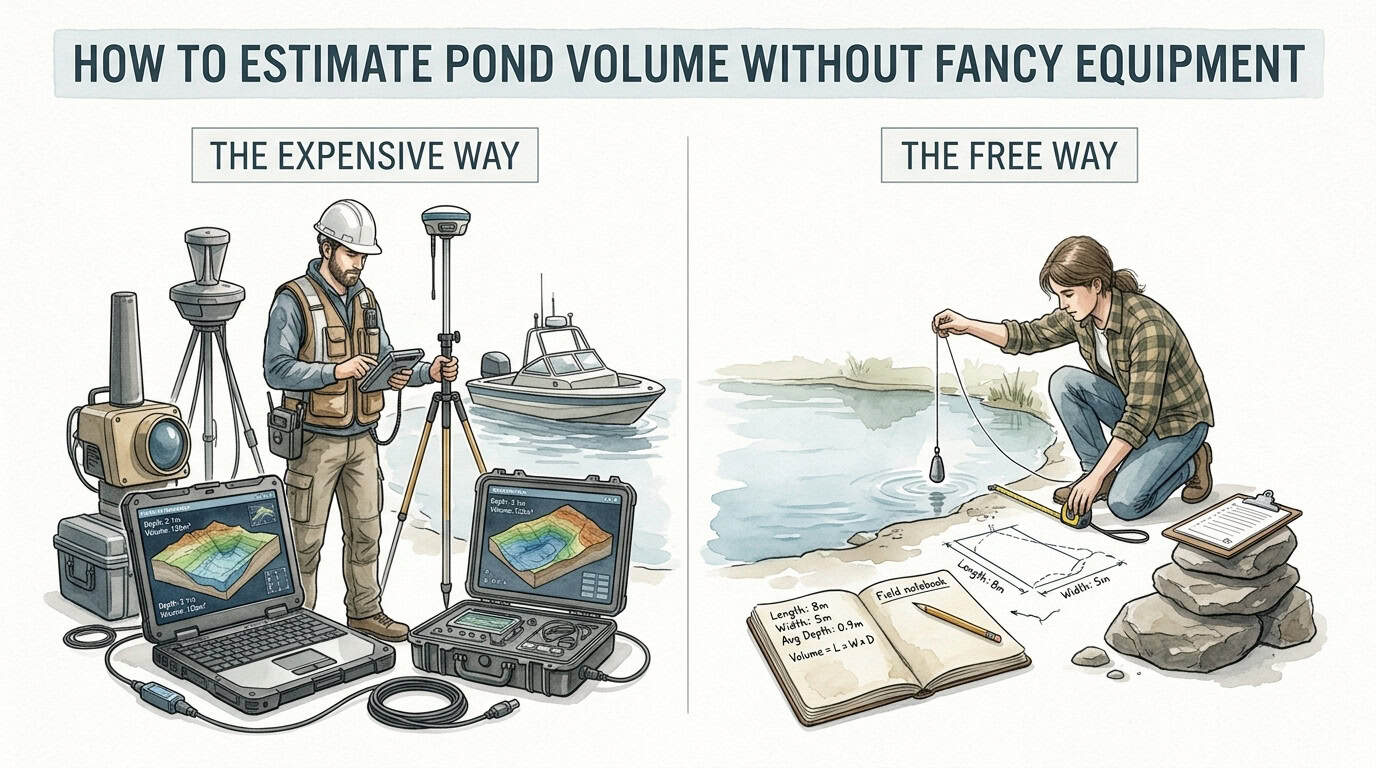
You don’t need a surveyor to know your pond’s volume. Just use this simple math hack. Knowing your pond’s volume is critical for dosing treatments. You can spend thousands on sonar, or five minutes with a tape measure and our volume calculator.
To estimate pond volume without specialized equipment, calculate the surface area by multiplying average length by average width, then multiply that value by the average depth and a conversion factor of 7.48 to determine total gallons. For irregular shapes, divide the pond into smaller geometric sections, calculate each volume separately, and sum the results to maintain dosing accuracy for chemical treatments.
How to Estimate Pond Volume Without Fancy Equipment
Pond volume is a 3D metric representing the total space occupied by water within a basin. In technical terms, it is the product of surface area and mean depth, adjusted for the geometric profile of the floor. This measurement is typically expressed in gallons or cubic feet in the United States, or liters and cubic meters in regions utilizing the metric system.
Accurate volume estimation serves as the primary data point for hydraulic engineering and biological management. It dictates the sizing of pond pumps, which must turn over the entire water volume every one to two hours to maintain oxygenation. Furthermore, it determines the safe concentration levels for algaecides, herbicides, and beneficial bacteria. An overestimate can lead to toxic chemical concentrations, while an underestimate results in ineffective treatment cycles.

Real-world applications range from residential koi ponds to large-scale agricultural reservoirs. In aquaculture, volume data determines fish stocking densities. In civil engineering, it assists in calculating retention pond capacity during peak storm events. Without sonar or flow meters, practitioners rely on manual depth profiling and geometric approximation to reach these values.
How to Calculate Pond Volume Step-by-Step
The manual calculation process requires high-precision measurements of length, width, and depth. Accuracy in the raw data collection phase is paramount to the reliability of the final output.
Determining Surface Area
Surface area is the 2D footprint of the pond. For rectangular ponds, measure the length and width at the water’s surface. For circular ponds, measure the diameter at the widest point and divide by two to find the radius.
Irregularly shaped ponds require a more granular approach. The “grid method” involves overlaying an imaginary grid across the pond’s surface. Measure the length and width of multiple sections to calculate individual areas, then add them together. Alternatively, use the average length and average width if the pond’s perimeter is only slightly curved.
Establishing Average Depth
Depth is rarely uniform across a pond bed. A single measurement at the deepest point will result in a significant volume overestimate. To find the average depth, use a weighted string or a measuring pole.
Take measurements along two perpendicular transects across the pond. For small ponds, five to ten measurement points are sufficient. For larger bodies of water, increase the frequency of measurements. Sum all depth readings and divide by the total number of measurements to find the mean depth.

Applying the Calculation Formulas
Once the dimensions are secured, apply the specific formula for the pond’s primary shape:
- Rectangular/Square: Length (ft) × Width (ft) × Average Depth (ft) × 7.48 = Total Gallons.
- Circular: 3.142 × Radius² (ft) × Average Depth (ft) × 7.48 = Total Gallons.
- Oval/Elliptical: Length (ft) × Width (ft) × Average Depth (ft) × 0.8 × 7.48 = Total Gallons.
The factor 7.48 represents the number of US gallons in one cubic foot of water. For metric calculations, multiply length, width, and depth in meters, then multiply the result by 1,000 to find the volume in liters.
Benefits of Manual Estimation
Manual estimation provides immediate data without the capital expenditure required for sonar equipment or specialized flow meters. This approach allows a pond owner or manager to perform calculations on-site using basic household tools.
Accessibility is a major advantage. Most pond maintenance tasks, such as clearing a sudden algae bloom, require immediate dosing. Waiting for a surveyor or purchasing expensive electronic tools is often impractical. A tape measure and a calculator allow for rapid response to environmental shifts.
Mathematical estimation also provides a baseline for future comparisons. If the pond is drained and refilled, these calculations can be cross-referenced with water meter readings to verify the accuracy of the original estimate. This dual-layered verification ensures that long-term maintenance protocols remain precise.
Challenges and Common Mistakes
Calculating volume for sloped or tiered ponds is the most frequent source of error. Most ponds do not have vertical walls; they feature shelves or gradual inclines. If a practitioner assumes the pond is a perfect cube, the resulting volume will be inflated by 20% to 35%.
Another common mistake involves ignoring the displacement caused by rocks, gravel, and submerged equipment. In koi ponds featuring heavy stone liners, the volume of water is significantly less than the volume of the basin. A “displacement factor” of 0.8 is often applied to the final result to account for the space occupied by solid materials.
Failure to account for varying water levels is a technical oversight. Evaporation or heavy rainfall can change the surface area and depth of a pond within hours. Measurements should be taken at the “standard fill line” to ensure the volume estimate reflects the pond’s typical operating capacity.
Limitations of Non-Electronic Methods
Manual methods are inherently limited by human error and the inability to “see” underwater contours clearly. Complex bottom configurations, such as deep holes or sandbars, may be missed during a manual transect. This leads to a statistical margin of error that is usually acceptable for maintenance but potentially problematic for highly sensitive chemical applications.
Environmental constraints also play a role. Measuring a large, murky pond from a boat is physically demanding and prone to measurement drift. In very large reservoirs, manual string measurements become susceptible to line sag and wind resistance, which can distort depth readings.
Precision levels for manual math typically hover between 85% and 95%. While this range is sufficient for most backyard and agricultural uses, it lacks the 99% accuracy required for industrial chemical processing or scientific research. In those instances, manual estimation serves only as a secondary check rather than the primary data source.
The Expensive Way vs. The Free Way
Comparing high-tech methods with manual calculations highlights the trade-off between cost and precision.
| Feature | The Expensive Way (Sonar/Meters) | The Free Way (Manual Math) |
|---|---|---|
| Cost | $500 – $5,000+ | $0 (Basic tools) |
| Accuracy | 98% – 99.9% | 85% – 95% |
| Time Required | Setup time + Analysis time | 10 – 20 minutes |
| Skill Level | Technical/Software knowledge | Basic Arithmetic |
| Equipment | Sonar, Flow Meter, GPS | Tape Measure, Weighted String |
The Expensive Way utilizes bathymetric mapping, where a sonar unit scans the pond floor to create a high-resolution 3D model. This is ideal for large lakes or industrial settling ponds. The Free Way relies on geometric simplification. For most property owners, the difference in accuracy does not justify the significant financial investment in electronics.
Practical Tips and Best Practices
Optimization of manual measurements can significantly narrow the margin of error. Always perform depth measurements in a systematic grid pattern. Dividing the pond into a 3×3 or 5×5 grid ensures that no significant troughs or peaks in the floor are overlooked.
Use a non-stretch line for depth measurements. Paracord or nylon string can stretch when wet, leading to deeper depth readings than actually exist. A heavy weight at the bottom of the line ensures it drops vertically and does not drift with underwater currents or wind.
Record the water level relative to a fixed point, such as a rock or a pier, during the measurement. This allows for easy volume adjustments if the water level drops later in the season. You can simply subtract the change in depth from the original average depth and recalculate the volume without repeating the entire measurement process.
Advanced Considerations for Practitioners
Serious practitioners may use the “Salt Method” to achieve higher precision without sonar. This involves measuring the baseline salinity of the pond, adding a known quantity of pure salt, and then measuring the salinity increase. Because salt dissolves uniformly, the change in concentration allows for a precise calculation of total water volume.
The formula for the salt method is: (Pounds of Salt Added × 12,000) / (Increase in Salinity in ppm) = Total Gallons. This method is highly effective for established koi ponds where irregular rocks make tape measurements difficult. It accounts for every cubic inch of water, including the water hidden within plumbing and filter systems.
Pond liner surface area is another advanced metric. If you are calculating for the purpose of replacing a liner, the formula is different from volume. You must add twice the maximum depth to both the maximum length and maximum width, plus two feet for the overlap. This ensures you have enough material to cover the basin’s contours.
Calculation Example: Irregular Backyard Pond
Consider a pond that is roughly oval, 20 feet long and 12 feet wide. The depth varies from 1 foot at the edges to 4 feet in the center.

Step 1: Calculate the average depth. Measurements are taken at 1, 2, 4, 3, and 1 feet. The sum is 11. Divide 11 by 5 to get an average depth of 2.2 feet.
Step 2: Apply the oval formula. Multiply Length (20) × Width (12) × Average Depth (2.2) × 0.8 (Shape Factor) × 7.48 (Gallon Constant).
Step 3: Execute the math. 20 × 12 = 240 sq ft. 240 × 2.2 = 528 cubic feet. 528 × 0.8 = 422.4 adjusted cubic feet. 422.4 × 7.48 = 3,159.5 gallons.
Step 4: Final adjustment for displacement. If the pond contains significant rockwork, multiply 3,159.5 by 0.8 to reach a final treatment volume of 2,527.6 gallons.
Final Thoughts
Mastering the math of pond volume estimation is a fundamental skill for any pond manager or property owner. Reliable data prevents the costly mistakes associated with chemical overdosing and equipment failure. While sonar technology offers extreme precision, manual calculations provide a robust and cost-effective alternative for the vast majority of real-world scenarios.
Applying these geometric principles allows for consistent and safe maintenance. Consistency in measurement techniques ensures that seasonal changes in water level or pond structure are accounted for accurately. Practitioners should revisit their volume estimates annually to adjust for sediment accumulation or structural shifts.
The process of measuring and calculating volume also encourages a deeper understanding of the pond’s ecosystem. Documenting the contours and dimensions of the water body provides insights into oxygenation patterns and temperature stratification. Knowledge of these metrics is the foundation of long-term aquatic health.
Frequently Asked Questions About How to Estimate Pond Volume Without Fancy Equipment
Why is it important to calculate average depth rather than just maximum depth?
Maximum depth only represents the single deepest point in the pond basin. Most ponds have sloped sides, shallow shelves, and varying floor contours. If the maximum depth is used in the volume formula, the result will drastically overestimate the total gallons of water present. This leads to dangerous over-concentration when adding chemical treatments like algaecides or fish medications. Average depth, calculated by taking multiple readings across the pond and dividing by the total number of readings, provides a more accurate representation of the water’s true 3D volume.
What is the “Shape Factor” and when should I use it?
The Shape Factor is a decimal multiplier used to adjust the volume calculation for non-rectangular ponds. Standard formulas for length times width assume vertical walls and flat bottoms. Because most ponds are bowl-shaped or have sloped sides, they hold less water than a rectangle of the same dimensions. A factor of 0.8 is commonly used for ovals or ponds with moderate slopes. For highly irregular ponds with significant shelving, a factor of 0.65 to 0.75 is more appropriate. Applying this factor prevents overestimating the capacity of the basin.
How do I account for the rocks and gravel in my pond?
Rocks and gravel displace water, meaning the actual volume of water is less than the volume of the basin. In a pond with a layer of gravel on the bottom and large stones along the perimeter, the “Rock Factor” is usually estimated at 0.8. You calculate the total volume of the pond as if it were empty, then multiply the final gallon count by 0.8. This 20% reduction accounts for the space occupied by solid materials. This adjusted number is the one that should be used for dosing water treatments.
Can I use a water meter to find the volume if the pond is already full?
A standard water meter only measures the flow of water as it passes through a pipe, so it cannot measure a full pond directly. However, you can use a water meter to determine volume during a partial water change. By measuring the exact number of gallons required to raise the water level by a specific increment (for example, six inches), you can calculate the total volume based on the total depth. Alternatively, the “Salt Method” is the preferred technical way to find the exact volume of an already full pond without draining it.
Is there a different formula for very large ponds or farm reservoirs?
For very large bodies of water, practitioners often use “acre-feet” rather than gallons to keep the numbers manageable. One acre-foot is the amount of water required to cover one acre of land to a depth of one foot, which equals approximately 325,851 gallons. To calculate this, you find the surface area in acres (square footage divided by 43,560) and multiply it by the average depth in feet. This unit of measurement is standard in agricultural and civil engineering applications for large-scale water management.